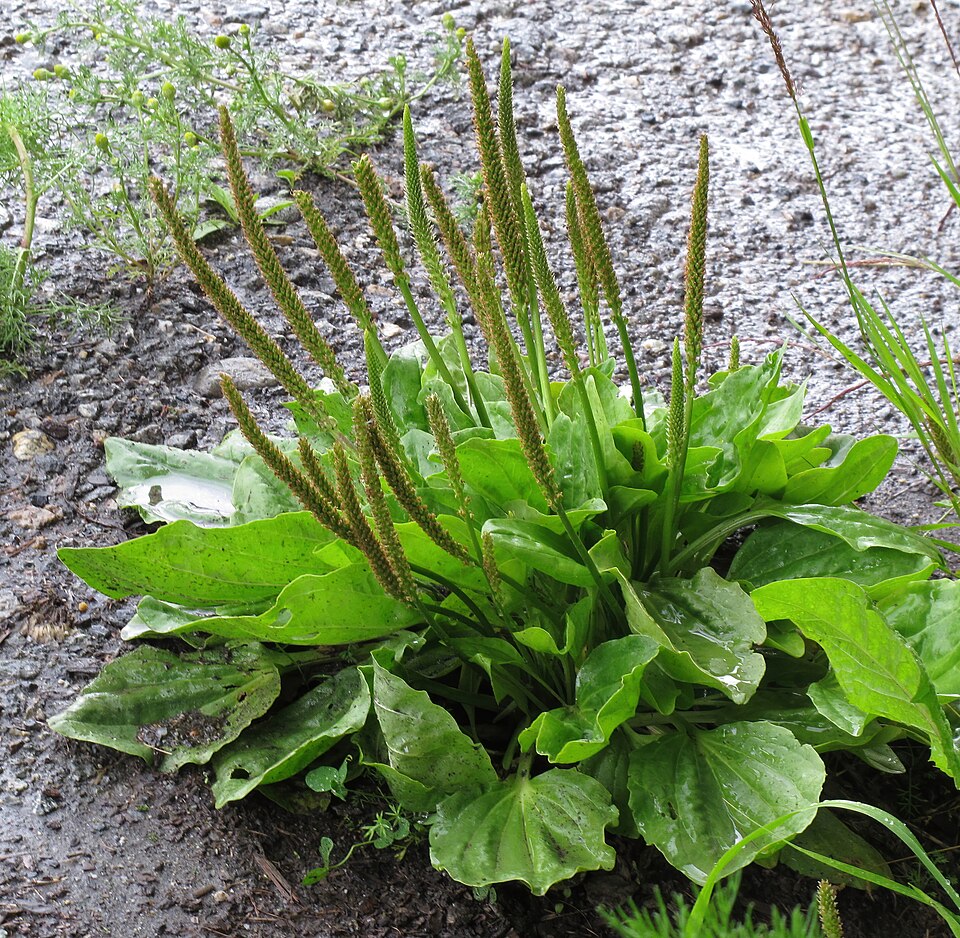
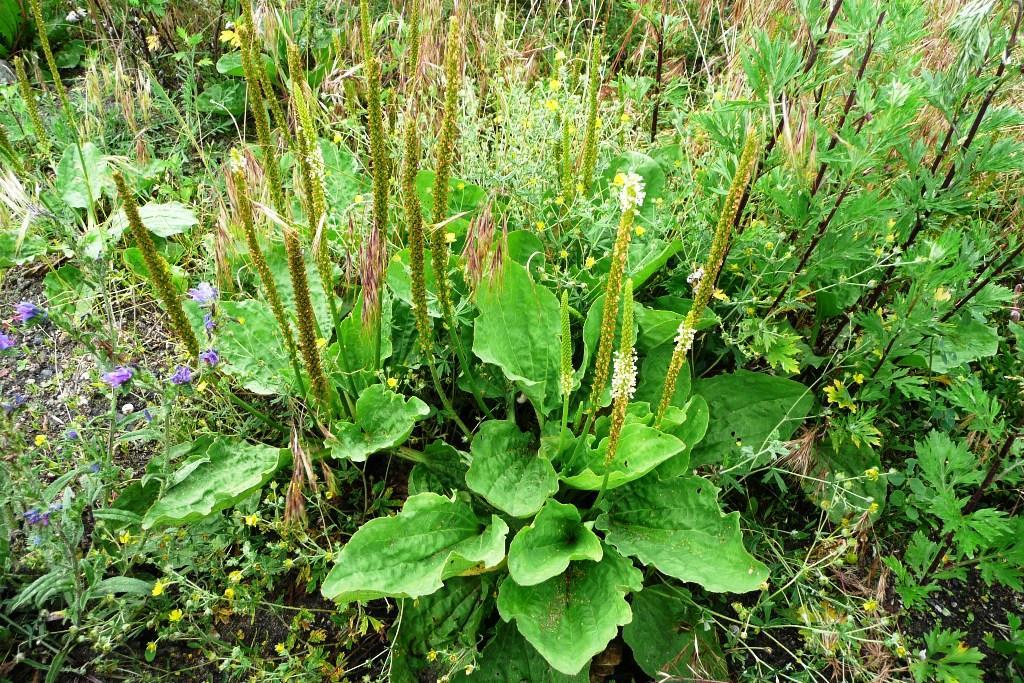
Greater Plantain, also known as Broadleaf Plantain or Common Plantain, is one of the most familiar plants of paths, lawns and waysides in the UK. Its large, strongly veined leaves spread into a flattened rosette, while slender, greenish-brown flower spikes rise from the centre. The flowers themselves are so small that it is easy to mistake the spikes for seed heads even when the plant is in bloom.
It belongs to the plantain family (Plantaginaceae), alongside Ribwort Plantain, foxgloves, speedwells and toadflaxes. Although these plants can look remarkably different, Greater Plantain and Ribwort Plantain are close relatives with similarly reduced, mainly wind-pollinated flowers.
Identification
- A common perennial that forms a low basal rosette of broad leaves, usually lying close to the ground.
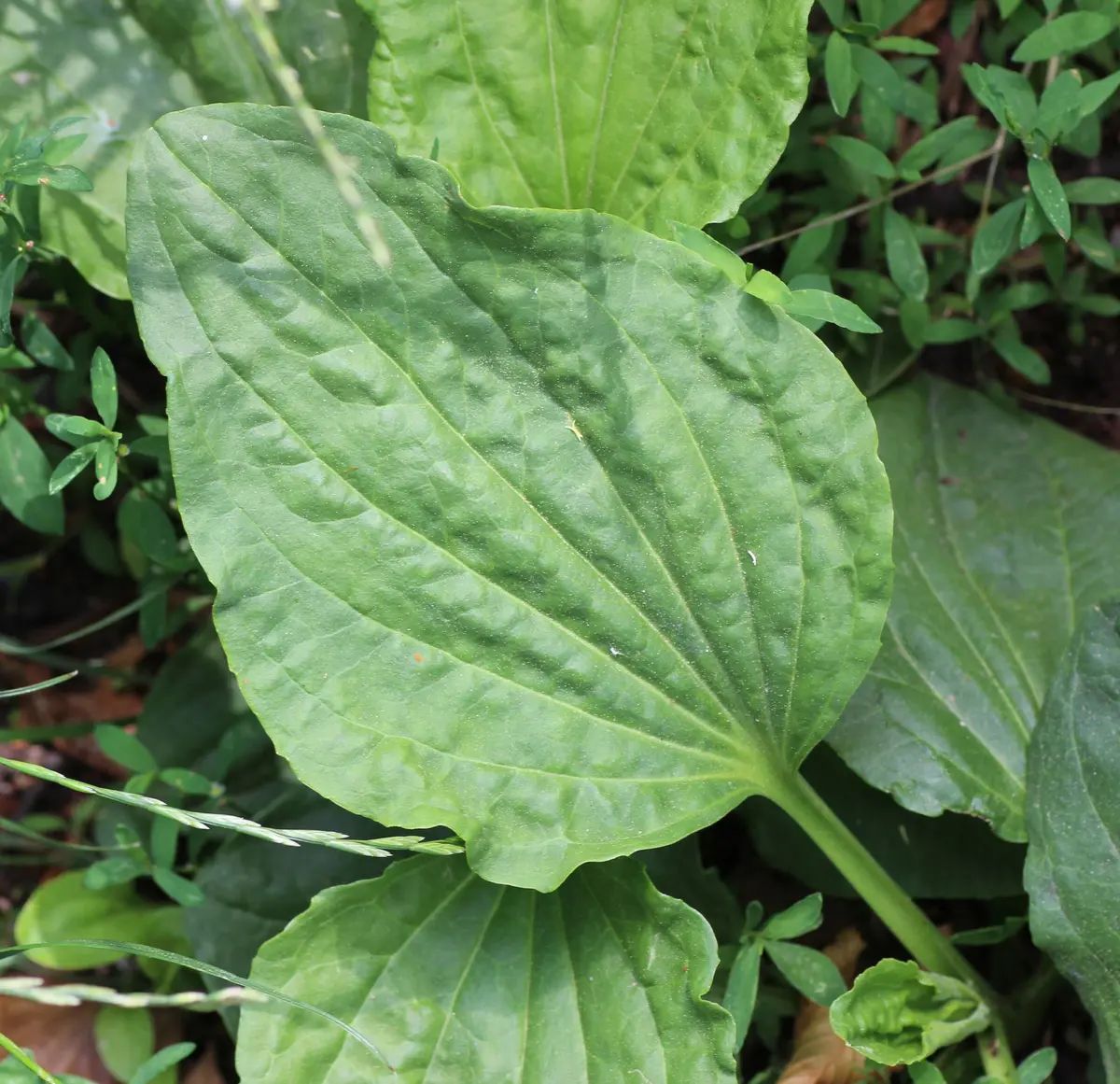
- Leaves are oval to broadly spoon-shaped, often with rounded tips and a distinct leaf stalk. Five to nine strong veins run lengthwise towards the tip.
- The leaf edges are usually smooth or slightly wavy, sometimes with shallow teeth; the surface may be smooth or finely hairy.
- Several leafless stalks emerge from the rosette, each carrying a long, thin, cylindrical spike of tiny flowers.
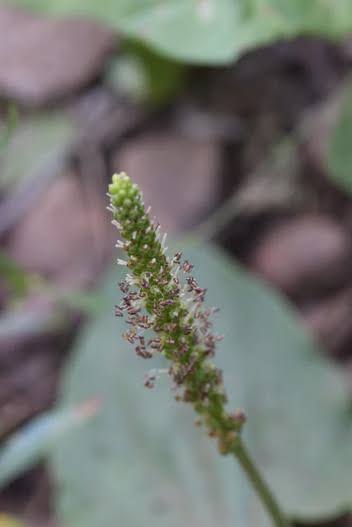
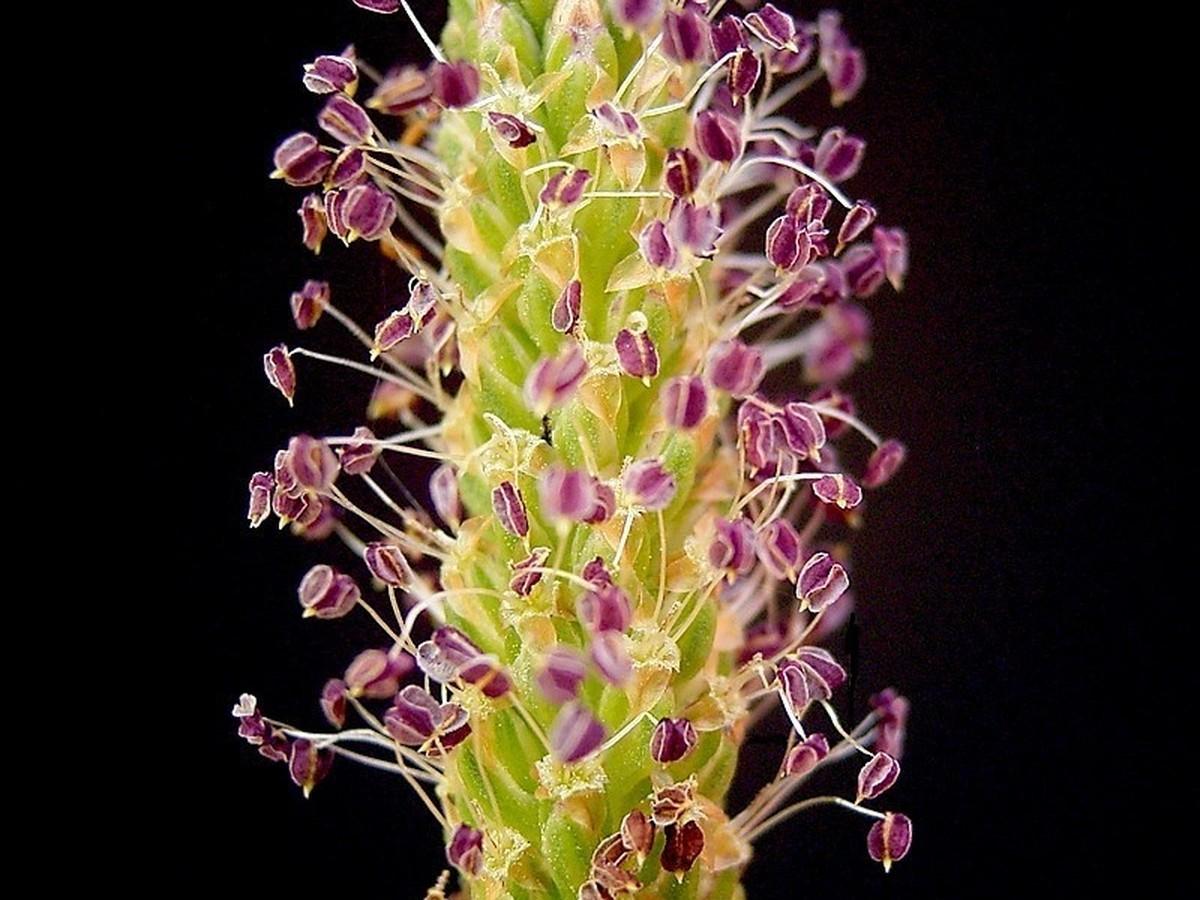
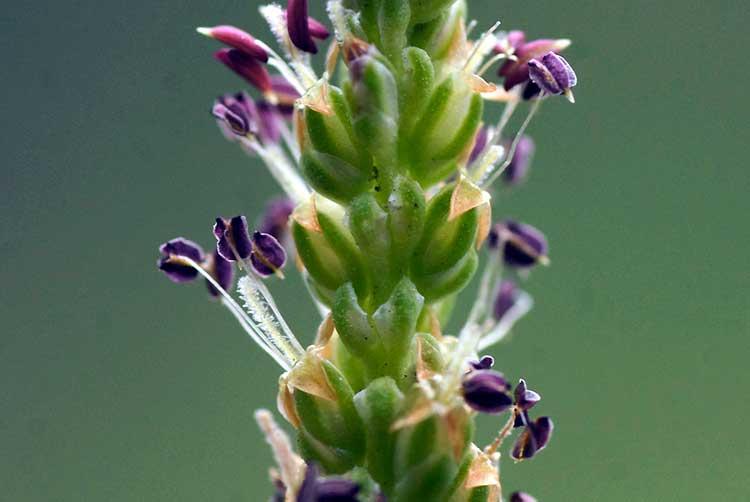
- Flowers are greenish to brownish, without conspicuous coloured petals. During flowering, tiny pale or purplish anthers can protrude from the spike.
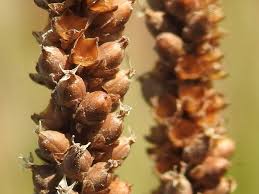
- The spikes later become straw-coloured or brown as small seed capsules develop.
- The plant is particularly common on compacted or frequently walked-on ground, where many taller wildflowers struggle.
The easiest field distinction from Ribwort Plantain is the combination of broad, stalked leaves and long, narrow flower spikes. Ribwort has narrow, lance-shaped leaves and much shorter, denser flower heads.
Flower structure
Each apparently simple flower spike is made up of many tiny individual flowers, attached closely along the stalk. Unlike a daisy or a bellflower, Greater Plantain does not produce showy petals. Each flower has four small sepals, a short four-lobed corolla, four stamens and a single style ending in a stigma.
During flowering the stamens extend beyond the tiny floral parts on fine filaments, releasing pollen into the wind. The stigmas are also exposed, helping them catch wind-borne pollen. Greater Plantain can also fertilise itself, a useful ability for a plant growing in isolated cracks and patches of disturbed soil.
After fertilisation, each flower produces a little dry capsule, usually containing several seeds. Its top separates like a tiny lid when ripe, though the seeds may remain packed in the old spike until it is shaken or knocked. A whole mature spike can hold a surprising number of seeds.
Leaves and stems
The large leaves are the most recognisable feature of Greater Plantain. They grow in a rosette at ground level, radiating from a short central crown, rather than being spaced up an upright leafy stem. Their shape varies from broadly oval to almost round or spoon-shaped. Each leaf narrows abruptly into a noticeable stalk.
Look closely at a leaf and you will usually see five to nine prominent longitudinal ribs. These veins start together near the base, curve outwards across the leaf blade and converge again towards the tip. They are not perfectly straight, but give the leaf a strongly ribbed appearance. The sturdy veins and elastic fibres allow the leaves to bend and withstand trampling. When a leaf stalk is pulled apart gently, fine strands may remain connecting the pieces.
The flowering stalks, known as scapes, are separate from the leaves, unbranched and almost entirely leafless. Each supports a long spike rather than the short, dark head familiar in Ribwort Plantain.
Habitat
Greater Plantain is widespread across the UK and is especially abundant where people or animals repeatedly disturb the ground. Look for it beside footpaths, on gravel tracks, between paving stones, in compacted lawns, around gateways, along roadside verges and on grazed grassland or field margins.
Its flattened rosette keeps much of its foliage beneath the height of a mower or grazing animal. It tolerates compacted soil remarkably well and can quickly reappear in worn patches of grass. These qualities have made it a constant companion of human settlement and travel over many centuries.
Flowering period
Greater Plantain usually flowers from May or June through September and October, depending on conditions. The inconspicuous flowers are easiest to recognise when the fine, projecting stamens are visible. Later in the year the spikes turn brownish and remain standing with their developing or mature seed capsules. The leaves can persist through mild winters.
Similar species
- Ribwort Plantain (Plantago lanceolata) has much narrower, pointed leaves with three to five conspicuous ribs, and shorter, dark oval flower heads that often carry a pale ring of anthers.
- Hoary Plantain (Plantago media) has broader, usually shorter-stalked leaves that often feel softly hairy or greyish. Its flowers may show longer, pale lilac or pinkish stamens and are particularly associated with dry, often chalky grassland.
- Buck’s-horn Plantain (Plantago coronopus) has narrow leaves that are deeply cut or toothed into pointed lobes. It is especially frequent on coastal and salty roadside ground.
- Sea Plantain (Plantago maritima) has narrow, somewhat fleshy, almost grass-like leaves and favours saltmarshes and coastal habitats.
Where the names come from
The name Greater Plantain distinguishes this broad-leaved species from smaller or narrower-leaved relatives. The alternative Broadleaf Plantain is particularly descriptive: its wide oval leaves are quite unlike the spear-shaped leaves of Ribwort Plantain. Common Plantain is another widely used name.
Plantago comes from Latin planta, meaning the sole of the foot, traditionally linked to the plant’s broad leaves spreading across the ground like footprints. The species name major is Latin for greater or larger. Carl Linnaeus formally published the name Plantago major in 1753.
One of its oldest English names is Waybread, also recorded as Waybred, Waybroad and Wayside Bread. It is connected with the Old English wegbrade, referring to the plant’s broad leaves along paths or roads. Its ability to flourish on trodden ground explains why the name lasted so long. In Wiltshire, the form Wayside Bread was also recorded by nineteenth-century collectors of local plant names.
The narrow, brownish seed spikes have inspired the country name Rat’s-tail. Other names include Healing Blade and, in North American tradition, Englishman’s Foot or White Man’s Foot: the plant followed European settlers and became common along newly disturbed tracks and settlements.
Folklore & history
Greater Plantain has a remarkable history in Anglo-Saxon writing. The Old English Nine Herbs Charm, preserved in the medical collection known as the Lacnunga (written down around the tenth or eleventh century), addresses the plant as Waybread, the mother of herbs. The charm celebrates its ability to withstand carts, riders and the crushing weight of travel. That description is a wonderfully accurate observation of how plantain survives even on the busiest paths. The charm brings together healing, spoken words and early English religious traditions, including references to Woden.
The plant remained familiar to later herbalists. John Gerard’s Herbal, published in 1597, and the writings of Nicholas Culpeper in the seventeenth century describe plantains as useful household herbs. Crushed leaves were traditionally placed on cuts, grazes, stings and sore skin. Shakespeare even gives plantain a moment in Romeo and Juliet, where Romeo recommends a plantain leaf and Benvolio asks what for; the reply is, ‘For your broken shin.’ The joke would have been understood by an audience familiar with the plant’s everyday reputation.
Plantain’s toughness also made it part of children’s play. Pulling apart a leaf or leaf stalk reveals fine, elastic strands that can resemble strings. Children compared their strength or used them as make-believe musical strings, inspiring names such as Angel’s Harp. It is a small reminder that a common weed can have a surprisingly rich cultural life.
In North America the plant’s spread alongside European settlement gave rise to names likening it to a settler’s footprint. The connection between plantain, worn paths and human movement is therefore found on both sides of the Atlantic, although the names reflect different histories.
Wildlife
Greater Plantain is mostly wind-pollinated, so its flowers do not rely on bright petals or a plentiful nectar reward. Nevertheless, its leaves support a range of small insects and other invertebrates.
Its many seeds are valuable to seed-eating birds, including finches. They also become sticky when wet, which helps them attach to passing animals and spread to new ground. Leaving some mature flower spikes standing in a garden can provide food later in the season, while the low rosette helps protect small creatures living close to the soil.