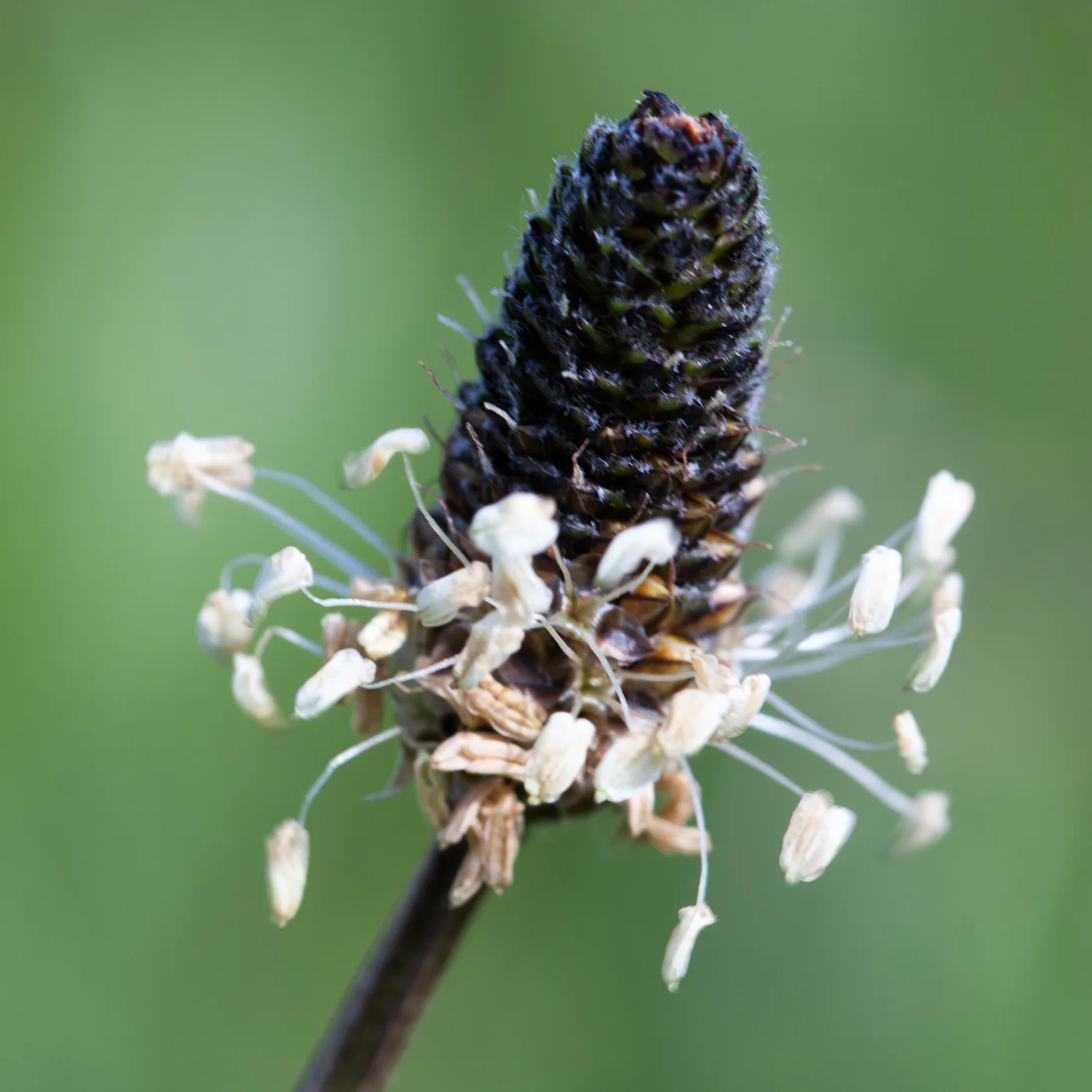
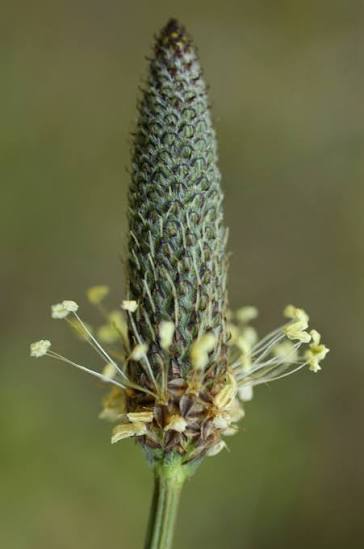
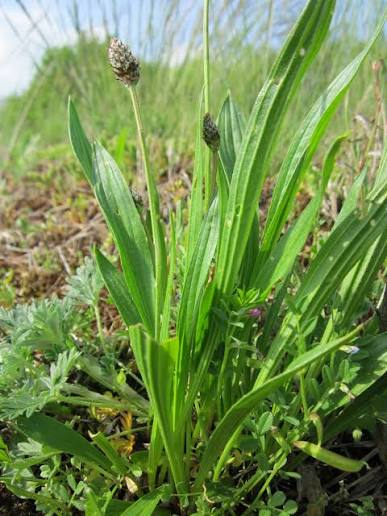
Ribwort Plantain is one of the most familiar plants of British lawns, meadows and grassy verges. Although its flower heads may look like simple dark-brown or greenish spikes, a closer look reveals a ring of tiny flowers with pale, projecting stamens.
It belongs to Plantaginaceae, the plantain family, alongside foxgloves, speedwells and toadflaxes. Unlike the conspicuous tubular flowers of Foxglove, Ribwort Plantain has many small, reduced flowers packed together and is mainly pollinated by the wind.
Identification
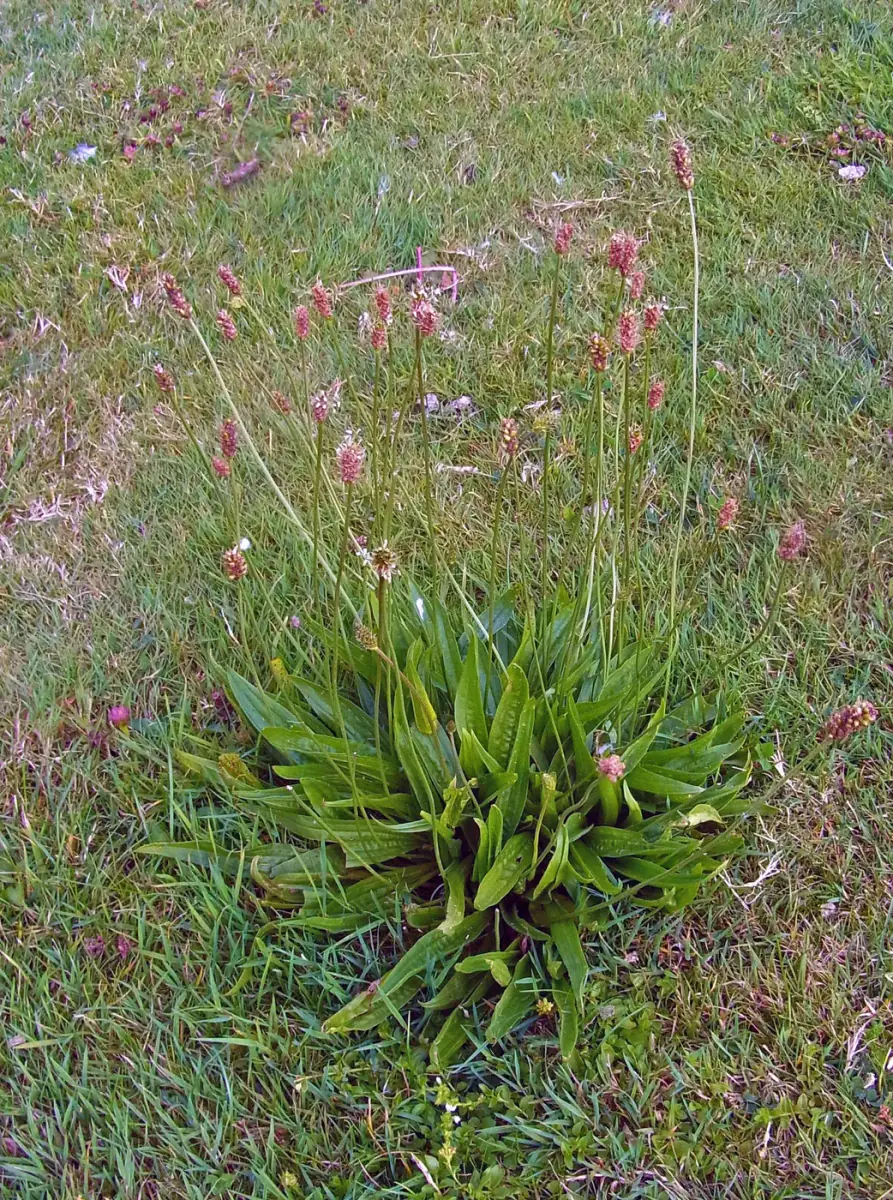
- A common perennial, usually reaching 10–50 cm in flower.
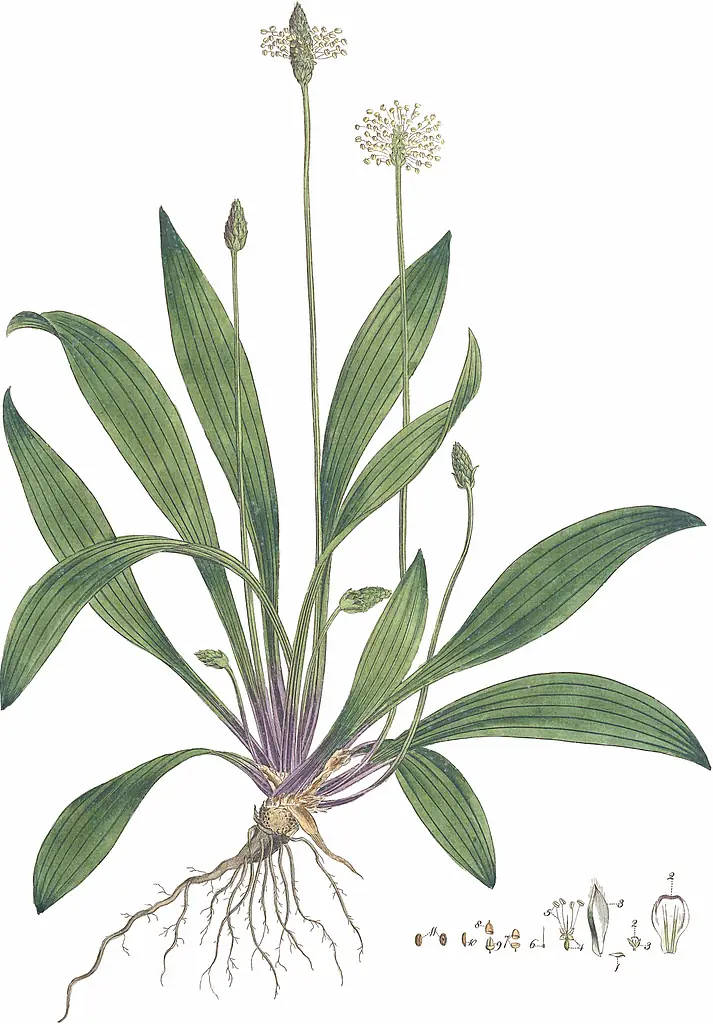
- Narrow, spear-shaped leaves grow in a basal rosette, not up the flower stalk.
- Each leaf has three to five especially noticeable lengthwise ribs or veins.
- Long, tough, usually grooved, leafless flower stalks carry the heads above the leaves.
- The flower heads are short, dense, oval to cylindrical spikes, often dark brown or greenish.
- At flowering time, a conspicuous ring of pale, dangling anthers may surround the head.
The combination of ribbed, narrow leaves and compact flower heads on wiry stalks is particularly distinctive.
Flower structure
What looks like one flower is actually a short, tightly packed spike of many tiny individual flowers. Each flower has a small, four-lobed, papery corolla, four stamens and a single style ending in a feathery stigma.
The stamens have slender filaments with pale anthers, which extend beyond the flower. When several neighbouring flowers shed pollen at once, the anthers form the familiar whitish ring around the spike. Flowering normally advances upwards through the head.
Ribwort Plantain is mainly wind-pollinated. The flowers are small and inconspicuous because they do not need large, colourful petals to attract pollinating insects. The female stigmas generally become receptive before the pollen is released, which helps reduce self-pollination.
After fertilisation, each flower can develop a small, dry capsule containing seeds.
Leaves
The leaves are long, narrow and lanceolate (spear-shaped), with a pointed tip. Their most distinctive feature is the set of strong longitudinal veins, typically three to five prominent ribs, which can be felt as well as seen.
Leaves arise together from the base of the plant. Their margins are usually entire or only faintly toothed; some leaves may be slightly hairy. The flowering stalks are separate from the leaves and remain leafless all the way to the spike.
Habitat
Ribwort Plantain is widespread across Britain and thrives in many open places, including:
- meadows, pasture and other grassland
- roadside verges and footpath edges
- lawns, parks and gardens
- field margins and farmland
- disturbed ground and grassy banks
It tolerates mowing, grazing and some trampling, which helps explain why it is so frequent in managed grassland.
Flowering period
Ribwort Plantain typically flowers from April to October, with the main flush often in late spring and summer. The brown seed heads may persist long after flowering.
Similar species
- Greater Plantain (Plantago major) usually has much broader, oval leaves and longer, more slender flower spikes. Ribwort Plantain has narrower leaves and shorter, denser heads.
- Hoary Plantain (Plantago media) has broader, softly hairy leaves and often produces more conspicuous lilac-tinged stamens. It is more associated with dry, often calcareous grassland.
- Buck’s-horn Plantain (Plantago coronopus) has deeply cut or toothed leaves and is often found in coastal or other saline habitats, making its foliage very different from the simple, ribbed leaves of Ribwort Plantain.
Where the names come from
Ribwort refers to the strong lengthwise ribs in its narrow leaves; ‘wort’ is an old word for a plant. Plantain is the longstanding English name for plants of this group.
Plantago is linked to Latin planta, meaning the sole of a foot, a reference traditionally made to the flat leaves of some plantains. Lanceolata means ‘lance-shaped’, describing Ribwort Plantain’s pointed leaves.
Folklore & history
Ribwort Plantain has long been known by traditional names including soldiers, soldiers and sailors and hardheads. Children played a game by looping or striking the tough stalks against one another, trying to knock off an opponent’s flower head. The game was sometimes compared with conkers.
Like other plantains, Ribwort Plantain has a history in traditional herbal practice. Its leaves were applied to minor wounds and stings.
Wildlife
Although largely wind-pollinated, Ribwort Plantain can attract small insects, and its leaves are important food for several herbivorous invertebrates. It is a food plant for caterpillars of the scarce Glanville Fritillary butterfly in parts of Britain.
Its seeds are eaten by seed-feeding birds, including goldfinches. Leaving some flower stalks standing into autumn and winter can therefore provide food for wildlife.