Green Alkanet is a vigorous perennial with bright blue flowers that look like large forget-me-nots. It commonly grows along hedgerows, shaded roadsides, woodland edges and in gardens. Its large, rough leaves and bristly stems are as characteristic as the flowers. Originally from south-western Europe, it was introduced to Britain and is now widespread as a naturalised plant. It belongs to Boraginaceae, the borage family.
Identification
- An upright, bushy perennial, commonly 30–90 cm tall and sometimes reaching about 1 m.
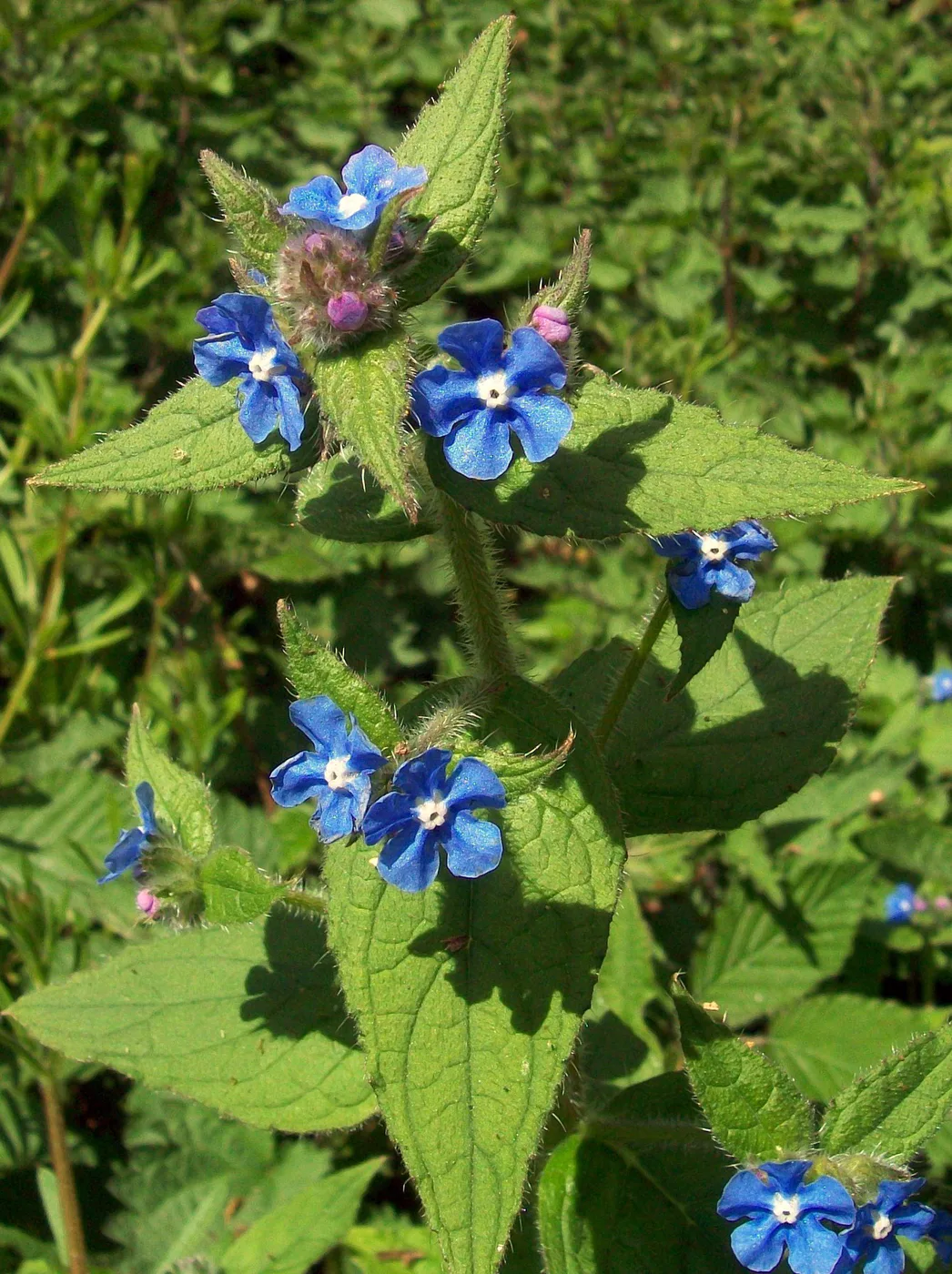
- Small, vivid blue flowers, roughly 1 cm across, each with five spreading lobes and a conspicuous white centre.
- Pinkish or purplish buds that turn blue as the flowers open.
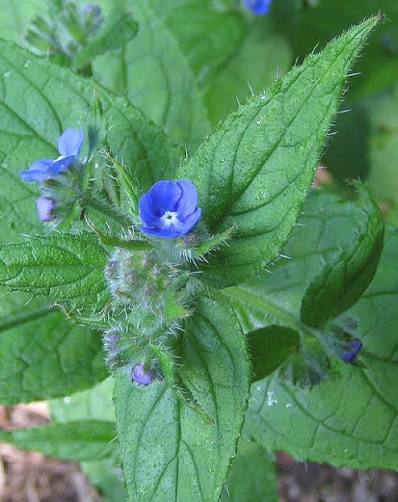
- Large, pointed, oval to lance-shaped leaves with prominent veins and a noticeably rough, bristly surface.
- Lower leaves on stalks, forming a leafy clump near the base; upper leaves smaller and often almost stalkless.
- Flower clusters held among the upper leaves on hairy, branching stems.
- A deep, persistent taproot; established plants can form dense patches.
The combination of bright blue, white-eyed flowers and large, stiff-haired leaves is particularly useful for recognising Green Alkanet in the field.
Flower structure
Each flower has five petals joined at their bases into a short tubular corolla, spreading into five rounded blue lobes. Five small whitish scales inside the throat produce the striking pale eye. Five stamens are tucked inside the flower, rather than projecting beyond the petals. A green calyx with five narrow lobes surrounds the base.
The flowers grow in leafy, branching clusters. As in many members of the borage family, developing clusters can be curled or coiled cymes that gradually open out. After pollination the fruit can divide into four small nutlets.
Leaves and stems
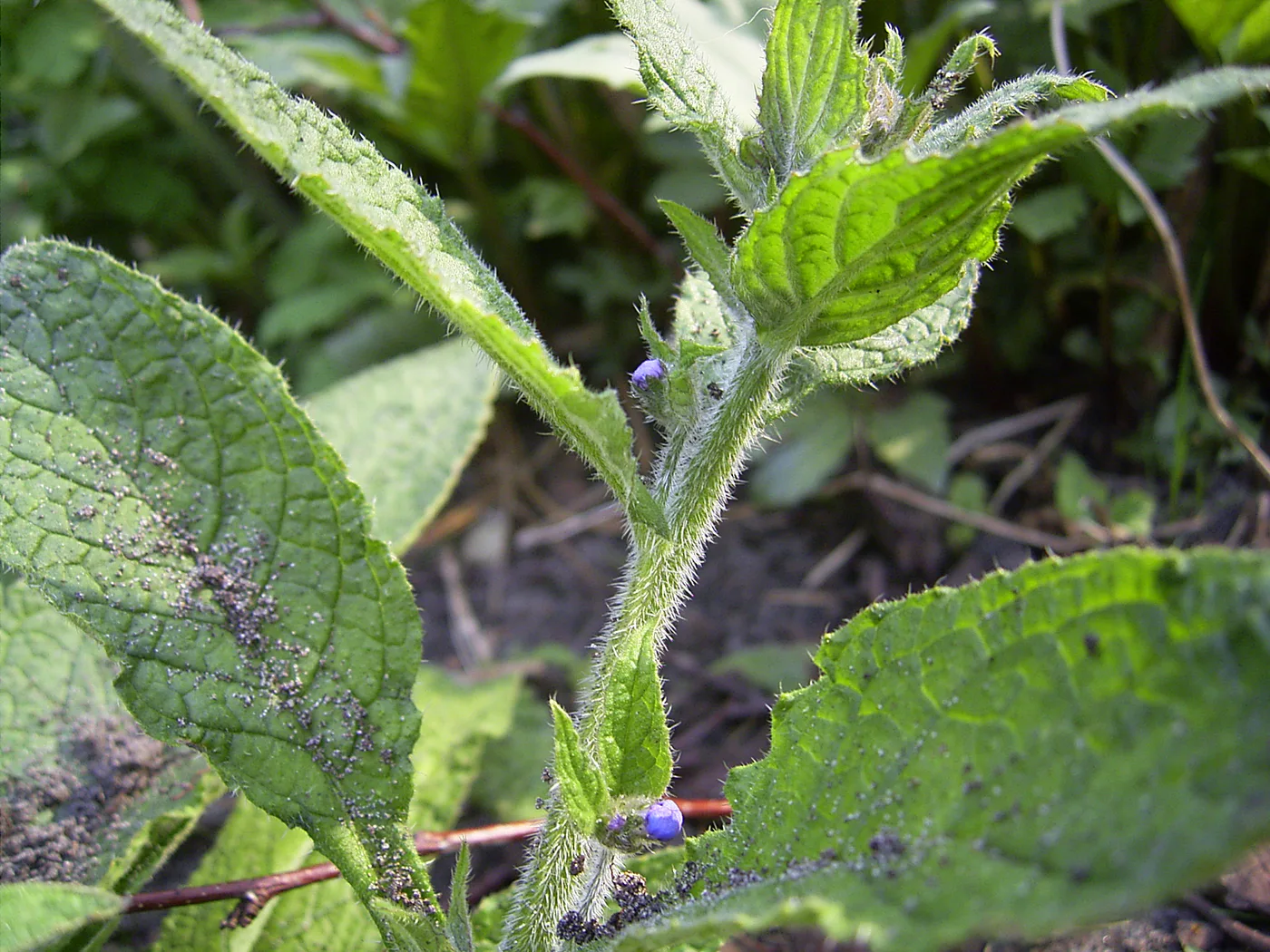
The basal leaves are broad, pointed and sometimes 30–40 cm long, with conspicuous veins and a puckered appearance. Their stiff hairs make them feel coarse to the touch. Leaves higher up the stem become progressively smaller, with shorter stalks or almost none at all.
The stems are covered in bristly hairs, including around the buds and flower stalks. A strong taproot anchors the plant, and fresh leaves can appear early in the year. In mild winters, some foliage remains green.
Habitat
Look for Green Alkanet in shaded or partly shaded hedgerows, woodland margins, old gardens, road verges and disturbed ground, especially where the soil retains some moisture. It thrives in fertile places and can spread readily by seed.
It is not native to Britain. Originally grown in gardens, it has become a familiar naturalised wildflower, particularly across England and Wales, though less frequent farther north.
Flowering period
Green Alkanet usually flowers from April to July, sometimes beginning earlier in a mild spring and continuing into late summer where conditions remain moist. Pinkish buds and open blue flowers can often be seen on the same stem.
Similar species
- Forget-me-nots (Myosotis species) also have blue flowers, but they are usually smaller, often with a yellow eye, and their leaves are generally narrower and less coarse.
- Common Comfrey (Symphytum officinale) has similarly rough foliage, but its bell-shaped flowers droop in clusters and are commonly purple, pink or cream rather than bright blue with a white eye.
- Viper’s-bugloss (Echium vulgare) is another bristly borage-family plant, but it typically grows in open, drier places and has showier projecting stamens.
Where the names come from
The word Alkanet is related to a name historically used for dye plants. It came into European languages through Spanish from the Arabic al-henna, associated with henna and the colouring of materials. Green refers to the plant’s persistent foliage, not its blue flowers.
Pentaglottis comes from Greek words meaning ‘five tongues’, referring to the five scales in the throat of the flower. The Latin sempervirens means ‘evergreen’, a reference to leaves that can remain green through mild winters.
Folklore & history
Green Alkanet came to Britain from south-western Europe and was grown in gardens by at least the late sixteenth century. It gradually escaped cultivation and established itself along lanes, hedgebanks and other places close to settlements.
Its name recalls the old trade in red plant dyes. The roots of various alkanets were used to produce red colouring, and Green Alkanet has also been associated with dye-making, although the best-known dye plant was Dyer’s Alkanet (Alkanna tinctoria). Green Alkanet is now especially familiar for the blue flowers that brighten shady springtime corners.
Wildlife
The flowers provide nectar for bees and are also visited by hoverflies and butterflies. Their early appearance makes them a useful source of food for insects in spring, particularly in gardens and along sheltered hedgerows.
Where it grows in quantity, Green Alkanet can form a dense leafy patch that shelters small invertebrates.