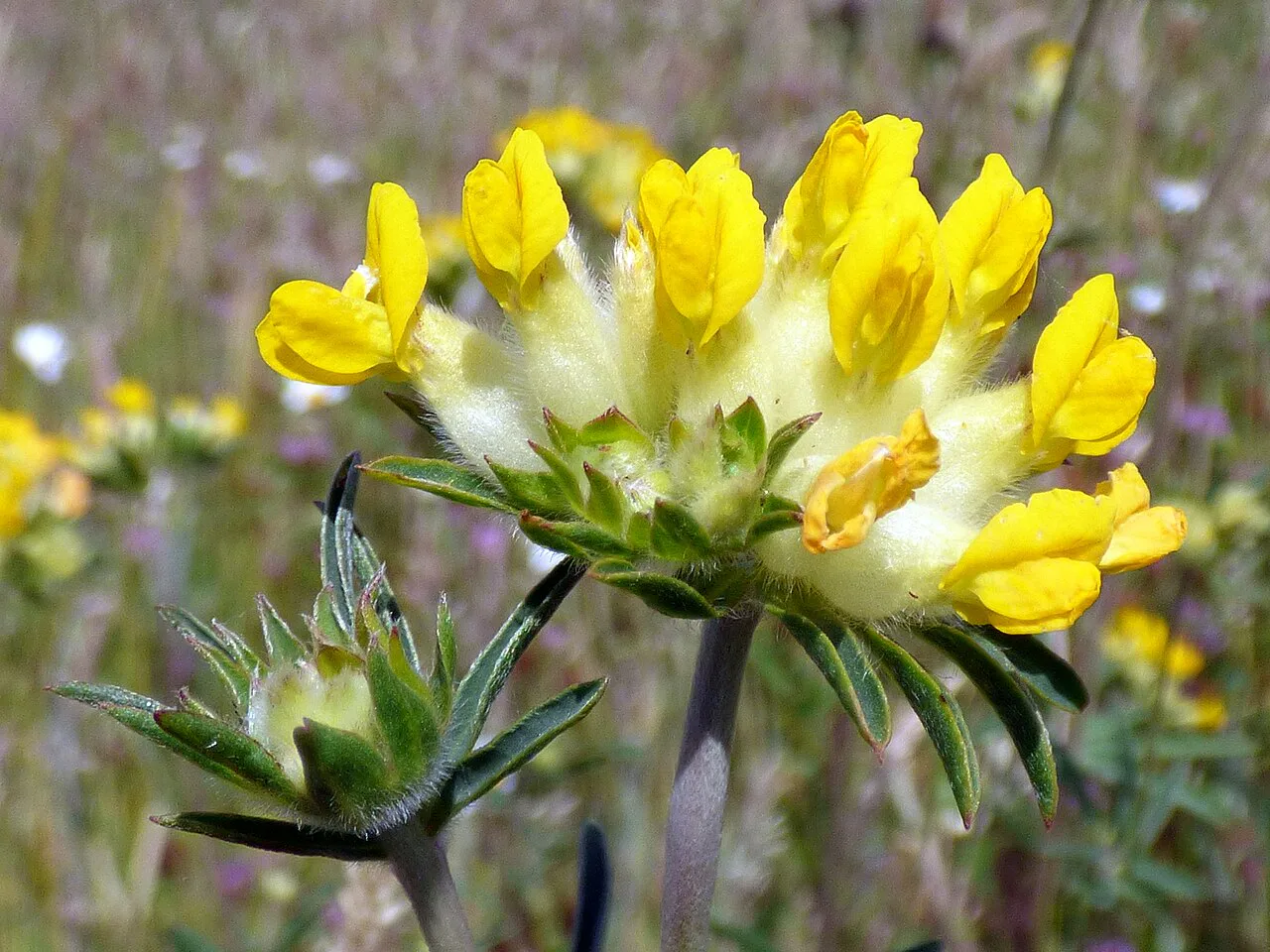
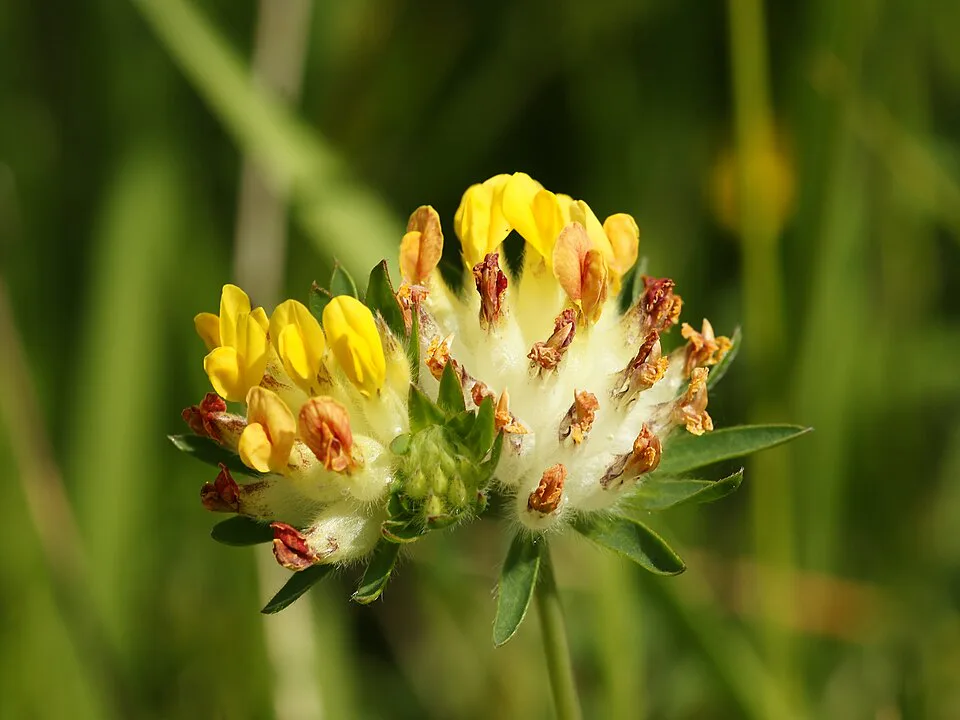
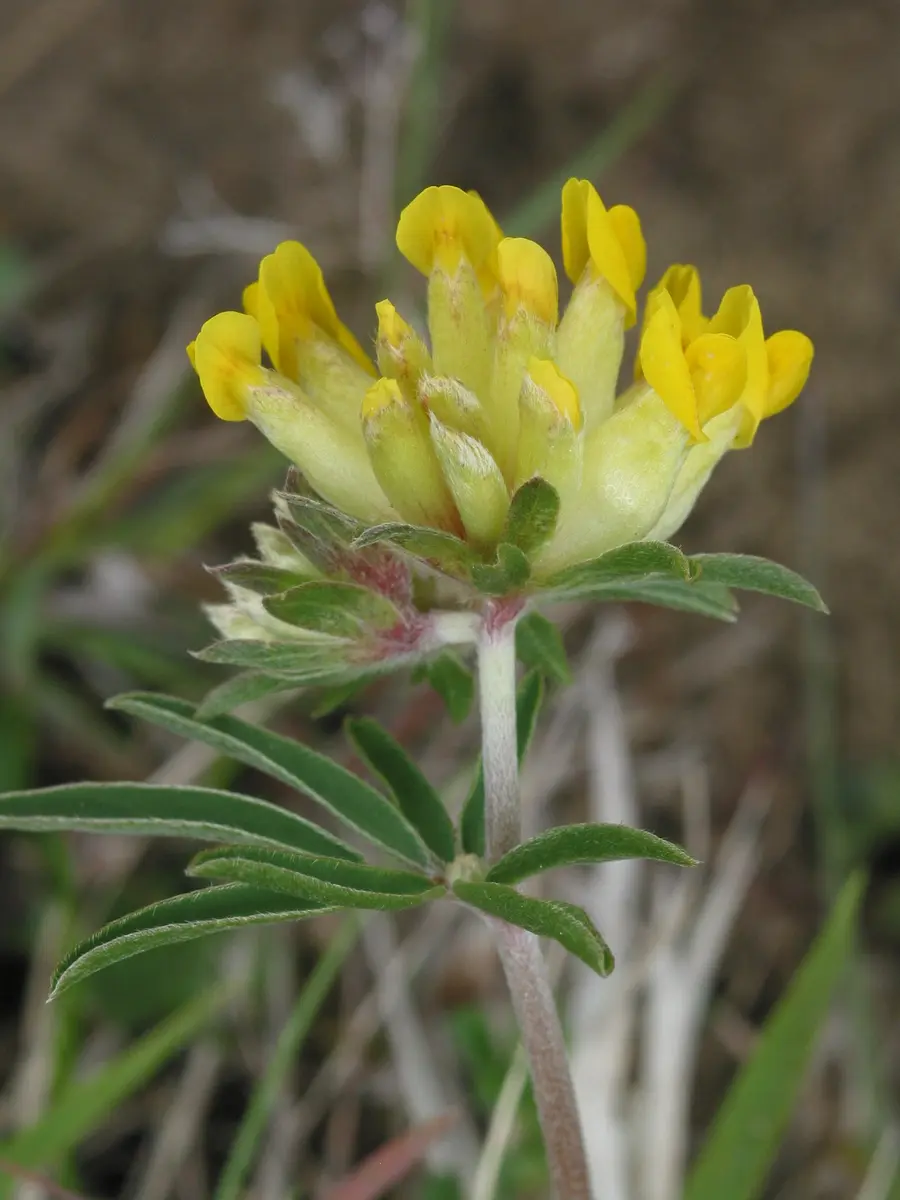
Kidney Vetch is a low-growing native wildflower of sand dunes, chalk grassland and sunny coastal cliffs. In summer, its little heads of yellow flowers sit on soft, woolly cushions, giving the plant a look quite unlike most other members of the pea family. It belongs to Fabaceae, the pea family, alongside Red Clover and Common Bird’s-foot-trefoil.
Identification
- Rounded heads of small, usually bright yellow flowers, sometimes flushed orange or red.
- Each individual flower sits inside a swollen, silky-hairy calyx, producing the characteristic white or pale woolly look.
- The flowers grow in compact clusters at the ends of slender stems, often with leafy bracts immediately below the head.
- Compound leaves divided into several leaflets, with a larger leaflet sometimes at the tip.
- Silky hairs, often especially visible on the undersides of the leaves and around the flower heads.
- A low, spreading or loosely upright habit, commonly no more than about 30 cm tall.
The combination of yellow flowers and a woolly flower head is the quickest clue. Even when flowering is nearly over, the pale, hairy calyces can remain conspicuous.
Flower structure
Although Kidney Vetch’s flower heads can look like a single fluffy bloom, each head contains numerous individual flowers. As in many members of Fabaceae, each flower has five petals arranged into the characteristic pea-flower shape: an upper standard petal, two wings and two lower petals forming a keel. In Kidney Vetch the flowers are rather short and crowded together.
Five sepals are joined into a tubular calyx, which becomes noticeably swollen and is covered in long, silky hairs. The pale calyces are particularly distinctive when the yellow petals have withered. After pollination, a small pod develops inside each persistent calyx, generally containing one or two seeds.
Leaves and stems
The leaves are made up of several separate leaflets along a central stalk, often with a broader leaflet at the end. Leaflet number and shape are variable, but the foliage is generally softly hairy, with a pale, silky underside. Lower leaves can sometimes look almost undivided, while those higher on the stem are more obviously compound.
The plant often forms loose, low clumps with slender, branching stems. On exposed coastal ground it may hug the turf or spread over open patches of sandy or chalky soil.
Habitat
Kidney Vetch thrives on sunny, well-drained, often lime-rich ground. Look for it on sand dunes, chalk and limestone grasslands, dry banks and coastal cliffs. It can also appear on disturbed open ground and suitable roadside verges.
It is especially characteristic of flower-rich coastal and calcareous grassland, where the turf is short enough to let sunlight reach low-growing plants. Like many pea-family plants, it has a relationship with nitrogen-fixing bacteria in nodules on its roots.
Flowering period
Kidney Vetch usually flowers from June to September, although the exact season varies with the weather and location. Its bright flower heads are particularly striking in early and midsummer.
Similar species
- Common Bird’s-foot-trefoil (Lotus corniculatus): also has yellow pea-shaped flowers, sometimes orange-tinged, but its flowers are usually in smaller, more open clusters and lack Kidney Vetch’s woolly flower heads.
- Horseshoe Vetch (Hippocrepis comosa): has a ring or crown of yellow pea-shaped flowers, but lacks the distinctive pale, silky calyces and has many paired leaflets.
- Red Clover (Trifolium pratense): also forms rounded heads of numerous pea flowers, but these are normally pink-red, and its leaves are made up of three leaflets.
Where the names come from
The name Kidney Vetch reflects its traditional association with kidney complaints; ‘vetch’ is an old English name used for a number of plants in the pea family. Its older name Woundwort points to a different medicinal association.
Anthyllis is generally explained through Greek words relating to flowers and downy or woolly growth, an apt description of its soft, hairy flower heads. Vulneraria comes from Latin vulnus, ‘wound’, recalling its use in traditional wound remedies.
Folklore & history
Kidney Vetch has long been called woundwort. Herbalists used the plant in preparations associated with wounds, bruises and swellings, as well as complaints of the stomach and kidneys.
Another old name, Lady’s Fingers, evokes the small clusters of flowers.
Wildlife
Kidney Vetch has a particularly important connection with the Small Blue butterfly (Cupido minimus), Britain’s smallest butterfly. It is the sole foodplant of the Small Blue’s caterpillars in Britain. Females lay their eggs on the flower heads, and the caterpillars feed on the developing flowers and seeds.
The flowers are also visited by bees and other nectar-feeding insects. Maintaining patches of Kidney Vetch in short, species-rich grassland is therefore especially important for the Small Blue.