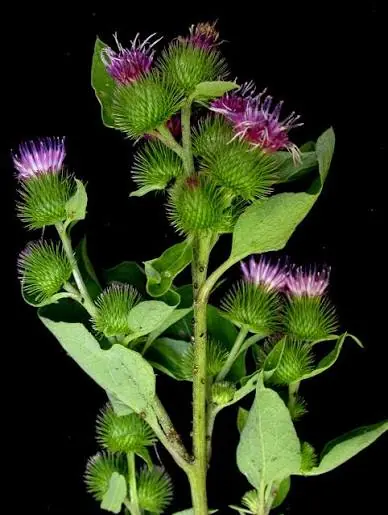
Lesser Burdock is a robust, broad-leaved plant of hedgebanks, woodland edges and rough ground. During its first year it often produces only a large rosette of leaves; in its second year, branching stems carry clusters of rounded, purple-tipped heads. Later these become the familiar burrs that catch on clothing and animal fur. Despite their thistle-like appearance, the heads belong to the daisy family (Asteraceae).
The plant is common across much of the UK. It is easily overlooked until the flowering stalks rise above other vegetation or the burrs make their presence felt on a walk.
Identification
- A stout biennial, typically 60–150 cm tall, often with a branching, somewhat hairy stem that can be tinged reddish-purple.
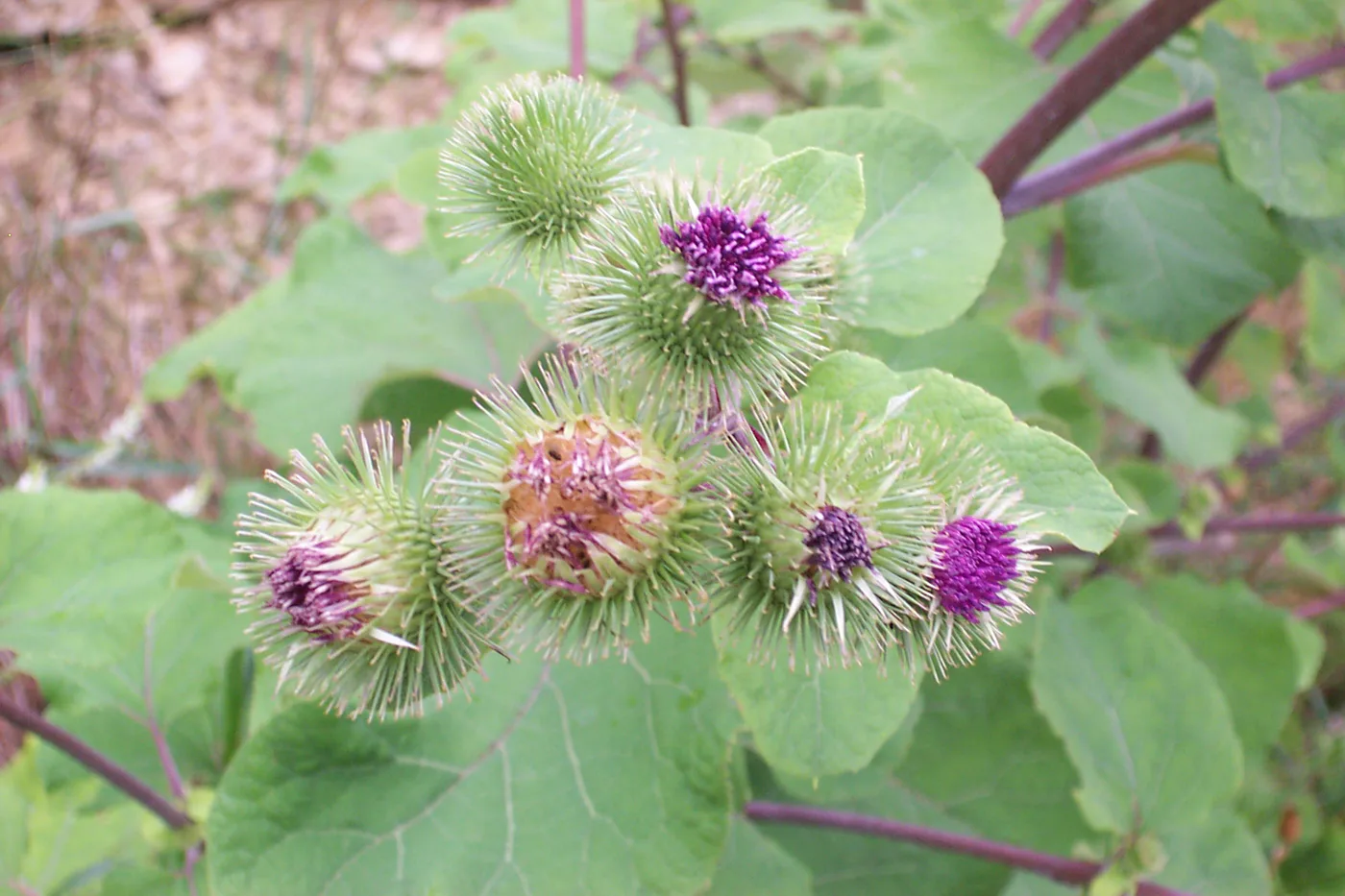
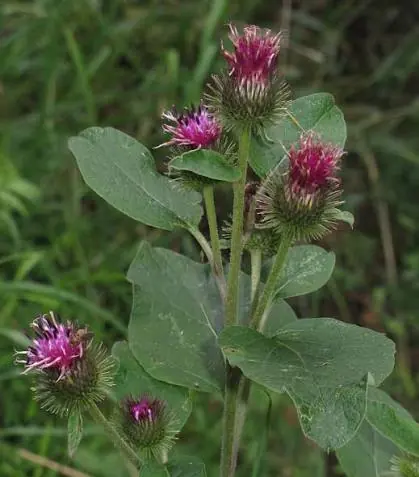
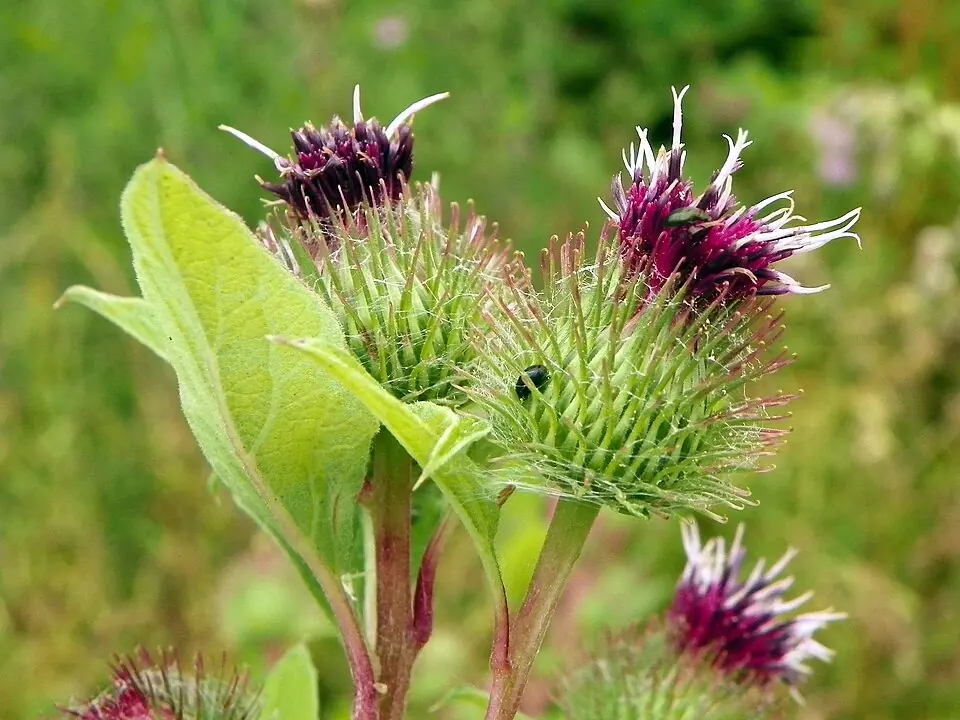
- Numerous rounded flower heads, usually around 1.5–2 cm across before fruiting, with small purple or pinkish-purple tubular flowers projecting from the top.
- Flower heads mostly on very short stalks, so they appear arranged along the branching stems rather than forming a broad, flat-topped cluster.
- Many narrow green or purplish bracts enclose each head; their tips curve into hooks, especially conspicuous when the head matures.
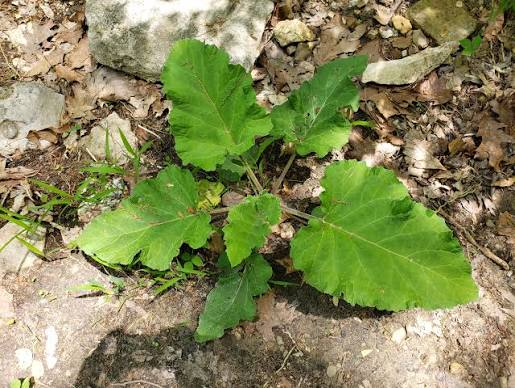
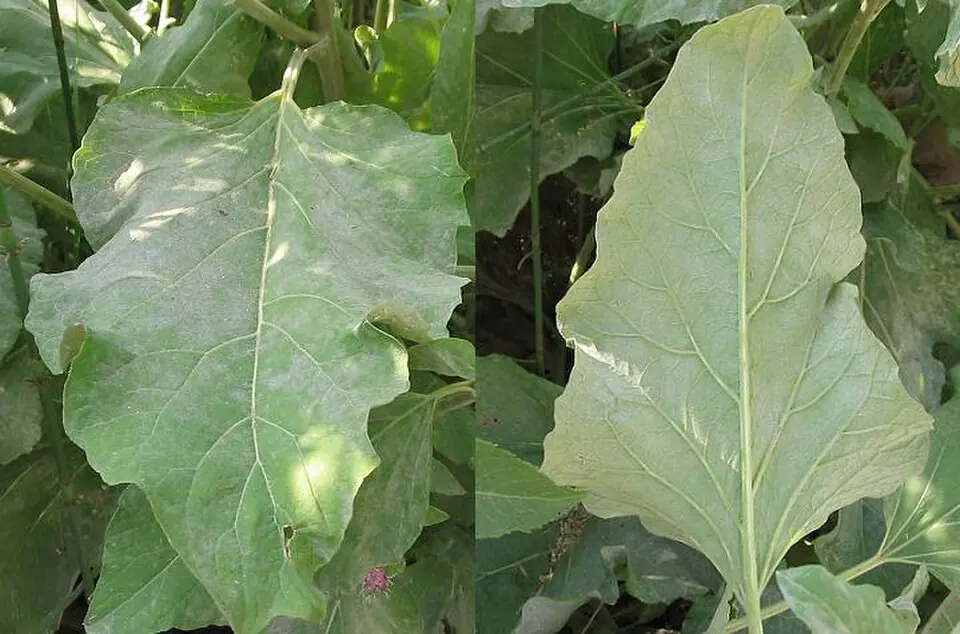
- Very large, oval to heart-shaped basal leaves, with a pointed tip, wavy or irregularly toothed edges and a paler, softly hairy underside.
- The leaf stalks of the lowest leaves are hollow, at least near the base. Cutting across a stalk can help distinguish Lesser from Greater Burdock.
- Brown, globular burrs persist after flowering and readily attach to fur, socks or sleeves.
The most useful combination is the relatively small, short-stalked flower heads, large heart-shaped leaves and hollow basal leaf stalks. Species within the burdock group can be variable, so several features should be checked together.
Flower structure
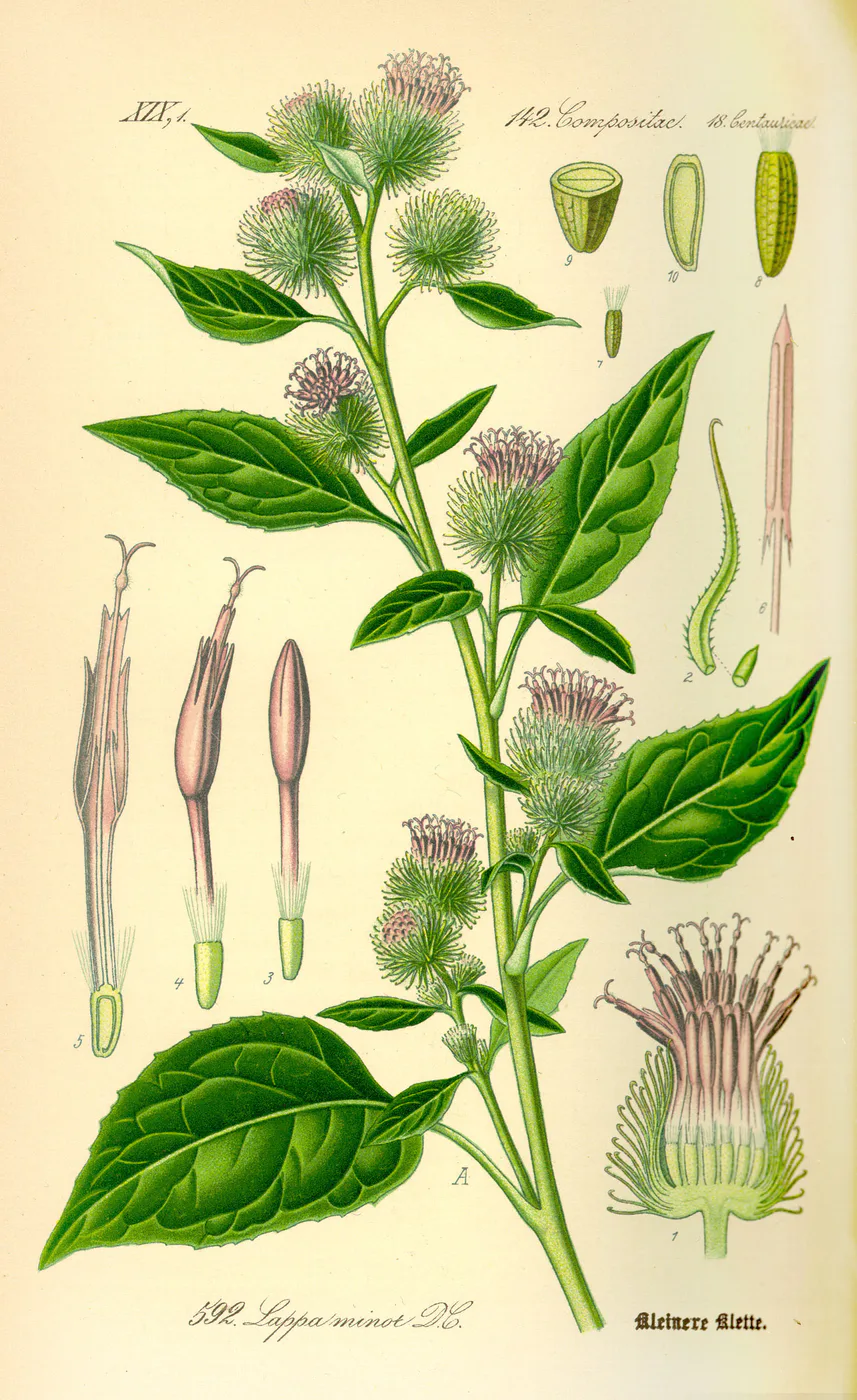
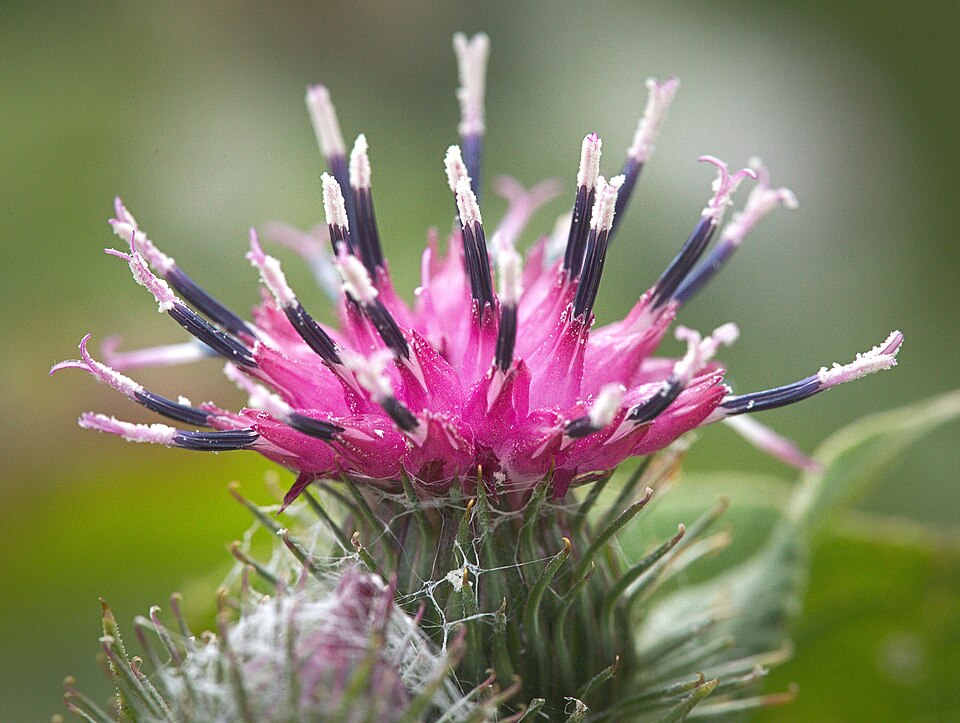
A burdock head is a capitulum: not one large flower, but many small tubular florets packed together. Unlike a daisy, there is no ring of broad, strap-shaped ray florets. Each purple floret has a narrow tubular corolla ending in five tiny lobes. The stamens form a tube around the developing style, which carries pollen upwards before its stigma becomes receptive.
Surrounding the whole head are overlapping bracts, collectively forming the involucre. Each outer bract ends in a small recurved hook. These are modified leaves, not the plant’s seeds or the spines of a true thistle. Their hooks are present while the florets are open, but their purpose becomes most obvious later, when the head has dried into a burr.
Following pollination, each fertile floret can produce a small, dry, one-seeded fruit known as an achene. The mature head holds many fruits together until it is carried away or breaks apart.
Leaves and stems
In its first year, Lesser Burdock makes a rosette of large leaves near the ground, storing food in a thick underground taproot. These leaves may reach 40–50 cm in length. Their blades are broadly oval or heart-shaped, usually with a notched base, prominent branching veins and a slightly wavy edge. The upper surface is green; the underside is noticeably paler and often softly downy.
During the second year, an upright stem develops with smaller alternate leaves. The leaves become progressively narrower towards the flowering branches. The stems are stout, often ridged and hairy, and may show reddish colouring. The large lower leaves attach by long petioles that are hollow at least towards their bases — a particularly valuable identification feature when compared with Greater Burdock.
Burrs and seed dispersal
After the purple florets fade, each flower head dries into a rounded, brown burr covered in numerous tiny hooks. When a mammal brushes past, the hooked bracts catch in its fur; the same thing happens to woollen clothing, walking socks or a dog’s coat. In this way the plant can transport its fruits far from the parent plant. This method of dispersal is called epizoochory: seeds or fruits travel on the outside of animals rather than being eaten.
The burr is not itself a single seed. It is the whole dried flower head, containing many small fruits within its hooked covering. Eventually the head breaks apart and the fruits fall free.
Habitat
Lesser Burdock grows in nutrient-rich, disturbed or neglected ground: hedge bottoms, field edges, roadside verges, railway margins, waste places, woodland rides and sheltered banks. It often stands among nettles, docks and other tall herbs. It favours reasonably fertile soil and can tolerate partial shade.
Flowering period
Its purple flower heads usually appear from July to September in the UK, occasionally persisting into early autumn. The brown burrs remain conspicuous long after the flowers have faded and may still be present in winter.
Similar species
- Greater Burdock (Arctium lappa) has typically larger flower heads, with longer stalks arranged into more open, often nearly flat-topped clusters. Its large basal leaf stalks are normally solid rather than hollow.
- Wood Burdock (Arctium nemorosum) is closely related and can be difficult to separate reliably; plants may have more elongated, well-stalked heads. Some floras treat it within the Arctium minus group, so detailed identification can require care.
- Woolly Burdock (Arctium tomentosum) has flower heads densely covered in pale, cobweb-like hairs and is a much rarer introduction in the UK.
- Spear Thistle (Cirsium vulgare) can also bear purple flower heads, but its leaves and stems are sharply spiny and its heads lack burdock’s clinging, hooked bracts.
Where the names come from
Burdock is an old English plant name associated with the burrs that cling to wool and clothing, and the great, dock-like leaves. The exact historical development of the word is complicated: nineteenth-century writers such as R. C. A. Prior connected both bur and dock with old words used for tangled wool or coarse plant material. Either way, the name captures the two features people notice most — the broad foliage and the tenacious burrs.
The scientific name Arctium comes from the Greek arktos, meaning ‘bear’, usually explained as an allusion to the rough, shaggy flower heads. The Latin minus means ‘smaller’, distinguishing it from Greater Burdock, Arctium lappa. The older name Lappa minor appears in historical botanical illustrations. Other traditional names include beggar’s buttons, cuckoo-buttons, clot-bur and louse-bur, all referring to the round heads or their tendency to cling to people and animals.
Folklore & history
Burdock burrs have amused and annoyed people for centuries. Children used them as makeshift fasteners and threw them at each other’s clothes, while shepherds knew how easily the heads could become tangled in fleeces. Early herbalists described the roots, leaves and seeds of burdock in preparations for skin complaints, wounds and various other ailments; Nicholas Culpeper included burdock among the plants discussed in his seventeenth-century herbal writings. The name burdock was usually applied to the group rather than always distinguishing one species from another.
One of the most unusual surviving customs is the Burry Man of South Queensferry, near Edinburgh. Each August, a local man is covered almost from head to foot in thousands of sticky burdock burrs and slowly parades through the town, accompanied by helpers. The costume is painstaking to construct because every burr grips the fabric beneath it. The procession has been recorded for centuries, but its original purpose is uncertain: explanations have ranged from bringing good fortune to protecting the town from misfortune. Both Lesser and Greater Burdock have been used to make the remarkable costume.
Burdock also helped inspire a twentieth-century invention. In 1941 the Swiss engineer George de Mestral noticed burrs caught in his dog’s coat and on his own clothes after a walk. Examining them under a microscope, he discovered that tiny hooks on the burrs caught on loops of hair and fabric. He spent years developing a reusable fastening system based on that principle. The first Swiss patent followed in 1954 and a US patent in 1955; the resulting hook-and-loop fastener became famous under the name VELCRO®, formed from French words for velvet and hook. The everyday inconvenience of burdock burrs had inspired a widely used technology.
Wildlife
The purple florets provide nectar and pollen for bumblebees, other bees, hoverflies and butterflies. Large leaves give cover to smaller invertebrates, while the ripe fruits can feed seed-eating birds. The burrs spread most effectively when carried by passing mammals, but they are also a reminder of the plant’s unusual relationship with the animals moving through its habitat.