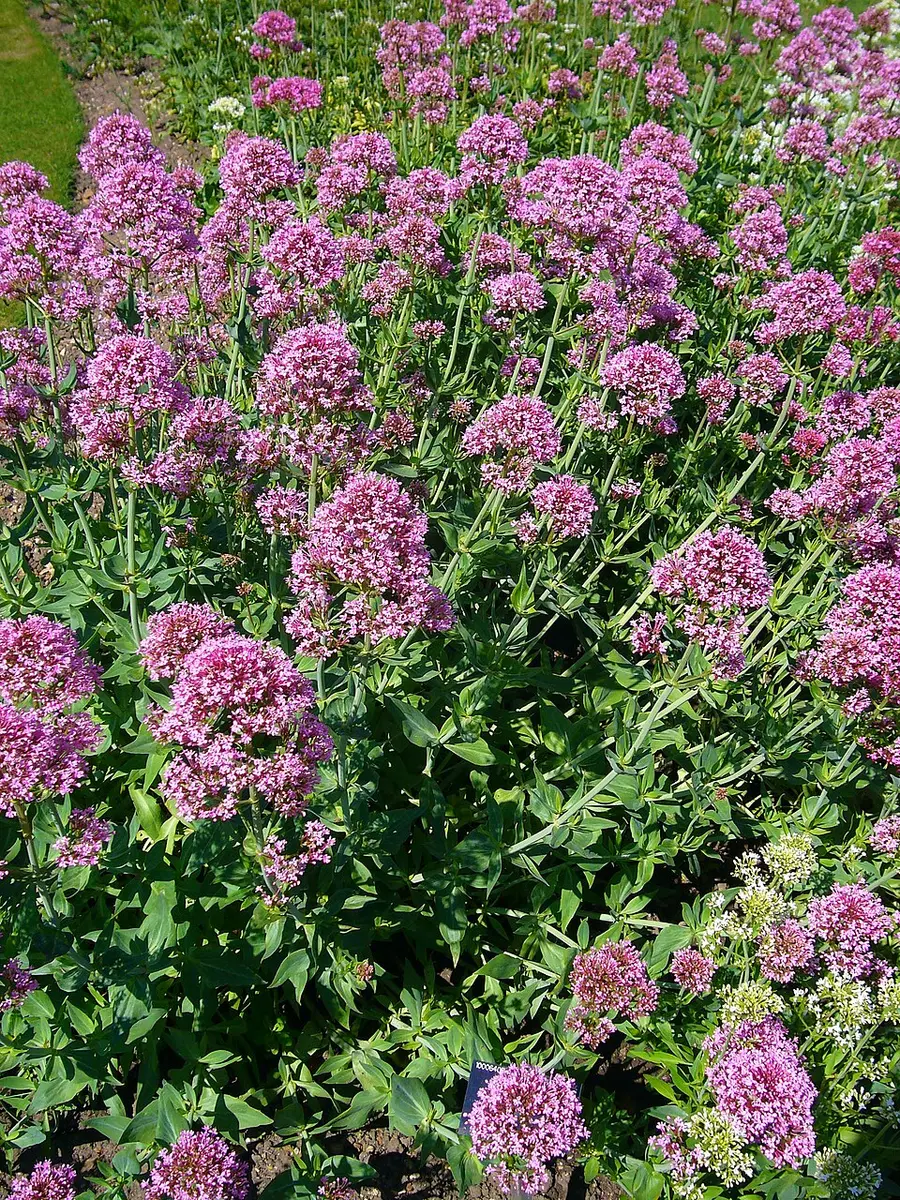
Red Valerian is a familiar sight on old stone walls, coastal cliffs, rocky banks and roadside verges, particularly in southern Britain. Its clouds of rosy-red or pink flowers can brighten apparently inhospitable places where there is very little soil. White-flowered plants also occur.
It is not native to Britain. Originally from southern Europe and nearby regions, Red Valerian was grown in gardens and has become widely naturalised. It belongs to the honeysuckle family, Caprifoliaceae, within a group traditionally treated as the separate valerian family, Valerianaceae.
The scientific name Centranthus ruber is still widely used in British floras and horticulture, including by the RHS. Kew’s Plants of the World Online currently treats it as a synonym of Valeriana rubra. Both names refer to the same plant.
Identification
- A bushy, sometimes woody-based perennial, commonly 30–100 cm tall.
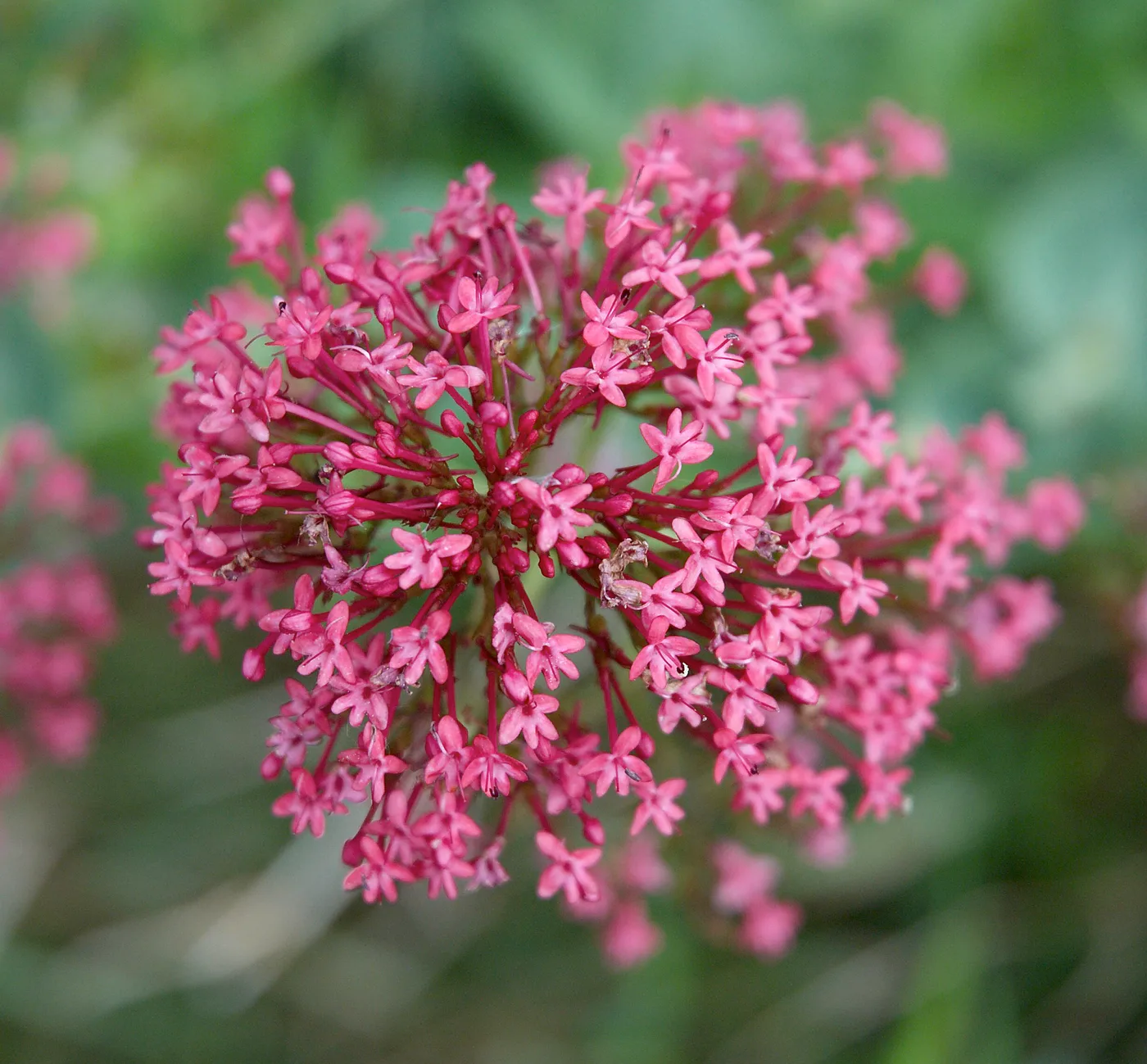
- Numerous small pink, crimson-red or white flowers are held in dense, branching clusters at the stem tips.
- Each tiny flower has a narrow tube ending in five unequal lobes and a slender, backward-pointing spur at its base.
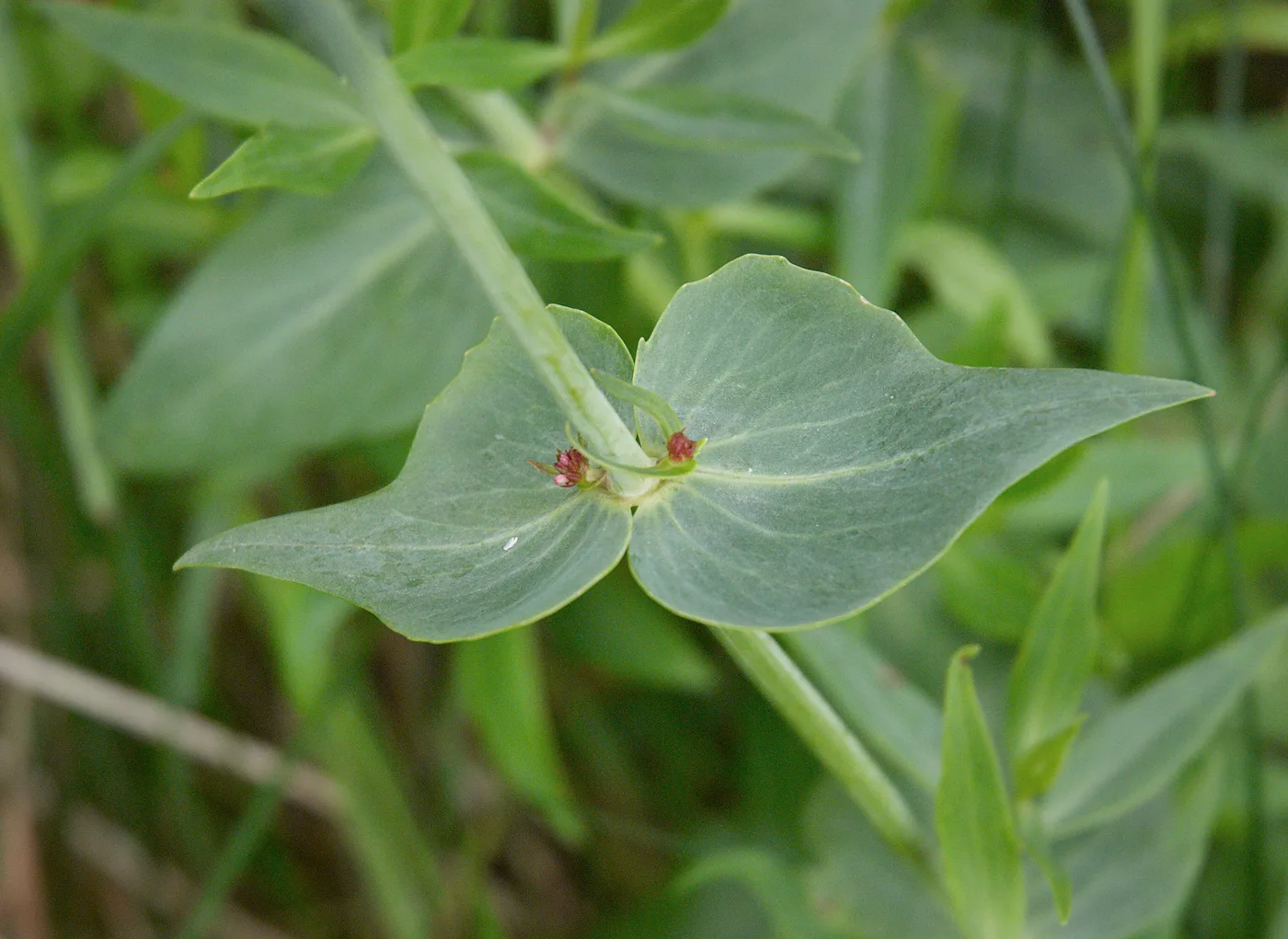
- The grey-green to blue-green leaves are opposite, with a pair at each node on the stem.
- Leaves are simple and unlobed, usually oval to lance-shaped, often with smooth edges.
- The plant frequently grows from cracks in walls, old masonry, rocky slopes and other dry, sunny sites.
- Once established it may seed freely, forming sizeable patches on walls and banks.
The combination of opposite, undivided leaves, dense pink-red flower clusters and a spur on each small flower is especially distinctive.
Flower structure
Look closely at a single flower rather than the entire cluster. Each bloom is tubular, with five short lobes at the opening. A long, narrow nectar spur extends backwards from the base of the flower tube. The spur may be easier to see when viewing a flower from the side.
Red Valerian has one stamen per flower, a useful botanical feature of the genus traditionally called Centranthus. The flowers are grouped in tightly packed, branching, terminal clusters, so the flowering stem can resemble a single large pink head from a distance.
After pollination, the flowers develop small, dry, one-seeded fruits. The fruit is topped by a spreading tuft of feathery hairs, sometimes called a pappus, which helps it travel on the wind.
Leaves and stems
The leaves are borne in opposite pairs along upright, often slightly bluish or reddish stems. Lower leaves tend to be broader and may have short stalks; the upper leaves are narrower and often clasp the stem or lack a noticeable stalk.
Unlike Common Valerian, the leaves are not divided into many leaflets. Their smooth, simple outline and pale grey-green colour are helpful when identifying the plant before it flowers.
Older Red Valerian plants develop a woody base and can become quite bushy, especially in sheltered positions.
Habitat
Red Valerian is particularly associated with dry, sunny, well-drained ground, including:
- cracks in old stone walls and masonry
- sea cliffs and rocky coastal slopes
- roadside verges and railway embankments
- quarries, rubble and waste ground
- gardens, village walls and urban banks
It is widespread and well established in southern Britain, especially in coastal areas, but is less common farther north. Although it is often seen growing wild, it is an introduced, naturalised species rather than a native British wildflower.
Flowering period
In Britain, Red Valerian commonly flowers from May to October, sometimes with particularly impressive displays in late spring and early summer. Individual stems may carry fresh flowers while older clusters are already developing feathery fruits.
Similar species
- Common Valerian (Valeriana officinalis) is a British native that usually favours damper habitats, including riversides and moist meadows. It has clusters of pale pink or whitish flowers, but its leaves are pinnately divided into leaflets. Red Valerian has simple, undivided leaves and is much more typical of dry walls and rocky places.
- Devil’s-bit Scabious (Succisa pratensis) also belongs to Caprifoliaceae, but its rounded blue-purple flower heads are quite different. It usually grows in damp or unimproved grassland, and its flowers do not have Red Valerian’s long, narrow spur.
- Garden Phlox (Phlox paniculata) and other ornamental phloxes can also have clusters of pink or reddish, tubular flowers. Their individual flowers normally have much broader, spreading lobes, making them look more star- or wheel-shaped, and they lack the distinctive nectar spur of Red Valerian.
- Plants with pure white flowers are simply a white-flowered form of Red Valerian, not a separate species. Check the same opposite, simple leaves and spurred flowers.
Where the names come from
Red Valerian takes its common name from its often red-pink flowers and its resemblance to the valerian group. It is not the same plant as Common Valerian. The alternative name Spur Valerian points to the narrow spur behind each flower.
Centranthus combines Greek kentron (‘spur’) and anthos (‘flower’), referring to that floral spur. Ruber is Latin for ‘red’, although the flowers can also be pink or white.
Folklore & history
Red Valerian arrived in Britain as an ornamental garden plant and was being cultivated by the seventeenth century. Its ability to grow from tiny cracks has made it a characteristic flower of old walls, harbours, villages and coastal towns.
It has acquired a colourful collection of common names, including Jupiter’s Beard, Fox’s Brush and Kiss-me-quick. Jupiter’s Beard is sometimes connected with the conspicuous feathery structures that develop on the fruits.
Despite its name, Red Valerian should not be confused with Common Valerian, the species traditionally associated with preparations made from valerian root. They are related plants, but not interchangeable.
Wildlife
Red Valerian provides nectar over a long flowering season and is visited by bees, butterflies and moths. It is particularly well known as a nectar source for the Hummingbird Hawk-moth (Macroglossum stellatarum), which may hover in front of the flowers and probe their nectar spurs with its long proboscis.
Although Red Valerian is non-native, its flowers can benefit nectar-feeding insects in gardens, towns and other disturbed habitats. In places where it spreads aggressively, it is worth managing its self-seeding to give native plants room to establish.