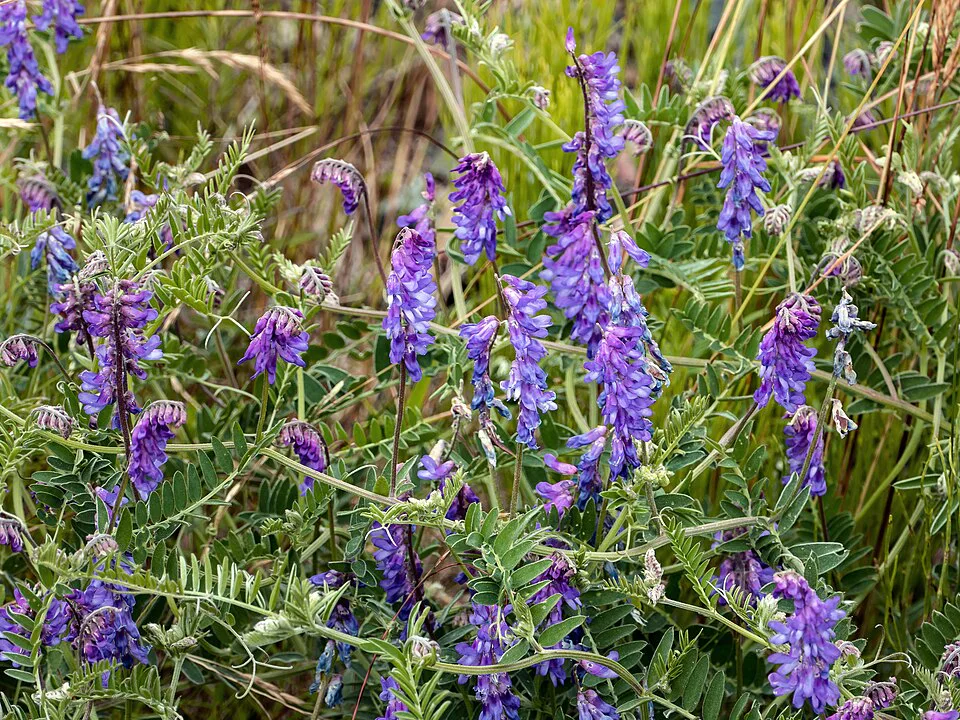
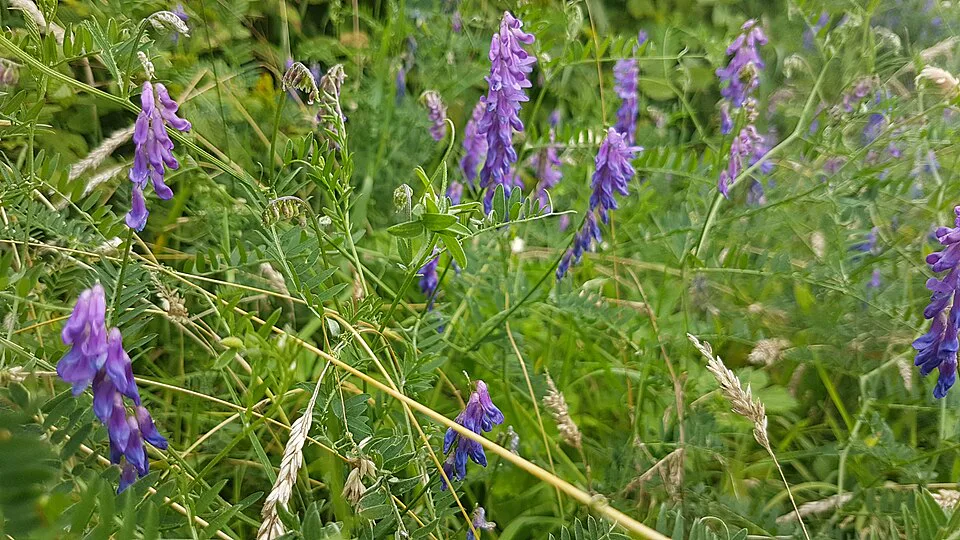
Tufted Vetch is a native, scrambling perennial found among meadow grasses, hedgerows and woodland edges. In summer, its long clusters of blue-violet flowers often seem to float above the surrounding vegetation. It belongs to Fabaceae, the pea family, alongside Red Clover and Common Bird’s-foot-trefoil.
Identification
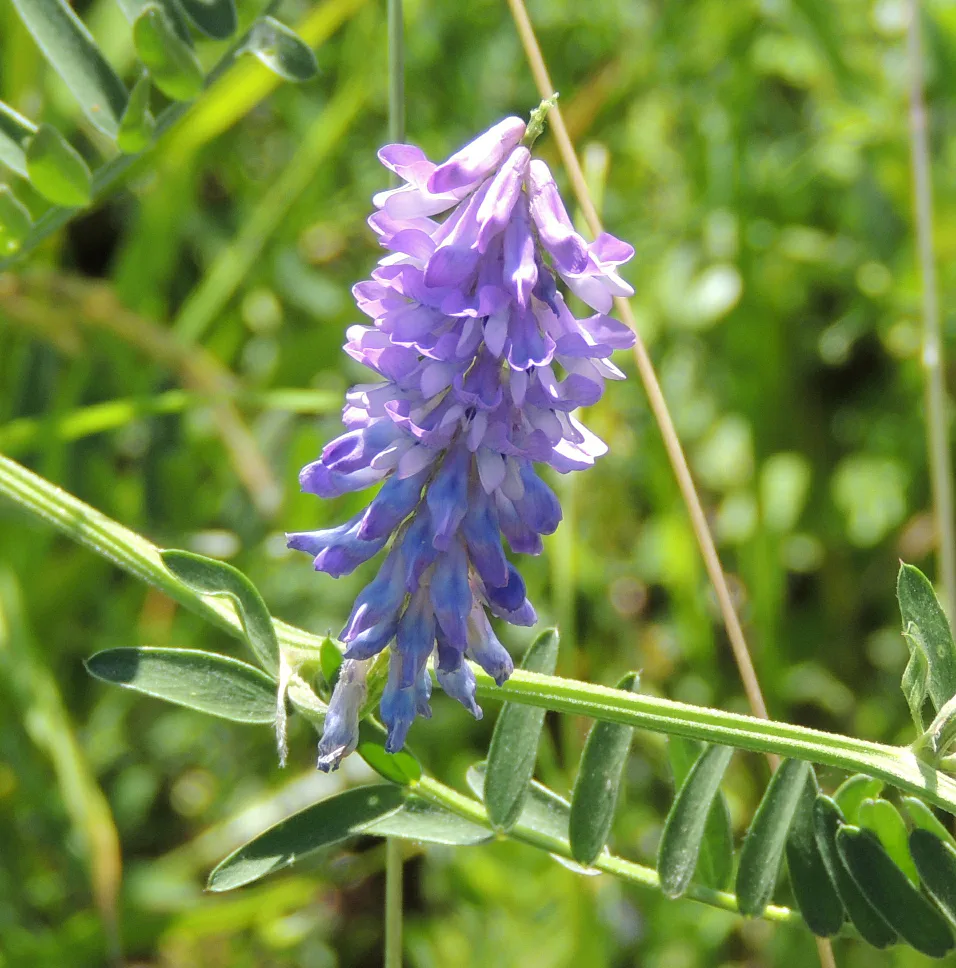
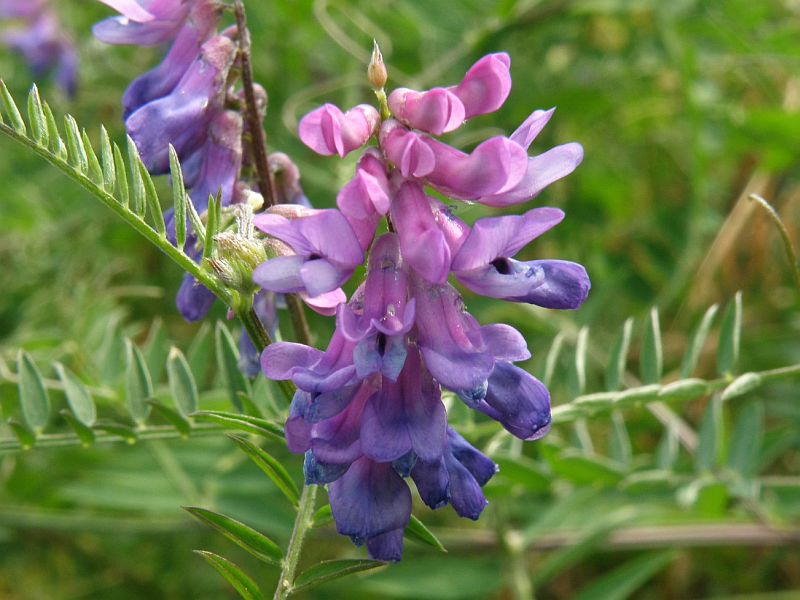
- Long, dense, often slightly curved clusters of blue-violet or purplish flowers, with many flowers arranged along one side of the stalk.
- Each small flower has the characteristic pea-family shape.
- Pinnate leaves, usually with about 8–13 pairs of narrow, pointed leaflets.
- A branching tendril at the tip of each leaf that curls around nearby grasses and stems.
- Slender, trailing or climbing stems that may reach around 1–1.5 metres through other vegetation, sometimes farther with support.
- Small, narrow green seed pods that become dark brown or black when ripe.
The combination of long, many-flowered purple clusters, feathery-looking leaves and curling tendrils distinguishes it from most other British vetches.
Flower structure
Each cluster is a raceme: individual flowers attach along a central stalk, usually making a distinctive one-sided spray.
The flowers have five petals arranged in the familiar pea-family pattern: an upper standard, two side wings and two lower petals that form the keel. The keel encloses the reproductive structures. There are ten stamens, usually with nine filaments joined together and one free, and a single carpel that develops into the seed pod.
Leaves and stems
The compound leaves are made up of numerous small leaflets arranged in opposite pairs along a central axis. Unlike the leaves of clovers, they end in branched tendrils rather than a terminal leaflet. These tendrils coil around neighbouring plants, allowing Tufted Vetch to climb without supporting itself on a rigid stem.
The leaflets are narrow and often greyish-green. The long stems weave through grass and shrubs, sometimes making it difficult to trace an individual plant back to its roots.
Seed pods
After pollination, the flowers develop into small, smooth pods containing several seeds. They begin green, then darken to brown or nearly black as they mature. Like peas and beans, Tufted Vetch is a legume, and its pods are the fruit of individual flowers.
Habitat
Tufted Vetch is widespread in grassy places, particularly meadows, rough grassland, hedgebanks, woodland margins, scrub and coastal grassland. It grows among taller plants, using them for support as its tendrils curl and grip.
Flowering period
Flowers are most often seen from June to August, sometimes continuing into September. The closely packed purple blooms make the plant particularly noticeable in high summer.
Similar species
- Bush Vetch (Vicia sepium) has similar pea-shaped flowers, but usually only a few in each short cluster rather than the long, crowded racemes of Tufted Vetch.
- Common Vetch (Vicia sativa) tends to bear larger flowers singly or in pairs, with fewer pairs of leaflets.
- Hairy Vetch (Vicia villosa) can also have long purple clusters, but its stems and leaves are usually much more conspicuously hairy.
Where the names come from
The name Tufted Vetch refers to its crowded flower clusters. It has also been called Cow Vetch and Bird Vetch, while vetch is an old English name for plants in this group. Vicia is the Latin name for vetches.
Folklore & history
Older country names for vetches included tare and fetch. Tufted Vetch itself appears in historical botanical writing under names such as Wild Vetch, Wild Fetch and Strangle Tare — names that suit the way its tendrils entangle the stems around it.
Vetches have long been familiar plants of farmland and hay meadows, where their leafy growth could contribute to grazing and fodder. Like other members of the pea family, Tufted Vetch forms root nodules containing nitrogen-fixing bacteria, an important part of its relationship with the soil.
Wildlife
The flowers attract bees and other pollinating insects. Their pea-shaped structure encourages visiting insects to push against the petals to reach nectar and pollen. The sprawling stems also provide cover among meadow plants.