Wood Avens is a native perennial wildflower of hedgerows, woodland paths and shady corners of gardens. Also known as Herb Bennet, it has small, five-petalled yellow flowers carried on thin, branching stems. Later in the year, the flowers give way to rounded, bristly fruit heads that catch on clothing and animal fur. It belongs to Rosaceae, the rose family.
Identification
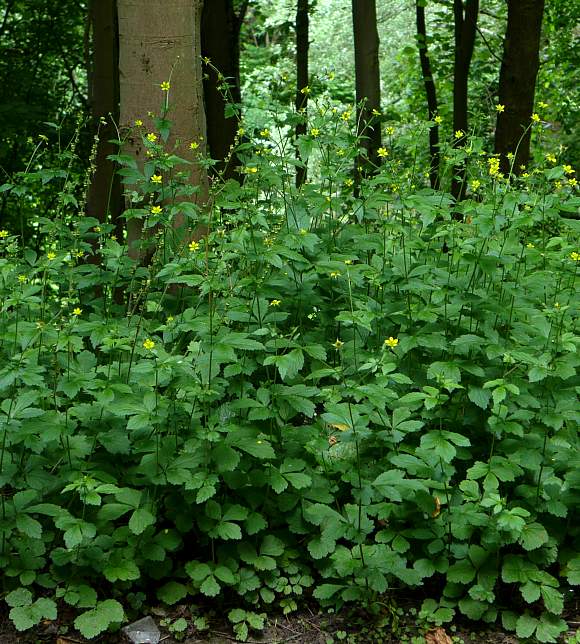
- Commonly 30–70 cm tall, with slender, upright, slightly hairy, branching stems.
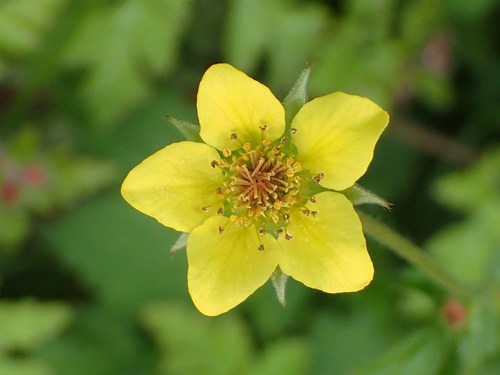
- Small yellow flowers, usually about 1–2 cm across, with five widely spaced petals.
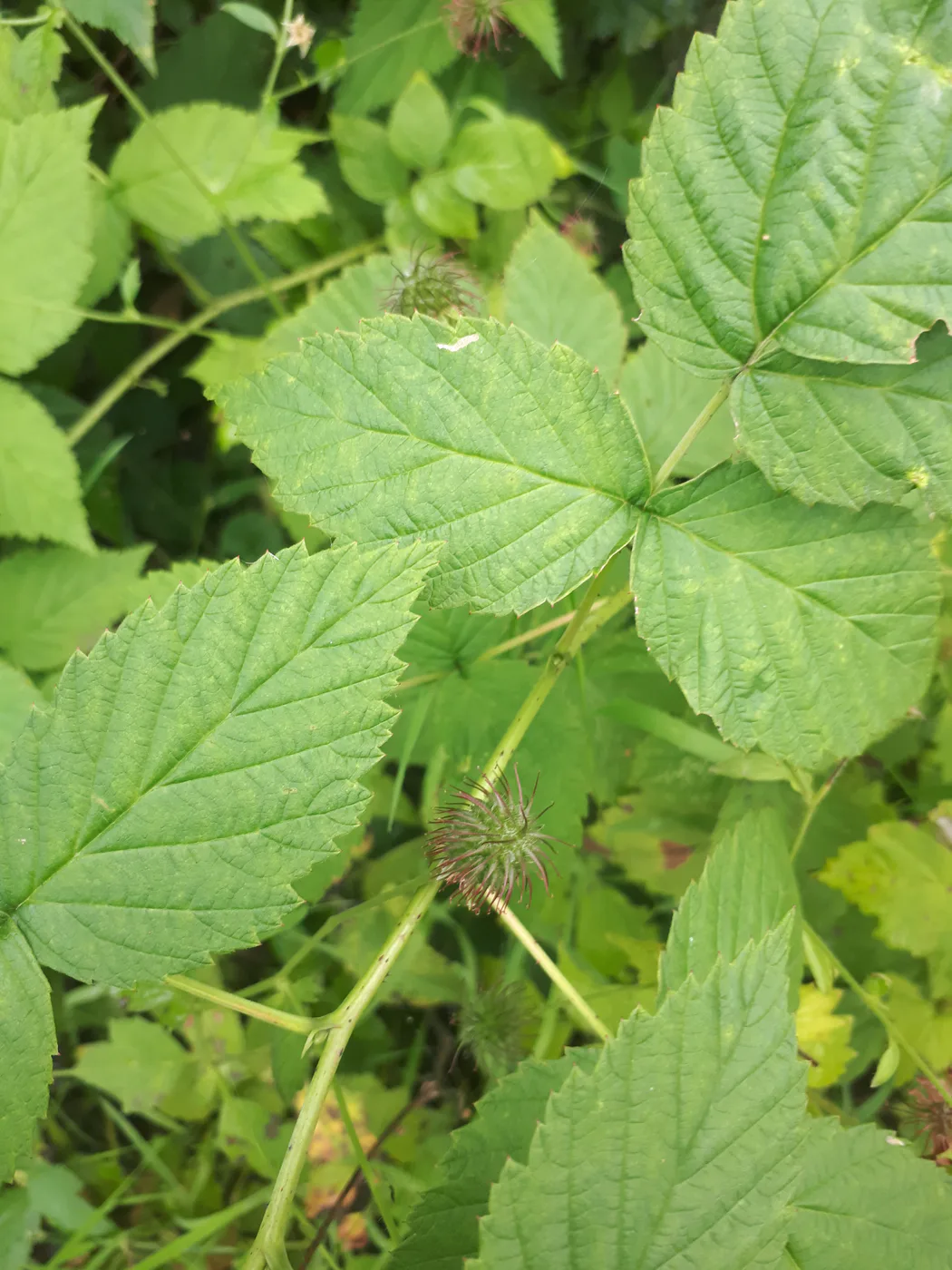
- Lower leaves form a loose rosette and are divided into toothed leaflets, with a larger terminal leaflet.
- Upper leaves are usually smaller and may be three-lobed, with conspicuous leafy stipules at their bases.
- Flower buds nod, but the open flowers generally face upwards or outwards.
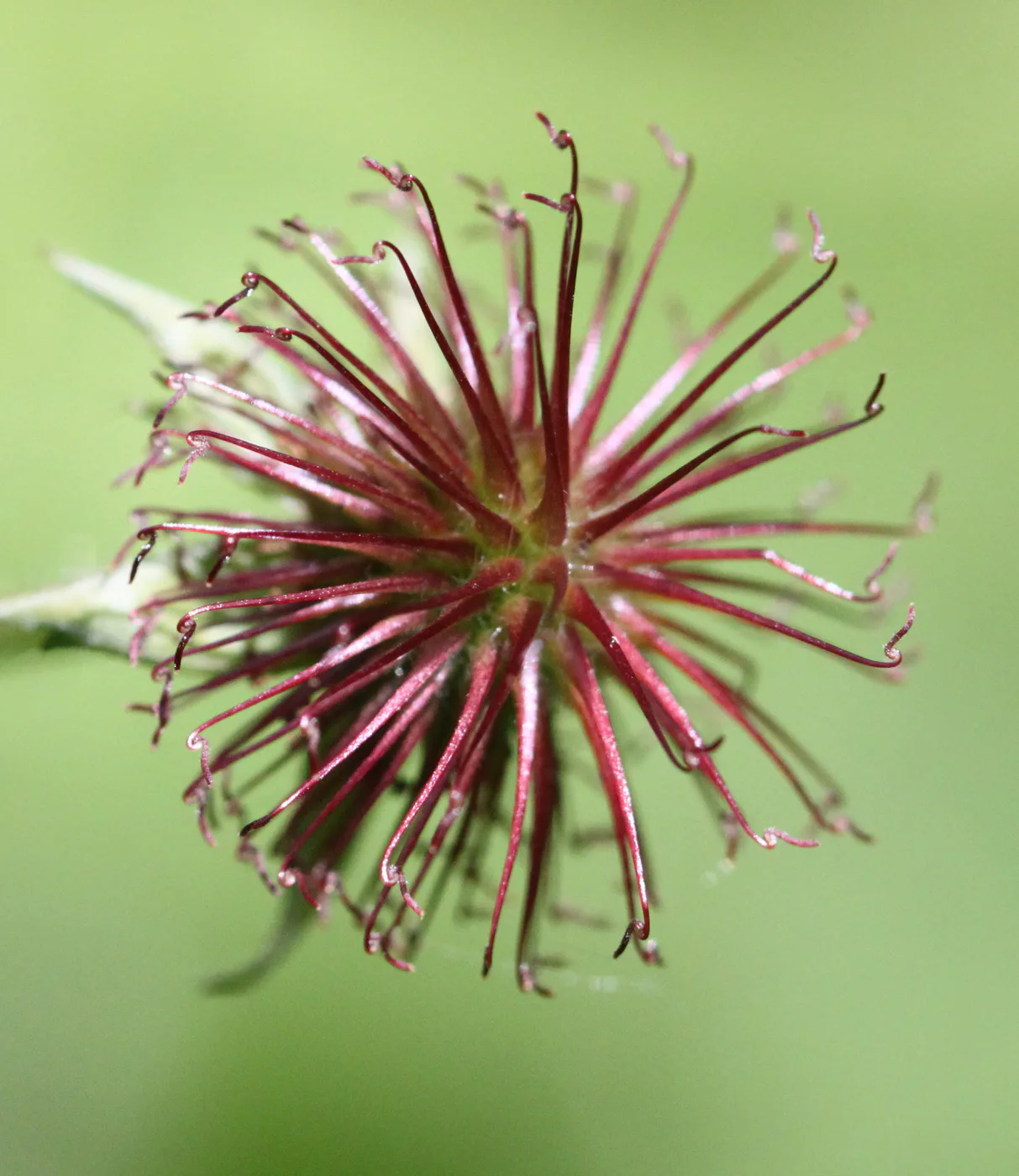
- Rounded seed heads develop with reddish, hooked projections, creating the familiar burr-like appearance.
The combination of modest yellow flowers, unevenly divided leaves and hooked fruit heads makes Wood Avens especially distinctive from summer onwards.
Flower structure
Each flower has five separate yellow petals and five pointed green sepals, which often show between the petals. Outside the sepals is a second whorl of five smaller green segments, sometimes called an epicalyx.
Numerous stamens surround a central cluster of separate carpels. After pollination, these form a rounded group of small, one-seeded dry fruits called achenes. The persistent hooked styles give the ripe fruit head its burr-like appearance.
The flowers are usually carried in loose branching clusters rather than a dense spike. They may appear rather delicate beside the larger flowers of cultivated garden Geums.
Leaves and stems
At the base of the plant, the leaves are long-stalked and divided into several unequal leaflets. The largest leaflet is at the tip and is often three-lobed; the smaller leaflets beneath it may be quite variable in size. Their margins are toothed, and the surfaces are slightly hairy.
The leaves on the flowering stems are arranged alternately and become smaller higher up. Their conspicuous stipules can resemble small leaves beside the stalk. The slender stems are lightly hairy and sometimes reddish on one side.
Below ground, a short rhizome and roots have a characteristic clove-like scent, which explains another old name, Clove Root.
Habitat
Wood Avens is widespread in Britain, especially along woodland tracks, hedgerows, scrubby banks and shady roadside verges. It often grows where the soil is reasonably fertile and there is some disturbance, such as the edges of paths or gaps in vegetation.
It tolerates both partial shade and brighter conditions, and it is a familiar visitor to gardens, where its hooked seeds readily establish new plants.
Flowering period
Wood Avens flowers mainly from May to September, sometimes continuing into October or later in mild weather. The rounded hooked fruit heads are particularly conspicuous after flowering.
Similar species
- Water Avens (Geum rivale) usually grows in wetter places and has larger, nodding, bell-shaped flowers with pinkish or reddish-brown sepals. Its flowers are very different from the small open yellow flowers of Wood Avens.
- Garden Geums (Geum cultivars) are close relatives, often with larger yellow, orange or red flowers. They may sometimes escape or persist near gardens.
- Creeping Buttercup (Ranunculus repens) also has five yellow petals, but they are much glossier, and its leaves and fruits are different. Buttercups belong to another family.
Where the names come from
The name Wood Avens reflects its frequent presence beside woods and hedgerows. The old name Herb Bennet is associated with the medieval Latin herba benedicta, meaning ‘blessed herb’.
Geum is an old botanical name, traditionally linked with the Greek word for taste or flavour. Urbanum comes from Latin urbanus, meaning ‘of towns’, a reminder that this plant also grows near settlements, paths and gardens.
Folklore & history
Wood Avens was a familiar herb in medieval gardens and later English herbals. Its name Herb Bennet was associated with St Benedict, and the plant was regarded as a protective herb. The roots were carried as charms or kept in homes to ward off evil influences.
The clove-scented roots were used to flavour ale, wine and other preparations, and they were sometimes placed among stored clothes and linen. Herbal writers also described Wood Avens in remedies for digestive complaints and other ailments.
Wildlife
The small flowers provide pollen and nectar for bees, hoverflies and other visiting insects. Wood Avens is also recorded as a foodplant for the caterpillars of the Grizzled Skipper butterfly.
Its hooked fruits provide a different ecological service: they catch on the fur of passing mammals, helping disperse the seeds well beyond the parent plant. This is why new plants can appear along paths and in unexpected corners of gardens.