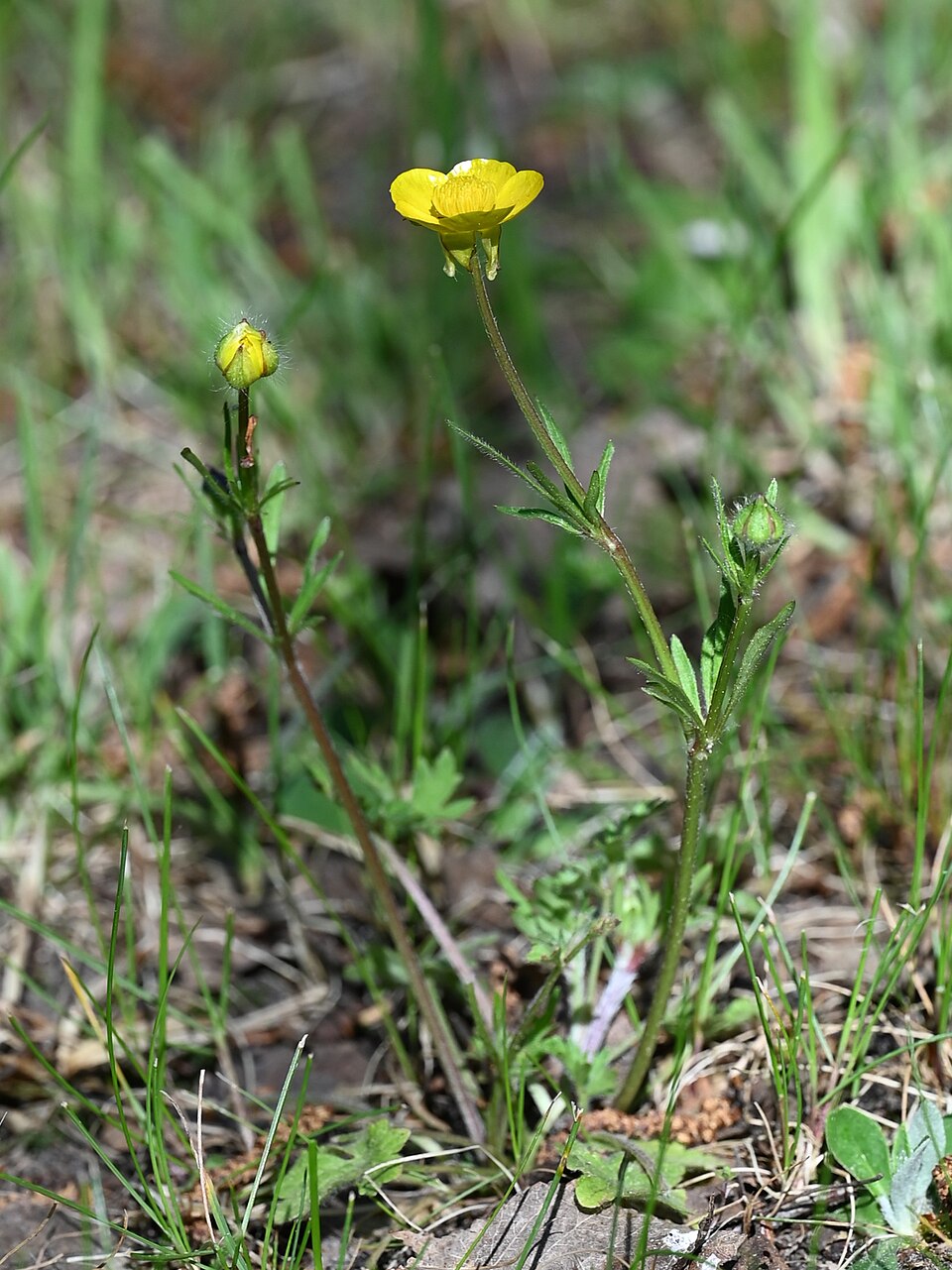
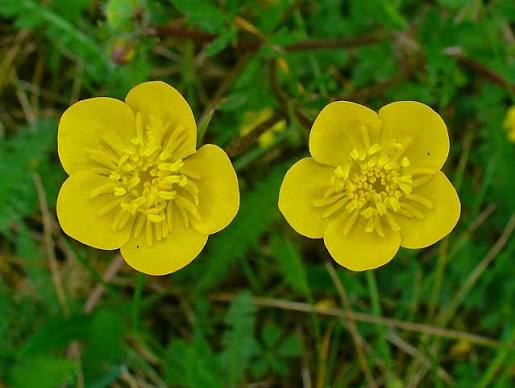
Bulbous Buttercup is one of the earliest familiar yellow buttercups of British meadows and sunny grassy banks. Its shining yellow flowers look very like those of Meadow Buttercup and Creeping Buttercup, but a look beneath the petals reveals a valuable clue: the five sepals are turned sharply downwards towards the flower stalk. The plant also has a swollen, bulb-like base just beneath the soil. It belongs to the buttercup family (Ranunculaceae).
Identification
- A hairy perennial, usually 10–40 cm tall, growing in clumps rather than spreading by long rooting runners.
- Shiny golden-yellow flowers, generally about 2–3 cm across, usually with five rounded petals.
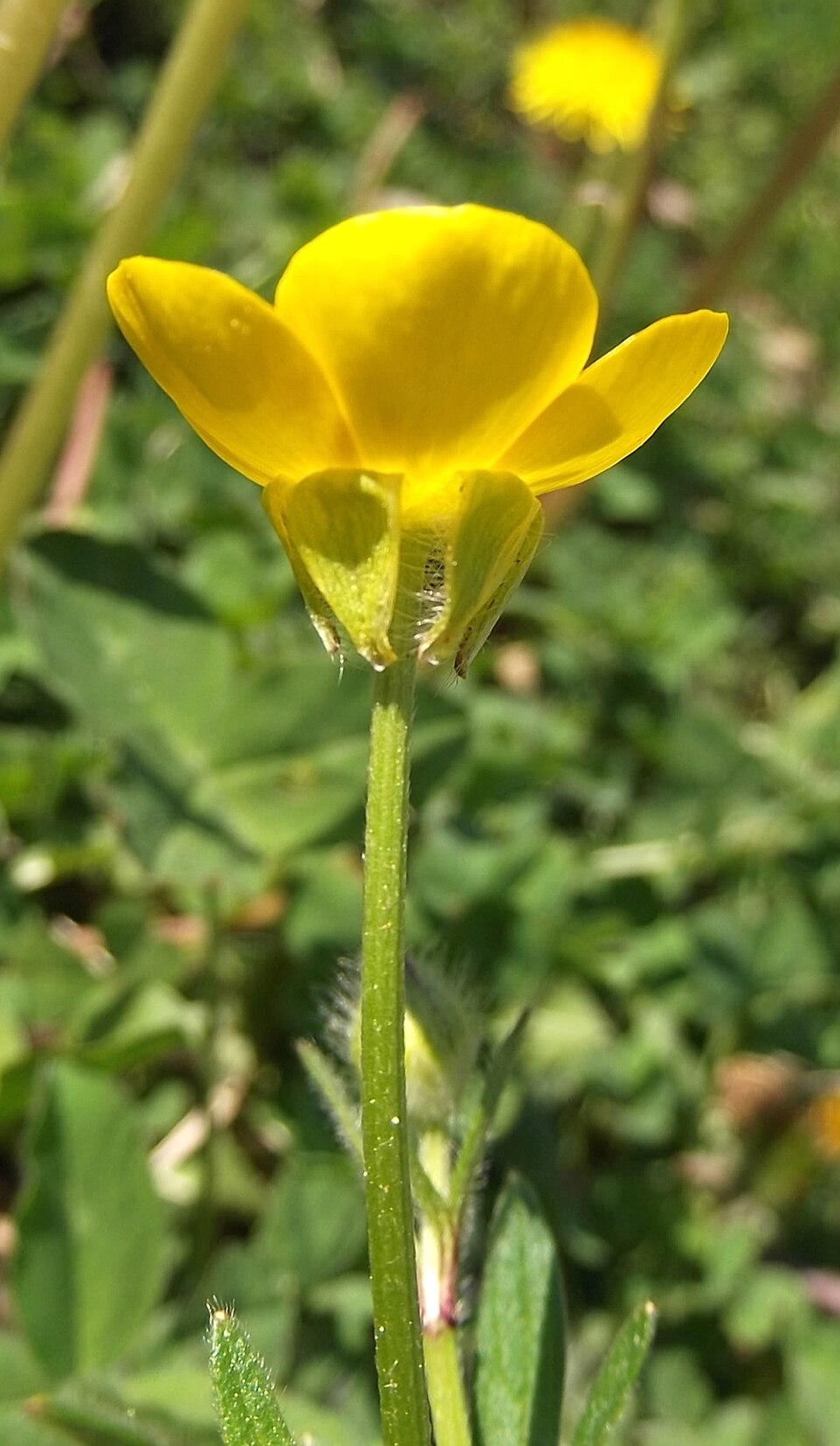
- Five greenish-yellow sepals are bent sharply backwards beneath the open flower, pointing down towards its stalk. This is known as being reflexed.
- The slender flower stalk is distinctly grooved or furrowed, unlike the smoother stalk of Meadow Buttercup.
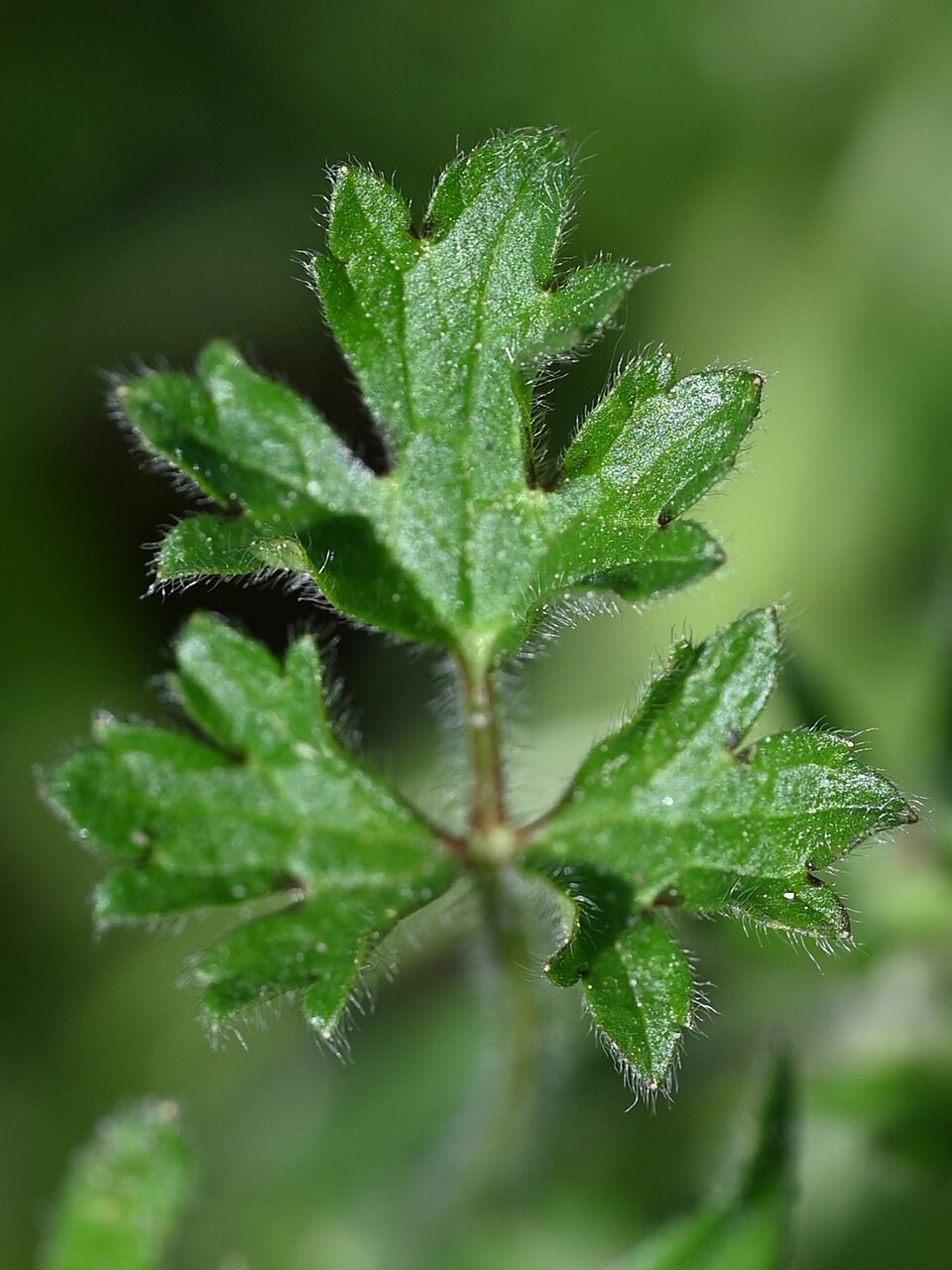
- Lower leaves generally have three main, deeply divided lobes. The middle lobe is attached by its own short stalk, and the margins are cut into further rounded teeth or lobes.
- Upper leaves become smaller and more narrowly divided than those at ground level.
- The base of the stem is thickened into a rounded, bulb-like swelling below the ground surface; this is not a true bulb.
The strongly reflexed sepals are the quickest identification feature while the plant is flowering. A photograph taken from the side, showing the underside of the petals, is often more useful than a photograph looking straight down into the flower.
Flower structure
Each flower normally has five bright, glossy petals and five sepals. The petals’ reflective surface gives buttercups their familiar golden shine. When the flower opens, the sepals fold backwards and hang down against the stalk, rather than cupping the petals as they do in Meadow and Creeping Buttercups.
At the centre, numerous stamens, each with an anther on a slender filament, surround many separate carpels. Each carpel contains an ovule and, after pollination, develops into a small, dry, one-seeded fruit called an achene. Together, the achenes form a rounded seed head.
The flowers are usually borne singly on the ends of branching stems, even when several blossoms appear above one plant. Their open centres make the pollen accessible to a range of visiting insects.
Leaves, stems and the swollen base
The lowest leaves sit close to the ground, forming a loose basal rosette. They have three main lobes, usually themselves divided and toothed, so their outline is much less regular than the rounded petals above. The terminal (middle) lobe is separated from the side lobes by a short stalk. Hair is often visible along the leaf stalks and the flowering stems.
The stem is upright and usually grooved below the flowers. If examined at the base, it widens into a small, rounded, fleshy swelling, sometimes likened to a miniature turnip. Botanists describe it as a corm-like swollen stem base: a store of food reserves that allows the plant to grow and flower early in spring. It is not a true bulb made of fleshy leaf scales, despite the common name.
Unlike Creeping Buttercup, Bulbous Buttercup does not send out long horizontal runners that root at their nodes. Its growth is usually clump-forming, and the above-ground parts commonly die back in summer while the underground base survives.
Habitat
Bulbous Buttercup favours reasonably open, sunny grassland where the soil is well drained. It is especially characteristic of chalk and limestone grassland, dry pastures, banks, churchyards and roadside verges, though it can also grow on other suitable soils.
It often flowers before taller grasses become dominant and is more likely to be found in comparatively dry ground than the much more moisture-tolerant Creeping Buttercup. In species-rich meadows it may share the spring display with Cowslips and other early flowers.
Flowering period
The main flowering season is April to June, with the strongest display commonly in May. A few flowers may appear in March or continue into July, depending on the site and weather. Bulbous Buttercup generally finishes earlier than Meadow and Creeping Buttercups.
Similar species
- Meadow Buttercup (Ranunculus acris) is usually taller, with more deeply divided leaves. Its flower stalks are smooth rather than grooved, and its sepals stay nearer the petals instead of bending strongly backwards.
- Creeping Buttercup (Ranunculus repens) has grooved flower stalks like Bulbous Buttercup, but its sepals are not strongly reflexed. It spreads by long runners that root at the nodes, often forming wide patches on damper ground.
- Lesser Celandine (Ficaria verna) flowers early in spring and has glossy yellow flowers, but it usually has eight to twelve narrower petals and broad, shiny, heart-shaped leaves rather than deeply divided buttercup leaves.
For the three familiar yellow buttercups, check the sepals first, then the flower stalk and leaves. The swollen stem base can confirm Bulbous Buttercup, but it is not usually necessary to disturb a plant to identify it.
Where the names come from
The name Bulbous Buttercup refers to the swollen stem base that stores energy beneath the soil, giving the appearance of a little bulb. Buttercup describes the bright yellow, cup-like flowers and belongs to a long tradition of names such as Butterflower, Goldcup and Crowfoot. Crowfoot alludes to the branching, divided leaves, whose outlines reminded people of a bird’s foot.
Its scientific name is descriptive too. Ranunculus comes from Latin for ‘little frog’, a name traditionally associated with the damp habitats of many members of this genus, although Bulbous Buttercup itself often favours drier grassland. Bulbosus is Latin for ‘bulbous’ or ‘swollen like a bulb’. The name Ranunculus bulbosus was published by Carl Linnaeus in 1753.
A more unusual traditional name is St Anthony’s Turnip; St Andrew’s Turnip has also been recorded. Both refer to the little turnip-shaped swelling at the stem’s base. Other older names include Goldcup and Frog’s-foot, describing the flowers and leaves respectively. These names preserve features that people noticed long before modern plant guides were available.
Folklore & history
The shiny yellow flowers of buttercups have inspired one of the best-known childhood traditions: holding a blossom beneath someone’s chin to see whether the reflected yellow light means they like butter. The test works because the petals reflect light so strongly; it has nothing to do with anyone’s taste in food.
Buttercups were also once blamed for giving butter its rich yellow colour when they grew in cow pastures. That association was part of country lore rather than a botanical explanation: grazing animals tend to avoid fresh buttercups because their sap has a sharp, irritating quality.
The bulb-like swelling gave this species a special place among older herbals. Maud Grieve’s A Modern Herbal (1931) records names including St Anthony’s Turnip, Crowfoot, Frog’s-foot and Goldcup. She connected its early flowering with the food reserves stored in its thickened base. Historical herbal preparations sometimes made use of the plant’s acrid qualities, including in counter-irritant applications to the skin.
The familiar golden buttercup also appears in literature. Shakespeare’s phrase ‘cuckoo-buds of yellow hue’ has sometimes been associated with Bulbous Buttercup, although it cannot be assigned to this species with certainty. It is a reminder of how buttercups, emerging as the countryside turns green, became part of the language of spring.
Wildlife
The open flowers offer both nectar and pollen to bees, hoverflies, beetles and other small insects. The many exposed stamens make pollen readily available, while the yellow petals form conspicuous signals in short spring grass.
Bulbous Buttercup contributes to the variety of early flowering plants found in traditional grasslands. Leaving suitable meadow areas uncut through their flowering season gives insects more opportunities to feed and allows plants to set seed.