Meadow Buttercup is one of the classic yellow buttercups of British grassland. In late spring and summer its glossy yellow flowers are held above the surrounding vegetation on tall, branching stems.
It belongs to Ranunculaceae, the buttercup family. It is a particularly useful species for learning the typical buttercup combination of five glossy petals, five sepals, numerous stamens and a central cluster of separate carpels.
Identification
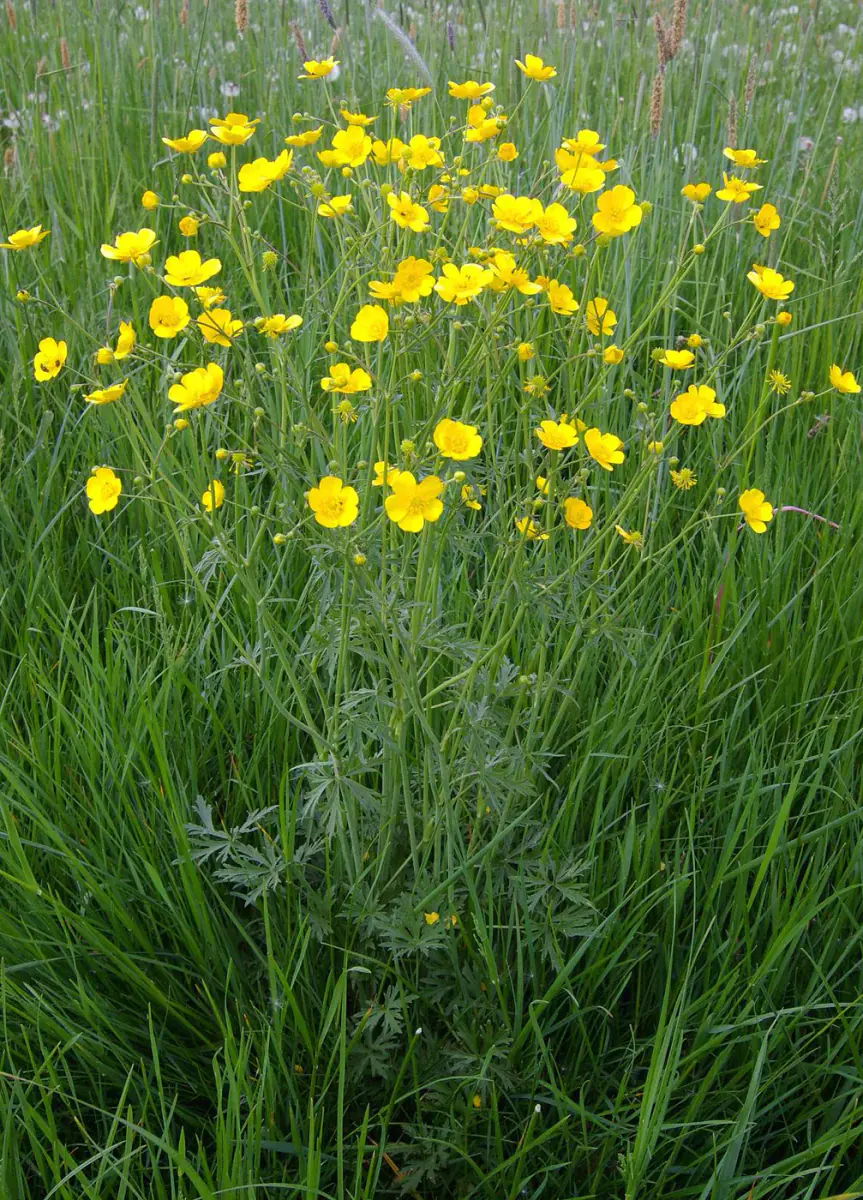
- A perennial, usually 30–100 cm tall.
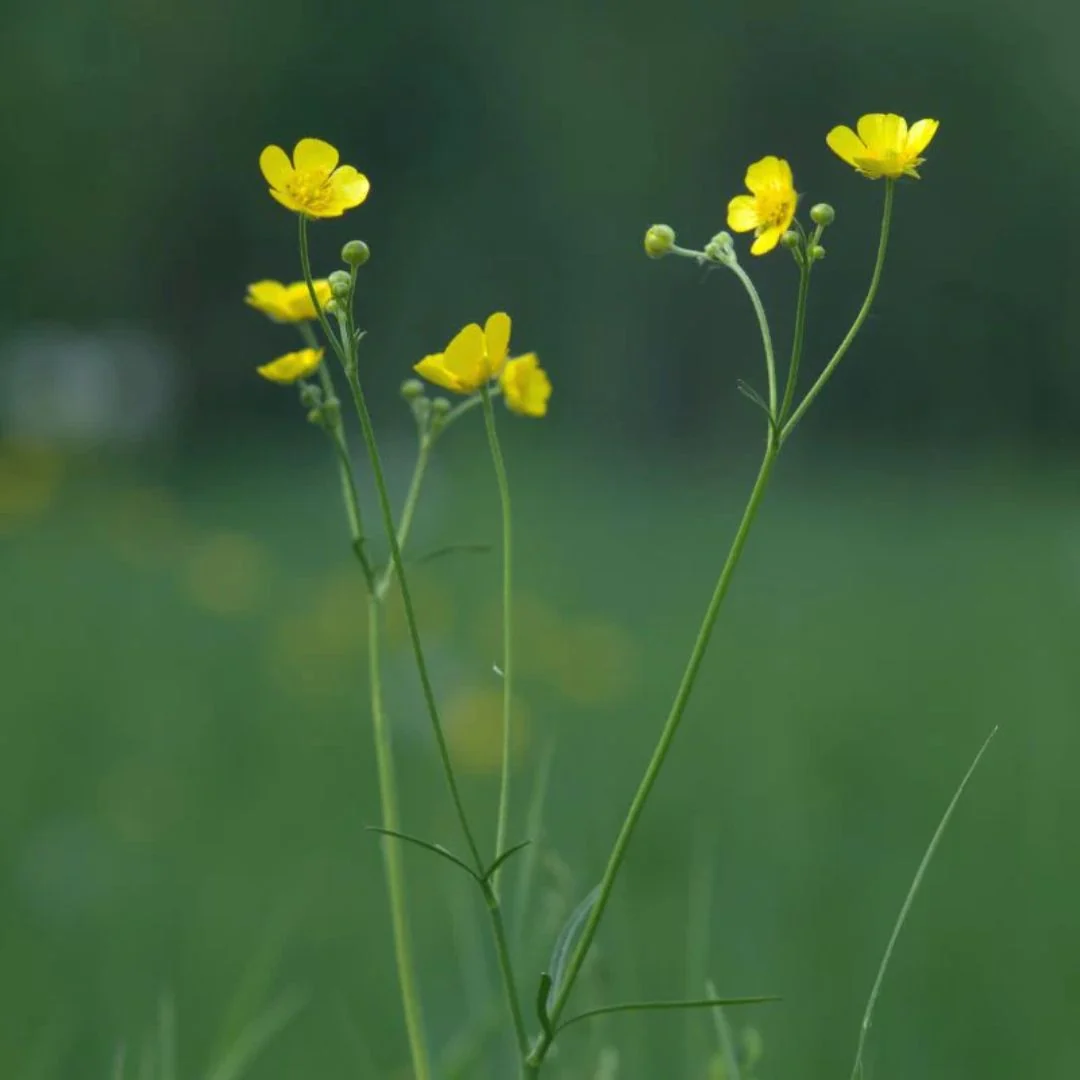
- Upright, branching stems rather than creeping runners.
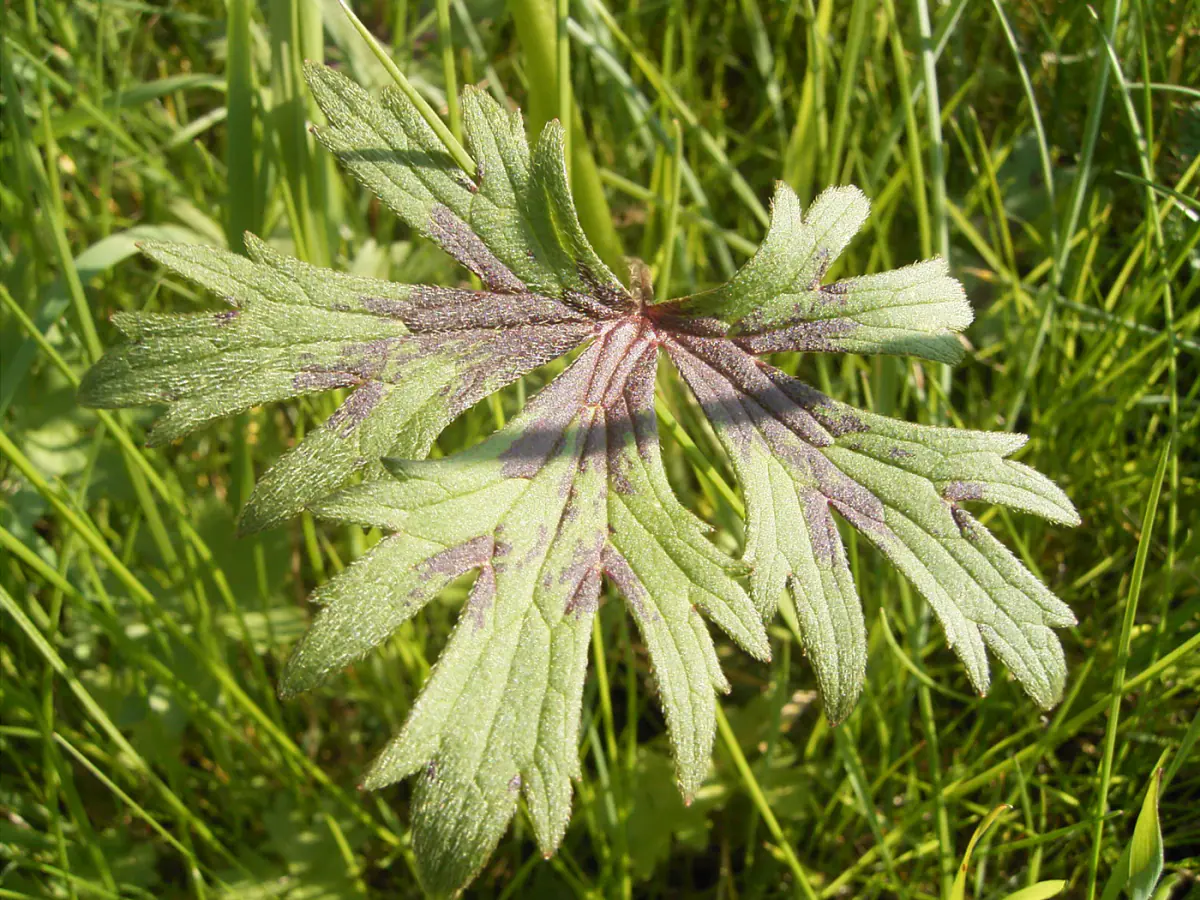
- Basal leaves are long-stalked and deeply divided, usually into three to five main lobes.
- The leaf lobes are themselves cut into narrower segments, giving the leaf a rather angular or palmate appearance.
- Stem leaves become smaller and more narrowly divided higher up the plant.
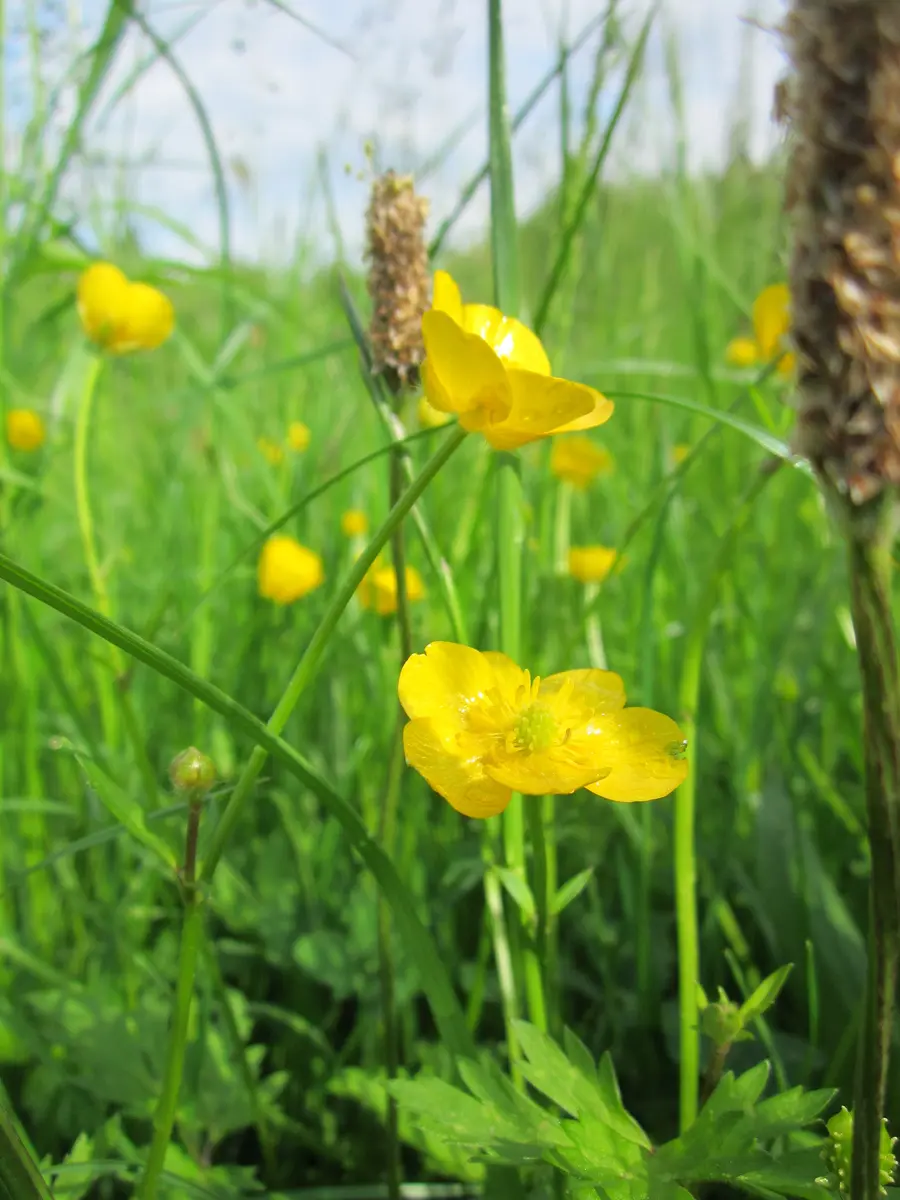
- Flowers are bright, glossy yellow and usually have five petals.
- Five green sepals sit beneath the petals and remain close to the flower rather than folding sharply backwards.
- Numerous stamens surround a central cluster of separate carpels.
- Flower stalks are round and ungrooved.
The combination of an upright habit, deeply divided leaves, ungrooved flower stalks and sepals that are not strongly reflexed is especially useful when identifying Meadow Buttercup.
Flower structure
Each flower normally has five glossy yellow petals and five green sepals. The petals contain a reflective surface layer that gives buttercups their characteristic shine, particularly in bright sunlight.
At the centre are numerous free stamens surrounding many separate carpels. This is a classic Ranunculaceae arrangement: the stamens are not fused into a tube, and the female structures remain separate rather than forming a single compound ovary.
After fertilisation, each carpel develops into a small dry one-seeded achene. The achenes are grouped together into a rounded head.
Leaves and stems
The lower leaves arise on long petioles and are deeply divided. Their main lobes radiate from roughly the same point, giving the leaf a palmate outline, although each lobe is further cut into narrow sections.
Higher up the plant, the leaves are smaller and divided into narrower segments. The flowering stems are upright, branched and usually slightly hairy.
Unlike Creeping Buttercup, Meadow Buttercup does not produce long rooting runners.
Habitat
Meadow Buttercup is strongly associated with grassland, especially places where the soil remains reasonably moist. Typical habitats include:
- hay meadows
- pastures
- damp or neutral grassland
- roadside verges
- grassy field margins
- gardens and other less intensively managed grassy places
It can be abundant in traditional meadows, where its yellow flowers form part of the familiar early-summer display.
Flowering period
Meadow Buttercup can flower from spring into autumn, with the main display usually occurring from May through the summer months.
Plants in regularly cut grassland may flower again after mowing if conditions remain suitable.
Similar species
- Creeping Buttercup (Ranunculus repens) is lower-growing and spreads by creeping runners that root at the nodes. Its leaves are usually divided into three broader leaflets, and the terminal leaflet has a distinct stalk. Its flower stalks are grooved.
- Bulbous Buttercup (Ranunculus bulbosus) usually grows in drier grassland and has a swollen bulb-like stem base. Most importantly, its sepals bend strongly backwards away from the petals.
- Lesser Celandine (Ficaria verna) is another yellow member of Ranunculaceae, but it flowers much earlier, has shiny heart-shaped leaves and usually eight to twelve narrow yellow petals rather than five.
Use several characters together: growth habit, leaf division, flower-stalk shape and the position of the sepals are all useful.
Where the names come from
‘Meadow’ describes where this buttercup commonly grows. Buttercup is an old English description of the glossy yellow, cup-shaped flowers; the association with butter is also reflected in several traditional beliefs.
Ranunculus is Latin for ‘little frog’, traditionally linked to the damp places favoured by many members of the genus. Acris means ‘sharp’ or ‘acrid’, referring to the plant’s biting, irritating sap.
Folklore & history
Buttercups are closely tied to childhood folklore. The familiar game of holding a buttercup beneath someone’s chin to see whether the yellow reflection appears was traditionally said to reveal whether they liked butter.
One old belief held that buttercups growing in pasture were responsible for the rich yellow colour of butter, although grazing animals generally avoid fresh buttercups because of their acrid taste.
Wildlife
The open flowers are accessible to a wide range of insects. Bees, hoverflies, beetles and other small pollinators visit the flowers for pollen and nectar.
In species-rich grassland, Meadow Buttercup is one component of a much wider flowering community and can occur alongside plants such as Red Clover, Oxeye Daisy and Common Knapweed.