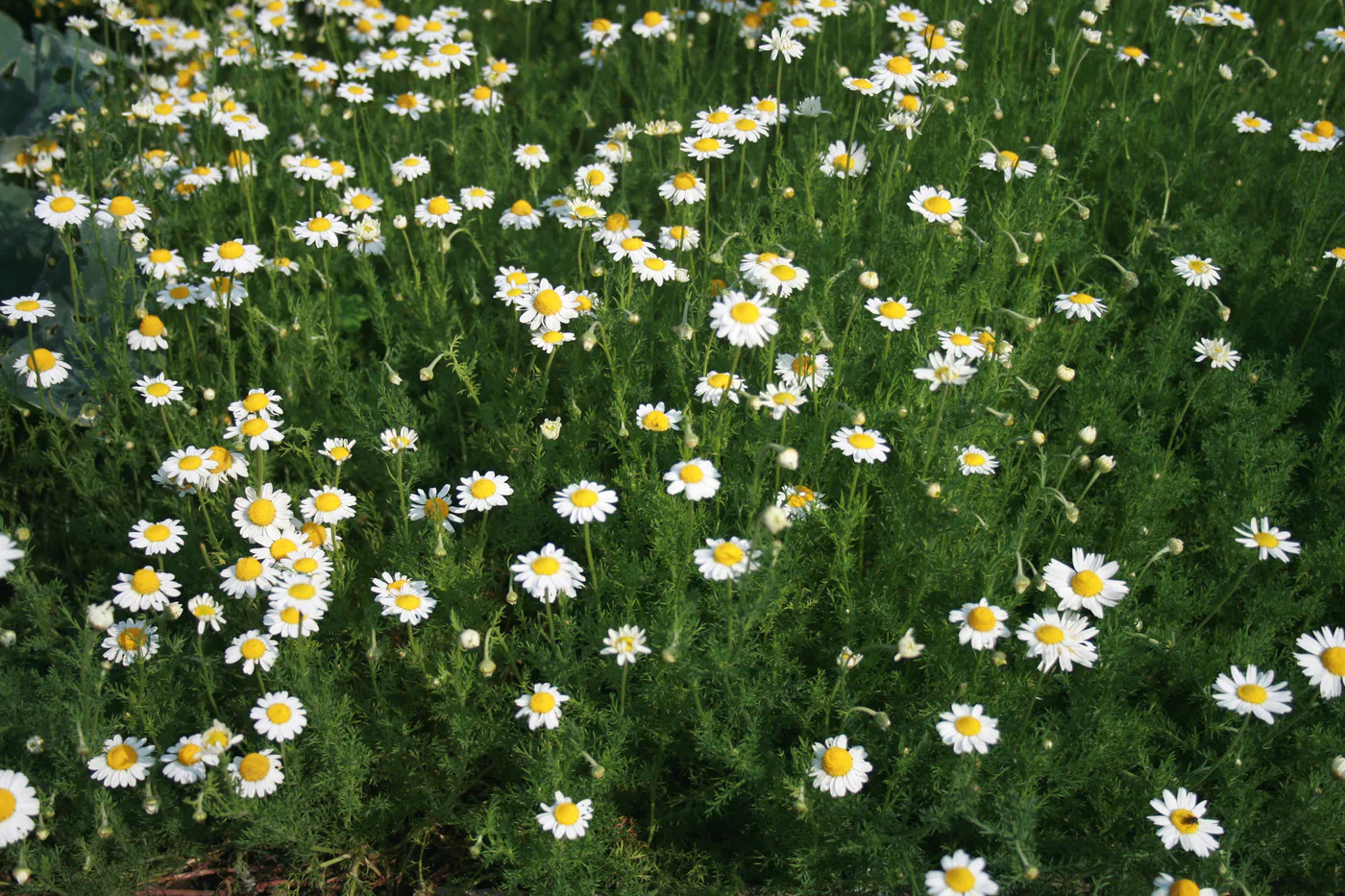
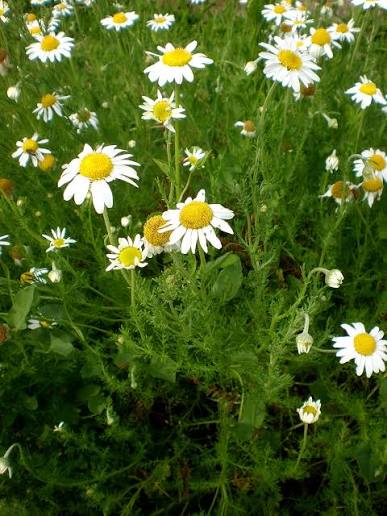
Chamomile (Chamaemelum nobile) is a low, pleasantly aromatic native perennial of short grassland, old commons and coastal turf. Its small white-and-yellow flower heads resemble miniature daisies, but the leaves are narrow, finely divided and almost feathery. Crush a leaf gently and the plant releases the distinctive sweet, apple-like scent for which it has been known for centuries.
Also called Roman Chamomile, it belongs to the daisy family (Asteraceae). Despite its long history as a garden herb, wild Chamomile is now a scarce and declining plant in Britain. It should not be confused with Scented Mayweed (Matricaria chamomilla), which is also often sold or described as chamomile.
Identification
- A low-growing, spreading perennial, commonly 10–30 cm high when flowering, with stems that may root where they touch the soil.
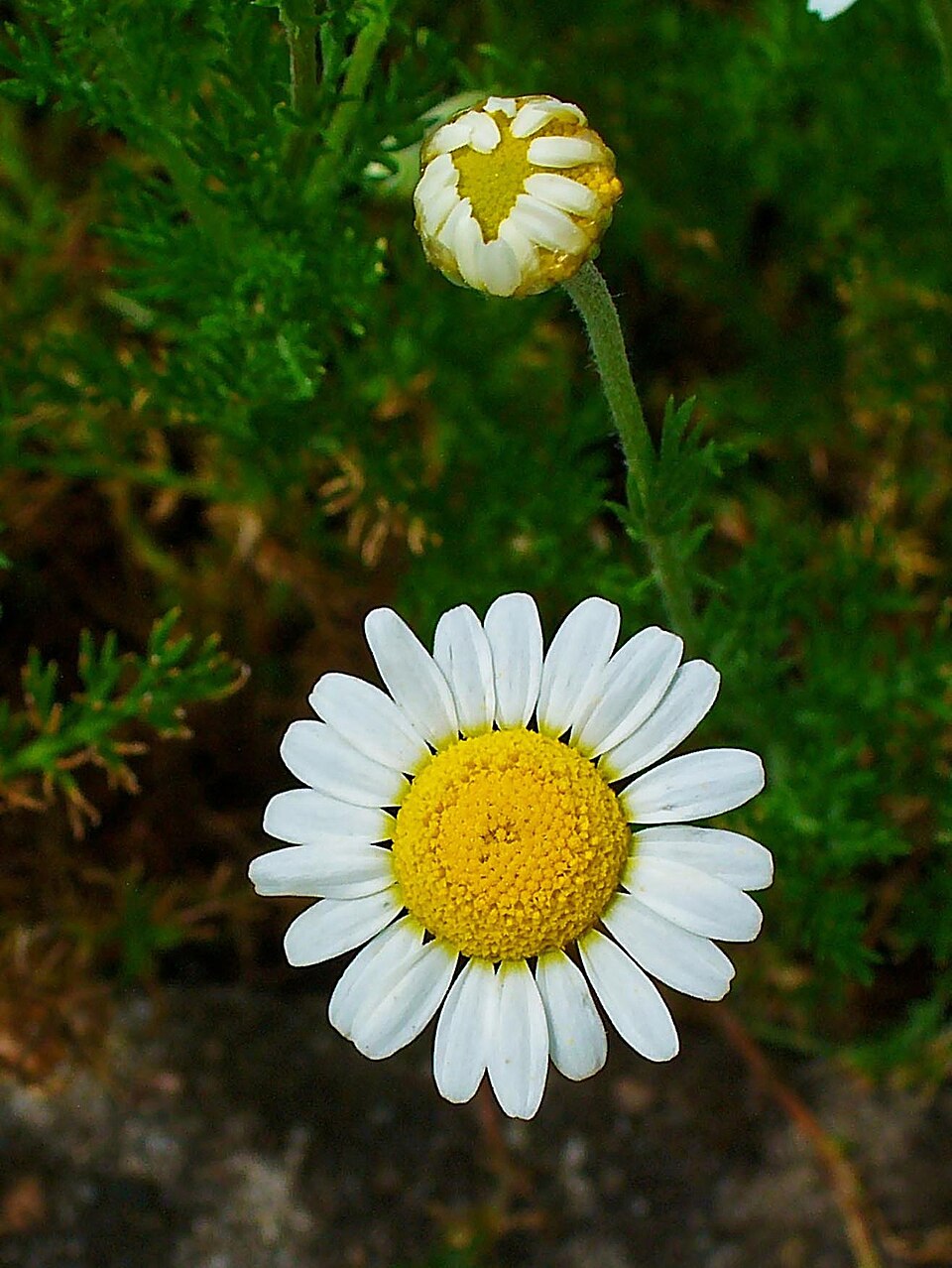
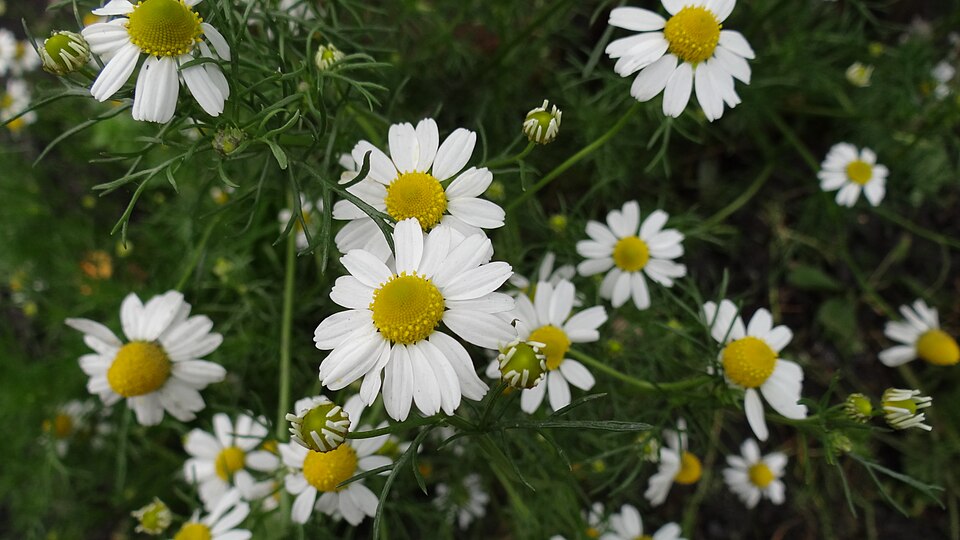
- Solitary daisy-like flower heads, often around 1.5–2.5 cm across, with white outer ray florets and a rounded yellow centre of disc florets.
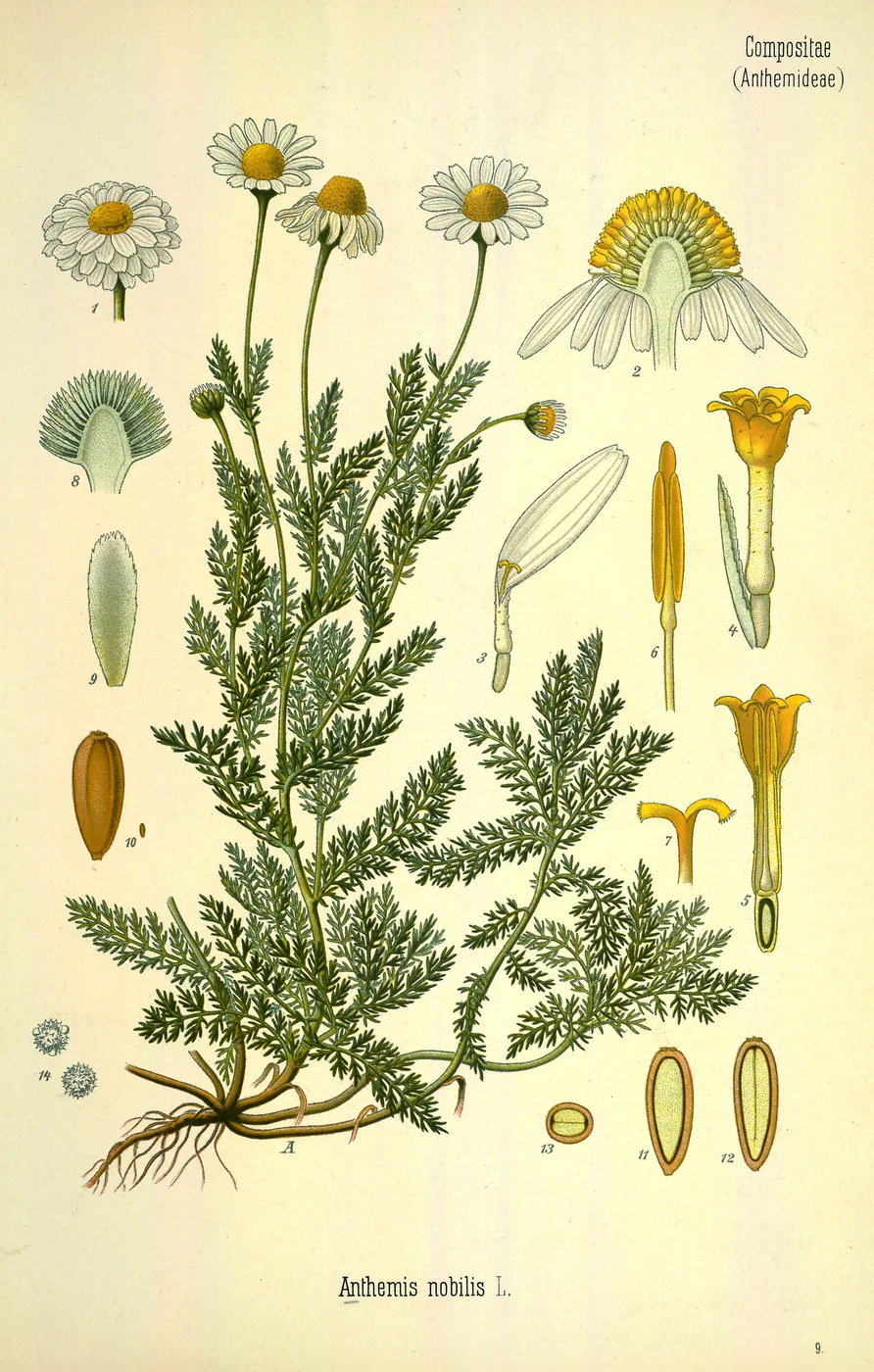
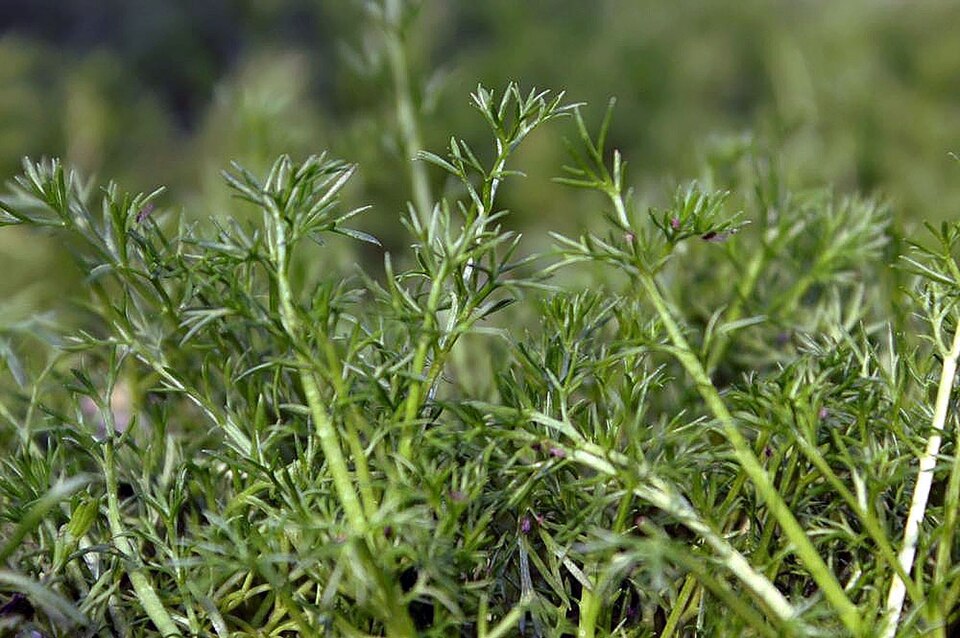
- Greyish-green leaves cut two or three times into very fine, narrow segments, giving a feathery appearance.
- A pleasant, sweet, apple-like scent when leaves or flowering shoots are rubbed.
- Slender flower stalks rising above a mat of leafy stems, rather than a tall, strongly upright plant.
- Small papery scales hidden between the florets on the flower-head receptacle, an important difference from some similar mayweeds.
Look at the leaves and growth habit as well as the flower heads. Many members of Asteraceae have white rays and yellow centres, but relatively few combine Chamomile’s low, creeping habit with such finely divided, fragrant foliage.
Flower structure
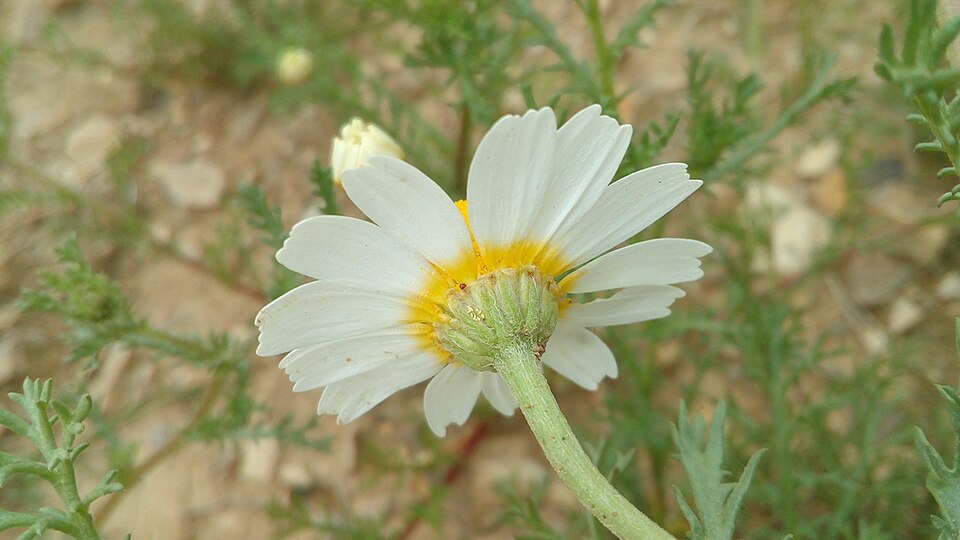
Each apparent flower is a capitulum, a compact head composed of numerous tiny individual flowers. Around the outer edge are white, strap-shaped ray florets, forming what look like petals. The raised yellow centre consists of many much smaller tubular disc florets.
Beneath the head is an involucre of overlapping green bracts. Inside the head, small, thin, papery scales stand between individual florets on the receptacle. These hidden scales are particularly useful in distinguishing Chamomile from Scented Mayweed, whose flower head lacks them. Chamomile’s receptacle is solid rather than hollow.
The flowering heads are normally solitary at the tips of long, fine stalks. Cultivated double-flowered forms may have many additional white ray-like florets and little visible yellow centre; these are not representative of the ordinary wild plant.
Leaves and stems
The leaves are arranged alternately along the stems. Each leaf is divided repeatedly into many very narrow, pointed segments, producing a soft, almost fern-like outline. Their greyish-green colour and their strong, sweet scent are useful clues even when the plant is not flowering.
Chamomile sends out prostrate stems that spread through short grass and may root at their nodes. This allows an established plant to form a low patch. Flowering stems rise above the foliage, carrying the individual heads high enough for insects to visit. The leaves are very different from the broad, spoon-shaped leaves of Common Daisy.
Habitat
Wild Chamomile favours open, relatively nutrient-poor ground, particularly short, damp-in-winter grassland on somewhat acidic soils. Traditional village greens and commons, lightly grazed pastures, heathland turf, woodland glades and coastal grassland can all provide suitable conditions. Regular grazing or cutting helps prevent taller plants from overwhelming it.
The species was once more widespread, but changes to grassland management, drainage, agricultural improvement and the loss of old commons have contributed to its decline. It is now mostly associated with scattered lowland sites in southern and western Britain. It is assessed as Vulnerable in Great Britain and should not be assumed common in the wild merely because cultivated Chamomile is familiar in gardens.
Flowering period
Chamomile generally flowers from June to August. In favourable conditions individual flower heads may appear a little earlier or continue into late summer, but the main display is usually in the warmer months.
Similar species
- Scented Mayweed (Matricaria chamomilla, also known as German Chamomile) is an aromatic annual with finely divided leaves, but it generally grows more upright. Its yellow flower-head receptacle becomes noticeably conical and is hollow inside, unlike the solid, scaly receptacle of Chamomile.
- Scentless Mayweed (Tripleurospermum inodorum) has similar white-and-yellow heads and deeply divided leaves, but has little scent when crushed. It is generally a more upright annual and lacks the papery scales between the florets.
- Corn Chamomile (Anthemis arvensis) is another white-flowered annual with feathery leaves. It tends to be more erect and branching, often growing in cultivated or disturbed ground rather than making Chamomile’s low, rooting mat.
- Stinking Chamomile (Anthemis cotula) is distinguished partly by the strong, unpleasant smell of its foliage and its more erect annual habit.
- Pineappleweed (Matricaria discoidea) has finely divided, pleasantly scented foliage, but its small, cone-like yellow-green heads have no conspicuous white rays.
Where the flowers look very similar, the scent, growth habit and structure of a mature flower head are often more informative than the colour alone.
Where the names come from
The name Chamomile comes ultimately from the Greek chamai (‘on the ground’) and mēlon (‘apple’). Together they refer to the low growth and sweet, apple-like fragrance of the plant. The name passed into Latin and later European languages, acquiring several spellings along the way, including Camomile.
Chamaemelum, the modern genus name, preserves the same Greek roots. The species name nobile is Latin for ‘noble’ or ‘distinguished’, reflecting the high esteem in which this plant was held as a medicinal herb. It was previously placed in the genus Anthemis and may still be encountered under the older scientific name Anthemis nobilis.
The alternative name Roman Chamomile has its own history. The botanist Joachim Camerarius is credited with using that name in 1598 after finding the plant growing near Rome. It also became known as English Chamomile and Lawn Chamomile because of its association with herb gardens and closely cropped lawns.
Folklore & history
Chamomile has been grown and valued for its fragrance for hundreds of years. In medieval and later European herbal traditions its flower heads were used in preparations associated with digestion, feverish illnesses, rest and soothing baths. It was also used in scented strewing herbs and other household preparations. Historical references to ‘chamomile’ can describe more than one similar daisy-like plant, however, so not every ancient mention can be assigned confidently to Chamaemelum nobile.
By the sixteenth century, Chamomile had become a feature of English gardens. Its low, resilient growth and apple-like scent made it suitable for planted paths, lawns and even fragrant garden seats. Walking over the foliage released its fragrance, and regular clipping helped to maintain the close turf for which it was prized. The tradition of Chamomile lawns survived long after ordinary grass became the more usual choice.
Shakespeare alludes to its reputation for enduring trampling in Henry IV, Part 1 (first performed in the late 1590s). Falstaff remarks that Chamomile grows faster the more it is trodden on, using the plant as a comparison in a warning about wasted youth. The image would have been familiar to audiences who knew Chamomile from gardens and pathways.
Its domestic uses were equally varied. Dried flowers were kept for scented infusions and herbal preparations, and Chamomile’s distinctive fragrance became closely associated with calm, comfort and the household herb garden. Double-flowered garden forms, bred for their fuller white flower heads, were especially valued for cultivation; the ordinary wild plant retains the clear yellow centre surrounded by white rays.
Wildlife
The exposed yellow disc florets provide pollen and nectar for small bees, hoverflies and other visiting insects. Chamomile is most valuable as part of varied, flower-rich grassland, where its low habit allows it to flower alongside other short-growing native plants.