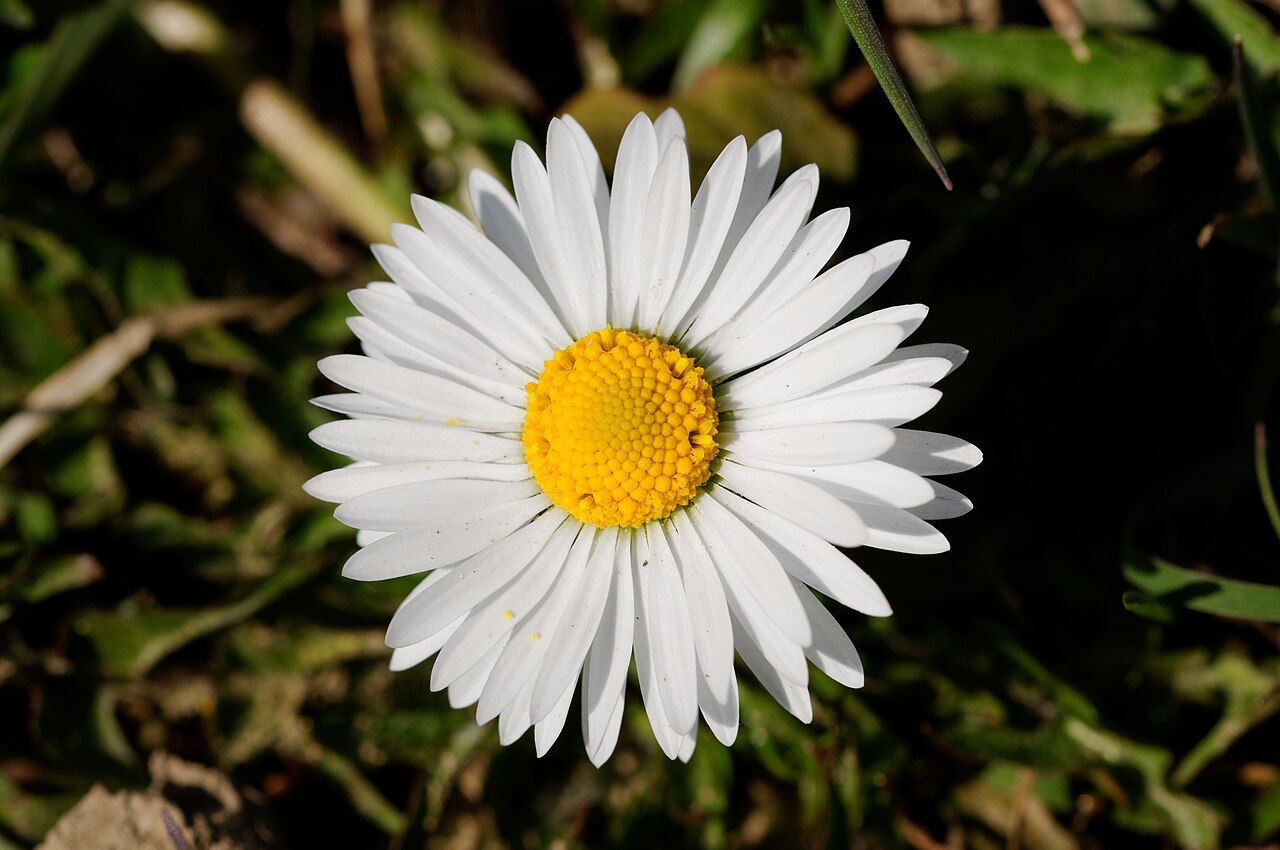
Common Daisy is one of Britain’s best-loved wildflowers, scattered through lawns, short grassland and grassy paths. Its small, white-and-yellow heads are familiar almost all year in mild weather. It is a native perennial in the daisy family, Asteraceae.
Identification
- Small flower heads, usually around 1.5–3 cm across, with a yellow centre and white outer rays, often pinkish underneath or at the tips.
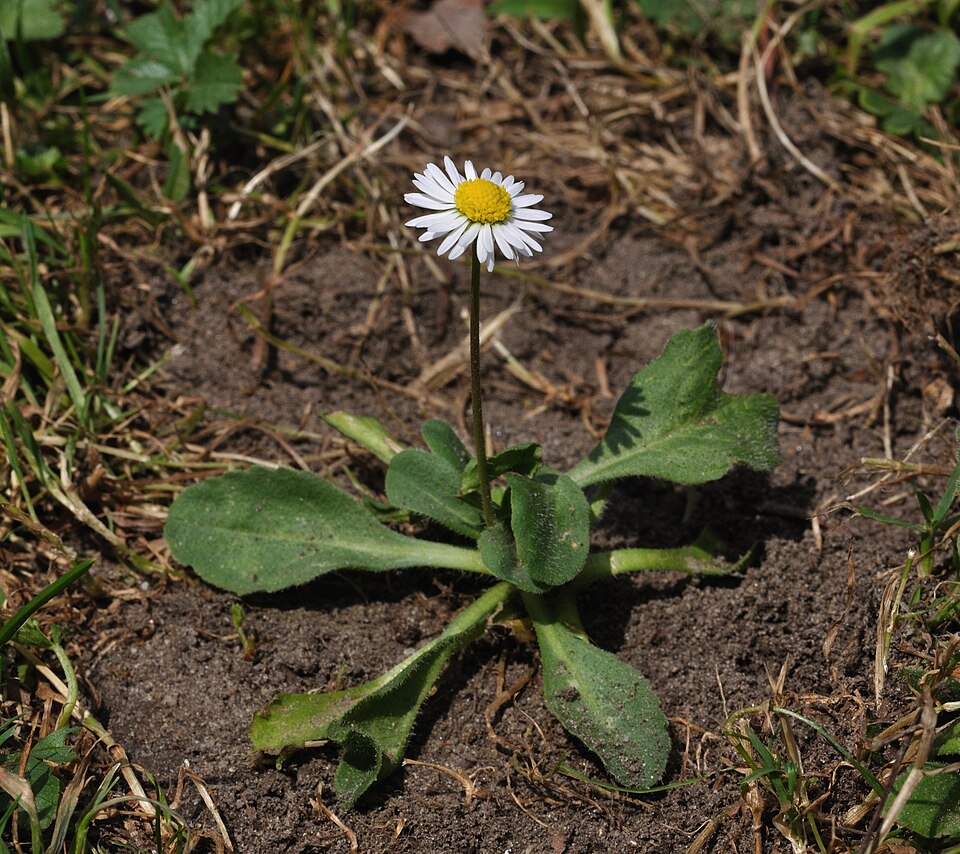
- One flower head at the end of each slender, leafless, sometimes hairy stalk, usually 5–15 cm tall.
- A low basal rosette of spoon-shaped green leaves, often with shallowly toothed or rounded edges.
- Several flower stalks can grow from one plant, rising directly above the rosette.
- The heads tend to open in daylight and close in the evening or dull weather.
Unlike the much taller Oxeye Daisy, Common Daisy stays close to the ground and has no leafy upright flowering stem.
Flower structure
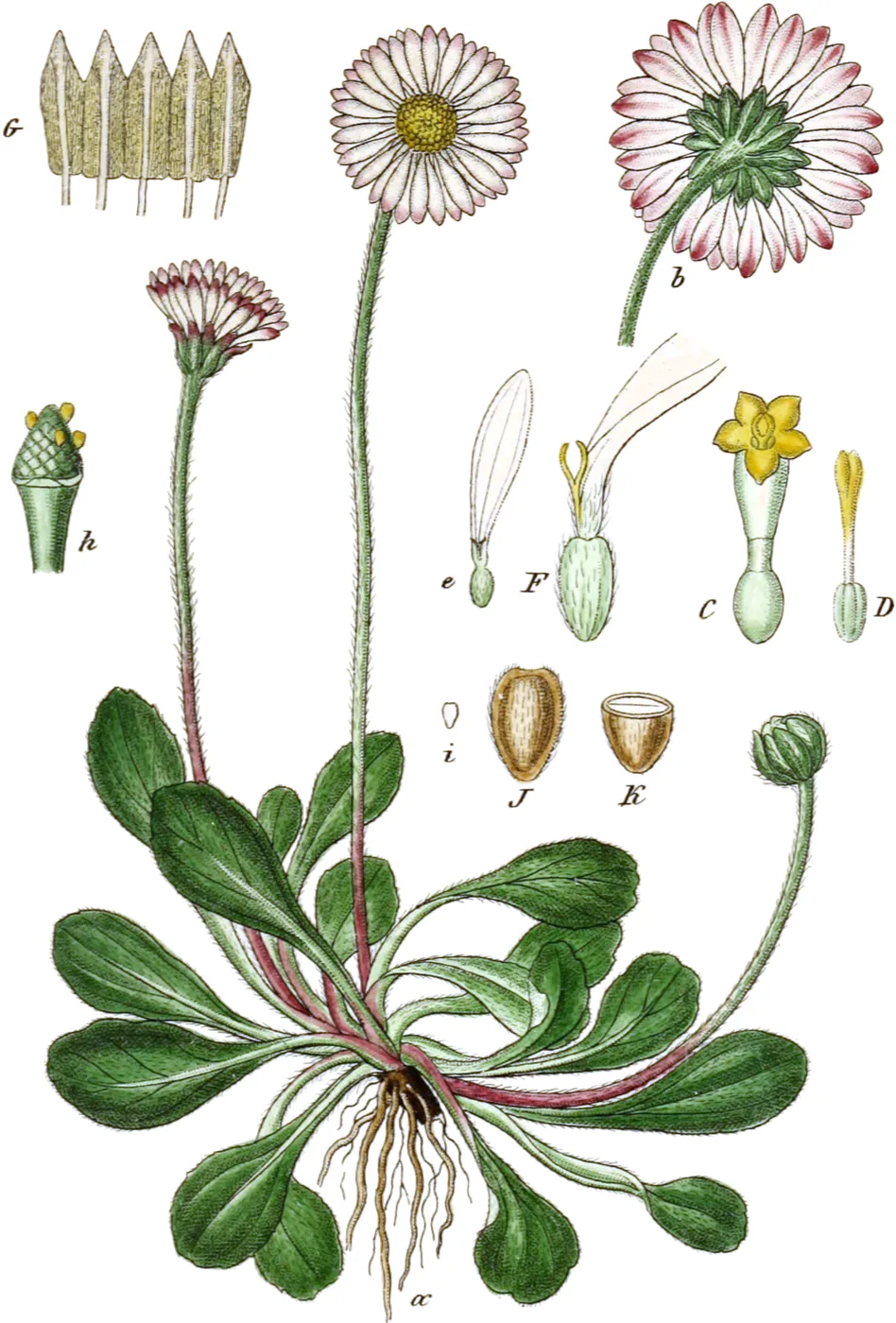
Although it looks like one flower, each daisy head is a capitulum containing many individual florets.
The white, petal-like outer structures are ray florets, each with a long, flat, strap-shaped corolla. Some are flushed pink, particularly on their undersides. The central yellow button is made from numerous small, tubular disc florets. These florets contain the reproductive organs that produce pollen and, after fertilisation, fruits.
Turn a flower head over and you will find a ring of small green bracts forming an involucre beneath it. The bracts protect the developing head when it is still a bud.
Leaves and stems
The leaves form a tight rosette at ground level. Each leaf is broadly spoon-shaped, narrowing towards its stalk, and may have a few shallow teeth near its rounded tip. The leaves can be slightly hairy and often remain green throughout winter.
Each flowering stalk, or scape, has no ordinary leaves. The low-growing habit helps the plant survive grazing and frequent lawn mowing: the leaves remain below the cutting height, while new flower stalks can grow after mowing.
Fruits and reproduction
After pollination, the disc and ray florets produce small dry, one-seeded fruits called cypselae. Unlike a Dandelion, Common Daisy does not make a spherical, feathery seed clock. The small fruits can be moved by animals, water and activity on the ground.
The plant can also spread vegetatively from its short rootstock and creeping shoots, helping it persist in established patches of short turf.
Habitat and wildlife
Common Daisy thrives in lawns, village greens, parks, pastures, roadside verges and other closely grazed or mown grassland. It tolerates a range of soils and is particularly conspicuous in open, sunny patches of turf.
The yellow disc florets provide pollen and nectar for visiting bees, hoverflies and other small insects. Allowing daisies to flower in a lawn creates a useful food source, particularly in early spring.
Flowering period
Flowering is usually most abundant from March to October, though occasional heads may appear in any month of the year during mild spells.
Similar species
- Oxeye Daisy (Leucanthemum vulgare) has much larger heads and tall, upright stems with leaves above the basal rosette.
- Scentless Mayweed (Tripleurospermum inodorum) is a taller annual with finely divided, thread-like leaves rather than a rosette of spoon-shaped leaves.
- Other small daisy-like species may grow in gardens, but Common Daisy’s low rosette, leafless stalks and compact flower heads are a useful combination.
Where the names come from
Daisy comes from the Old English dæges ēage, meaning ‘day’s eye’, referring to its habit of opening its flower heads in daylight. The genus name Bellis means ‘pretty’ or ‘beautiful’, while perennis means ‘lasting through the years’ or ‘perennial’.
Folklore & history
Daisies have long been associated with childhood and spring. Generations have threaded their flower stalks into daisy chains, while their white rays feature in the familiar ‘loves me, loves me not’ game.
Older names include Bruisewort and Woundwort. In traditional herbal practice, the leaves and flowers were prepared as poultices and ointments for bruises and wounds. The plant’s everyday presence in lawns and pasture has also made it a frequent subject of poetry, including the writings of Chaucer and John Clare.