Charlock, also called Field Mustard or Wild Mustard, is a familiar yellow-flowered plant of fields, waysides and disturbed ground. In spring and summer, its branching stems carry bright flowers above coarse, often bristly leaves. It belongs to the cabbage family (Brassicaceae), which also includes Garlic Mustard, Cuckooflower and Shepherd’s Purse.
Once one of the most troublesome weeds of cereal crops, Charlock is also a useful plant for learning the characteristic flowers and seed pods of the cabbage family.
Identification
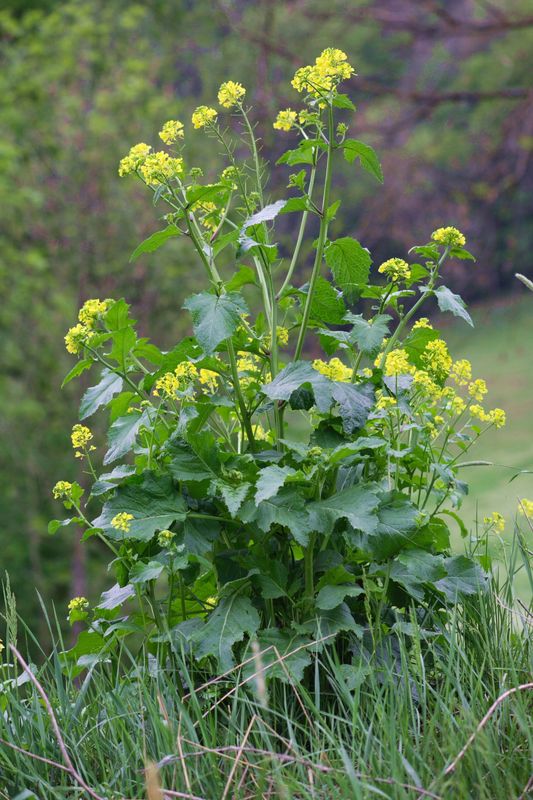
- An upright, often branching annual, commonly 20–100 cm tall, though exceptionally vigorous plants can grow taller.
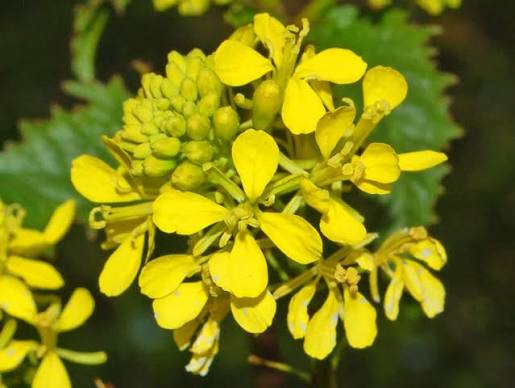
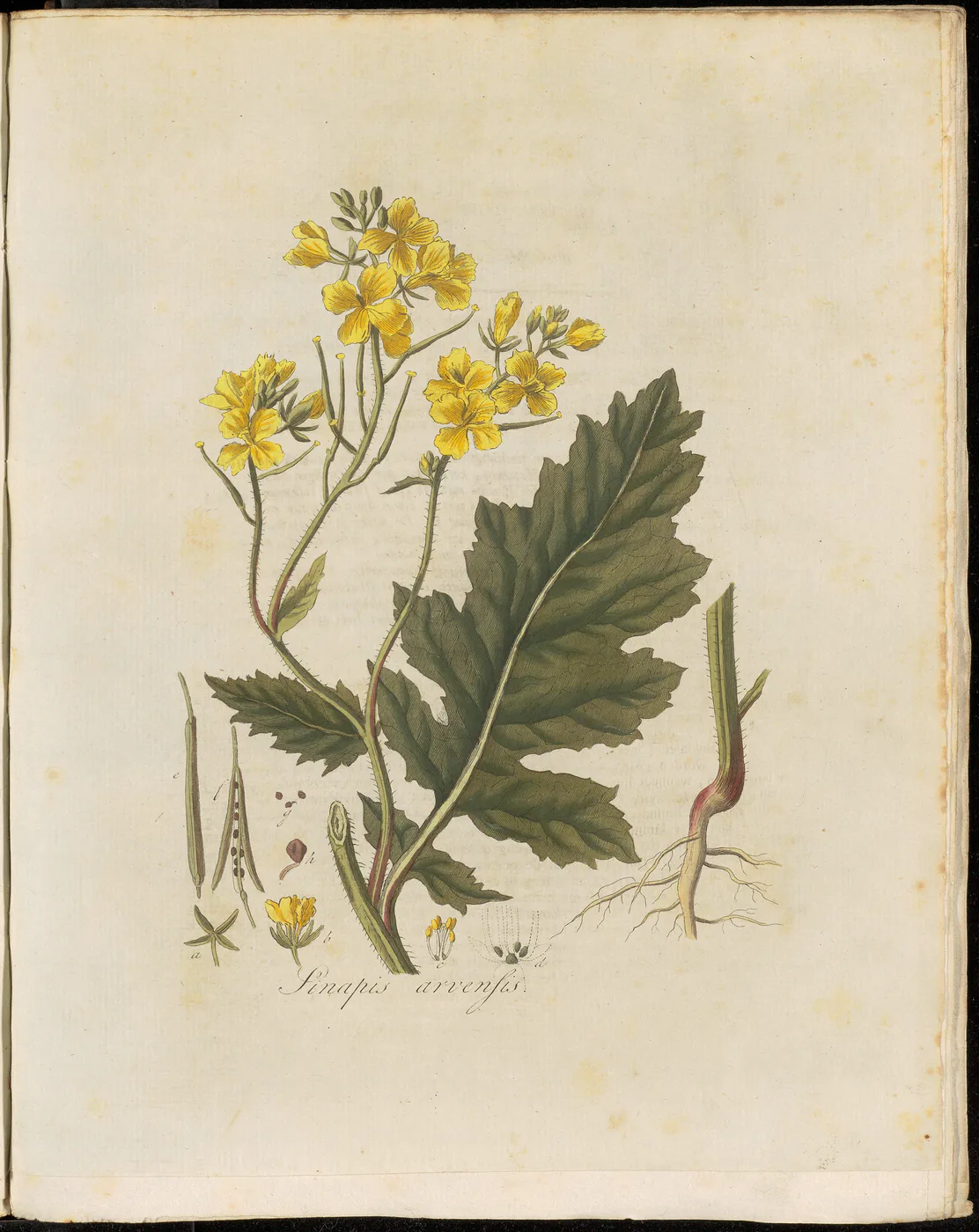
- Bright yellow flowers, usually around 1–2.5 cm across, each with four petals forming a cross.
- Four greenish-yellow sepals that often spread outwards beneath the open petals rather than remaining pressed against them.
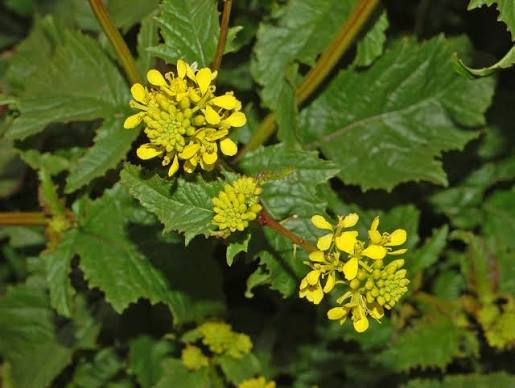
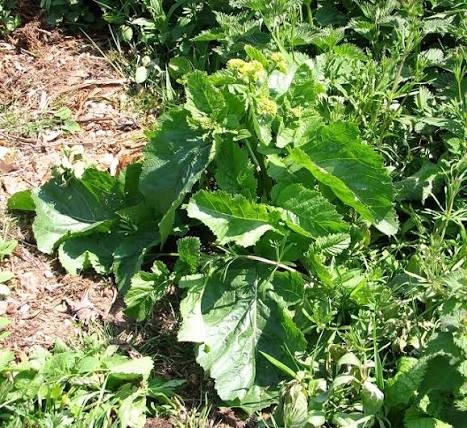
- Rough, dark-green lower leaves with irregular teeth or lobes; the end lobe is often larger than those to either side.
- Smaller upper leaves with coarse teeth, usually short-stalked or nearly stalkless. Unlike the upper leaves of Oilseed Rape, they do not normally clasp the stem broadly.
- Stems that are often bristly, particularly towards the base, and may be tinged purple.
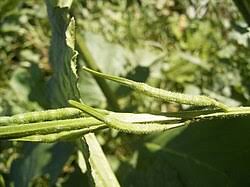
- Narrow, upright to spreading seed pods below the flowers, each ending in a noticeable tapering beak.
The combination of yellow cross-shaped flowers, rough foliage and conspicuously beaked pods is particularly helpful. When several yellow-flowered members of Brassicaceae grow together, the pods are often more useful than flower colour alone.
Flower structure
Each flower has four yellow petals arranged in a cross, the cruciform arrangement which gives the cabbage family its traditional name, the crucifers. Beneath them are four sepals, often held out to the sides in an open flower.
At the centre are six stamens, usually four longer and two shorter. This arrangement is called tetradynamous. Pollen is carried on the anthers, while the central stigma receives pollen from visiting insects.
The flowers form a raceme at the end of each branch. The newest buds and flowers are near the top; older flowers below develop into fruits, so both blossoms and seed pods can often be seen on the same stem.
Leaves and stems
Charlock’s leaves can look surprisingly different depending on where they grow. The lower leaves are usually larger and stalked, sometimes deeply cut into side lobes with a broad terminal lobe. Their surfaces are often rough with scattered stiff hairs, and the veins can appear sunken or wrinkled.
Further up the stem, the alternate leaves become smaller, less divided and more simply toothed. They have short stalks or almost none. The flowering stem is upright, often branched and sometimes purplish near its base.
Young plants initially form a low rosette of leaves before sending up flowering shoots. In crowded or dry places they may stay quite small, whereas plants on open fertile soil can become much more robust.
Fruits and seeds
After flowering, Charlock produces a narrow, cylindrical fruit called a silique. The pods are commonly a few centimetres long, on short stalks, and are held upright or at an angle away from the stem. Each ends in a conspicuous pointed or tapering beak, often at least 7 mm long.
As the pods mature, they turn from green to brown and eventually split to release small, rounded brown to dark seeds. The seeds can lie dormant in cultivated soil for many years, then germinate when digging, ploughing or other disturbance brings them into favourable conditions. This helps explain why Charlock can reappear suddenly in a patch of newly turned earth.
Habitat
Charlock favours open, sunny places with disturbed, reasonably fertile, well-drained soil. It is particularly associated with arable fields and their margins, but can also appear beside roads, on building sites, in gardens and on waste ground.
It is widespread across the UK, although changes in farming and weed control have greatly reduced it in some cultivated fields. It may still be conspicuous where the ground is regularly turned over or where old buried seeds are exposed.
Flowering period
Charlock mainly flowers from spring to autumn, often most noticeably between May and July. In favourable conditions it may begin in April and continue into October, with occasional later flowers in a mild season. Buds, open flowers and developing pods may all occur together.
Similar species
- Hedge Mustard (Sisymbrium officinale) also has yellow flowers, but these are much smaller. Its thin pods remain pressed close to the main stem rather than projecting outwards with a conspicuous beak.
- Oilseed Rape (Brassica napus) can make entire fields appear yellow. Its upper leaves are generally smoother, bluish-green and broadly clasp the stem, while Charlock’s leaves are usually rougher and its upper leaves are not so strongly clasping.
- White Mustard (Sinapis alba) has bright yellow flowers too, but its seed pods are usually conspicuously hairy and have a long flattened beak. Charlock’s pod body is more often smooth or only sparsely hairy.
- Wild Radish or Jointed Charlock (Raphanus raphanistrum) may have pale or yellowish flowers, often with darker veins, and its seed pods develop distinctive constrictions between the seeds, rather than splitting open as ordinary siliques.
- Garlic Mustard (Alliaria petiolata) is a relative with white flowers and foliage that smells of garlic when bruised. Shepherd’s Purse (Capsella bursa-pastoris) has much smaller white flowers and flat, heart-shaped fruits.
For a reliable identification, examine a lower leaf and a mature seed pod as well as the flowers.
Where the names come from
Charlock is a very old name. It can be traced through Middle English spellings such as charlok to the Old English cerlic or cyrlic, although the original meaning of the word is uncertain. Its long history has produced many local variations, including carlock, kedlock, chedlock, skellocks and kerlock. Some of these names were used for more than one mustard-like weed.
Field Mustard and Wild Mustard are more straightforward: they describe a wild relative of cultivated mustards growing in arable fields. The name Charlock has also sometimes been applied to Wild Radish, which is why that plant is occasionally called Jointed Charlock.
The genus name Sinapis is an ancient name for mustard, used in Greek and Latin botanical writing. The species name arvensis comes from Latin arvum, meaning a ploughed or cultivated field. It is an especially fitting name for a plant so closely associated with farming.
One particularly intriguing Somerset name was Bread-and-Marmalade. The precise explanation is uncertain, but it may link the yellow flowers to the old use of Charlock seeds as food in times of hardship.
Folklore & history
Charlock has accompanied people who cultivate the land for centuries. Archaeological finds place it among the weeds associated with farming in Britain in prehistoric, Roman and medieval times. Before modern methods of weed control, whole patches of grain fields could be bright with its yellow flowers, and farmers complained of its competition with wheat and other crops.
The Tudor agricultural writer Anthony Fitzherbert mentioned kedlokes in his Book of Husbandry in 1523, describing their rape-like leaves and yellow flowers and regarding them as a weed. By the eighteenth and nineteenth centuries, agricultural writers recorded an assortment of regional names, evidence of just how familiar the plant had become across the countryside.
Charlock also had a place in the history of rural food. Young plants were sometimes boiled as greens, particularly by poorer households. Historical accounts from Ireland and Scotland describe Charlock as a famine food; in Scotland, the seeds were sometimes ground and mixed into bread when ordinary grain was scarce. The oil from mustard seeds was also occasionally used for burning in lamps.
Its ability to reappear long after a field was last cultivated gave the plant a remarkable persistence. Seeds can survive buried for decades, emerging after the soil is disturbed again. In more recent times, widespread herbicide use has made Charlock less abundant in many intensively farmed fields, even though it remains a characteristic wildflower of open, disturbed ground.
Wildlife
Charlock’s yellow flowers supply nectar and pollen to visiting bees, hoverflies, butterflies and other insects. The flowers produce a slight scent and have ultraviolet patterns that insects can detect, even though people mainly see a uniform yellow blossom.
As with other members of the cabbage family, Charlock may be eaten by caterpillars of white butterflies. Its seeds are also taken by some birds, including finches. The plant depends heavily on insect visits for successful pollination, because it generally cannot fertilise itself with its own pollen.