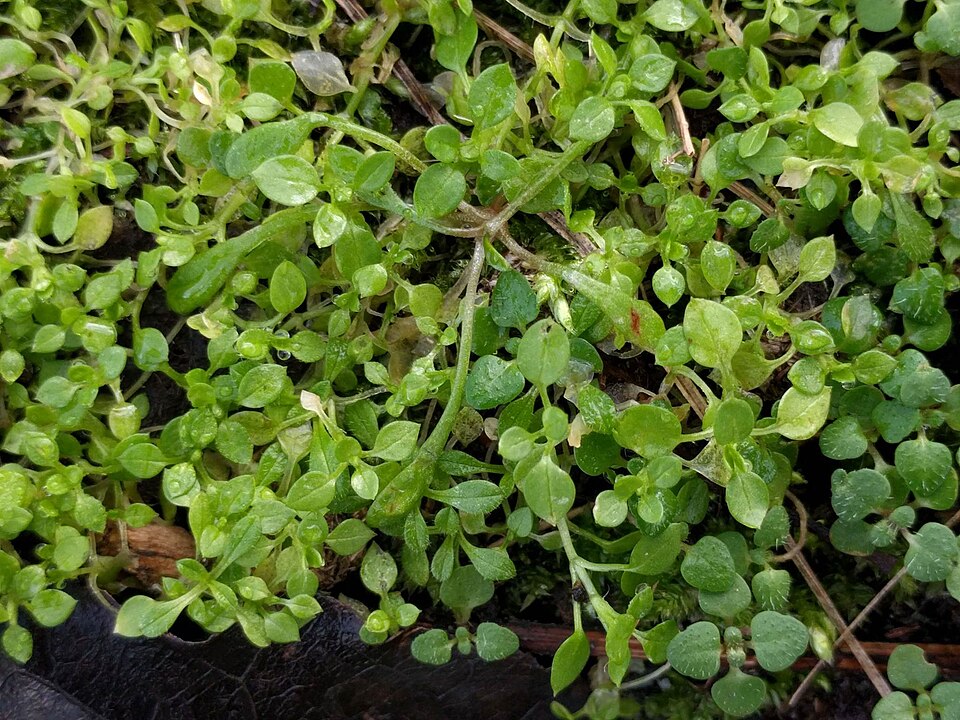
Common Chickweed is one of the UK’s most familiar yet easily overlooked wildflowers. This low-growing native annual spreads through gardens, field margins, hedgerows and disturbed ground, often forming a soft carpet of bright green leaves. Its minute white flowers can seem to have ten petals, but each actually has five that are deeply divided. It belongs to Caryophyllaceae, the pink family, alongside Greater Stitchwort, Lesser Stitchwort and the campions.
Identification
- A low, sprawling or loosely climbing plant, usually 5–40 cm tall, with slender, soft stems that often lie along the ground before turning upwards.
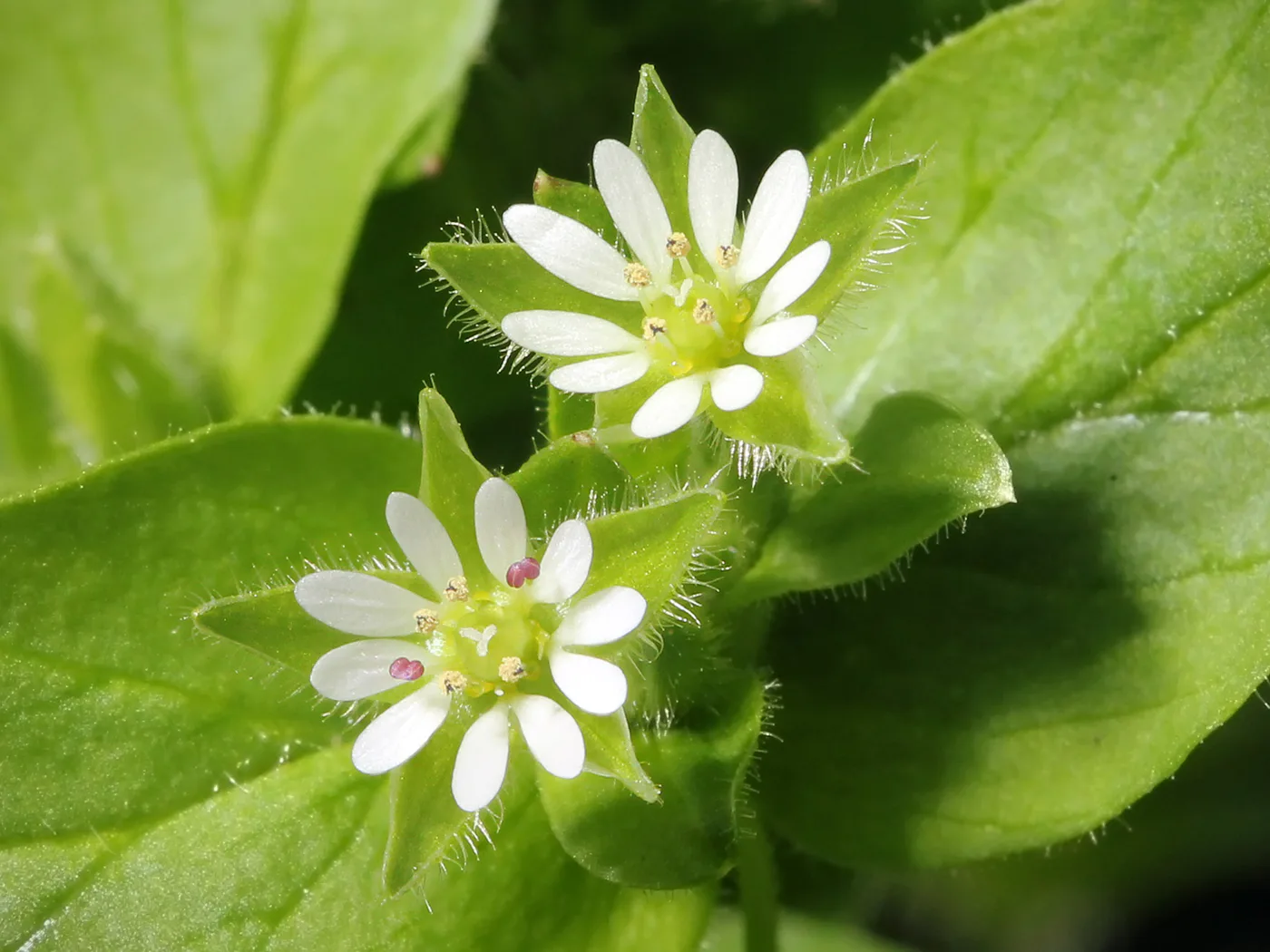
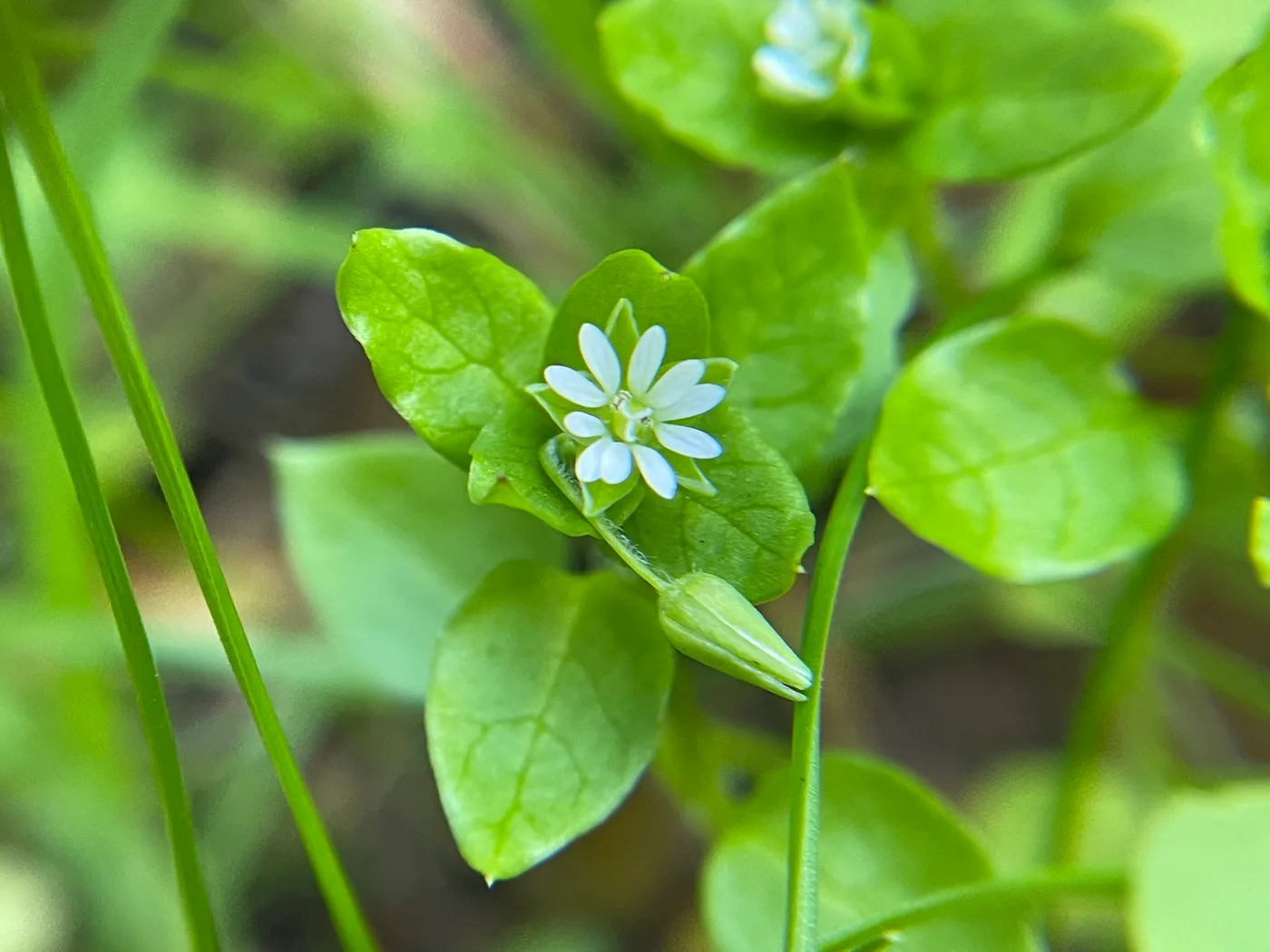
- Very small white flowers, often only 3–6 mm across, each with five petals split nearly to the base, so that they appear to be ten narrow petals.
- Five green, pointed sepals, often slightly longer than the petals and edged with fine hairs.
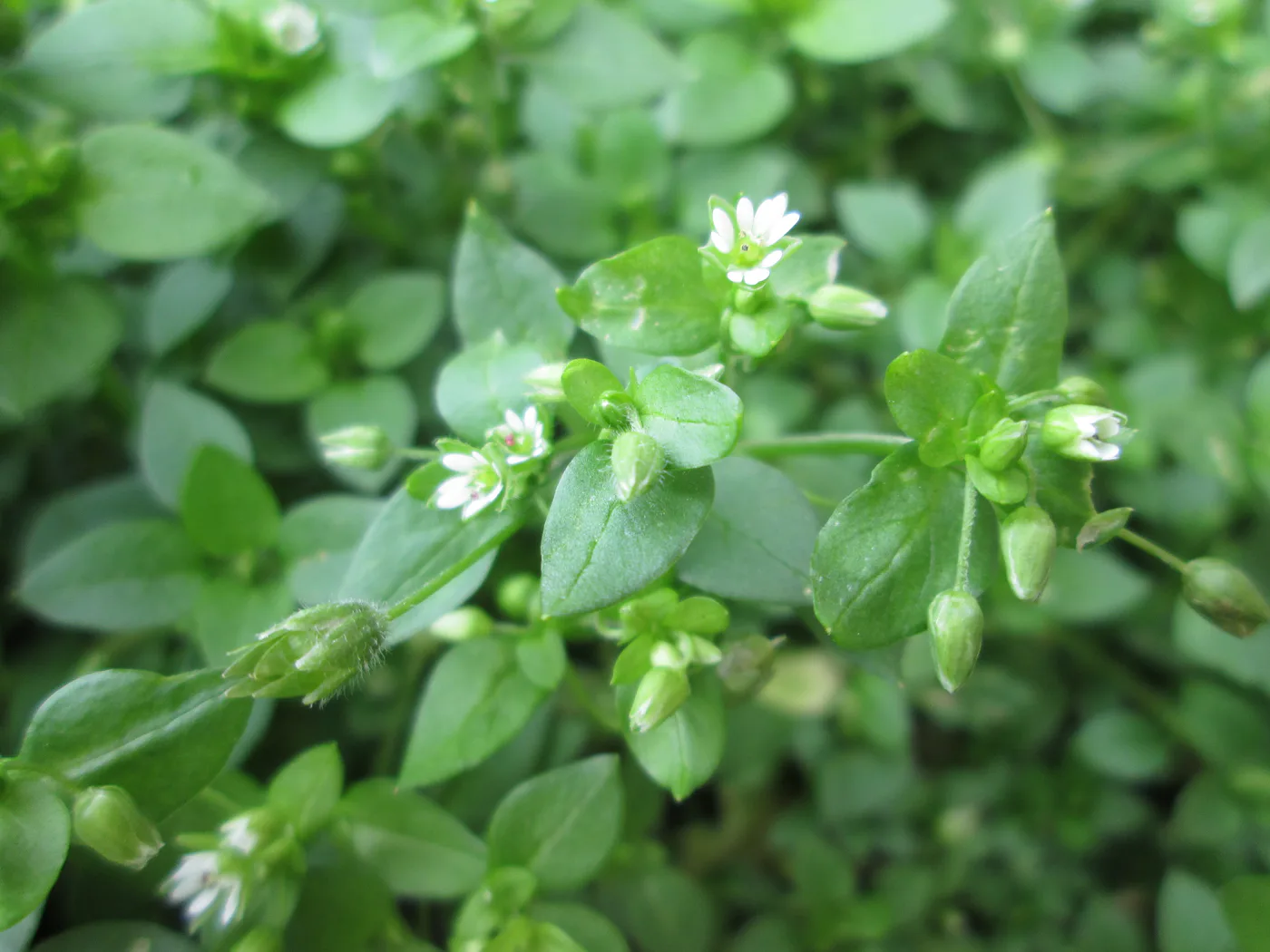
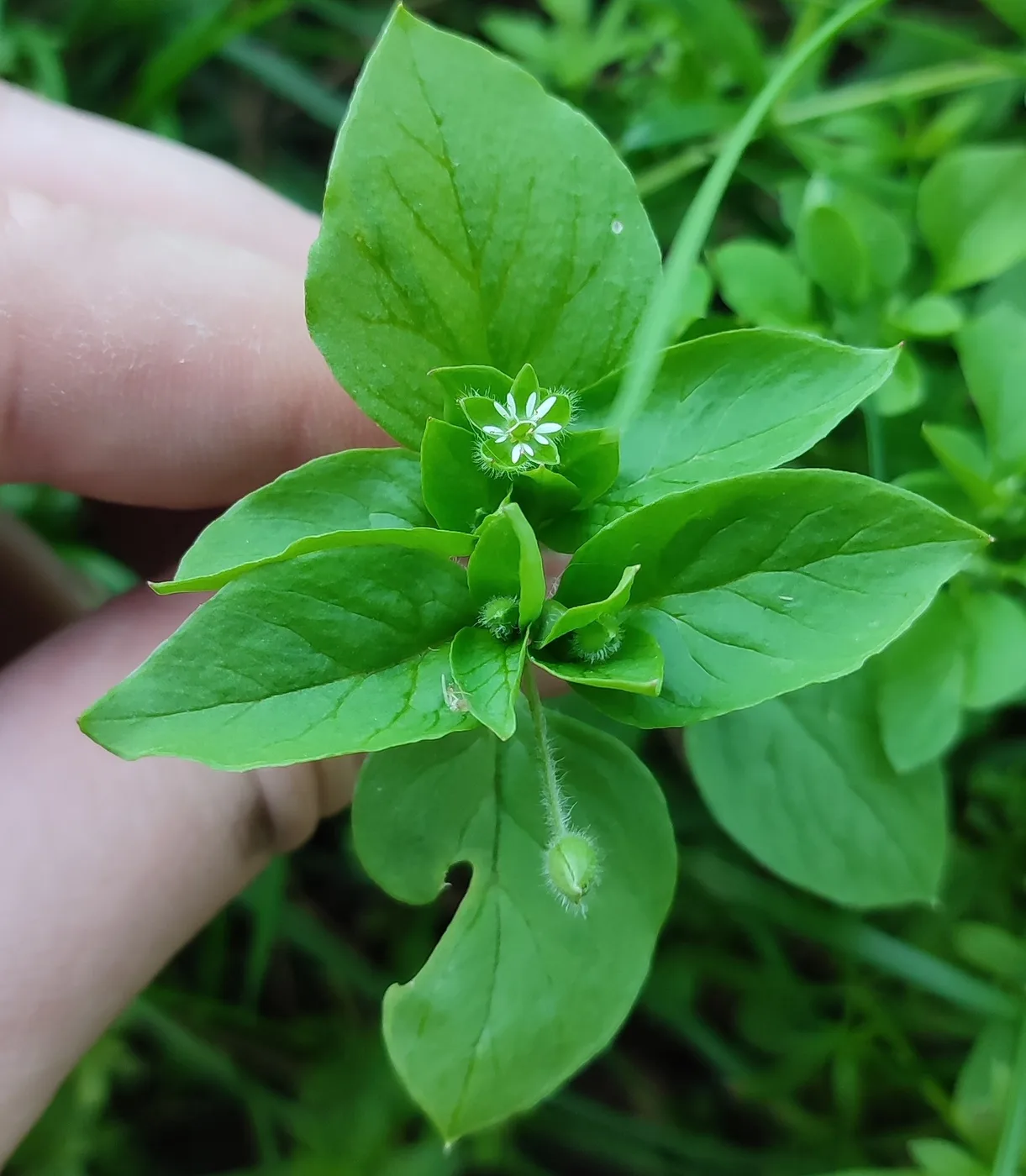
- Bright green, oval to egg-shaped leaves with pointed tips, arranged in opposite pairs.
- Lower leaves borne on noticeable stalks, with upper leaves often almost stalkless.
- A distinctive single line of fine hairs along the stem, usually changing sides at each pair of leaves.
- Small oval capsules develop after flowering, releasing numerous tiny brown seeds.
The line of hairs along the stem is especially helpful: rather than a uniformly hairy stem, Common Chickweed usually has just one narrow, lengthwise strip of hairs between leaf joints.
Flower structure
Each flower is formed from five deeply divided white petals. The division runs so far towards the base that each petal resembles two separate narrow lobes, giving the appearance of ten petals. Sometimes the petals are shorter than the green sepals, and a few flowers may have reduced or missing petals.
The five sepals form a small pointed star behind the petals. In the centre there are usually three to five stamens, sometimes more, and three short styles arising from the ovary. The flowers often occur on slender stalks among the upper leaves, opening in succession as new buds form.
After flowering, the ovary becomes a small dry capsule. When ripe it opens at the tip by six little teeth or valves, allowing its brown seeds to escape. The flowering stalks commonly bend downwards as the fruit develops.
Leaves and stems
The leaves are soft, smooth-edged and usually a fresh, light green. They are oval or broadly egg-shaped, often ending in a small pointed tip, and grow in opposite pairs along the stem. Lower leaves have stalks, whereas those near the flowers usually have very short stalks or none at all.
The weak, round stems branch freely and often spread over the soil. Look closely along a stem and you may see one neat line of short hairs. At the next pair of leaves, this line commonly switches to the opposite side of the stem. The leaves themselves are generally hairless, an important distinction from many mouse-ears.
The plant has shallow fibrous roots and can develop into a dense mat when conditions are moist and mild.
Habitat
Common Chickweed thrives in damp, fertile, disturbed soil. It is abundant in gardens, vegetable plots, cultivated fields, allotments, hedgebanks, gateways, paths and waste ground. It can also appear in lawns, at woodland edges and beneath open hedges where the soil remains moist.
It is widespread across the UK and is especially noticeable on bare ground during the cooler months, when many larger flowering plants have died back. Its fast growth and abundant seed production help it colonise freshly disturbed places.
Flowering period
Common Chickweed can flower in every month of the year, although flowering is reduced during severe frost or prolonged dry weather. It is often most conspicuous in spring and autumn, and may continue producing small white flowers during mild winters.
Similar species
- Greater Stitchwort (Stellaria holostea) has much larger flowers, typically 2–3 cm across, and long, narrow leaves with rough margins. Common Chickweed’s flowers are tiny and its leaves are much broader.
- Lesser Stitchwort (Stellaria graminea) has narrow, grass-like leaves and smooth, four-angled stems. Common Chickweed has oval leaves and the characteristic single line of stem hairs.
- Common Mouse-ear (Cerastium fontanum) has small white, notched flowers too, but its leaves and stems are conspicuously hairy rather than mostly smooth.
- Greater Chickweed (Stellaria neglecta) can look very similar but is usually more robust, with larger flowers and generally more stamens. A careful examination of the flowers is useful.
- Lesser Chickweed (Stellaria pallida) often has very small or absent petals, making its flowers look largely green; it is particularly easy to overlook in short grass.
Where the names come from
The name Chickweed comes from its long association with domestic fowl and other small birds. Chickens readily peck at the fresh shoots and seeds, and the plant was traditionally gathered as feed for hens and cage birds. Another old name, Chick-wittles, recorded in Suffolk, uses wittles in the sense of victuals or food — literally, food for chicks.
The botanical name Stellaria comes from the Latin stella, meaning ‘star’, referring to the delicate, star-like flowers. Although they seem to have ten narrow petals, there are really only five, each split into two lobes. The species name media means ‘middle’ or ‘intermediate’, traditionally understood as a reference to its size among related plants.
Other country names include Starweed, Starwort, Satin Flower and White Bird’s-eye. In Devon, the name Skirt Buttons was recorded, perhaps prompted by the little white flowers, although the precise origin is uncertain. Tongue-grass is another historical name recorded from Ireland, including by the botanist John Threlkeld in his 1727 account of Irish plants.
Folklore & history
Common Chickweed has a long place in everyday country life, not because it is showy, but because it grows almost everywhere people cultivate the soil. Its usefulness as poultry feed is remembered in its common name. Country households gathered its soft shoots for chickens and cage birds, and wild finches and other seed-eating birds also make use of it.
It was also familiar in traditional herbal practice. Chickweed was commonly prepared as a poultice for irritated skin, swellings and minor sores, and its use for skin complaints continued in regional British folk medicine. The herbal writer Maud Grieve described these traditions in A Modern Herbal (1931), including the plant’s use as a cooked green resembling spinach.
The writer Geoffrey Grigson gathered a rich collection of regional names for Chickweed in The Englishman’s Flora (1955). Some, such as Chick-wittles, recall its role as bird food; others, including Skirt Buttons, hint at how closely country people once observed even the smallest flowers growing around their homes.
Unlike some more dramatic wildflowers, Chickweed is not especially associated with supernatural folklore. Its history is that of an everyday companion of cottages, farmyards and gardens, valued as an early source of fresh growth and a familiar ingredient in old country remedies.
Wildlife
Although its flowers are small, Chickweed can offer nectar to tiny bees and other insects during mild weather. The many small seeds are eaten by birds, including finches, while the leafy growth provides food and shelter for invertebrates. In gardens, a patch of Chickweed left in a quiet corner can contribute to the wildlife value of otherwise bare soil.