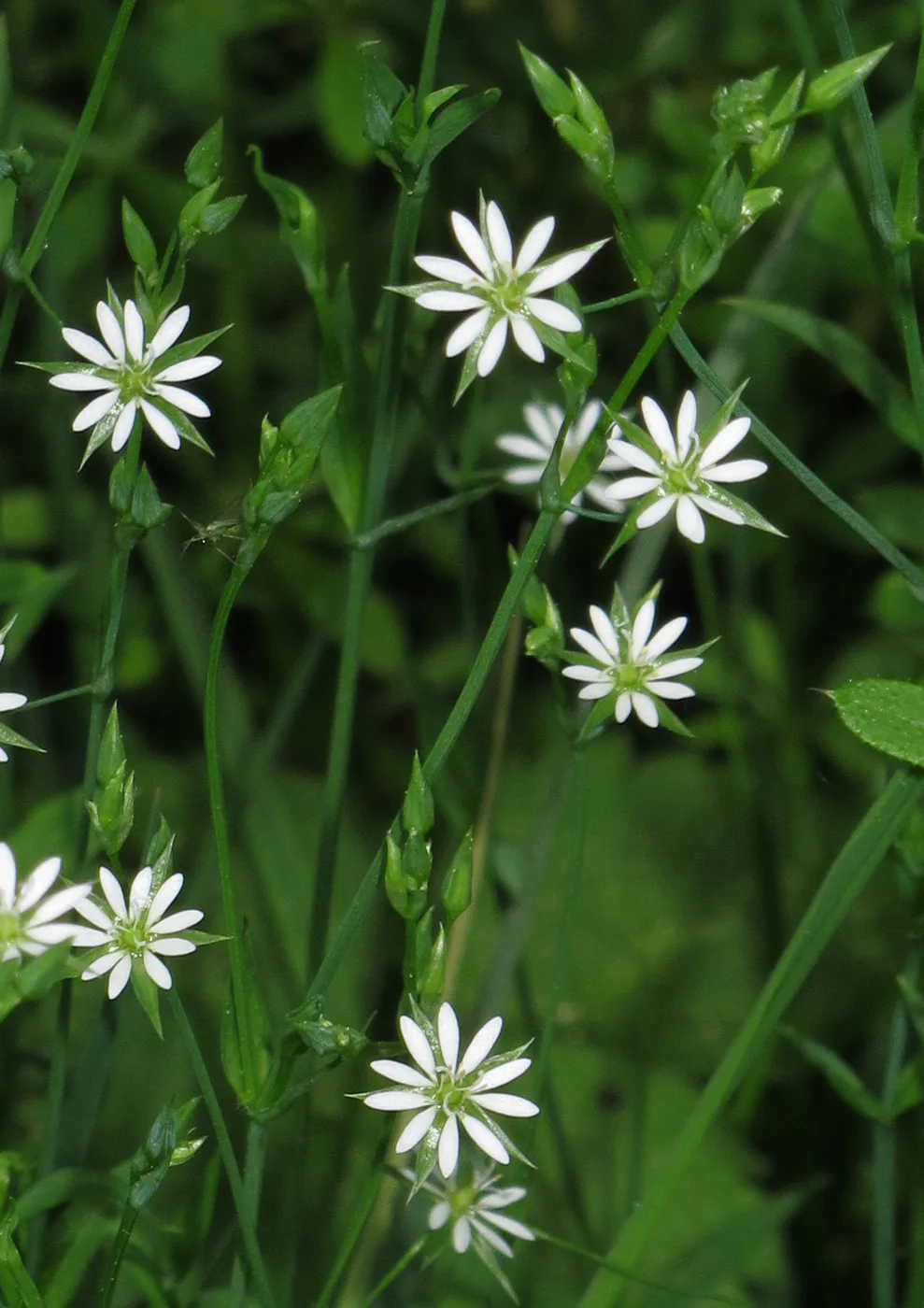
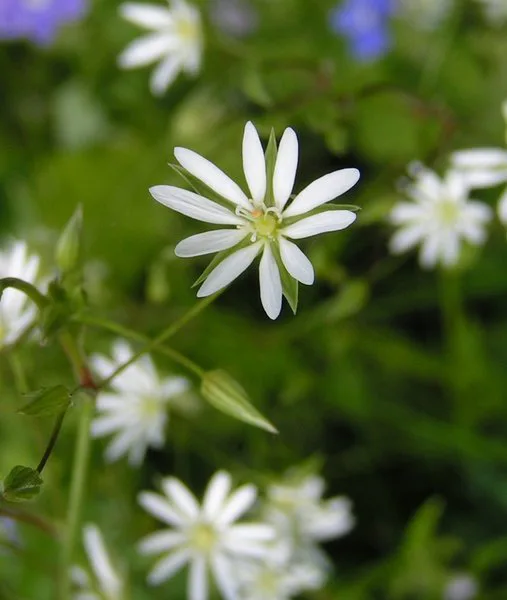
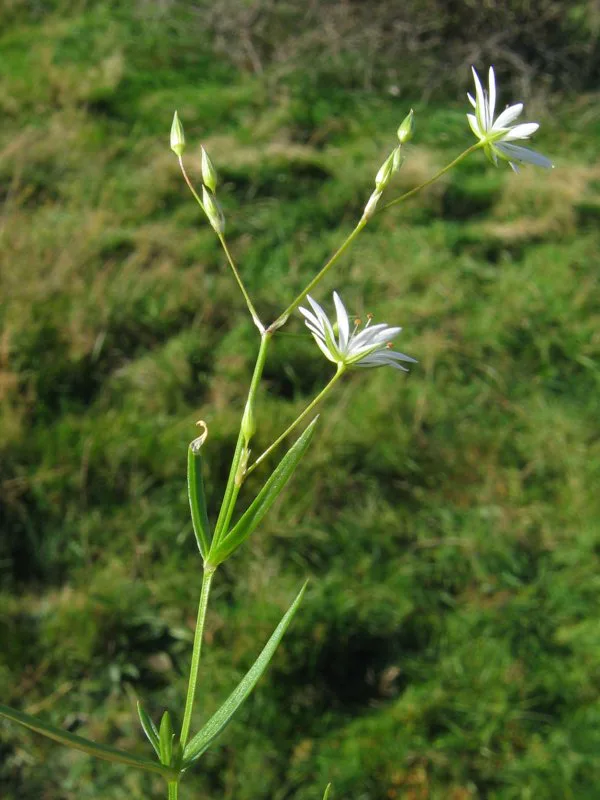
Lesser Stitchwort is a native perennial wildflower of meadows, rough grassland, hedgebanks and open woodland. Its small white flowers look like tiny stars scattered among the grasses. It belongs to Caryophyllaceae, the pink family, and is also known as Grass-leaved Stitchwort.
Identification
- Usually 20–60 cm tall, with thin, weak, much-branched stems that often lean against surrounding grasses.
- Small white flowers, generally about 5–12 mm across, carried in loose, open clusters.
- Five deeply divided petals, which can make each flower appear to have ten narrow petals.
- Five pointed green sepals, usually about as long as the petals.
- Narrow, pointed, grass-like leaves arranged in opposite pairs along the stems.
- Leaves without stalks and with mostly smooth edges; the stems are smooth and four-angled.
- A dry capsule containing many small seeds develops after flowering.
The small flowers, very deeply split petals and narrow, smooth-edged leaves are particularly useful for telling Lesser Stitchwort from Greater Stitchwort.
Flower structure
Each flower has five white petals, each split almost to its base into two slender lobes. This makes a flower look as though it has ten petals, although it has only five. The petals usually reach about the same length as the five pointed green sepals beneath them.
In the centre are usually up to ten stamens and three styles. The flowers appear at the ends of fine, branching stalks in loose cymes, rather than in a dense spike. After pollination, the ovary develops into a dry seed capsule.
Leaves and stems
The leaves are narrow and pointed, often only a few millimetres wide, with the shape of small grass blades. They grow in opposite pairs and attach directly to the stem without a noticeable stalk. Their edges are generally smooth, though very fine hairs may be present near the leaf bases.
The stems are slender, smooth and four-angled. They are often too weak to stand completely upright without the support of neighbouring vegetation. Several shoots may arise from a creeping underground rootstock, giving the plant a loose, spreading appearance.
Habitat
Look for Lesser Stitchwort in grassy meadows, rough pasture, hedgerows, roadside banks and the lighter edges of woodland. It also occurs on heaths and in open scrub, often threading its stems through taller grasses.
It grows especially well on neutral to acidic soils and is widespread across Britain. Although the flowers are small, a patch of plants can be quite conspicuous when many are open together.
Flowering period
Lesser Stitchwort usually flowers from May to September, often at its best in early summer. New flowers continue opening as older ones fade, so the white stars may be visible over a long period.
Similar species
- Greater Stitchwort (Stellaria holostea) has much larger flowers, usually around 2–3 cm across. Its petals are divided less deeply and are about twice as long as its sepals; its leaves also have noticeably rougher margins.
- Marsh Stitchwort (Stellaria palustris) has larger flowers and is more typical of marshes, wet meadows and other damp ground.
- Common Chickweed (Stellaria media) also has very small, deeply divided white petals, but usually has broader lower leaves and a rounded stem with a single line of hairs rather than the smooth, four-angled stem of Lesser Stitchwort.
Where the names come from
Stellaria comes from the Latin stella, meaning star, a reference to the shape of the white flowers. The species name graminea means grass-like and describes the slender leaves.
The name Lesser Stitchwort distinguishes it from the larger-flowered Greater Stitchwort. Stitchwort itself comes from an old belief that plants bearing the name could relieve a sharp ‘stitch’ in the side.
Folklore & history
Stitchworts have a place in British herbal tradition, particularly through the belief that they could ease a stitch or sharp pain in the side. Older herbals most often describe Greater Stitchwort in connection with this use, while the smaller-flowered Lesser Stitchwort shares its familiar English name.
The small white flowers of stitchworts have long been a feature of country lanes, meadow edges and hedgerows. Their star-like appearance is also reflected in the old botanical name Stellaria.
Wildlife
The small, open flowers are accessible to a range of visiting insects, including small bees, flies and hoverflies, which visit for nectar and pollen. Flowering over several months, Lesser Stitchwort contributes to the supply of food for insects in meadows and along grassy margins.
Its loose growth also adds to the variety of plants within a grassland or hedgerow, where it grows among grasses and other wildflowers.