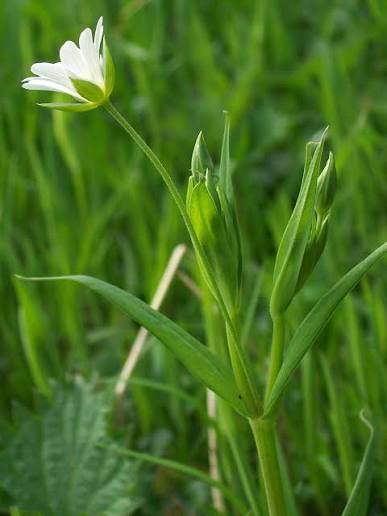
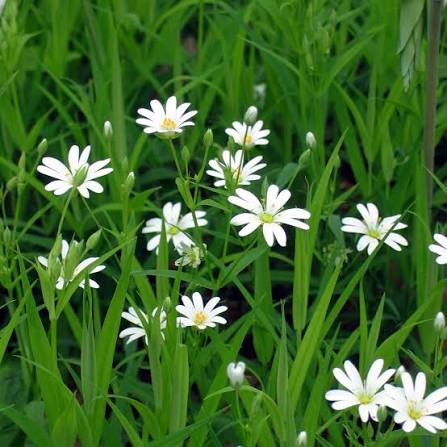
Greater Stitchwort is a native perennial wildflower that brightens hedgerows, grassy banks and woodland edges with masses of large, white, star-like flowers in spring. It is a member of Caryophyllaceae, the pink family, alongside campions and Lesser Stitchwort. Despite its delicate flowers, its wiry stems and narrow, pointed leaves are surprisingly distinctive once you know what to look for.
Identification
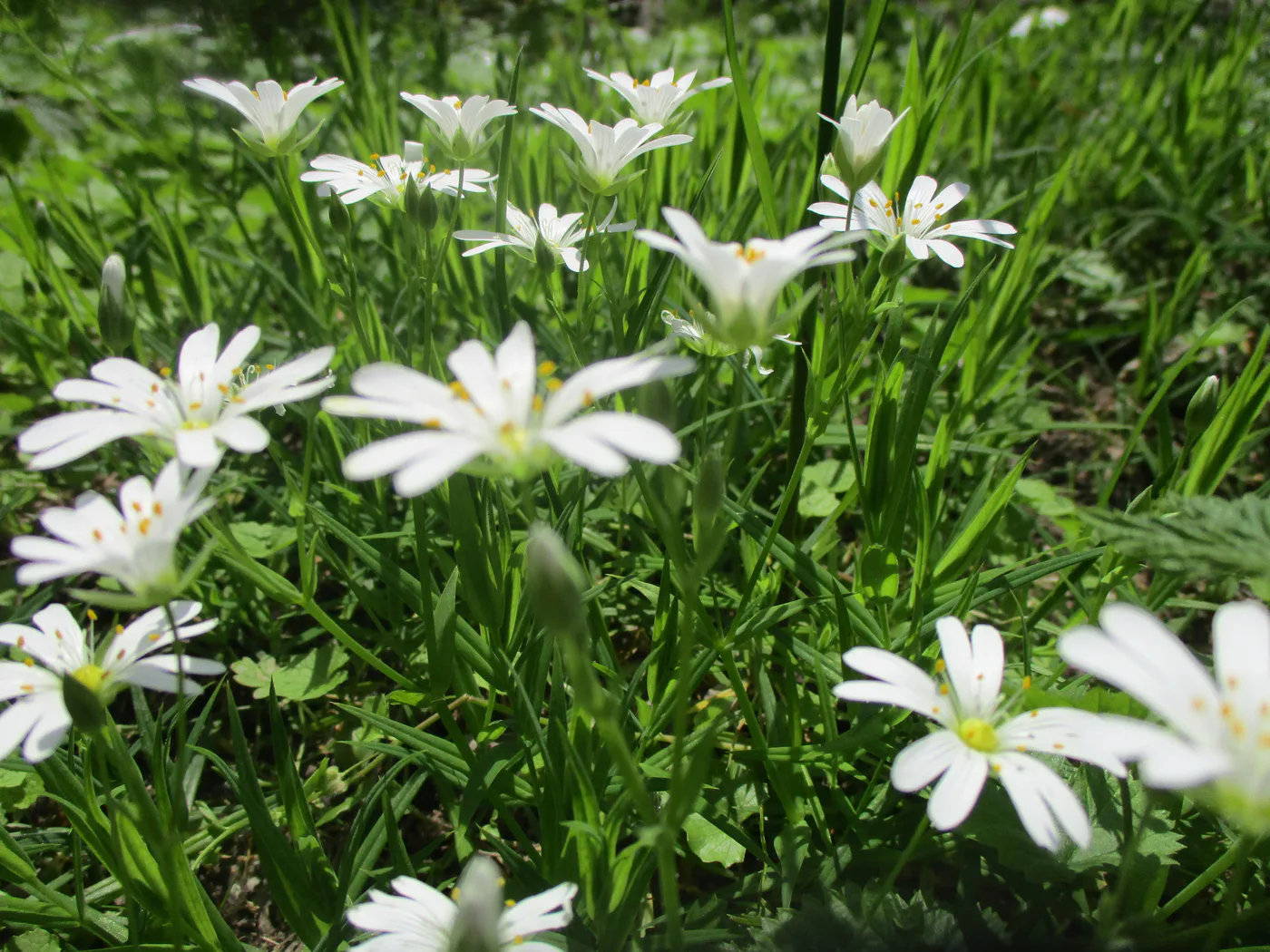
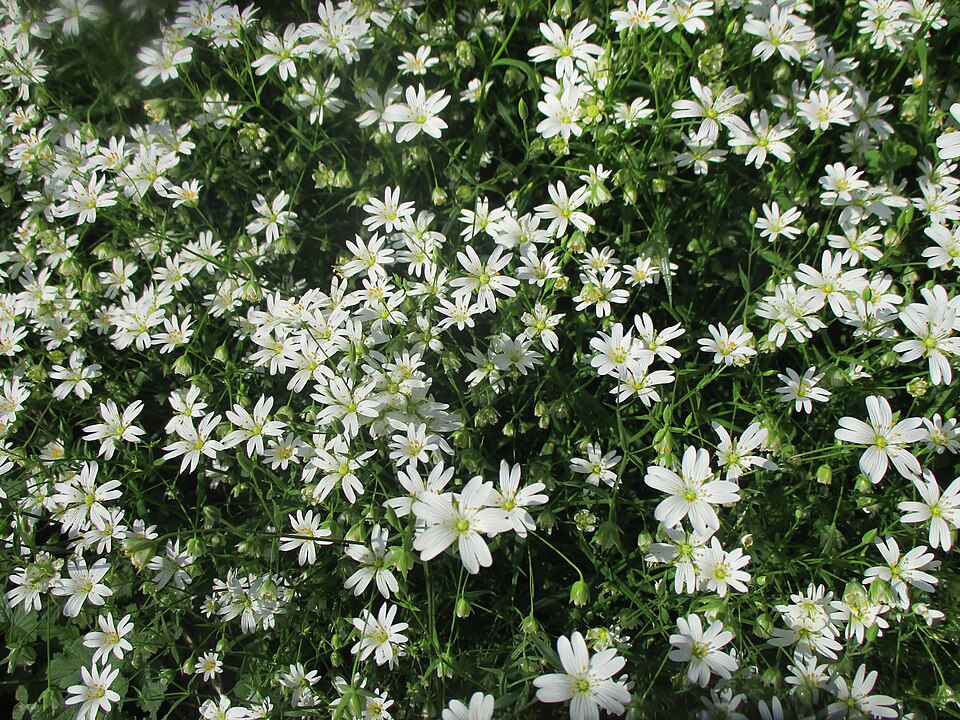
- Usually 20–50 cm tall, often forming loose patches or spreading drifts along hedges and woodland margins.
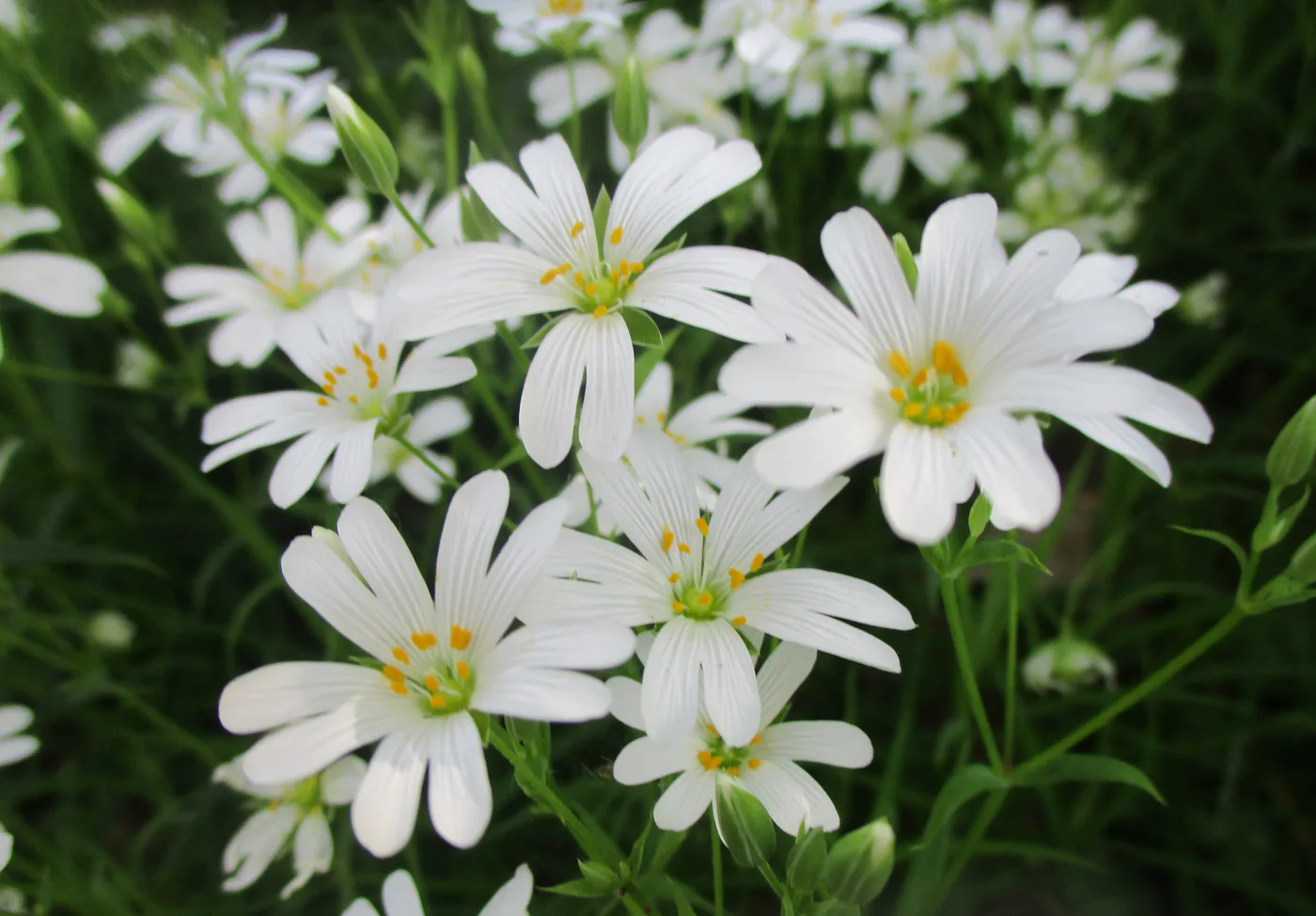
- Showy white flowers, typically 2–3 cm across, borne on slender stalks in open, branching clusters.
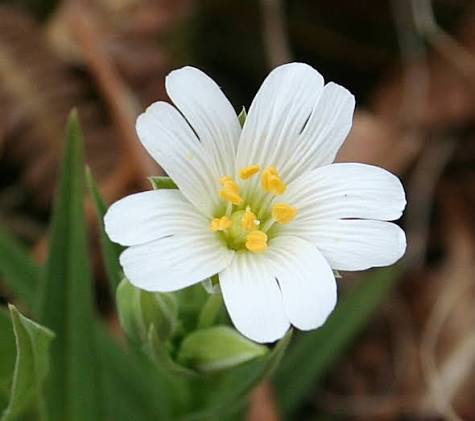
- Five white petals, each deeply notched about halfway to its base, making the flower look as though it has ten petals.
- Five narrow, green sepals, much shorter than the petals.
- Slender, unstalked, grass-like leaves arranged in opposite pairs, with pointed tips and noticeably rough edges.
- Four-angled stems that are slightly rough to the touch and brittle enough to snap readily.
- Small dry seed capsules follow the flowers and release their seeds as they ripen.
The broad, deeply notched white petals and rough-edged leaves are especially useful when separating Greater Stitchwort from its smaller-flowered relatives.
Flower structure
Each flower is built from five white petals, but every petal has a deep notch dividing it into two rounded lobes. This produces the familiar ten-pointed, star-like appearance. Fine veins can often be seen running lengthways along the petals, towards the pale green centre.
There are five pointed green sepals beneath the petals, usually about half their length. In the centre are normally ten pollen-bearing stamens, with yellow anthers, and three styles. The flowers are carried in loose branching cymes, so several blooms may open on a single shoot while other buds are still developing.
Following pollination, the ovary develops into a dry capsule containing small seeds. When ripe, the capsules can open suddenly with an audible popping sound, scattering their seeds away from the plant.
Leaves and stems
The leaves are long, narrow and pointed, somewhat like short blades of grass. They are attached directly to the stem without a noticeable stalk, and each pair grows opposite the other. The margins and central ridge are slightly rough, a useful identification feature that can be felt by gently running a finger along the leaf.
The stems are slender and distinctly four-angled, with rough edges and joints where the paired leaves arise. They are also rather brittle and can snap easily. The plant grows from a perennial rootstock, sending up fresh flowering shoots each spring.
Habitat
Look for Greater Stitchwort along old hedgerows, woodland rides, roadside banks, grassy field edges and the lighter margins of deciduous woods. It is especially conspicuous where sunlight reaches the edge of a hedge or woodland path, sometimes covering a bank with white flowers.
It is widespread across much of the UK and often favours moderately moist, well-drained ground in partial shade. Its presence in spring is a familiar feature of established hedgerows and woodland margins.
Flowering period
Greater Stitchwort usually flowers from April to June, with its strongest display often in April and May. The flowering period overlaps the emergence of fresh leaves on hedgerow shrubs and woodland trees, making its white flowers particularly noticeable against the new green growth.
Similar species
- Lesser Stitchwort (Stellaria graminea) has much smaller flowers, typically around 5–12 mm across. Its petals are more deeply divided, usually close to their bases, and the leaves and stems are generally smoother. Greater Stitchwort has flowers about 20–30 mm across, with broader petal lobes and rougher leaf margins.
- Common Chickweed (Stellaria media) has smaller white flowers, often with deeply split petals, but its leaves are broader and its stems typically have a single line of hairs rather than the rough, four-angled stems of Greater Stitchwort.
- Common Mouse-ear (Cerastium fontanum) also has white, notched petals, but usually has smaller flowers and noticeably hairy, oval leaves and stems, rather than the long, narrow leaves of Greater Stitchwort.
Where the names come from
The name Stitchwort comes from the old belief that the plant could ease a painful ‘stitch’ in the side, such as the sharp pain felt when running. ‘Greater’ distinguishes its large flowers from those of the smaller Lesser Stitchwort.
The familiar botanical name Stellaria is derived from the Latin stella, meaning ‘star’, a description of the ten-pointed appearance created by the five deeply notched petals. The species name holostea comes from Greek words meaning ‘whole bone’, an old botanical name often associated with its rather brittle stems. Although most British field guides still use Stellaria holostea, the species is now placed by Kew in the genus Rabelera, as Rabelera holostea.
Traditional names capture several other features. Snapdragon, Snapcrackers and Snap-stalks refer to the stems that snap readily, while Popguns or Poppers describe the sound made by the ripe seed capsules. Star-of-Bethlehem reflects the bright white star-shaped flowers, and Wedding Cakes, Daddy’s Shirt Buttons and Poor Man’s Buttonhole recall their use as small, decorative country flowers.
Folklore & history
Greater Stitchwort was once associated with a sharp pain in the side, or a ‘stitch’, which country herbal traditions claimed the plant could relieve. That old use survives in its common name even though most people now know it simply as a springtime hedgerow flower.
In Cornwall, Greater Stitchwort was sometimes considered a flower belonging to the pixies. Picking it was said to anger them and might result in the picker being bewitched. Another country belief held that gathering stitchwort could bring on a thunderstorm, giving rise to names such as Thunder Flower. These stories helped turn a familiar plant of lanes and woods into one that children were sometimes warned not to pick.
Its more cheerful names tell a different story. Wedding Cakes, Milkmaids and Daddy’s Shirt Buttons suggest the white flowers’ place in the everyday language of the countryside. As the ripe capsules pop and scatter their seeds, the names Poppers and Popguns also preserve an observation that children and naturalists alike could make in late spring and summer.
Wildlife
Greater Stitchwort provides spring nectar and pollen for small bees, hoverflies and butterflies, including Orange-tip butterflies. Its early flowering makes it useful along woodland edges and hedges while many summer wildflowers are still developing.
The plant is also used by several moth species, including the Marsh Pug and Plain Clary, whose caterpillars feed on it. Patches of Greater Stitchwort add both food and cover to the varied vegetation along woodland rides and old hedgerows.