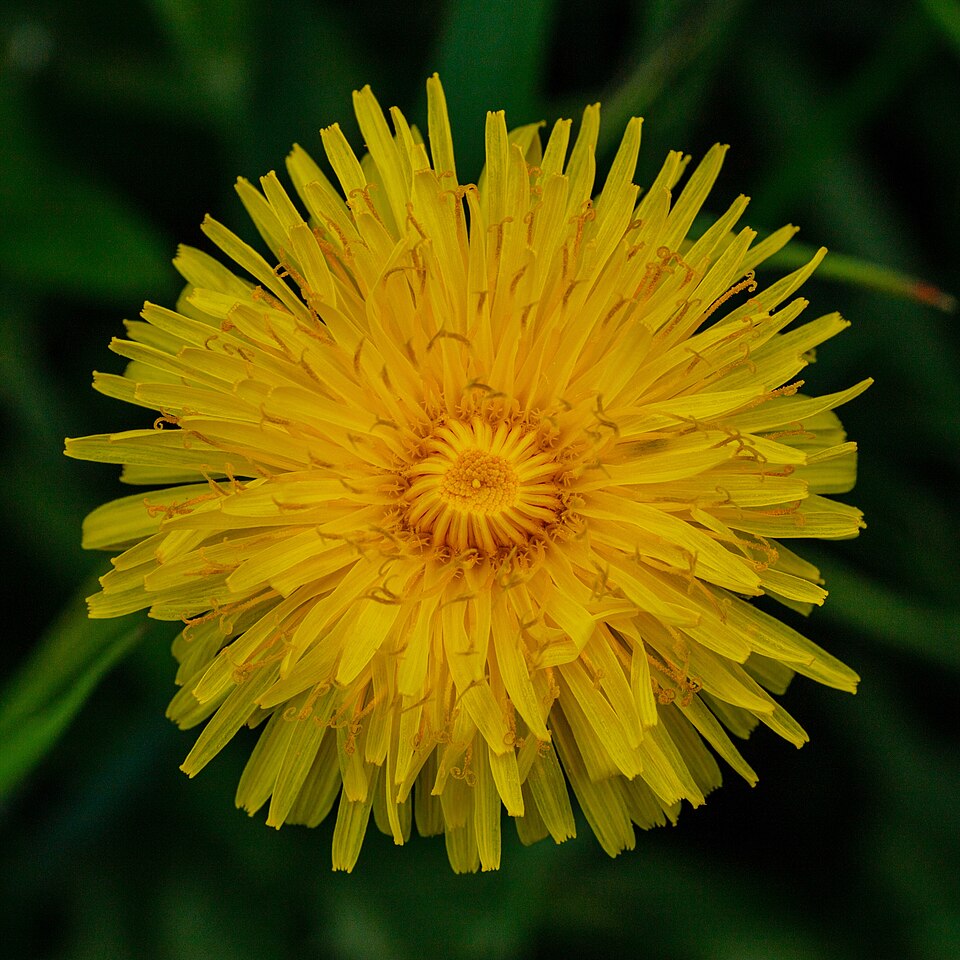
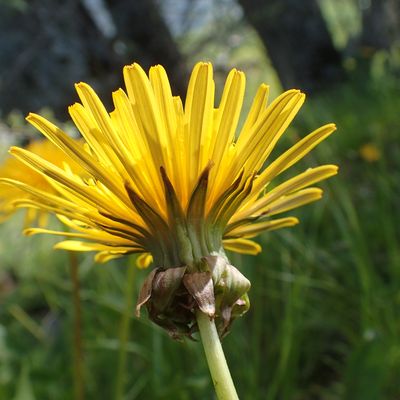
Dandelion is one of Britain’s most familiar wildflowers, brightening lawns, meadows, roadsides and grassy banks. Its golden flower heads give way to the white, spherical seed clocks known to almost everyone. It belongs to the daisy family, Asteraceae.
The scientific name Taraxacum officinale agg. refers to an aggregate of many closely related dandelion microspecies. Britain has more than 200 of these, and identifying an individual microspecies usually requires specialist examination. For everyday wildflower identification, recognising the dandelion group is more useful.
Identification
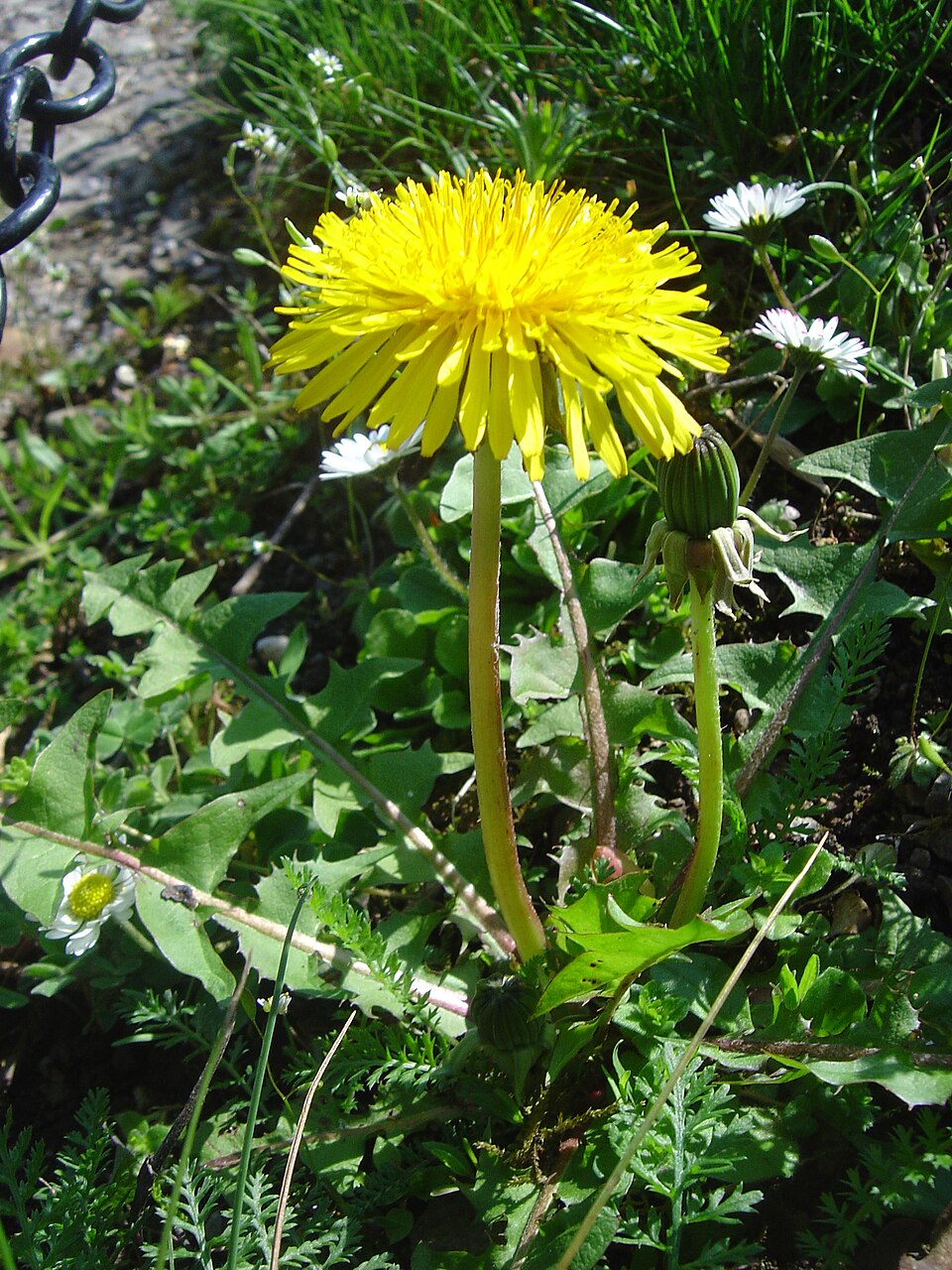
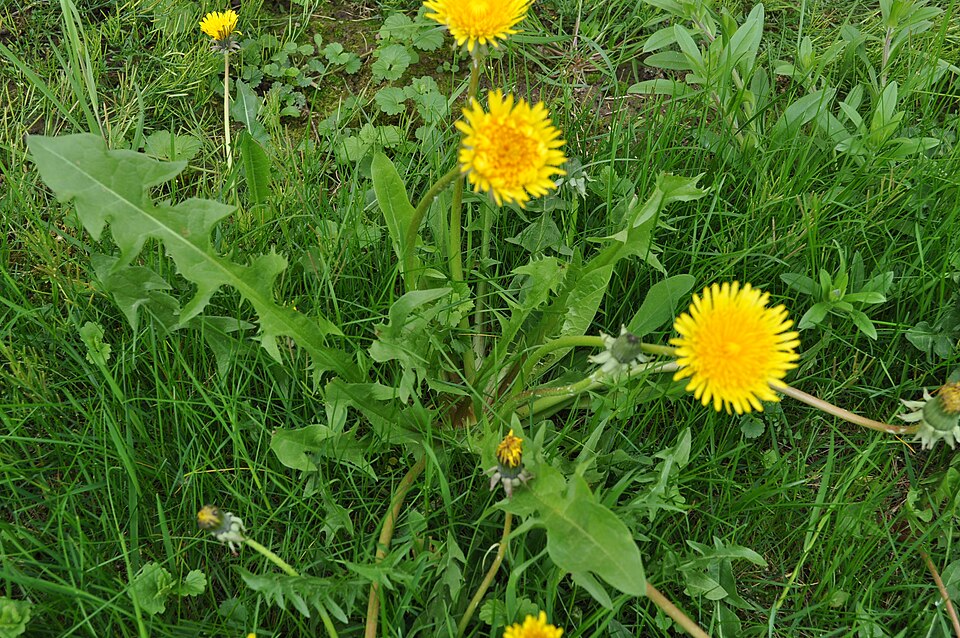
- Bright yellow flower heads, usually about 2–5 cm across, held singly on hollow, leafless stalks.
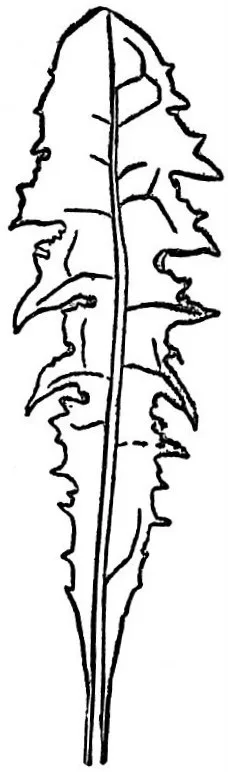
- A basal rosette of green leaves, often deeply cut into pointed lobes.
- A thick, deep taproot from which leaves and flower stalks arise.
- White, milky latex released when a stalk or leaf is broken.
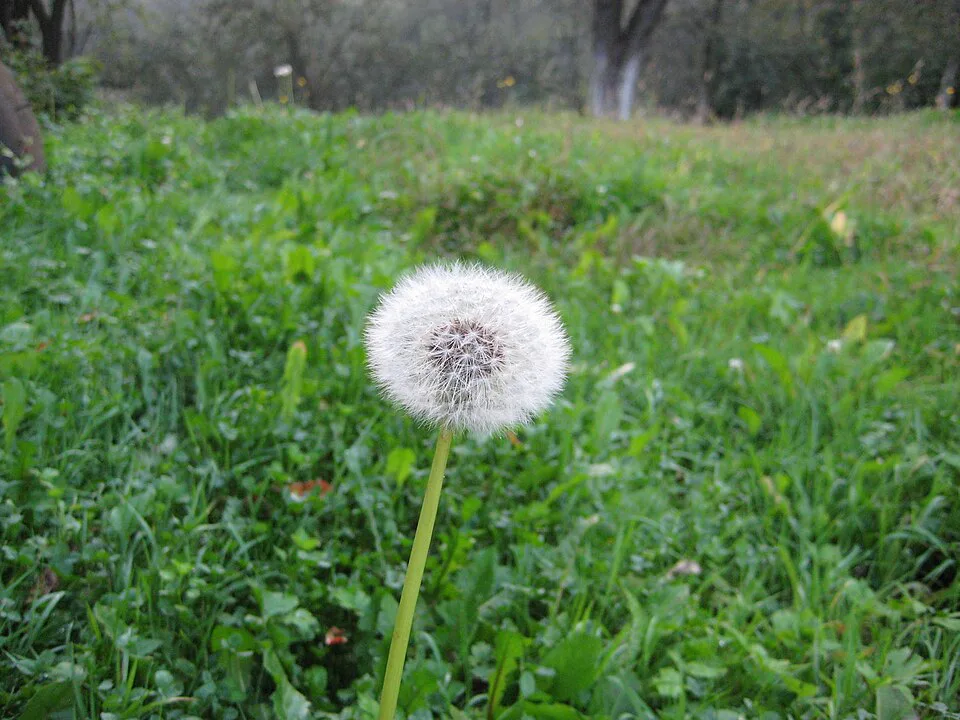
- A rounded, feathery seed clock after flowering.
- Green bracts beneath the flower head, often with an outer row curving downwards.
Leaf shape varies considerably. Some plants have strongly toothed leaves, while others have shallower lobes or almost entire margins.
Flower structure
The apparent single flower is actually a capitulum, a head packed with many individual florets. Every floret has a narrow, strap-shaped yellow corolla with five tiny teeth at its tip. These are called ligulate florets. Unlike the Oxeye Daisy, a Dandelion has no separate central disc of tubular florets.
Looking closely, you may see the darker tips of the styles emerging from the florets. Beneath the head is an involucre of green bracts, including an outer series that often bends backwards.
Leaves and stems
Dandelion leaves grow directly from the crown in a low rosette rather than along the flower stalk. Their distinctive backward-pointing lobes can resemble a row of teeth, although their shape is extremely variable.
Each flower stalk is an unbranched, hollow tube containing milky latex. A mature plant may produce several flower stalks from the same rosette, but each usually carries just one flower head. A substantial taproot anchors the plant and stores food for fresh growth.
Seed clock and dispersal
After flowering, the head closes while the fruits develop. When it opens again, the yellow florets have been replaced by a nearly spherical clock.
Each small, dry, one-seeded fruit is a type of achene, more precisely called a cypsela in the daisy family. It is attached to a slender stalk topped by a pappus of silky hairs. The pappus acts like a parachute, helping the fruit travel on the wind. The fluffy structures are attached to fruits rather than being the seeds themselves.
Many British dandelion microspecies can produce viable seeds without fertilisation, a process called apomixis. This allows a plant to produce offspring genetically very similar to itself.
Habitat and wildlife
Dandelions thrive in lawns, pasture, meadows, field margins, verges and other open, often disturbed ground. They tolerate close mowing and grazing because their leaves remain low to the ground and they can regrow from the root.
Their open, nectar- and pollen-bearing flower heads are visited by bees, hoverflies and other insects, particularly in spring when flowering plants can still be scarce. Some birds also eat the fruits.
Flowering period
Dandelions flower most freely in spring, but further flowers commonly appear from March to October. In mild weather, an occasional Dandelion may flower outside this period.
Similar species
- Cat’s-ear (Hypochaeris radicata) has hairy basal leaves and usually branching flower stalks, rather than one unbranched hollow stalk per head.
- Rough Hawkbit (Leontodon hispidus) has noticeably hairy leaves, a rough, often hairy flowering stalk and hairy bracts beneath the yellow head.
- Common Sow-thistle (Sonchus oleraceus) has yellow heads too, but its taller stem carries leaves and branches into several flowering stalks.
Several other members of the daisy family have similar all-yellow heads, so it helps to check the leaves, stalk and bracts together.
Where the names come from
Dandelion comes from the French dent de lion, meaning ‘lion’s tooth’, referring to the jagged leaf edges. The genus name Taraxacum is thought to derive from the Arabic tarakhshaqūq, possibly originating from the Persian talkh chakok, meaning ‘bitter herb’. Alternative origins have been suggested from Greek words associated with disorders and healing. The Latin officinale was traditionally applied to plants used by apothecaries.
Folklore & history
The Dandelion clock has long been part of children’s games: blowing away the fruits to ‘tell the time’, or making a wish as they drift off on the breeze. Other traditional names include Blowball, Fairy Clock and Piss-a-bed, the latter linked to an old belief that the plant could cause bed-wetting.
Dandelion leaves have long been gathered as a bitter spring green, while the roots were used in traditional herbal preparations. Roasted Dandelion roots were also ground to make a coffee substitute, notably during wartime shortages.