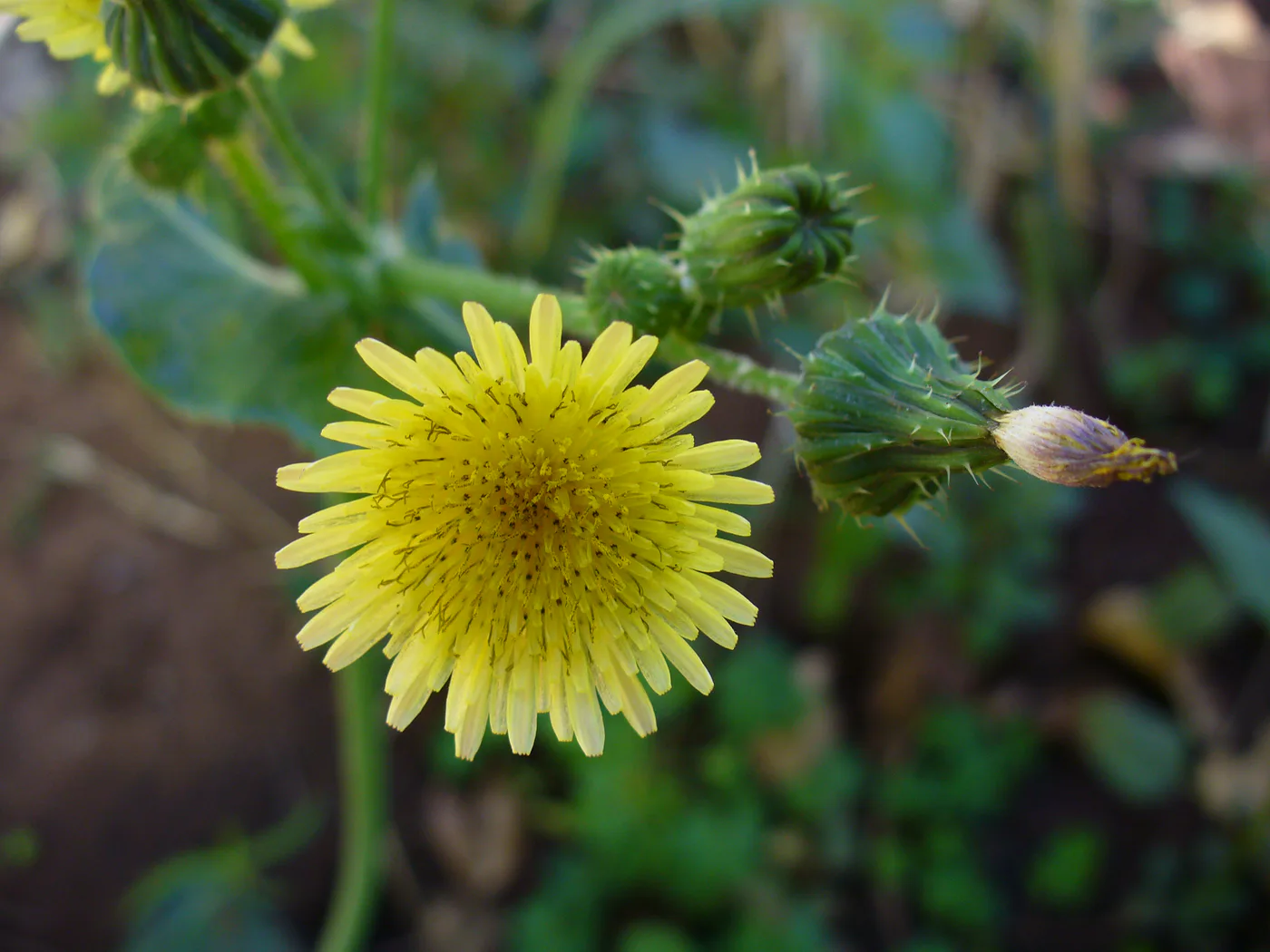
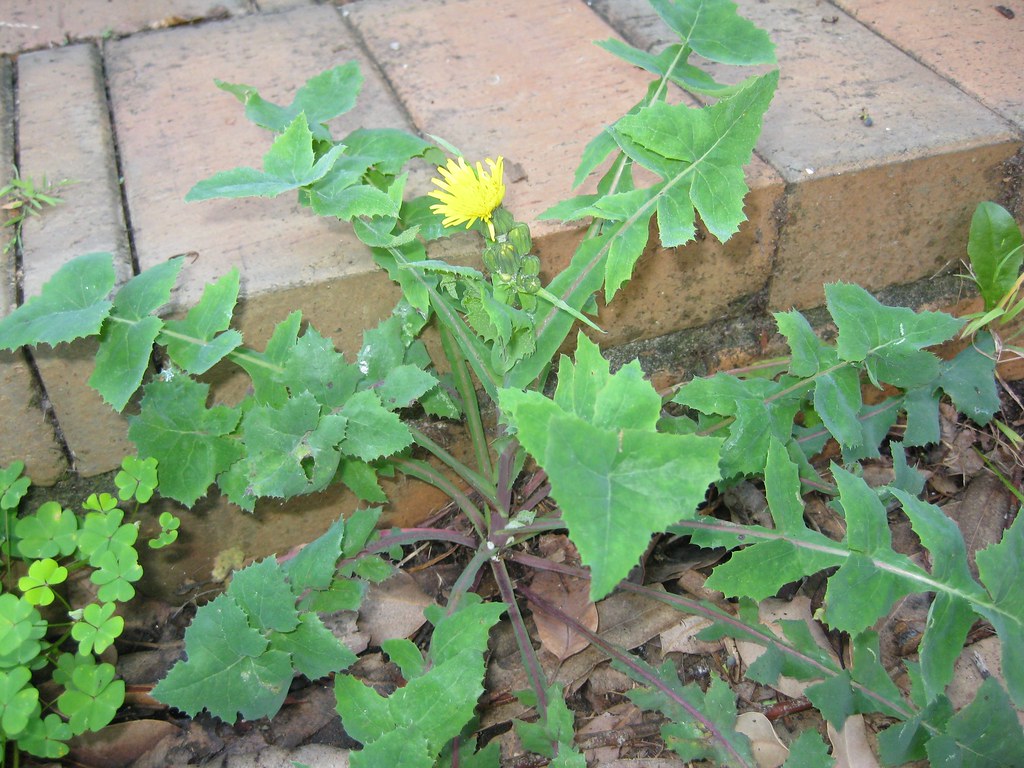
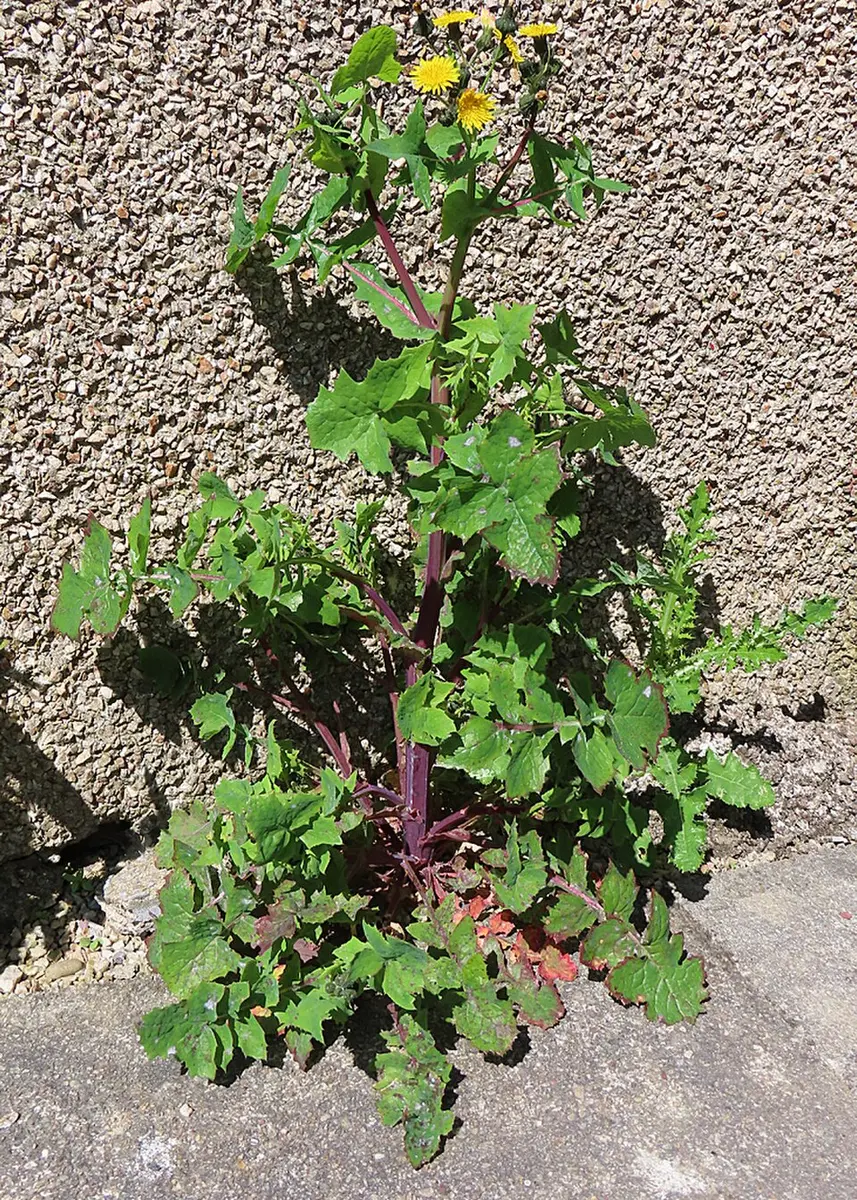
Common Sow-thistle, also called Smooth Sow-thistle, is an upright, yellow-flowered plant found in gardens, field margins, roadside verges and other disturbed places. Its bright flower heads resemble small dandelions, but grow in clusters on a branching, leafy stem. Despite its name, it is not one of the true prickly thistles. It belongs to the daisy family, Asteraceae.
Identification
- Usually 30–120 cm tall, but sometimes reaching around 150 cm on fertile ground.
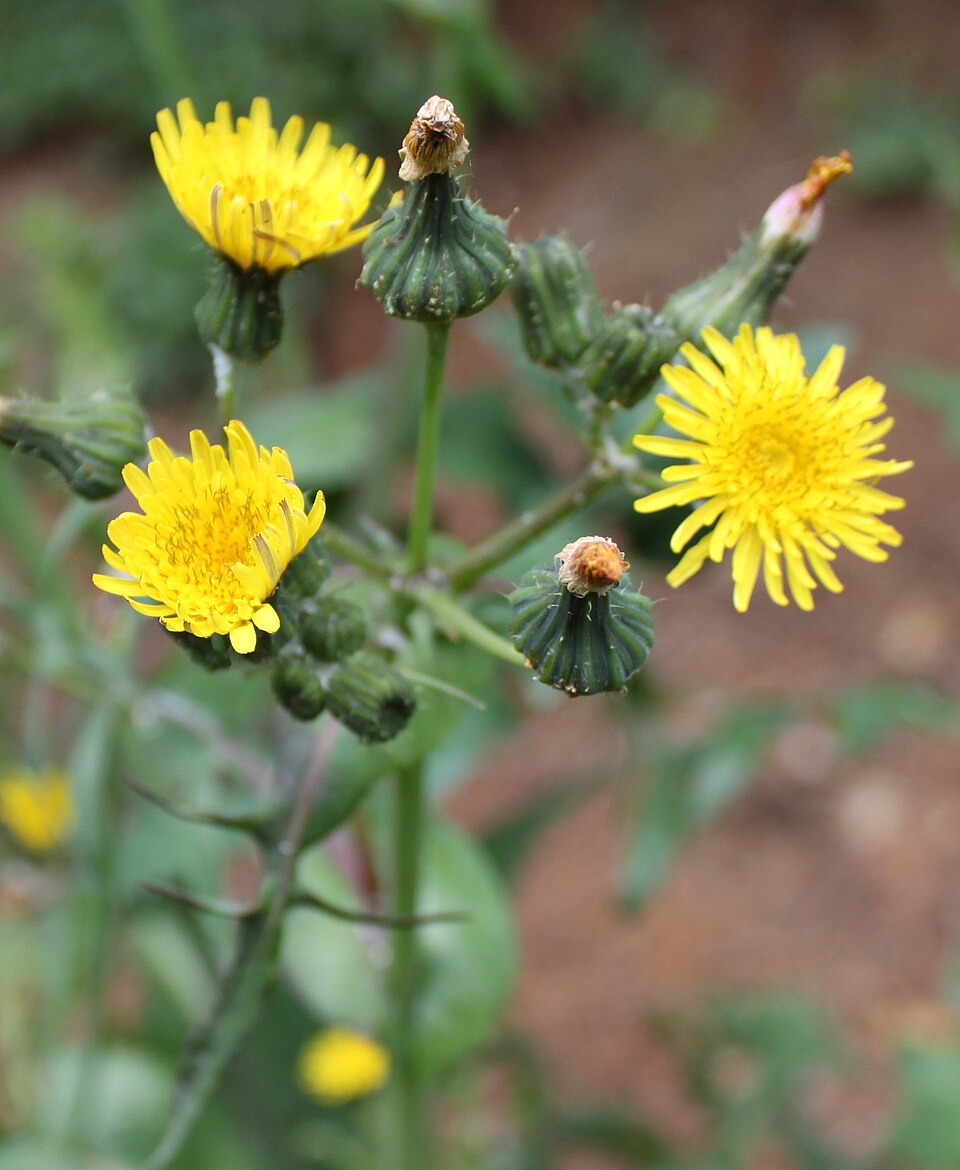
- Several pale to golden-yellow flower heads, typically around 2–2.5 cm across, carried in loose groups at the stem tips.
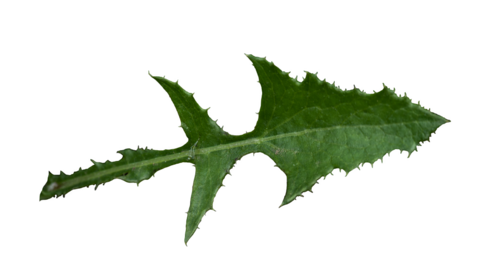
- Deeply or irregularly lobed, often greyish-green leaves with soft prickles along the edges.
- Upper leaves clasp the stem, with small, pointed, outward-facing basal lobes, or auricles.
- An upright, branched, hollow stem that releases white, milky latex when broken.
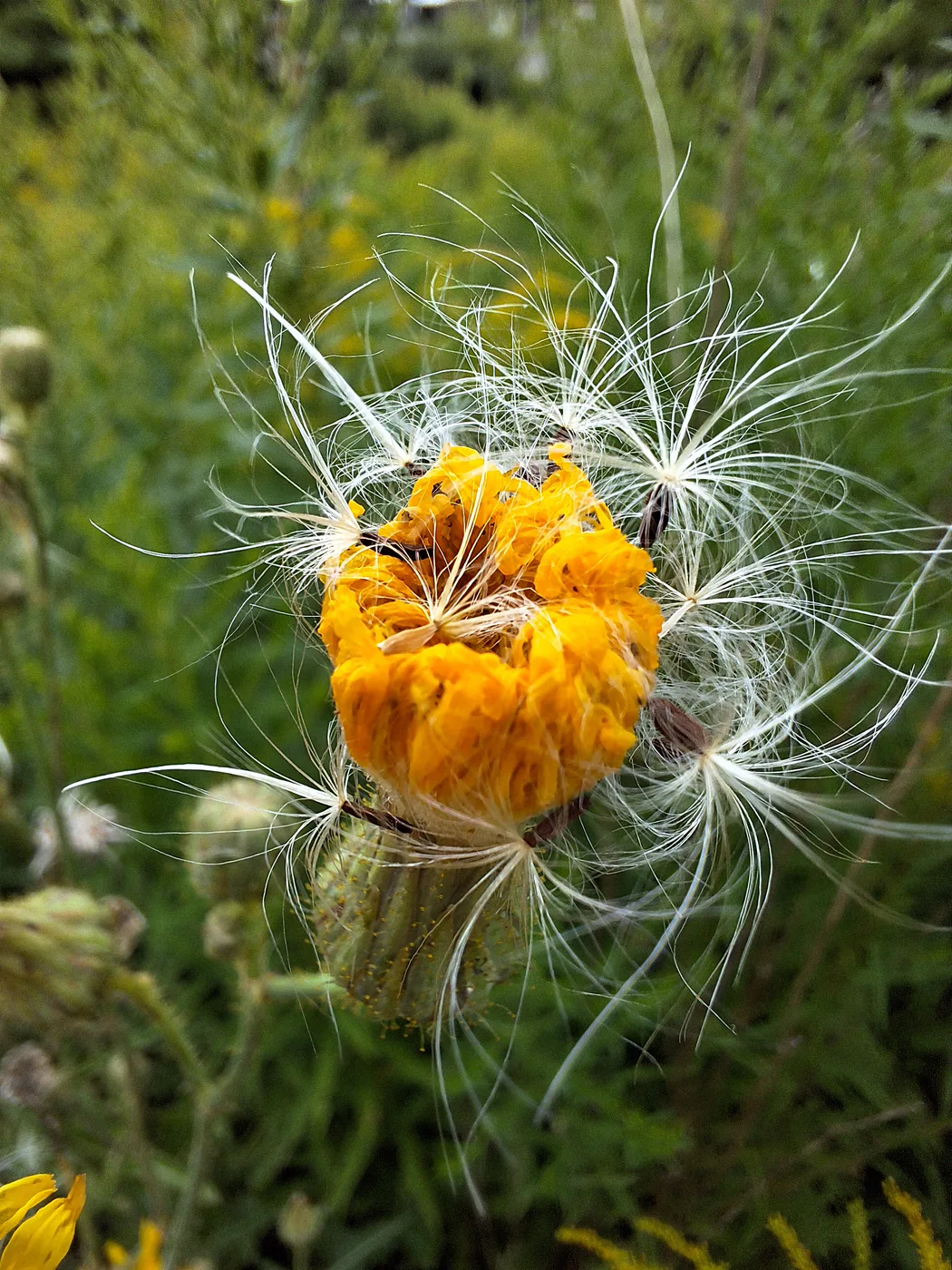
- Fluffy, white seed heads that develop after the yellow flowers fade.
The pointed lobes at the bases of the upper leaves are one of the most useful features for separating it from the closely related Prickly Sow-thistle.
Flower structure
Each apparent flower is a capitulum, a head made up of numerous small florets. All are strap-shaped and yellow, with no separate central disc of tubular florets. The head is enclosed beneath by green bracts, which form a narrow, often flask-shaped base.
The flower heads usually appear in loose, branching clusters rather than singly. Buds may remain closed while nearby heads are already open or developing fruits.
After flowering, each floret can produce a small, dry, one-seeded fruit called an achene, more precisely a cypsela. A soft, white pappus of hairs helps it disperse in the wind.
Leaves and stems
The lower leaves are often deeply divided, with a larger triangular terminal lobe and smaller side lobes pointing backwards. Leaves higher up the stem are generally less divided. Their edges may look prickly, but the teeth are usually softer than those of Prickly Sow-thistle.
The upper leaves have clasping bases with pointed auricles that project outwards from the stem. Their shape is particularly valuable in identification, although it is best to examine several leaves rather than relying on just one.
The stem is hollow and often smooth, sometimes tinged reddish or purple, and contains milky white sap. Unlike the leafless flower stalks of a Dandelion, it carries leaves and branches into several flowering stems.
Habitat
Common Sow-thistle is widespread across the UK. It thrives on open, nutrient-rich or recently disturbed soil, including vegetable beds, arable land, pavements, waste ground, field margins and roadside verges. It is less likely to persist in dense, established grassland where other plants compete strongly for space.
It is usually an annual, although some plants that germinate in autumn survive through winter as leaf rosettes before flowering the following year.
Flowering period
The main flowering period is from late spring through summer and into autumn, usually May to November. Flowers are especially frequent from June to August, but plants can bloom outside these months in mild weather.
Similar species
- Prickly Sow-thistle (Sonchus asper) has more glossy, rigidly prickly leaves. The lobes at the leaf bases are usually rounded and curl back around the stem, rather than ending in outward-pointing tips.
- Perennial Sow-thistle (Sonchus arvensis) usually has larger, deeper yellow flower heads and often bears sticky, yellowish glandular hairs on the upper stems and bracts. It spreads through creeping roots.
- Dandelion has similar yellow heads, but each grows on its own leafless, unbranched, hollow stalk above a basal rosette of leaves.
- Bristly Ox-tongue is also yellow-flowered, but its coarse, rough foliage bears stiff hairs arising from raised bumps, and its flower heads have conspicuously broad outer bracts.
Where the names come from
Sow-thistle is an old country name associated with pigs, which were said to relish its tender leaves. Its toothed foliage resembles that of a thistle, although its prickles are usually much softer.
The name Smooth distinguishes it from the more sharply prickly sow-thistle. Sonchus is an ancient name for this group of plants, while the Latin oleraceus refers to a vegetable or kitchen herb.
Folklore & history
Sow-thistles have been gathered as pot herbs since antiquity. Their young leaves were cooked or eaten fresh in parts of Europe, and the plant appears in older herbal writings under names such as Hare’s Lettuce and Hare’s Colwort.
The old association with sows is sometimes explained by a belief that the plant was favoured by nursing pigs. Its milky sap also encouraged comparisons with other plants traditionally associated with milk.
Wildlife
The small, accessible yellow flower heads attract hoverflies, bees and other visiting insects. Sow-thistles can provide pollen and nectar in gardens and on disturbed ground at times when fewer other wildflowers are blooming.
Their light fruits spread on the wind, helping the plant quickly colonise newly opened patches of soil.