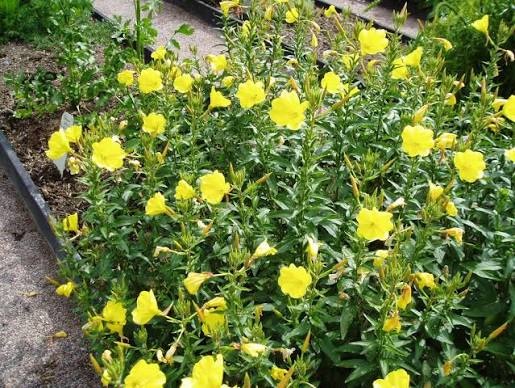
Common Evening-primrose (Oenothera biennis) is a tall, striking wildflower with soft yellow blooms that often open as daylight fades. Native to North America, it has been established in the UK for centuries and is especially at home on sunny, disturbed ground, coastal dunes, railway banks and roadsides. Although its name suggests a relationship with the familiar Primrose, it belongs instead to the evening-primrose family (Onagraceae), alongside the willowherbs. It is often called simply Evening Primrose.
Identification
- An upright biennial, typically 50–150 cm tall, occasionally taller.
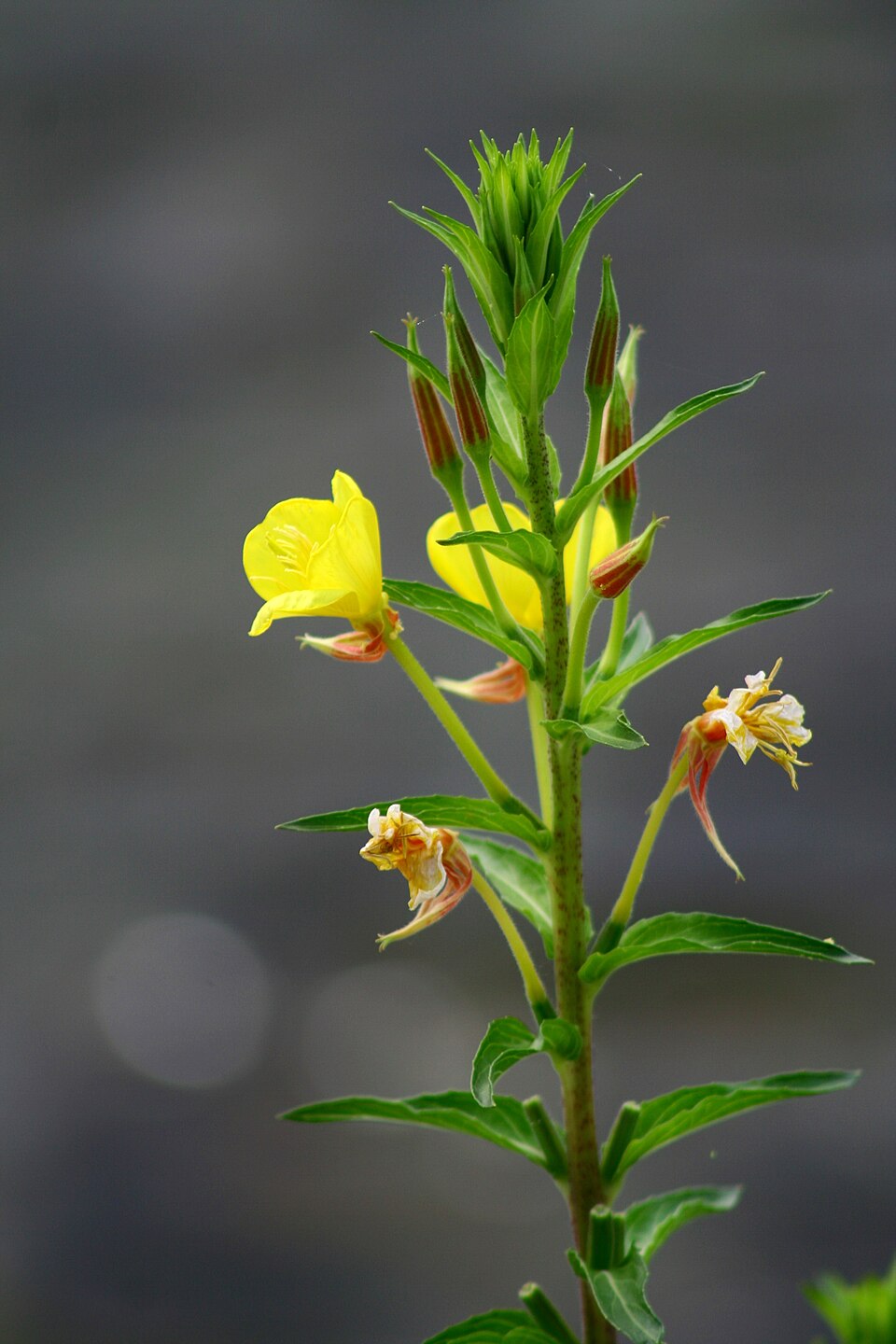
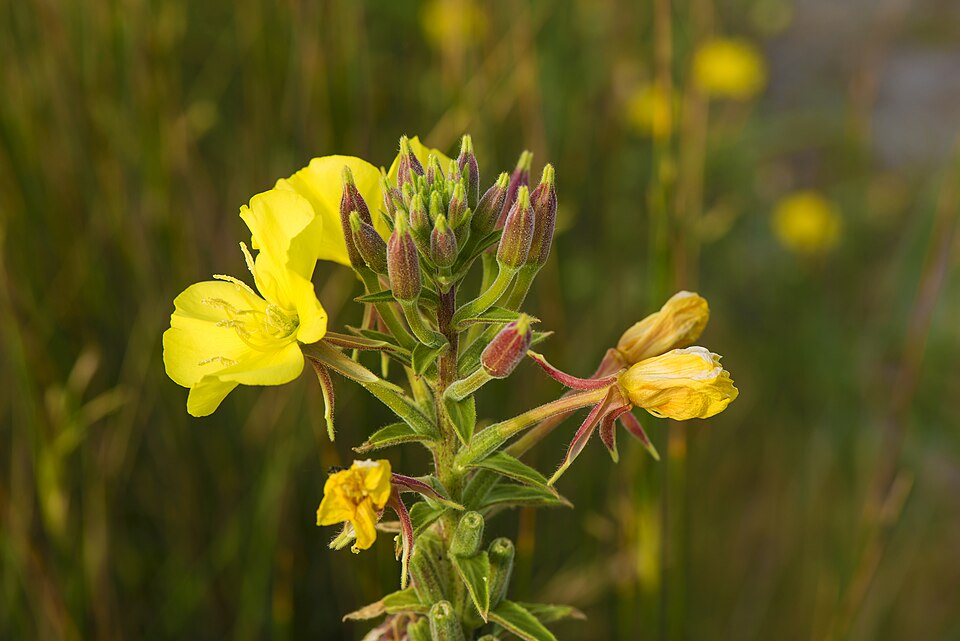
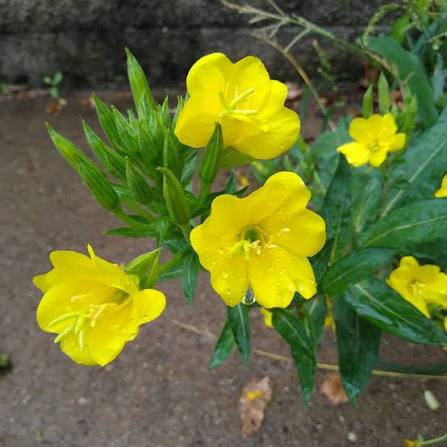
- Flowers are pale to golden yellow, with four broad petals, often around 2–5 cm across, borne towards the top of the stem.
- Flowers usually open in the late afternoon or evening, often fading by the following day; cloudy weather can keep them open longer.
- A long, narrow floral tube separates the petals from the developing seed capsule below.
- The four sepals bend backwards as the flower opens, and eight stamens surround a four-lobed stigma.
- The stems are erect, leafy and often hairy, sometimes with a reddish tinge.
- Leaves are long, rather narrow and slightly toothed or wavy-edged, with a prominent central vein that may be tinged red.
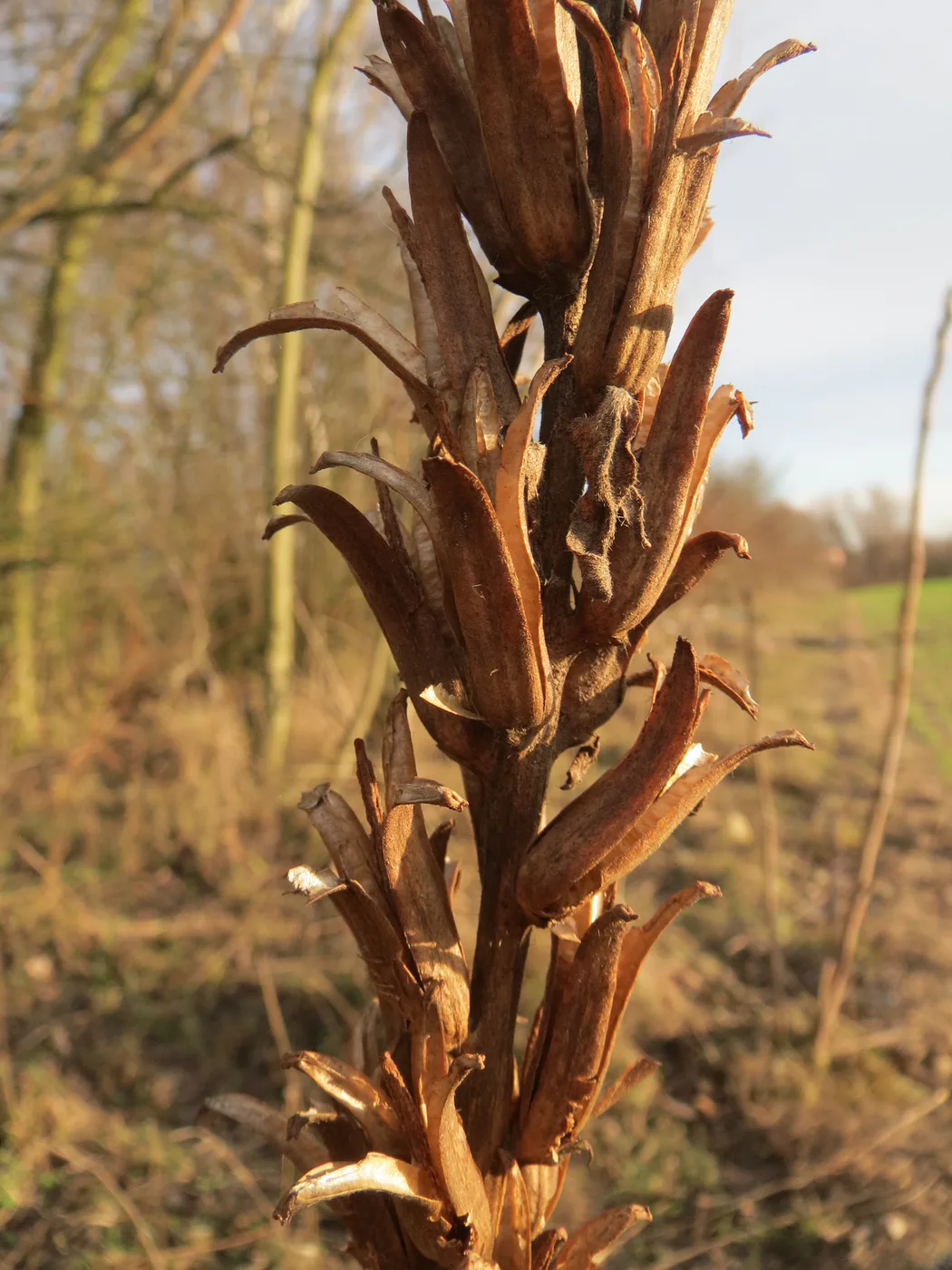
- After flowering, elongated seed capsules develop close to the stem and remain visible into winter.
The evening-opening flowers, pointed buds and tall leafy stem are especially helpful features. Several other evening-primroses grow wild in the UK, so flower size and the colour and shape of the buds and sepals are also worth checking.
Flower structure
Each flower normally has four separate yellow petals, four green sepals and eight stamens. The stamens bear pollen around the central style, which ends in four spreading stigma lobes. These can look rather like a small cross when viewed from the front.
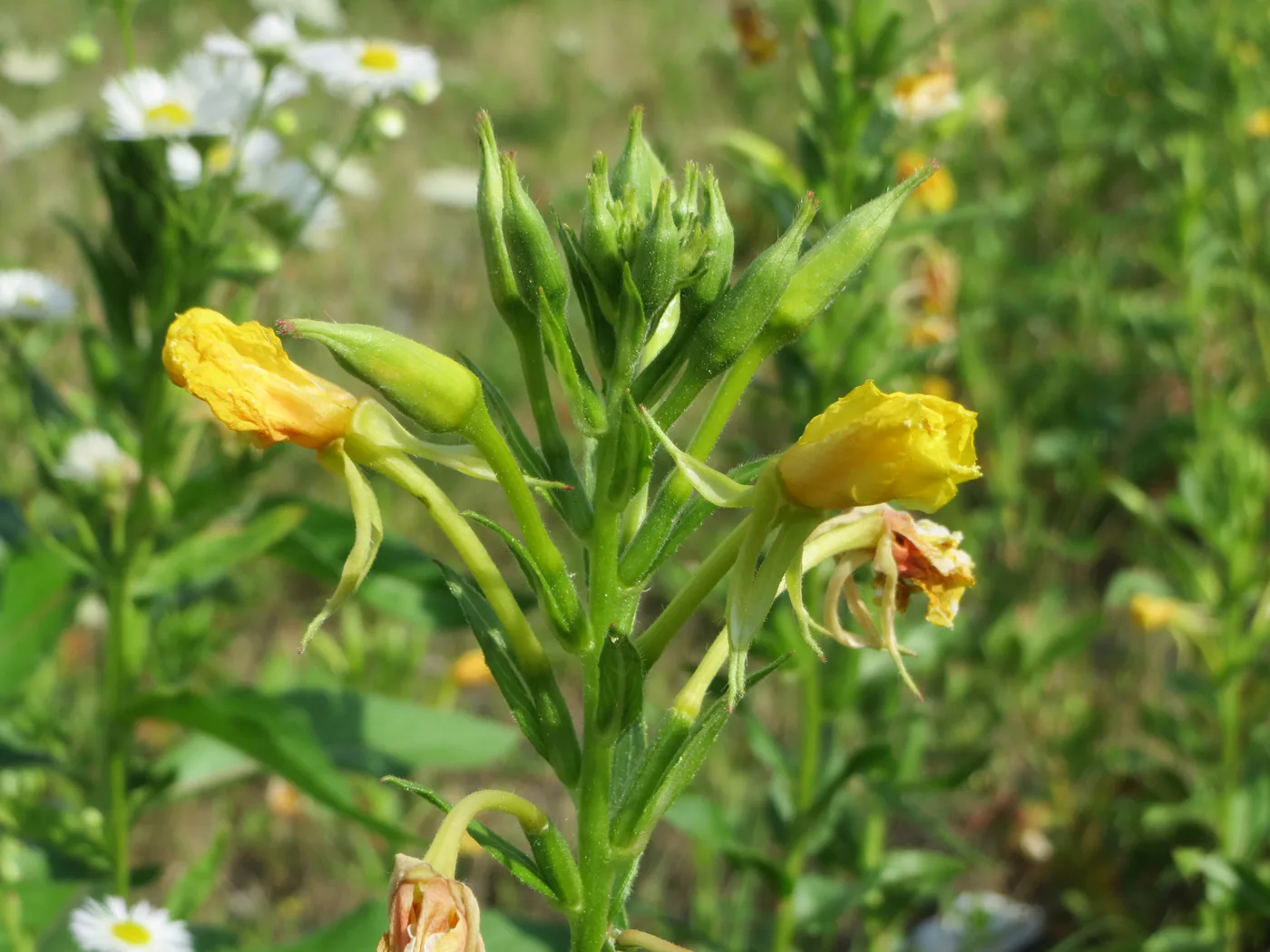
An unusual feature is the long, slender floral tube, with the inferior ovary positioned beneath the other flower parts. The flower may appear to be held out on a stalk, but much of that length is actually the floral tube. The ovary later becomes the seed capsule.
Buds are upright and tapering. Their sepals enclose the folded petals before the flower opens, then bend sharply backwards. New flowers appear in succession along the upper stem, so fresh buds, open flowers and fading blooms can be seen together.
The flowers are usually sweetly scented and often unfold quite quickly at dusk. Their scent and timing make them attractive to night-flying moths, though bees and other insects may also visit when blooms remain open in daylight.
Leaves and stems
During its first year, Common Evening-primrose usually forms a low rosette of oblong to lance-shaped leaves. These lie close to the ground and store energy for the following year’s growth.
In its second year the plant sends up a tall, usually unbranched or sparingly branched flowering stem. The stem leaves are alternate, becoming smaller higher up the plant. They are green, sometimes slightly hairy, with a conspicuous midrib that may be reddish. Their margins may be gently wavy or finely toothed, rather than strongly lobed.
The height, upright growth and long leaves help distinguish an established plant from a Primrose, which is much lower and has a completely different flowering habit.
Seeds and capsules
Once a flower has been pollinated, its ovary grows into a narrow, elongated capsule. These capsules sit close to the stem, often in a dense group below the newest flower buds.
The capsules dry and split as they mature, releasing numerous tiny seeds. Unlike those of Rosebay Willowherb, Evening-primrose seeds do not have conspicuous silky parachutes for wind dispersal. The persistent, dried seed-bearing stems can remain visible through autumn and winter.
The seeds contain an oil rich in fatty acids. Evening-primrose oil, widely known today, is extracted from these seeds.
Habitat
Common Evening-primrose favours open, sunny places with free-draining soil. In the UK it is especially associated with sand dunes, shingle, sandy roadsides, railway land, waste ground and other places where the soil has recently been disturbed. It also escapes from gardens.
Its ability to establish in bare, often rather poor soil makes it a conspicuous plant of coastal and urban wasteland. It is a naturalised introduction rather than a native UK wildflower.
Flowering period
The main flowering season is June to September, with a particularly noticeable display in midsummer and late summer. Flowers often begin opening around sunset, though the exact time varies with temperature, weather and day length.
Similar species
- Large-flowered Evening-primrose (Oenothera glazioviana) often has much larger yellow flowers and strongly red-tinged buds, flower stalks or sepals. It is another introduced evening-primrose established in the UK.
- Small-flowered Evening-primrose (Oenothera parviflora) generally has smaller flowers. It can be difficult to separate from Common Evening-primrose without examining several flower and bud features.
- Primrose (Primula vulgaris) has pale yellow flowers with five joined petals and a low spring-flowering habit. It is not related to Evening-primrose.
- Yellow Loosestrife (Lysimachia vulgaris) also bears yellow flowers on tall stems, but its flowers normally have five petals and its leaves are often in opposite pairs or whorls.
Where the names come from
The name Evening-primrose describes the plant’s most memorable feature: its flowers commonly open as the daylight fades. A plant that looks like a collection of tightly closed yellow buds during the day may suddenly display fresh blooms towards sunset. The name Evening Star has also been used, reflecting its twilight flowering.
The second part of the name is a comparison with the yellow flowers of the familiar Primrose. The resemblance is superficial: ordinary primroses belong to Primulaceae, whereas evening-primroses are members of Onagraceae.
The scientific name Oenothera has a long and somewhat uncertain history. It is linked to the ancient Greek words oinos, meaning wine, and thēra, often interpreted as seeking or catching. The name was used for plants in classical writings before being adopted in modern botany, so explanations connecting it directly with the modern Evening-primrose should be treated cautiously. The species name biennis means ‘lasting two years’, a reference to the plant’s usual life cycle: a leafy rosette in the first year, followed by flowering and seed production in the second.
Another evocative name is Night Candle, a reference to the bright yellow blooms appearing in the evening, rather like small lanterns along the stem.
Folklore & history
Common Evening-primrose comes from North America, where Indigenous communities used parts of the plant long before its introduction to Europe. Historical records describe uses of its roots and other parts as food and in traditional preparations. It later attracted attention in European gardens because of its unusual habit of opening flowers around dusk.
It was being cultivated in Britain by 1629, and a record of its appearance in the wild dates to 1725. Over time it escaped from cultivation and became established on sandy or disturbed ground. Its occurrence on British dunes and railway embankments today is part of that much longer story of introduced plants becoming familiar features of the landscape.
The dramatic opening of the blooms has always invited observation. On still summer evenings, the petals may visibly unfold over a short period, offering the impression that the plant has come to life as the light disappears. This helped inspire romantic names such as Evening Star and Night Candle.
In later centuries its seed oil became much more widely known than the plant itself. Evening-primrose oil is obtained by pressing the small seeds and has been sold for a variety of purposes. In botanical terms, it is particularly interesting that this familiar oil comes from the unassuming capsules left behind after the showy yellow flowers have faded.
Wildlife
The evening-opening, fragrant flowers are adapted to attract night-flying moths, some of which can reach into the floral tube for nectar. Bees and other insects may also visit open flowers during the day, especially in the morning.
The plant is an example of how flower shape, scent and opening time can work together to attract pollinators. Its seeds may also be taken by small birds, while the persistent stems give structure to otherwise bare ground later in the year.