Greater Celandine (Chelidonium majus) is a familiar wildflower of old walls, hedgerows, roadside verges and neglected corners. Its small, yellow flowers may initially suggest a buttercup or mustard, but the combination of four petals, softly lobed leaves and vivid orange sap makes it distinctive. It is a member of the poppy family (Papaveraceae), not a relative of Lesser Celandine, which belongs to the buttercup family.
Identification
- An upright, branching, short-lived perennial or sometimes biennial, usually 30–90 cm tall.
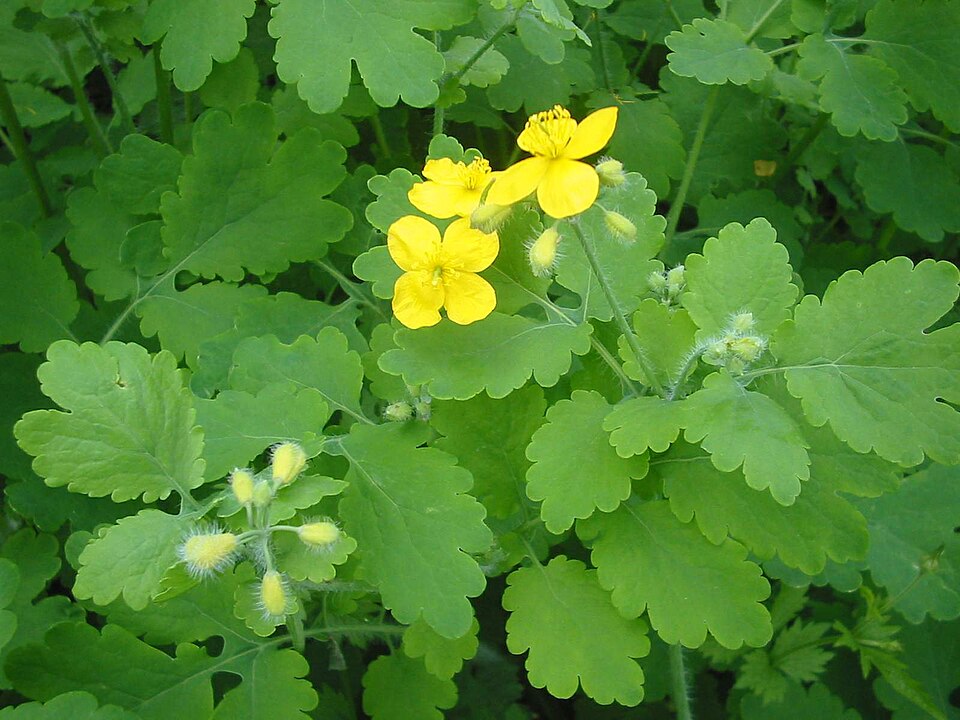
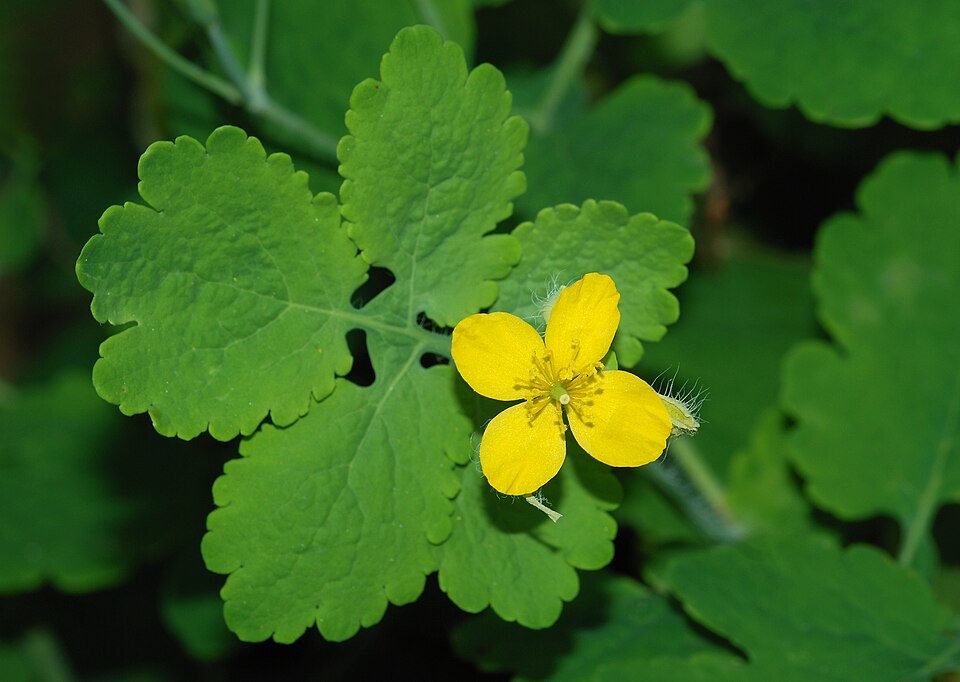
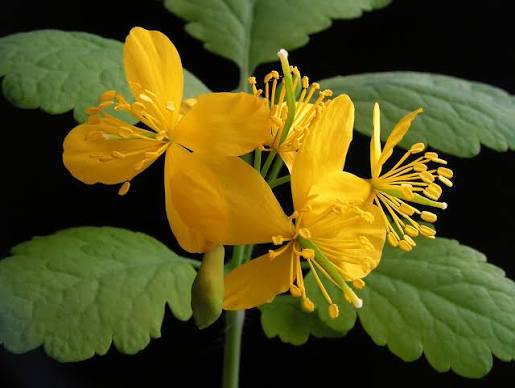
- Small, bright yellow flowers, generally 1.5–2.5 cm across, with four separate petals that do not usually overlap.
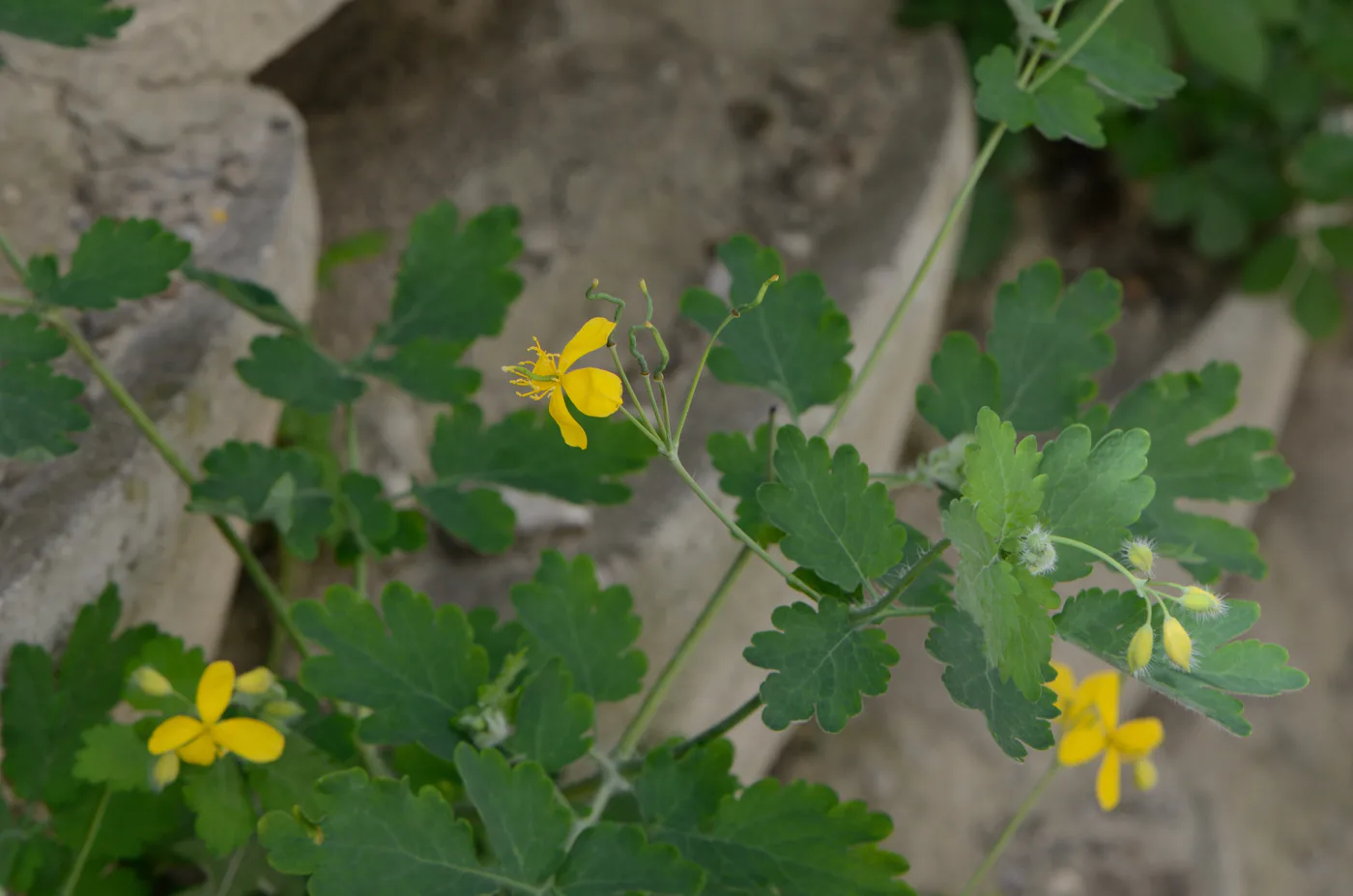
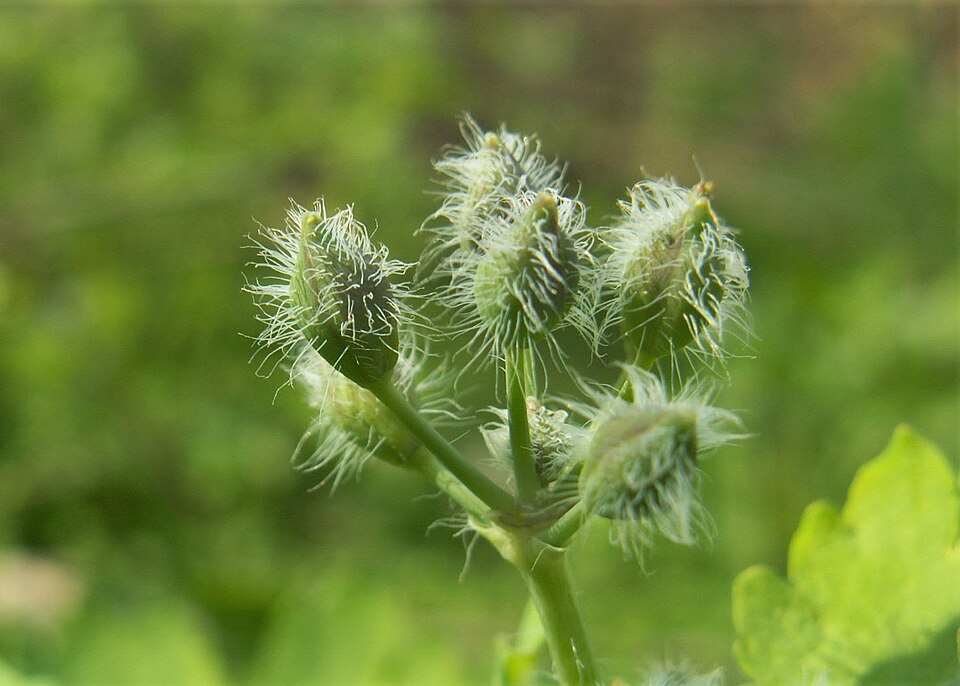
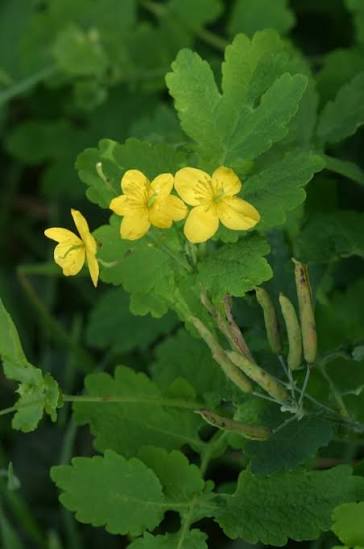
- Flowers held in loose groups near the tips of the stems; several buds, flowers and young fruits may be visible together.
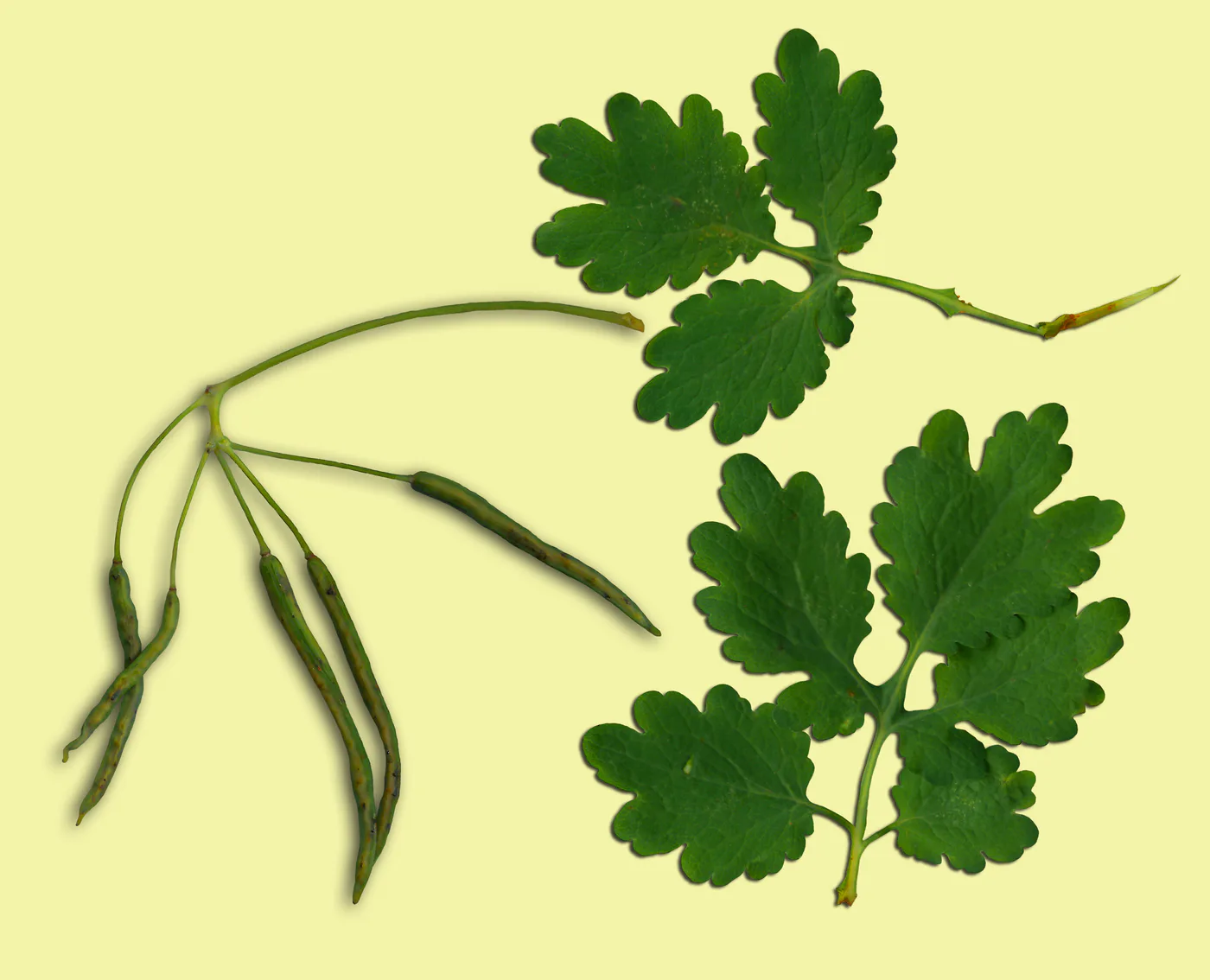
- Deeply divided, blue-green leaves with broad, rounded, irregularly toothed lobes; the undersides are often paler.
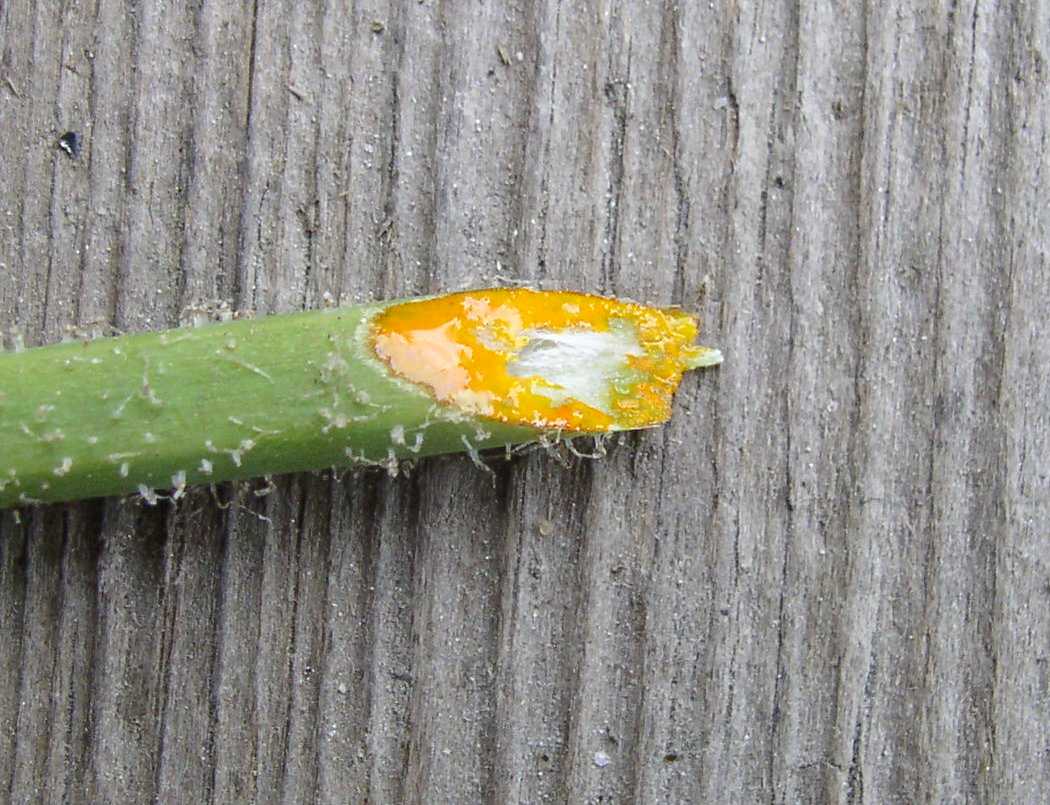
- Rather brittle, sometimes sparsely hairy stems that release conspicuous yellow-orange latex when broken.
- Long, slender, upright or spreading seed capsules after flowering, often 3–5 cm long.
The orange sap is one of the strongest clues, although a plant can usually be recognised without damaging it by examining its flowers, leaves and seed capsules.
Flower structure
Each yellow flower has four free petals, arranged around numerous stamens bearing yellow pollen. Before the flower opens, two sepals protect the bud; these normally fall away as the petals expand, a characteristic also seen in many other members of the poppy family.
In the centre is a single elongated ovary formed from fused carpels. After pollination, this develops into a thin, pod-like capsule. It may resemble the seed pod of a mustard, but it is not a true silique: its internal structure is different. At maturity the capsule opens lengthwise to release small, dark seeds.
Flowers are commonly arranged in a loose, almost umbel-like cluster, although their branching pattern is not a true simple umbel. As the flowering season progresses, individual stems may carry open flowers beside mature and immature capsules.
Leaves and stems
The leaves are alternate and pinnately divided, with rounded, sometimes rather uneven lobes and shallow teeth along the edges. Their upper surfaces are green while the undersides can appear grey-green or bluish. The foliage looks softer and more irregularly rounded than the narrow leaves of many other yellow-flowered wildflowers.
The stems are branched and relatively brittle. When cut or broken, they produce a striking orange-yellow latex, also found in the leaves and roots. This coloured sap is a hallmark of Greater Celandine and helps distinguish it from the yellow-flowered members of the cabbage and buttercup families. The sap is acrid and may irritate or stain the skin.
Seeds and dispersal
Following flowering, narrow, slightly curved capsules develop and eventually split open into two long valves. Inside are small, dark seeds, each bearing a pale, fleshy attachment called an elaiosome.
These attachments are attractive to ants, which carry the seeds away and feed on the nutrient-rich elaiosomes. The seeds may then be left in soil or cracks some distance from the parent plant. This helps explain why Greater Celandine often appears in unexpected crevices, around old masonry and beneath hedges.
Habitat
Greater Celandine is well established across much of the UK, particularly around settlements, old gardens, hedgerows, rubble, churchyards and the bases of walls. It also occurs along woodland edges and on shady banks, especially where the soil is reasonably fertile or disturbed.
It often thrives in the sheltered, slightly untidy places that receive little cultivation. Individual plants may self-seed freely, so an established patch can persist for many years even though individual stems are short-lived.
Flowering period
Greater Celandine commonly flowers from April to October. Its main display is in spring and early summer, but fresh flowers can continue appearing on branched stems well into autumn, particularly in mild conditions.
Similar species
- Lesser Celandine (Ficaria verna) is a much lower, early-spring plant with glossy heart-shaped leaves and usually eight to twelve shining yellow petals. Despite the shared name, it belongs to Ranunculaceae, the buttercup family.
- Charlock (Sinapis arvensis) has four yellow petals, but they form a more obvious cross and the flower normally has six stamens. Its rough leaves and lack of orange latex also distinguish it.
- Perforate St John’s-wort (Hypericum perforatum) has five yellow petals, numerous stamens and opposite leaves dotted with translucent glands when held to the light.
- Yellow-flowered buttercups generally have five petals and different leaves and fruits; they do not produce Greater Celandine’s characteristic long capsules or orange sap.
Where the names come from
The name Celandine has a surprisingly close connection with birds. Chelidonium comes from the ancient Greek chelidōn, meaning ‘swallow’, and reached English through Latin and later European forms of the word. Ancient writers associated the plant with the seasonal return of swallows, believing that it began flowering when the birds arrived and faded as they departed.
There was another explanation, even more memorable: people believed that parent swallows used the plant to restore the sight of their chicks. The story was repeated by classical authors including Dioscorides and Pliny the Elder, helping to establish alternative names such as Swallow-wort and Swallow-herb.
The species name majus is Latin for ‘greater’ or ‘larger’. Greater Celandine earned that description in contrast to the much smaller Lesser Celandine. Although early herbalists grouped the two plants together because of their yellow flowers and traditional names, botanists now place them in different families.
Other old names include Tetterwort, associated with traditional treatment of skin complaints called tetters, and Wartwort, a reminder of the orange sap’s use in country medicine.
Folklore & history
The swallow story gave Greater Celandine an unusually long place in European folklore. Dioscorides and Pliny, writing in the first century AD, described traditions that linked the plant to swallows and to remedies for failing eyesight. Later herbalists preserved these ideas, making the plant one of the better-known herbs of medieval and Renaissance medicine.
In his Herball of 1597, John Gerard described the plant’s juice as being ‘of the colour of Saffron’ and repeated older beliefs about its use for eye conditions. His account shows how closely the plant’s bright orange sap and the swallow legend had become entwined in herbal tradition.
The botanist and herbal writer John Parkinson took a more questioning approach in Theatrum Botanicum (1640). He pointed out that the old claim about celandines appearing and disappearing with swallows did not fit what could actually be observed: Greater Celandine could remain green well beyond the birds’ visit, while Lesser Celandine flowered much earlier. It is a charming example of a naturalist challenging a famous piece of botanical folklore by watching the plants themselves.
Greater Celandine was also widely associated with warts and other skin blemishes. In traditional country practice its orange juice was dabbed on warts, giving rise to names such as Wartwort and Tetterwort. The coloured sap also contributed to beliefs about treatments for jaundice, reflecting an old herbal habit of connecting a plant’s appearance with the ailments it was thought to address.
Wildlife
The flowers provide pollen, and some nectar, for small bees, hoverflies and other visiting insects. Although the individual blooms are modest, their long flowering period makes them a useful feature in sheltered corners and along hedge bases.
The seeds have a particularly interesting relationship with ants. Each seed carries a nutrient-rich elaiosome, which encourages ants to collect and move it. After taking the edible attachment, the ant may leave the viable seed elsewhere, helping the plant colonise cracks, loose soil and nearby sheltered places.