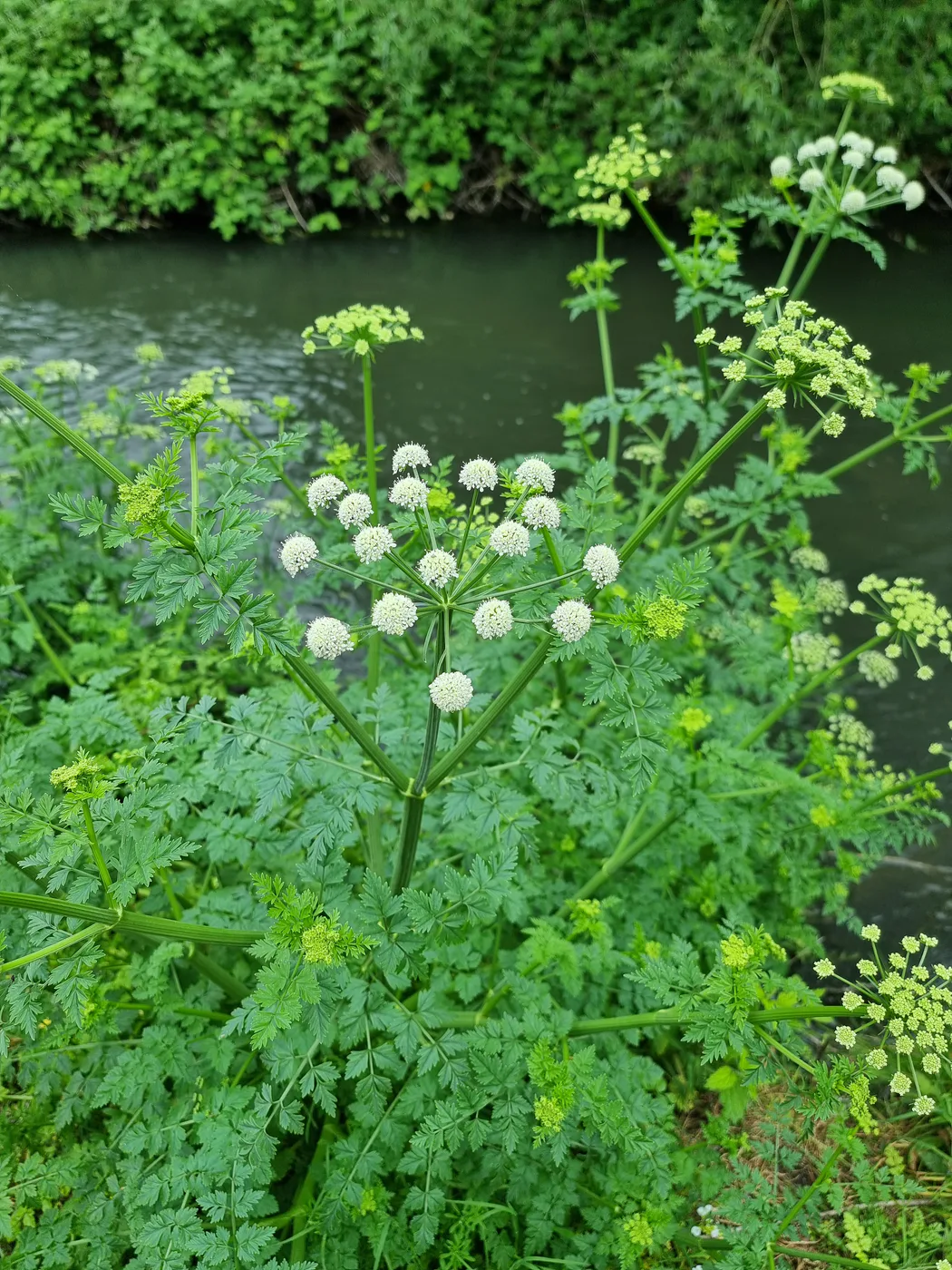
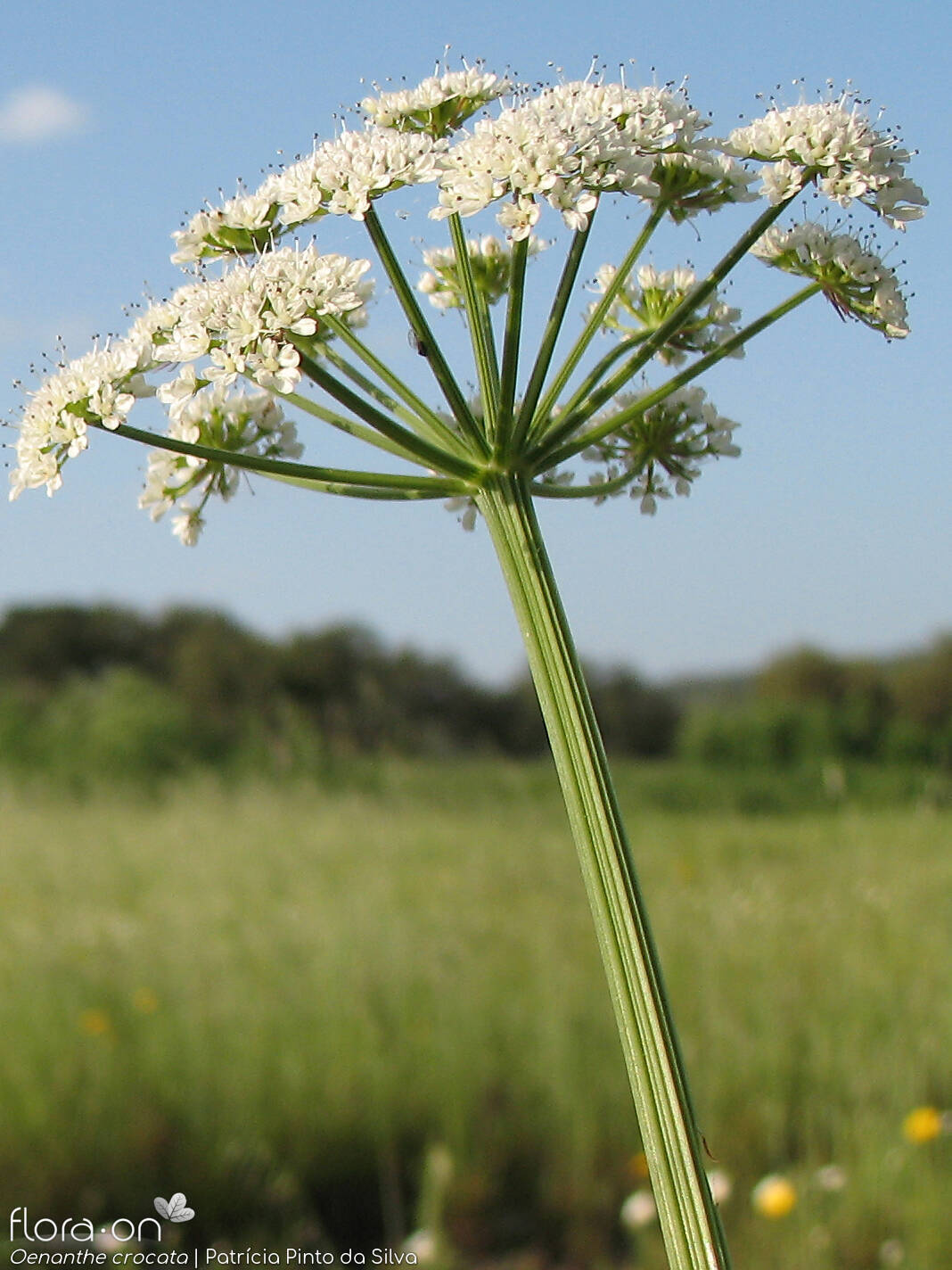
Hemlock Water-dropwort is a tall, robust perennial of stream banks, wet ditches and marshy ground. Its summer flowerheads are made up of dense clusters of tiny white flowers, carried above glossy, deeply divided leaves. It belongs to the carrot family (Apiaceae), but has a particularly strong association with waterside habitats. The species is native to the UK and is among its most poisonous wild plants.
Identification
- A substantial perennial, often reaching 1–1.5 m, sometimes forming dense stands along watercourses.
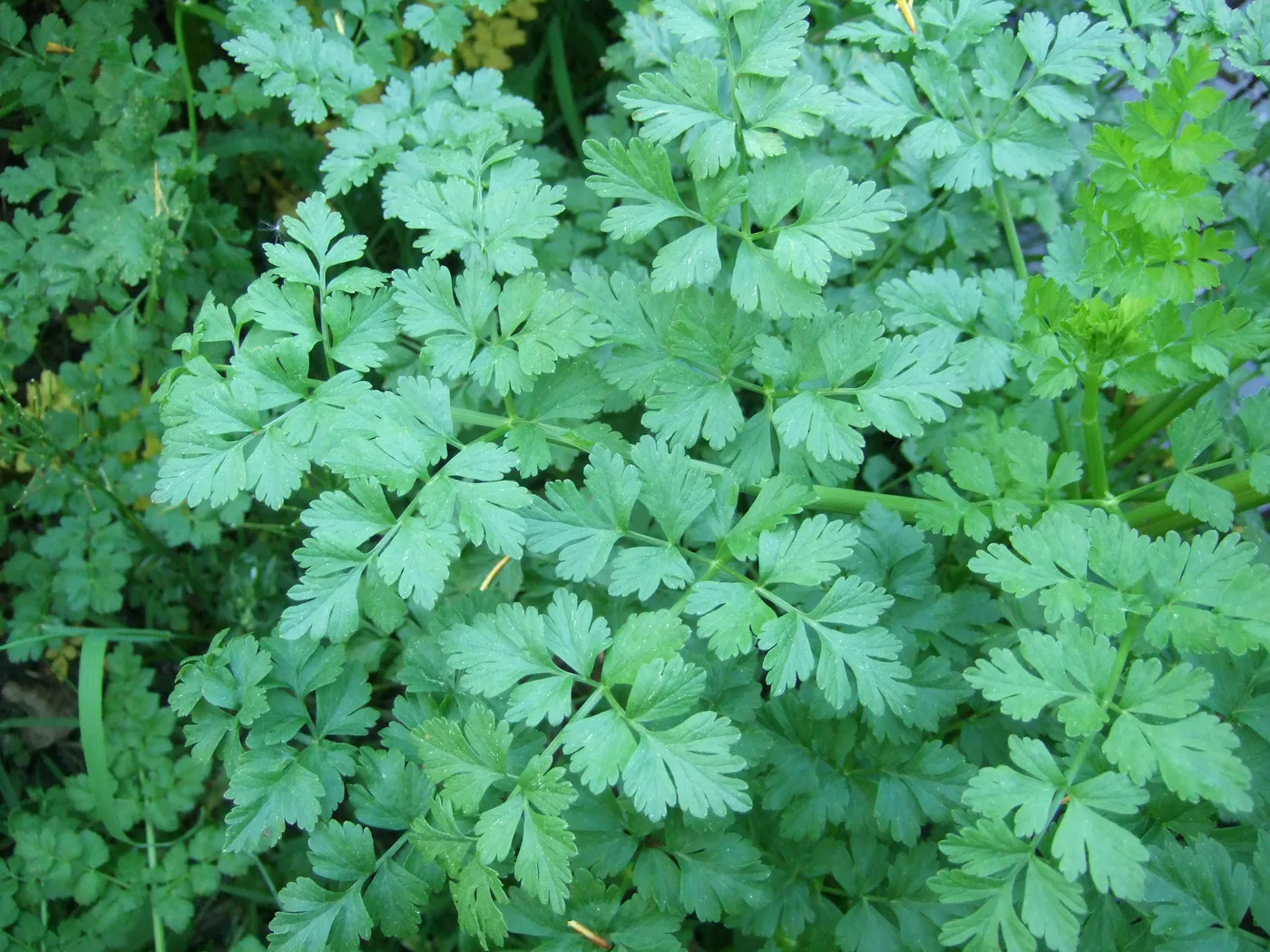
- Bright to dark green, often glossy, almost hairless leaves, divided repeatedly into rather broad, toothed or rounded-lobed leaflets. The upper leaves may be much more finely divided.
- Tall, green, hairless, hollow stems with conspicuous lengthwise grooves. Unlike Hemlock, they are not characteristically marked with dark purple blotches.
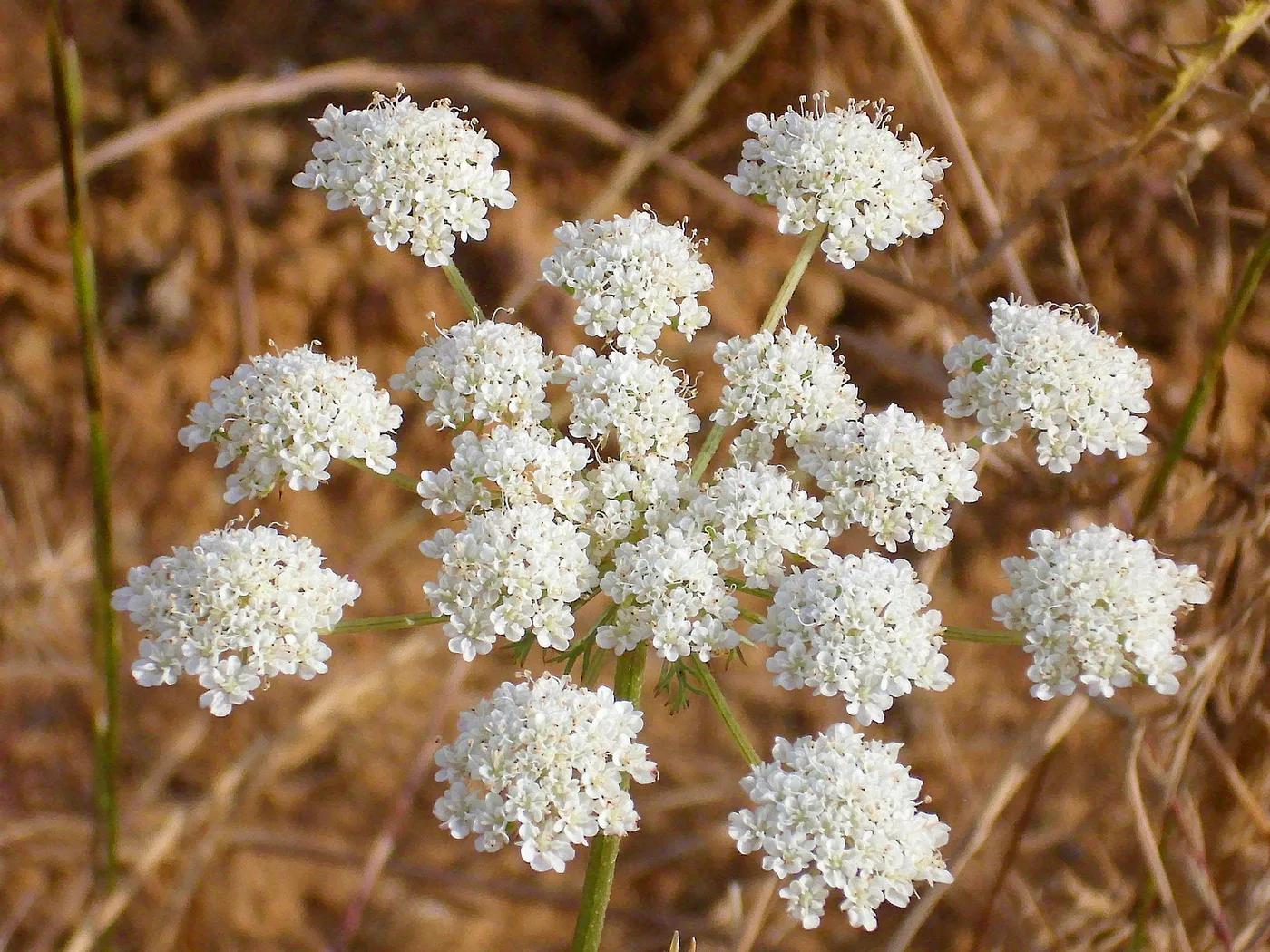
- White flowers arranged in rounded compound umbels, often around 5–10 cm across.
- Thick clusters of elongated underground root tubers, sometimes likened to small parsnips or fingers. These are a feature of the species, but there is no need to uncover them for identification.
- Often grows in wet soil or shallow water along ditches, streams and rivers.
The combination of wet habitat, glossy divided leaves, grooved stems and closely packed white umbels is useful. No single feature is sufficient on its own, especially among the many similar-looking members of Apiaceae.
Flower structure
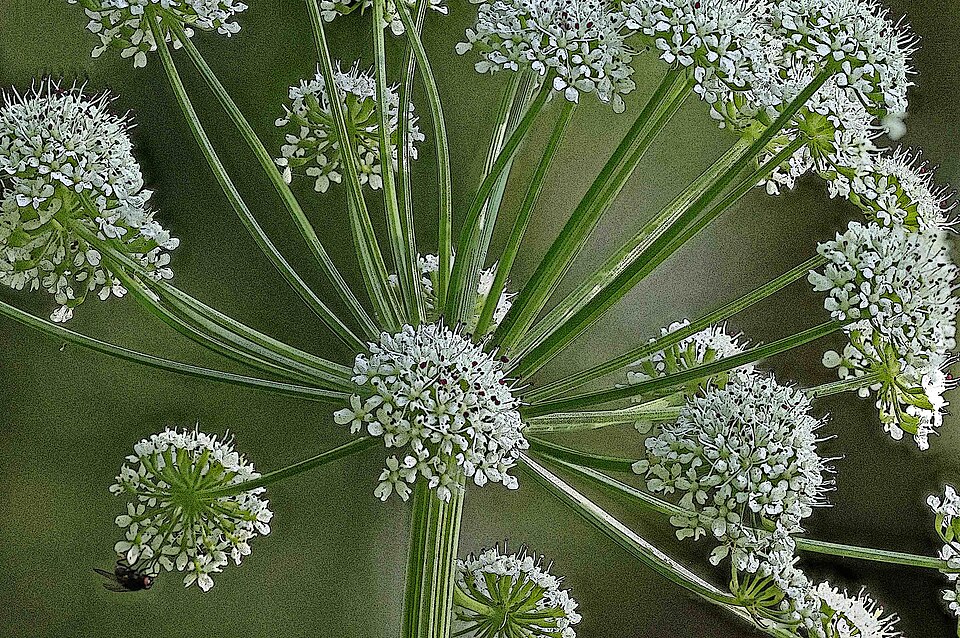
The white flowers are grouped in compound umbels. A number of main stalks, called rays, spread from one point at the top of a stem. Each ray supports a smaller cluster, or umbellet, giving the inflorescence its characteristic umbrella-like outline. The umbellets can be rounded or slightly domed, making the flowerheads look more compact than the airy sprays of Cow Parsley.
An individual flower has five small white petals and usually five stamens. Small bracts may occur below the main umbel, while narrower bracteoles are often present below its individual umbellets. These details are useful when comparing water-dropworts.
Leaves and stems
The leaves are one of the best features to study. The lower leaves are large, glossy and repeatedly divided, with relatively broad wedge-shaped leaflets cut into rounded or toothed lobes. Higher up, the divisions are usually narrower and more delicate. This difference can make the upper and lower parts of the same plant appear surprisingly unlike one another.
The leaf stalks have sheathing bases around the stem. The stems are sturdy, hollow and strongly grooved, and branch above the leafy base. In damp, nutrient-rich places the foliage may form a dense stand even before the first flowers appear.
Fruits and seed dispersal
After flowering, the green ovaries develop into dry, elongated fruits with visible ridges. As in other members of the carrot family, a mature fruit is a schizocarp that ultimately separates into two one-seeded halves, called mericarps. The seedheads gradually lose their fresh white appearance as the fruits ripen.
Habitat
Hemlock Water-dropwort is closely associated with damp or waterlogged ground, particularly along streams, rivers, drains, canals, wet woodland edges and marshy meadows. It can grow at the water’s edge and sometimes in shallow water. It is especially familiar in western and southern parts of the UK and can form striking local colonies.
Flowering period
The main flowering season is June to August, although flowers may appear earlier in favourable conditions. The divided leaves can be conspicuous well before flowering, especially in spring.
Similar species
- Hemlock (Conium maculatum) is another highly poisonous white-flowered member of Apiaceae. It typically has much finer, fern-like foliage and smooth stems with conspicuous purple blotches. It also grows in less consistently wet places.
- Cow Parsley (Anthriscus sylvestris) usually flowers earlier, has softer, more feathery-looking foliage and tends to produce lighter, airier flower clusters. It frequently grows on drier verges and hedge banks.
- Hogweed (Heracleum sphondylium) has much larger, coarser leaf divisions, hairy stems and flowerheads with conspicuously unequal outer petals.
- Fine-leaved Water-dropwort (Oenanthe aquatica) is a wetland relative with much narrower, more finely divided upper leaves and often a more delicate, branching appearance.
- Fool’s Water-cress (Helosciadium nodiflorum) often grows in shallow water but normally has much less divided leaves, with rows of oval toothed leaflets, and its umbels arise opposite leaves.
Where the names come from
The name Hemlock Water-dropwort combines two familiar plant names. “Hemlock” reflects the plant’s poisonous reputation and resemblance to other white-flowered umbellifers; it is not the same species as Hemlock, Conium maculatum. “Water” points to the wet places where it flourishes, while “dropwort” is an older name associated with members of this group and their distinctive underground tubers.
The scientific name Oenanthe comes from Greek oinos (“wine”) and anthos (“flower”), traditionally interpreted as “wine flower”. The specific epithet crocata refers to saffron yellow: damaged tissues, especially around the root and stem, can exude yellowish juice. The name therefore preserves a botanical observation that is not obvious when simply looking at the white flowers.
Folklore & history
One of the plant’s most memorable country names is “Dead Man’s Fingers”, a reference to the pale, elongated root tubers growing in a cluster beneath the soil. Other old names include Dead Tongue and Poisonous Parsnip. Such names reflect generations of recognition that the plant could be dangerously mistaken for a familiar edible root.
The plant’s reputation appears in historical botanical and toxicological writing. In 1924, the American pharmacist John Uri Lloyd published a treatise devoted to Oenanthe crocata. He discussed its fleshy roots, its occurrence beside British streams and ditches, historical cases of poisoning, and the long-standing name Water Hemlock. The treatise also reproduced an image from the seventeenth-century edition of Gerard’s Herball, showing how closely the species had been observed by earlier herbalists.
Its unusual combination of attractive white flowers and extremely poisonous roots made it a subject of repeated warnings in local plant lore. The name Dead Man’s Fingers is a particularly vivid example of how a plant’s danger could become part of its everyday identity.
Wildlife
The open flowerheads attract small insects, including hoverflies, beetles and flies, which can reach the tiny flowers for pollen and nectar. Dense stands also provide cover along damp margins. Despite the plant’s toxicity to people and livestock, some insects are adapted to feeding on it.