Honesty is a striking spring-flowering plant, familiar for its pinkish-purple flowers and the flat, silvery seed heads that remain after flowering. Although not native to Britain, it has long been grown in gardens and is now naturalised in hedges, woodland margins and rough ground. It belongs to Brassicaceae, the cabbage family, alongside Cuckooflower and Garlic Mustard.
Identification
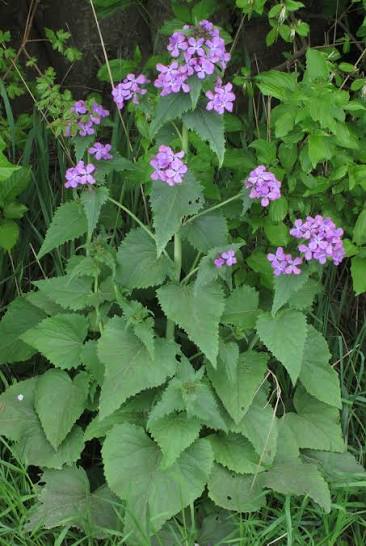
- An upright plant, commonly 50–100 cm tall, usually flowering in its second year.
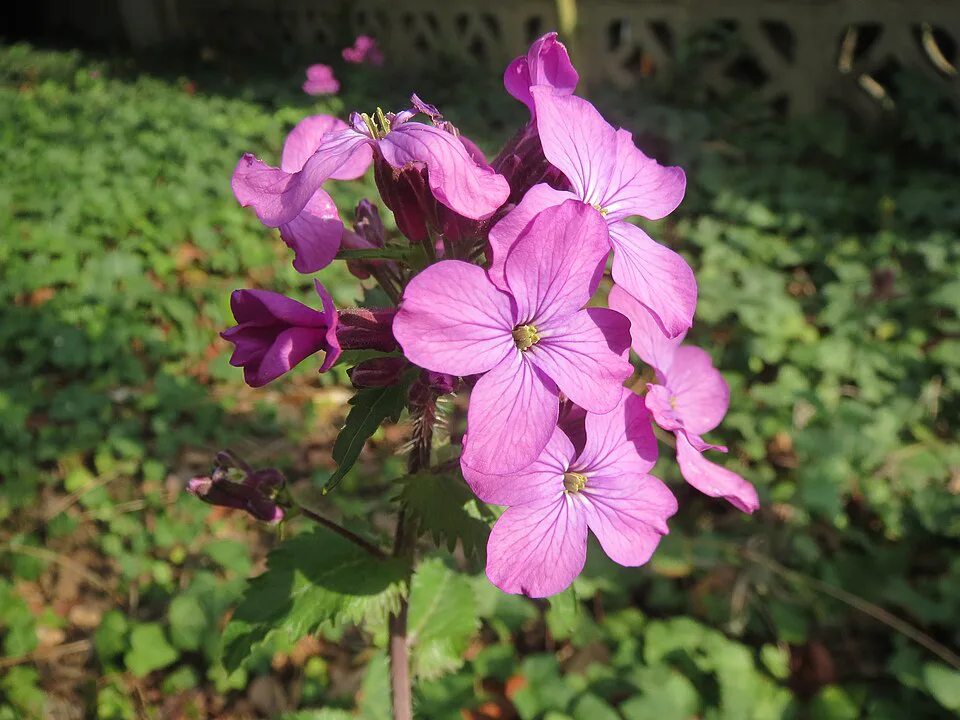
- Clusters of pinkish-purple or occasionally white flowers, each with four separate petals arranged in a cross.
- Broad, pointed, heart-shaped leaves with coarsely toothed margins and a slightly rough texture.
- Leaves arranged alternately along the flowering stems; lower leaves have longer stalks.
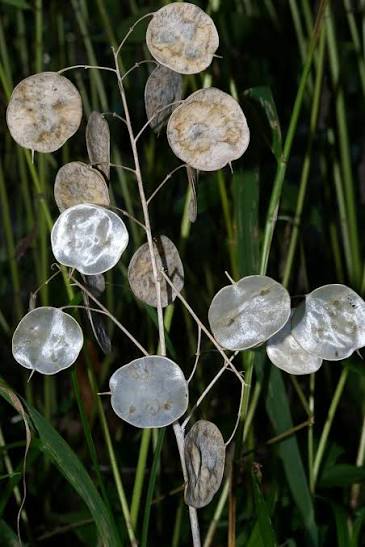
- Flat, almost circular or oval green seed pods, turning papery and silvery as they mature.
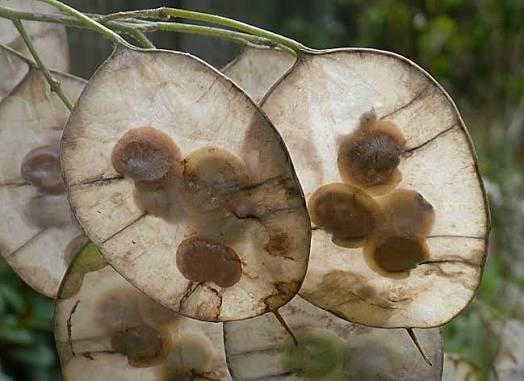
- Once the outer parts of the fruit and the seeds fall away, a translucent, coin-like membrane remains attached to the plant.
The combination of four-petalled flowers, toothed leaves and the distinctive round fruits makes Honesty particularly easy to recognise later in the year.
Flower structure
Each flower has four petals arranged crosswise, a pattern called cruciform. The four sepals sit just beneath the petals. Inside the flower are six stamens, typically four longer and two shorter, surrounding the central pistil. This is the characteristic stamen arrangement of the cabbage family, known as tetradynamous.
The flowers are carried in branching clusters at the tips of the stems. Each fertilised flower can develop into one of the flat fruits that make Honesty so recognisable.
Leaves and stems
The leaves are broadly oval to heart-shaped, with pointed tips, prominent veins and coarse, sometimes uneven teeth around the edges. The lower leaves usually have obvious stalks, while those higher up the stem are shorter-stalked or nearly stalkless.
The upright stems are often branched towards the top and may be slightly hairy. In its first year Honesty forms a leafy plant without the tall flowering stems seen in the following spring.
Fruits and seed dispersal
The green, flattened fruits are usually round to oval, sometimes several centimetres across. Botanically, these short, broad fruits are silicles, a form of the two-valved fruit characteristic of the cabbage family.
As the fruits dry, their outer valves split away, releasing the flat seeds and exposing the delicate central partition, or septum. It is this thin, translucent membrane — not an intact seed pod — that creates the familiar silver ‘coins’ which can remain on the dead stems into winter.
Habitat
Honesty is often found along woodland edges, shady banks, hedgerows, gardens, railway banks and waste ground. It prefers reasonably fertile soil and grows well in partial shade, although it also flowers in sunny places.
Originally from continental Europe, it is a long-established garden escape in Britain. Established plants often produce plenty of seedlings nearby.
Flowering period
Honesty usually flowers from April to June, depending on the weather and location. The green fruits follow in late spring and summer, gradually drying to expose their papery partitions later in the year.
Similar species
- Perennial Honesty (Lunaria rediviva) is an uncommon plant of shady, often damp woodland. Its flowers are generally paler and its fruits are more elongated and pointed, rather than broadly circular. Unlike the usually biennial Honesty, it persists for several years.
- Cuckooflower (Cardamine pratensis) also has four lilac-pink petals but much smaller flowers and long, narrow seed pods. Garlic Mustard (Alliaria petiolata) has small white flowers and slender upright pods; its leaves smell of garlic when crushed.
Where the names come from
Honesty is thought to refer to the transparent, silver-coloured membranes of its fruits, through which the dark seeds can once be seen. Other traditional names include Money Plant, Silver Dollars, Pope’s Pennies and Judas’s Pennies, inspired by the coin-like shape.
Lunaria comes from the Latin luna, meaning ‘moon’, referring to the round, silvery fruits. Annua means ‘annual’, although the plant is usually biennial in Britain.
Folklore & history
Honesty has been grown in cottage gardens for centuries, valued for both its spring flowers and its enduring silver seed heads. The coin-like fruits inspired associations with money and good fortune, reflected in names such as Money Plant and Judas’s Pennies.
Its dried stems have long been used in flower arrangements, where the translucent membranes catch the light. The plant was recorded in English herbals and gardens by the late sixteenth century and readily escaped into nearby hedgerows and woodland margins.
Wildlife
The flowers attract spring-flying bees, butterflies and other insects. Honesty is also used as a caterpillar foodplant by the Orange-tip butterfly, whose larvae feed on developing flowers and seed pods of several members of the cabbage family.