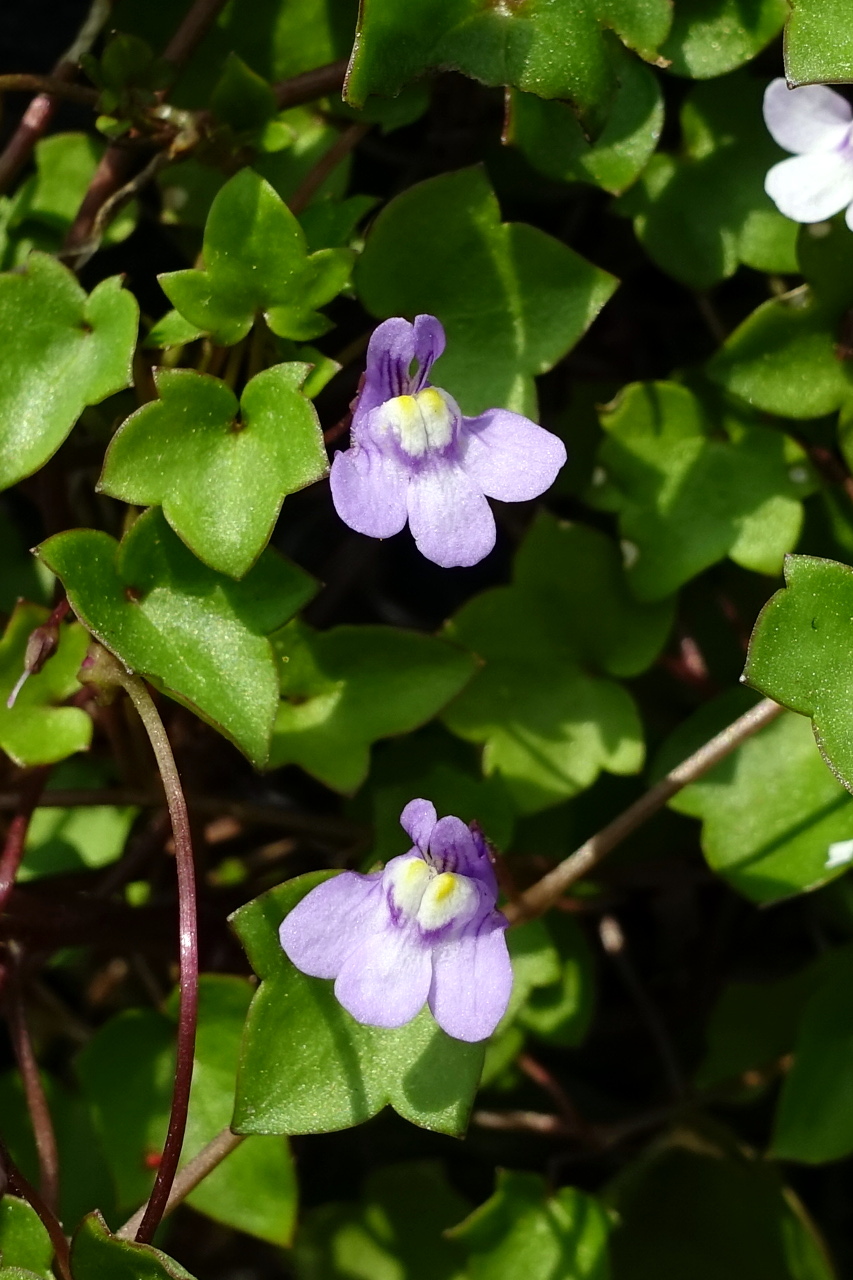
Ivy-leaved Toadflax is a charming little plant that seems almost made for old stone walls. Its slender, creeping stems trail across the masonry, carrying small, rounded leaves and delicate lilac flowers with yellow-and-white markings. It belongs to the plantain family, Plantaginaceae, although it looks very different from the upright toadflaxes.
Originally from southern Europe, Ivy-leaved Toadflax is an introduced species that has been naturalised in Britain for centuries. Its ability to flourish in narrow cracks has made it a familiar sight on walls, bridges and old buildings.
Identification
- A low-growing, trailing perennial, often forming a loose mat or hanging down a wall; the shoots can be much longer than the plant is tall.
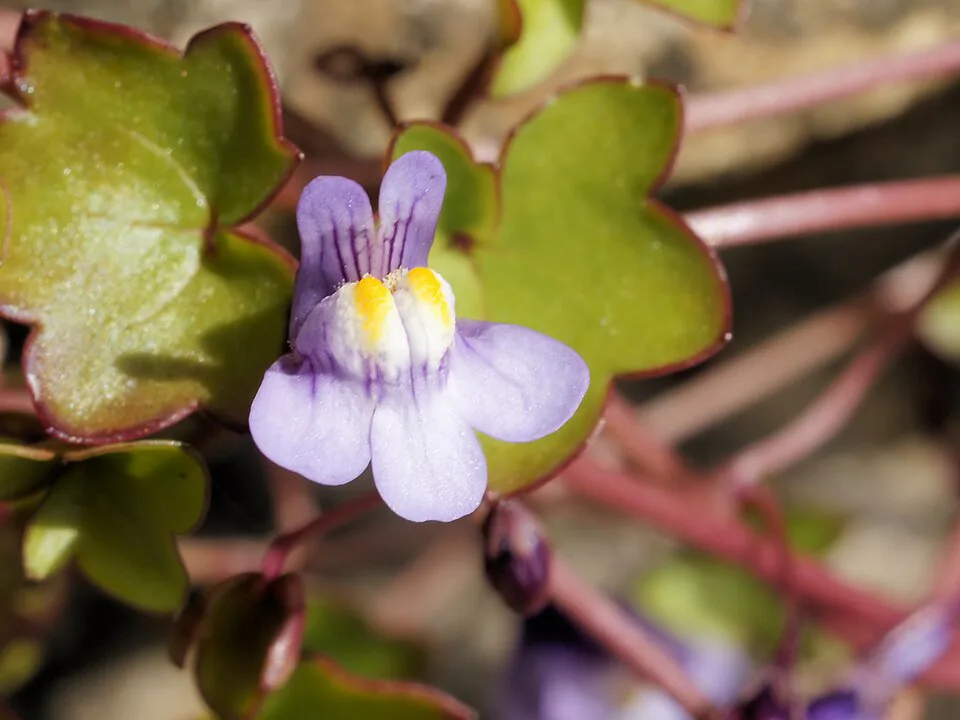
- Small lilac to pale violet flowers, resembling miniature snapdragons, with a white-and-yellow patch at the mouth.
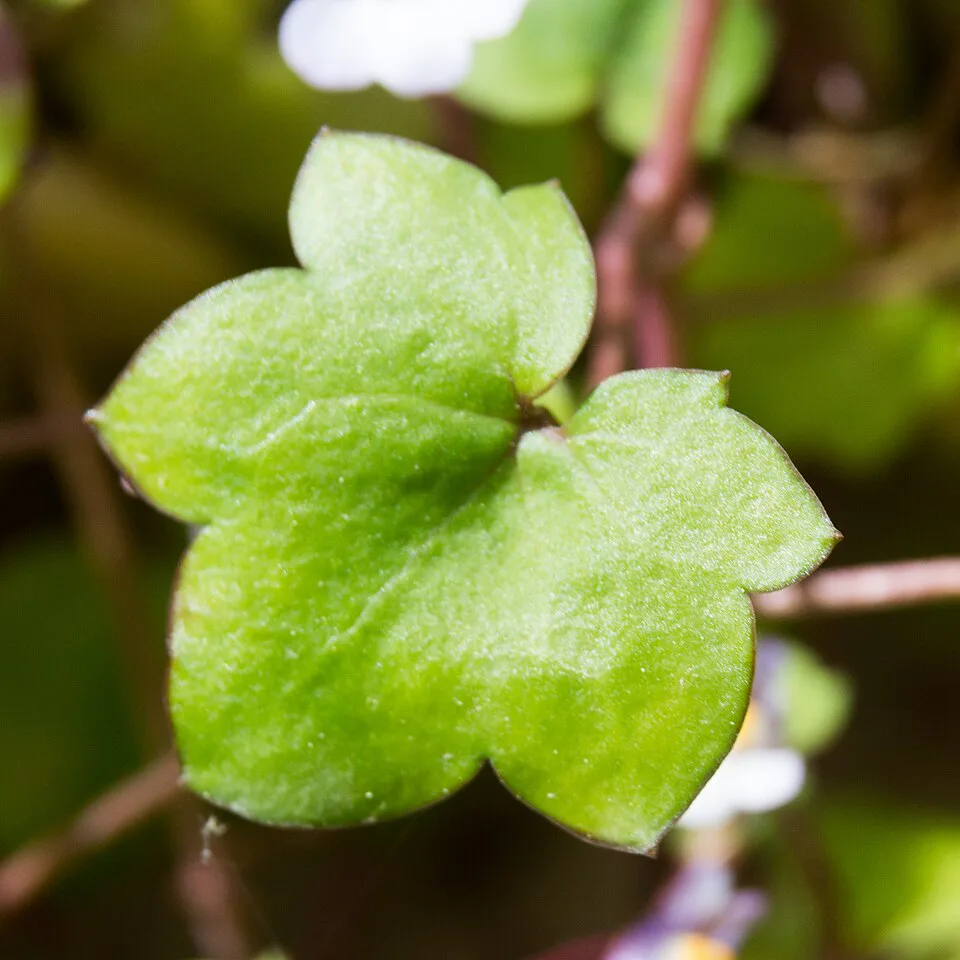
- Rounded to kidney-shaped leaves with three to seven shallow lobes, rather like little ivy leaves.
- Slender, sometimes reddish stems that creep across stonework or dangle from crevices.
- Individual flowers carried on fine stalks arising from the leaf axils.
- Particularly common in cracks in old walls and paving, often where there is a little moisture and shade.
The combination of ivy-like leaves, trailing habit and tiny lilac flowers is usually enough to recognise this species in the field.
Flower structure
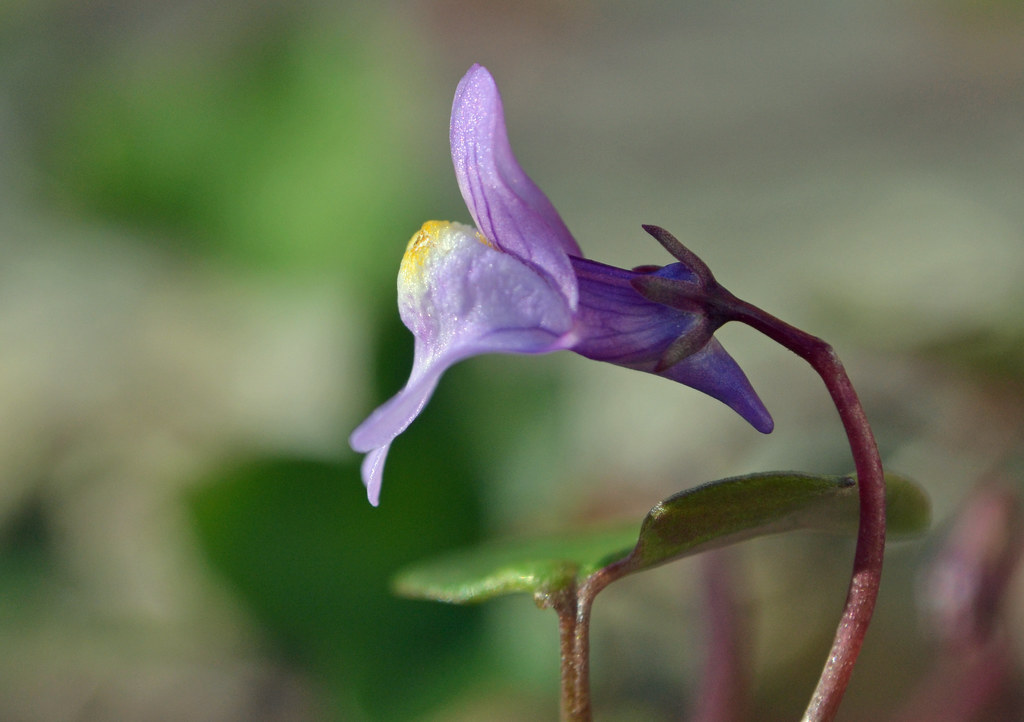
Each flower is bilaterally symmetrical and has a fused corolla divided into two lips. The upper lip has two upright lobes, while the lower has three spreading lobes. Yellow swellings and white markings near the opening act as nectar guides for visiting insects.
A short spur projects behind the flower and contains nectar. The four stamens are tucked inside the corolla, and the green calyx surrounds its base. The flowers are borne singly, rather than in a tall spike like those of Common or Purple Toadflax.
After pollination, the flower develops a small capsule containing seeds. This plant has an especially ingenious way of placing those seeds where they can grow.
Leaves and stems
The leaves are small, soft and broadly rounded, with a heart-shaped or kidney-shaped outline. Their shallow, often pointed lobes give them the ivy-like appearance reflected in the common name, although the plant is unrelated to true ivy.
They are arranged alternately along thin, trailing stems, which may become reddish. The shoots can root where they touch a suitable crevice, helping the plant spread over stonework.
How the seeds find cracks in walls
Ivy-leaved Toadflax has a remarkable change of behaviour after pollination. Its flowering stalks initially position the flowers towards the light, where insects can find them. As the fruits develop, the stalks bend towards darker places — a response known as negative phototropism.
This pushes the developing capsules into cracks and crevices in the wall. When the seeds are released, they are already close to a sheltered place where they may germinate. It is a wonderfully effective adaptation to life on rock faces and masonry.
Habitat
Look for Ivy-leaved Toadflax in the mortar of old brick or stone walls, between paving stones, in rocky places and occasionally on shingle. It particularly favours sheltered crevices with enough moisture to sustain its shallow roots, though it can also grow in sunny positions.
It is widespread in Britain, especially around towns, villages and gardens. It is naturalised here rather than native.
Flowering period
Ivy-leaved Toadflax commonly flowers from spring into late autumn, roughly April to November. In sheltered or mild places, a few flowers may appear outside this period, sometimes even in winter.
Similar species
- Purple Toadflax (Linaria purpurea) also has violet-purple flowers, but grows upright with tall flower spikes and very narrow leaves.
- Common Toadflax (Linaria vulgaris) has yellow-and-orange flowers on upright stems, again with narrow rather than rounded leaves.
- Other small wall plants, such as wall pennywort, can have rounded leaves but lack Ivy-leaved Toadflax’s characteristic lilac, two-lipped flowers.
Where the names come from
Ivy-leaved Toadflax is named for the little lobed leaves that resemble miniature ivy leaves. ‘Toadflax’ links it with related plants whose flowers have a similar two-lipped shape, although the original English word has an uncertain history.
Cymbalaria is derived from Latin cymbalum, ‘cymbal’, a comparison with the small, rounded leaves. Muralis means ‘of walls’, an especially fitting name for a plant that grows in cracks in masonry.
Folklore & history
Ivy-leaved Toadflax has several evocative names, including Kenilworth Ivy, Oxford Ivy, Oxford Weed and Wandering Sailor. Those names reflect the way it spreads through walls and slips out of gardens into the surrounding streets.
It was grown in Britain as a garden curiosity by the seventeenth century. A long-standing story links its spread to the Oxford Botanic Garden, where it was recorded in the 1640s. Whatever the exact route of its introduction, it has become a familiar part of the wild flora of British towns and villages.
Wildlife
The little flowers offer nectar to bees and other small visiting insects. Its trailing stems can also create pockets of greenery on otherwise bare walls. Once pollinated, the plant’s unusual seed-placement mechanism helps it establish the next generation in sheltered crevices.