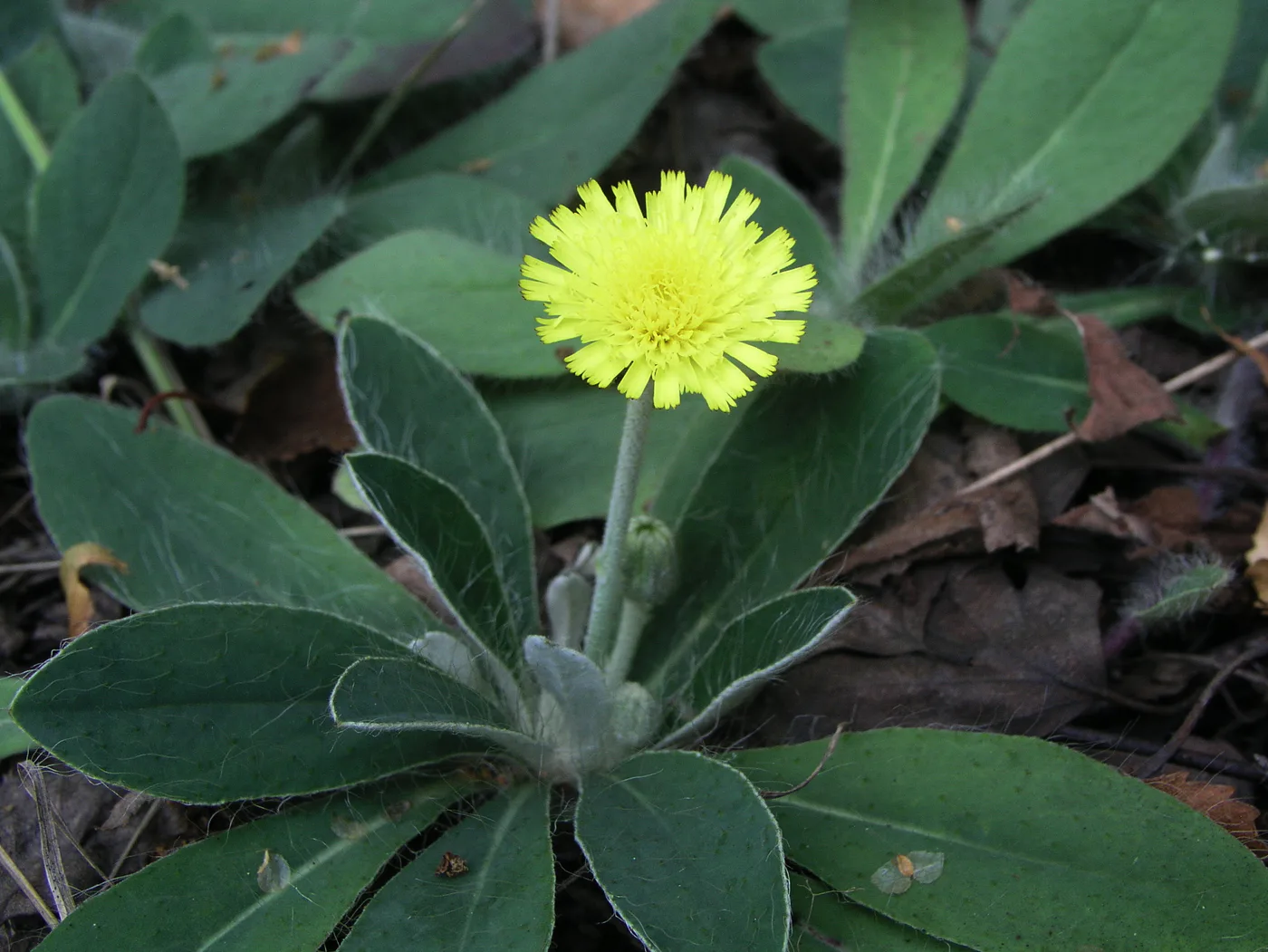
Mouse-ear Hawkweed is a low-growing perennial of dry grassland, short turf, heathland, banks, verges and dunes. Its pale lemon-yellow flower can look rather dandelion-like at first, but the low hairy rosette, solitary flower head and creeping runners make it quite distinctive.
It belongs to the daisy family, Asteraceae. What looks like one flower is actually a capitulum containing many individual strap-shaped florets.
Identification
- Usually forms a low basal rosette with flowering stems up to about 30 cm tall.
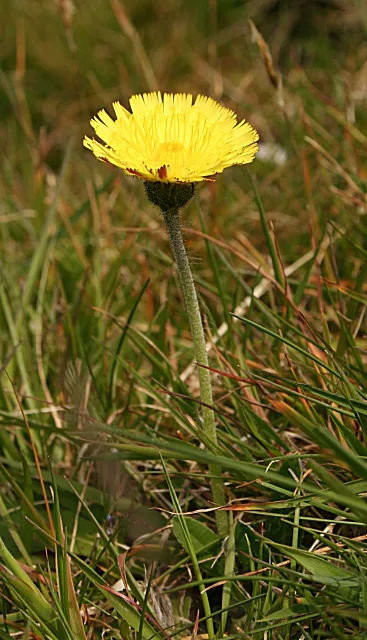
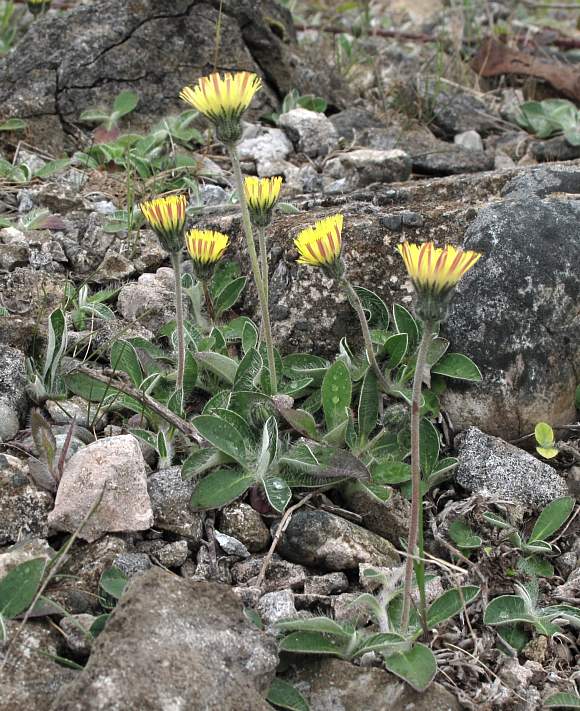
- Each flowering stem normally carries one solitary lemon-yellow flower head.
- The flowering stem is usually unbranched and has few or no normal leaves.
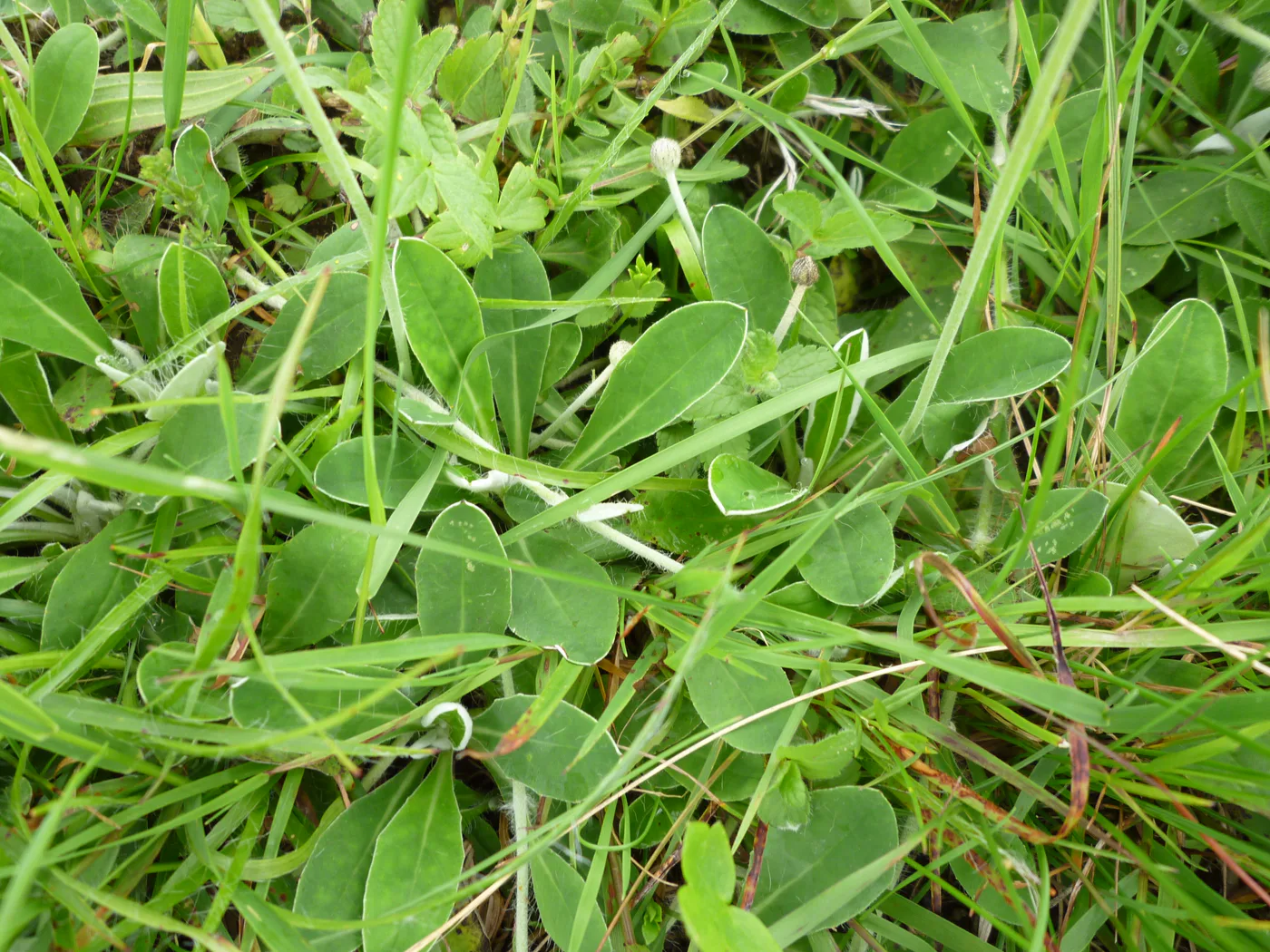
- Leaves are oblong to spoon-shaped, usually broadest above the middle, and covered with conspicuous hairs.
- The upper leaf surface is green with long simple hairs.
- The underside is much paler and often looks almost white because of dense felt-like hairs.
- Long creeping stolons can spread from the parent rosette and produce daughter rosettes.
- The outer ray florets often show reddish or orange-red stripes on their undersides.
The combination of a single pale-yellow head, a hairy basal rosette and white-felted leaf undersides is especially useful in the field.
Flower structure
The yellow “flower” is a capitulum, typical of the Asteraceae family.
Unlike an Oxeye Daisy, it contains only strap-shaped ray florets; there is no separate central group of tubular disc florets.
The flower head is generally around 2–3 cm across. The tips of the florets are toothed, and the outer florets can have a reddish stripe on their lower surface.
A group of narrow bracts surrounds the base of the flower head.
Leaves and stolons
The leaves form a rosette close to the ground rather than being distributed normally up the flowering stem.
They are:
- dull to greyish green above
- covered with scattered long hairs on the upper surface
- pale or whitish beneath
- densely felted underneath with fine star-shaped hairs
- generally entire or only very slightly toothed
- rounded to bluntly pointed toward the tip
Mouse-ear Hawkweed also spreads vegetatively by long creeping stolons. New rosettes can form along or at the ends of these runners, allowing the plant to form low mats.
The furry leaves are the source of the common name: their shape and soft covering were likened to a mouse’s ear.
Habitat
Mouse-ear Hawkweed favours dry, open, relatively short vegetation.
Typical habitats include:
- dry grassland
- short turf and lawns
- heathland
- roadside verges
- grassy banks
- sand dunes
- cliff-top grassland
- other open, nutrient-poor ground
It often performs well where taller vegetation does not shade out the low rosettes.
Flowering period
In Britain, Mouse-ear Hawkweed can flower from May into October, although it is often most conspicuous in early and mid-summer.
After flowering, the head develops into a small fluffy seed head. The seeds have a pappus of hairs that helps them disperse in the wind.
Similar species
- Dandelion (Taraxacum officinale agg.) also has yellow flower heads on leafless stems, but its leaves are deeply toothed rather than softly hairy and white-felted beneath. Dandelions also lack the characteristic creeping stolons of Mouse-ear Hawkweed.
- Cat’s-ear (Hypochaeris radicata) has hairy basal leaves and yellow flower heads, but its flowering stems are usually branched and can carry several heads. Mouse-ear Hawkweed normally has one flower head on each unbranched stem.
- Rough Hawkbit (Leontodon hispidus) has larger, deeper yellow heads and rough, often lobed rosette leaves; it lacks the white-felted leaf undersides and creeping runners of Mouse-ear Hawkweed.
Other hawkweeds and Pilosella species can be difficult to separate, but Mouse-ear Hawkweed is one of the more recognisable species because of its solitary pale-yellow head, strongly hairy basal leaves, white-felted undersides and creeping stolons.
Where the names come from
The small, softly hairy leaves inspired the name Mouse-ear: they really can look and feel like little mouse ears. Hawkweed is an old name shared by a number of related yellow-flowered plants.
Pilosella is a diminutive of Latin pilosus, meaning ‘hairy’, an excellent description of the leaf surfaces. Officinarum refers to the traditional apothecary’s shops or storerooms where medicinal herbs were kept.
Folklore & history
Mouse-ear Hawkweed has a history of use in traditional herbal medicine, including remedies associated with respiratory complaints.
Wildlife
The flower heads provide pollen and nectar for visiting insects, including bees, hoverflies and other small pollinators.
Because the plant grows in short, open grassland and spreads into low mats, it can form part of flower-rich turf on banks, heaths and dunes.