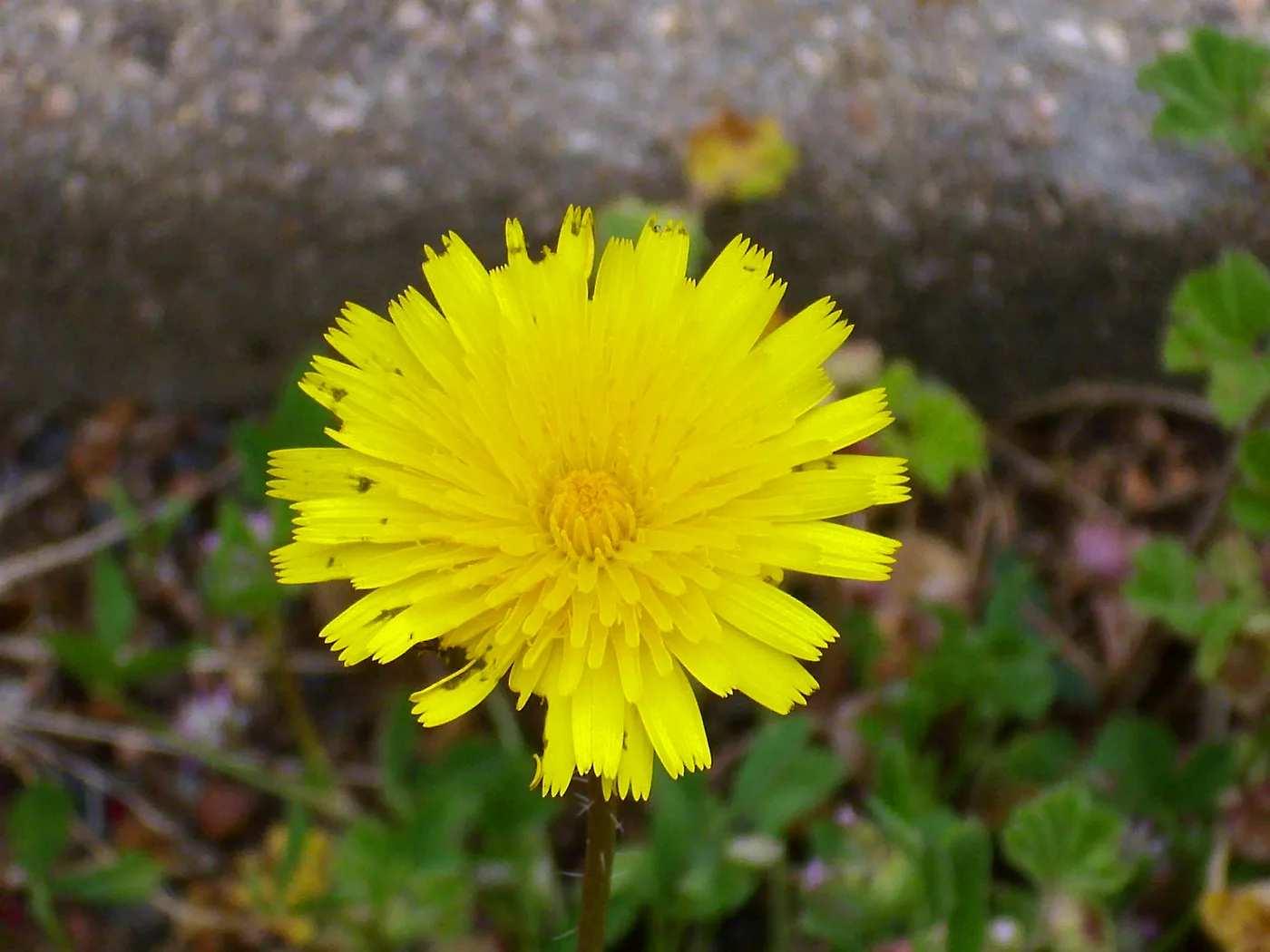
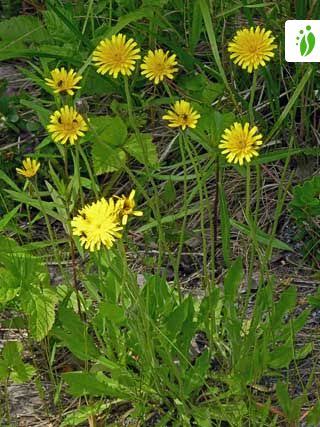
Rough Hawkbit is a native perennial of meadows, grassy banks and open, often chalky grassland. Its golden-yellow heads look rather like dandelions, but the coarsely hairy foliage and flowering stalks provide an important clue to its identity. It belongs to the daisy family, Asteraceae.
Identification
- Usually around 10–50 cm tall, with one yellow flower head at the top of each long, unbranched flowering stalk.
- Golden-yellow heads commonly about 2.5–4 cm across, sometimes with a reddish-orange tint on the undersides of the outer florets.
- Leaves form a basal rosette rather than growing up the flower stalk.
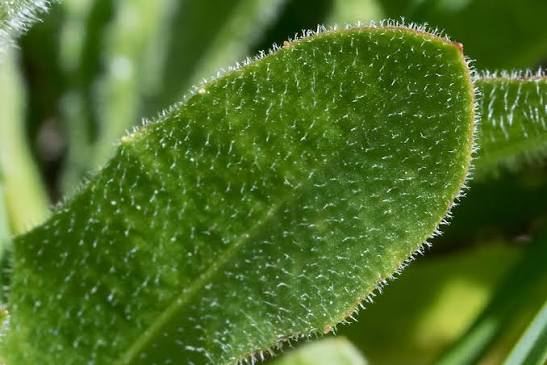
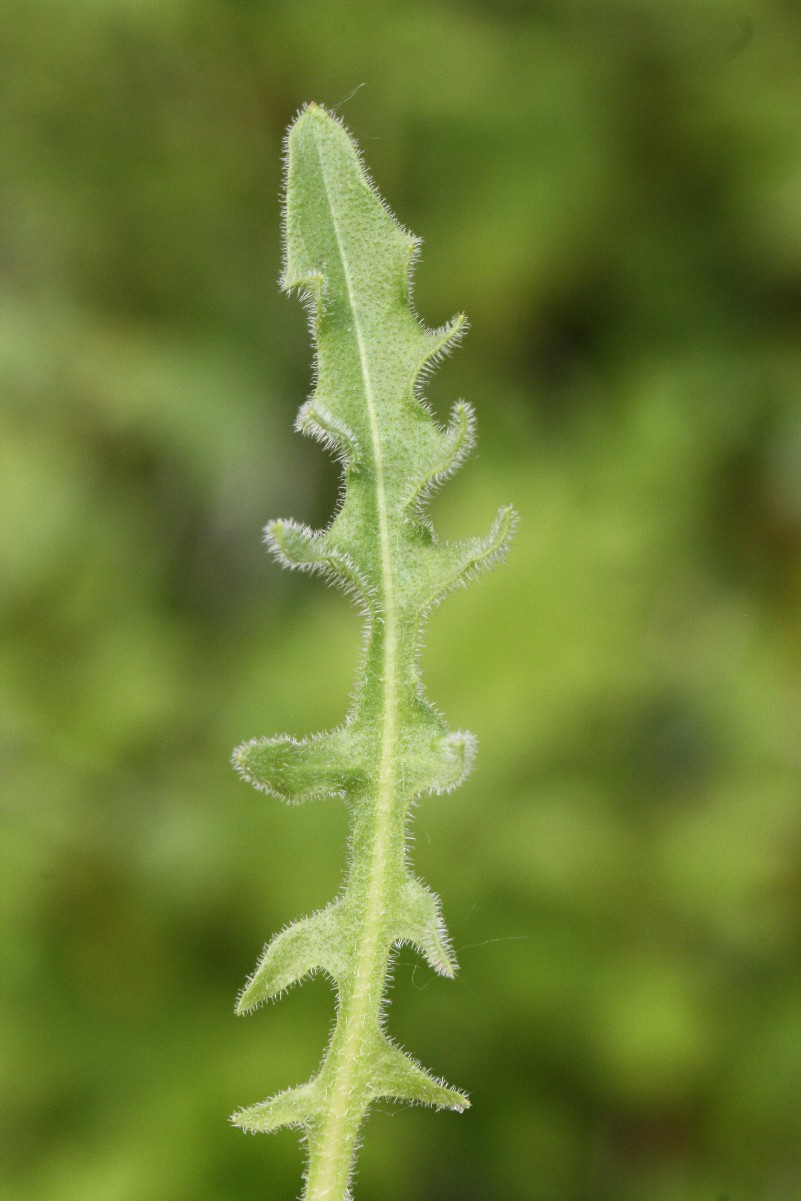
- Leaves are narrow to oblong, toothed or irregularly lobed, and noticeably hairy, especially along the edges and midrib.
- Many of the leaf hairs are forked into tiny Y-shaped branches, a useful feature when examined with a hand lens.
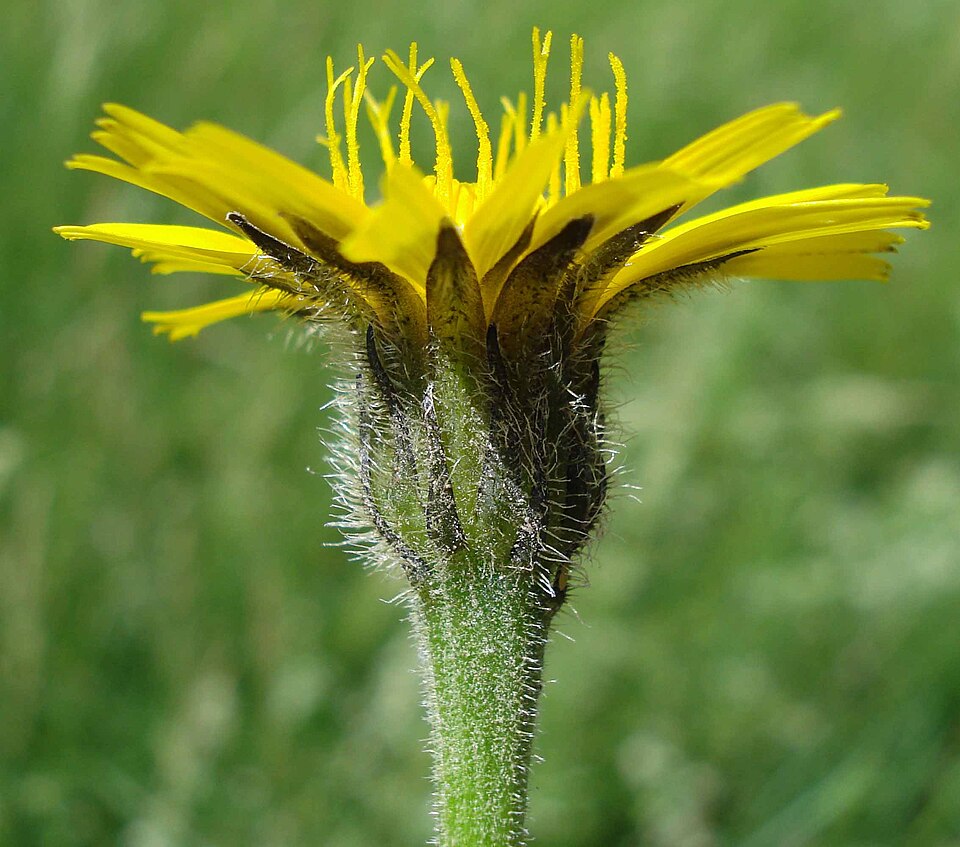
- The stalks and narrow green bracts beneath each head often carry conspicuous coarse hairs.
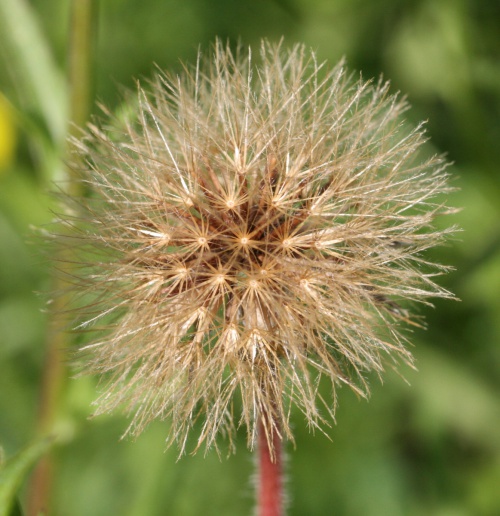
- After flowering, a rounded tuft of feathery fruits forms, rather like a smaller dandelion clock.
The combination of a large solitary yellow flower head, coarsely hairy stalk and rosette of rough leaves is characteristic, although the very similar Lesser Hawkbit may need close examination of its fruits to confirm an identification.
Flower structure
The yellow head is a capitulum: many small, strap-shaped florets packed together so that they appear to form one flower. There is no separate central disc of tubular florets, unlike a typical daisy.
A ring of narrow green bracts surrounds the base of the head. In Rough Hawkbit these bracts and the upper part of the flower stalk are often densely hairy. Turning a flower head over is a particularly useful identification step.
When the florets fade, each can develop a small dry fruit called an achene, more precisely a cypsela. Its pappus consists of long, feathery hairs that help the fruits travel on the wind. Unlike Lesser Hawkbit, even the outermost fruits have a pappus of long hairs.
Leaves and stems
The leaves grow from the base in a rosette. They are often held somewhat upright, with narrow, irregular lobes or coarse teeth and a rough texture caused by numerous hairs. With a hand lens, some hairs on the leaf edges split into two or three arms; the forked hairs help identify a hawkbit.
The flowering stalk is normally leafless and unbranched, carrying just one head. Its surface can be markedly hairy all the way up to the bracts. Several stalks may arise from the same rosette, making a plant look many-flowered even though each stalk is simple.
Habitat
Rough Hawkbit favours sunny, open, well-drained grassland, especially on chalk or limestone. It is found in old meadows, pastures, grassy roadside verges, banks and quarry grassland, where the vegetation is not too tall or dense.
It is widespread in England and Wales and occurs in parts of Scotland and Ireland, although its distribution becomes more scattered farther north.
Flowering period
Flowers are usually seen from June to October, with the main display in summer. In favourable conditions individual plants may flower into early autumn.
Similar species
- Dandelion (Taraxacum officinale agg.) has similarly yellow flower heads, but its hollow flower stalks are usually smooth rather than coarsely hairy and its outer bracts often curve conspicuously backwards.
- Lesser Hawkbit (Leontodon saxatilis) is generally smaller and less hairy. The most reliable distinction is in the fruits: the outermost fruits of Lesser Hawkbit lack the long feathery hairs present on all the fruits of Rough Hawkbit.
- Cat’s-ear (Hypochaeris radicata) also has a hairy basal rosette, but its flowering stems are commonly branched, with more than one flower head, and its leaf hairs are generally not forked.
- Mouse-ear Hawkweed (Pilosella officinarum) usually has paler lemon-yellow heads and broad leaves with pale, felted undersides; it can also spread by creeping runners.
Where the names come from
The name Rough Hawkbit describes the plant’s conspicuously coarse hairs, visible on the leaves, stalks and green bracts below the flower heads. The botanical epithet hispidus is Latin for rough, bristly or covered with stiff hairs, so the English and scientific names draw attention to much the same feature.
The genus name Leontodon comes from the Greek words for lion and tooth, a reference to the jagged edges of the leaves. It is closely related in meaning to Dandelion, whose name comes from the French dent de lion, or ‘lion’s tooth’. The familiar resemblance between their toothed leaves helps explain why early botanists grouped several dandelion-like flowers together.
The second part of Hawkbit belongs to an older group of country names shared with hawkweeds and similar yellow-flowered plants. They were often confused before modern botanical classification separated them. Rough Hawkbit has also been called Bristly Hawkbit; its Welsh name, Peradyl garw, likewise refers to its roughness.
Folklore & history
The ‘hawk’ in Hawkbit connects the plant with an old European belief about hawks and eyesight. In classical natural history, the Roman writer Pliny repeated a story that hawks used the juice of certain plants to clear their vision. That tradition became associated with hawkweeds and, through their shared names and resemblance, hawkbits. It is a story about the wider group of hawk-named plants rather than a proven historical use of Rough Hawkbit itself.
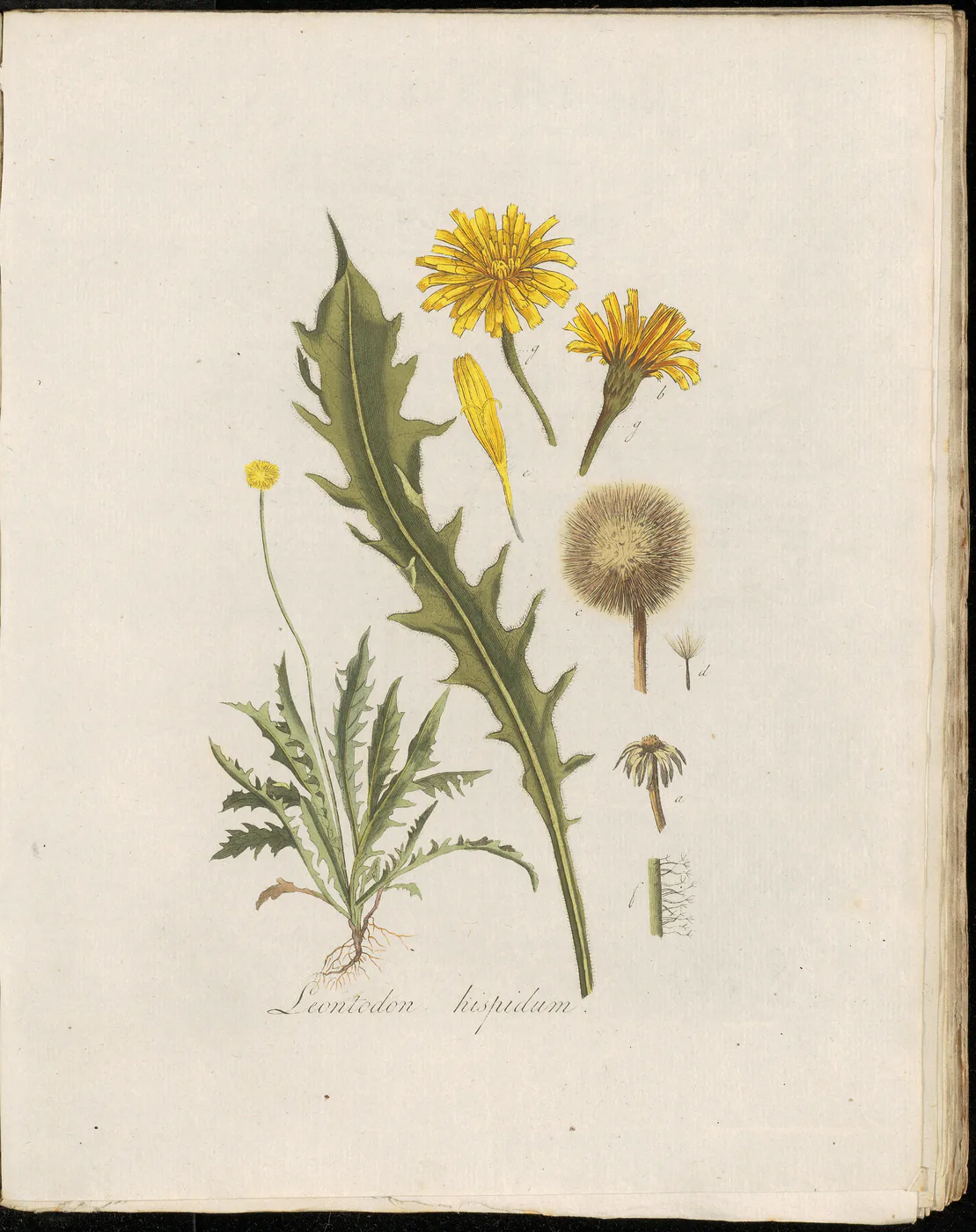
The species appears in older British botanical writings as an inhabitant of meadows and pastures, where its rough hairs, toothed leaves and solitary yellow heads helped separate it from other ‘dandelion’ flowers. An illustrated plate published in the Dutch Flora Batava in 1807 shows the flowers, leaves and seed head in detail, a reminder of the close observation needed to distinguish these easily confused plants long before modern field guides.
Unlike Dandelion, Rough Hawkbit has relatively little well-documented folklore or culinary history of its own. Its names preserve the more colourful older traditions surrounding hawks, lion’s teeth and the many yellow composites of Europe’s grasslands.
Wildlife
The yellow heads provide pollen and nectar to bees, hoverflies and other visiting insects during summer. Rough Hawkbit is especially valuable in flower-rich, low-nutrient grassland, where it forms part of a varied succession of nectar-bearing wildflowers.
After flowering, the feathery fruits are carried away on the breeze, allowing new plants to establish in open gaps among the grasses.