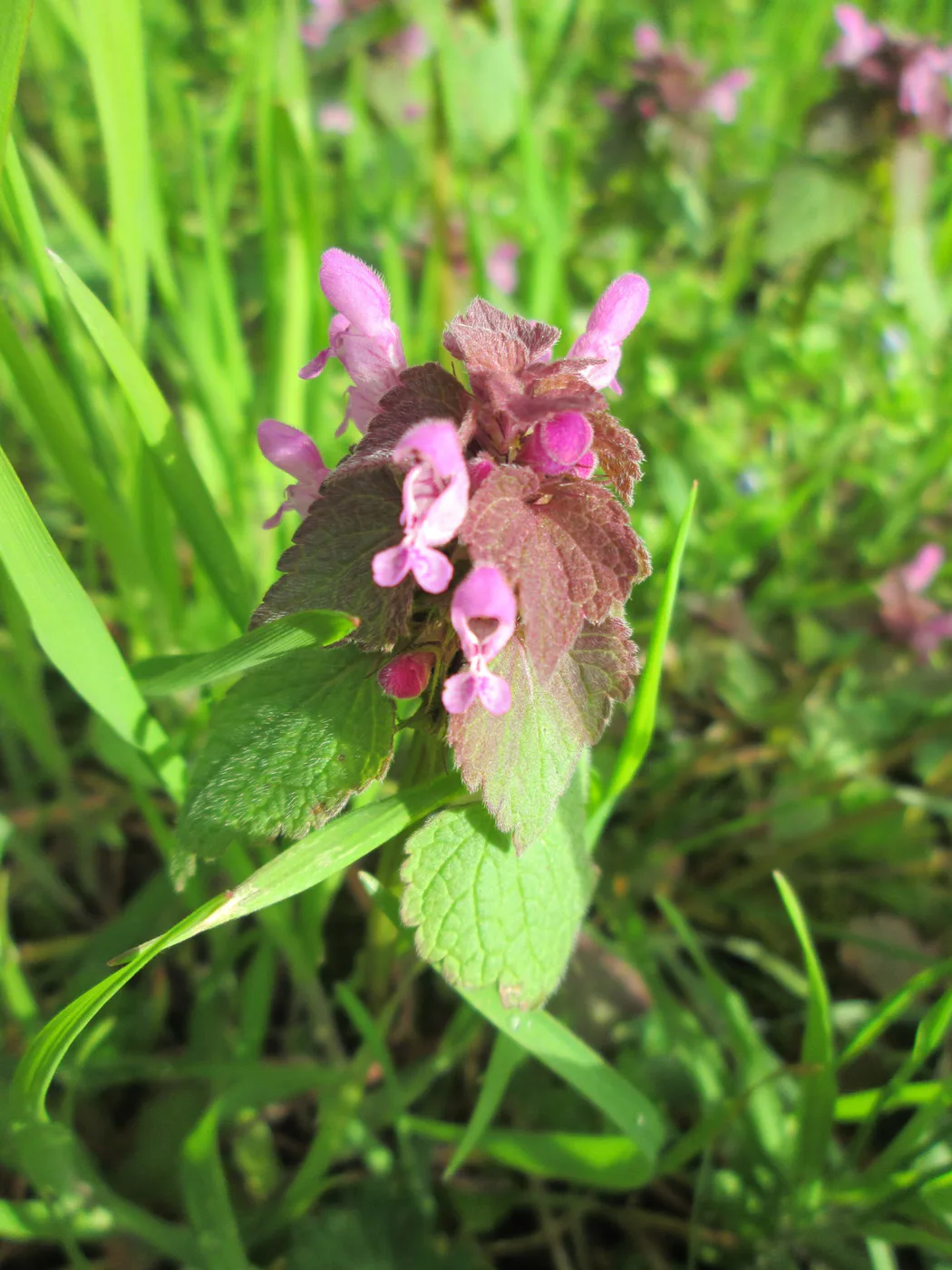
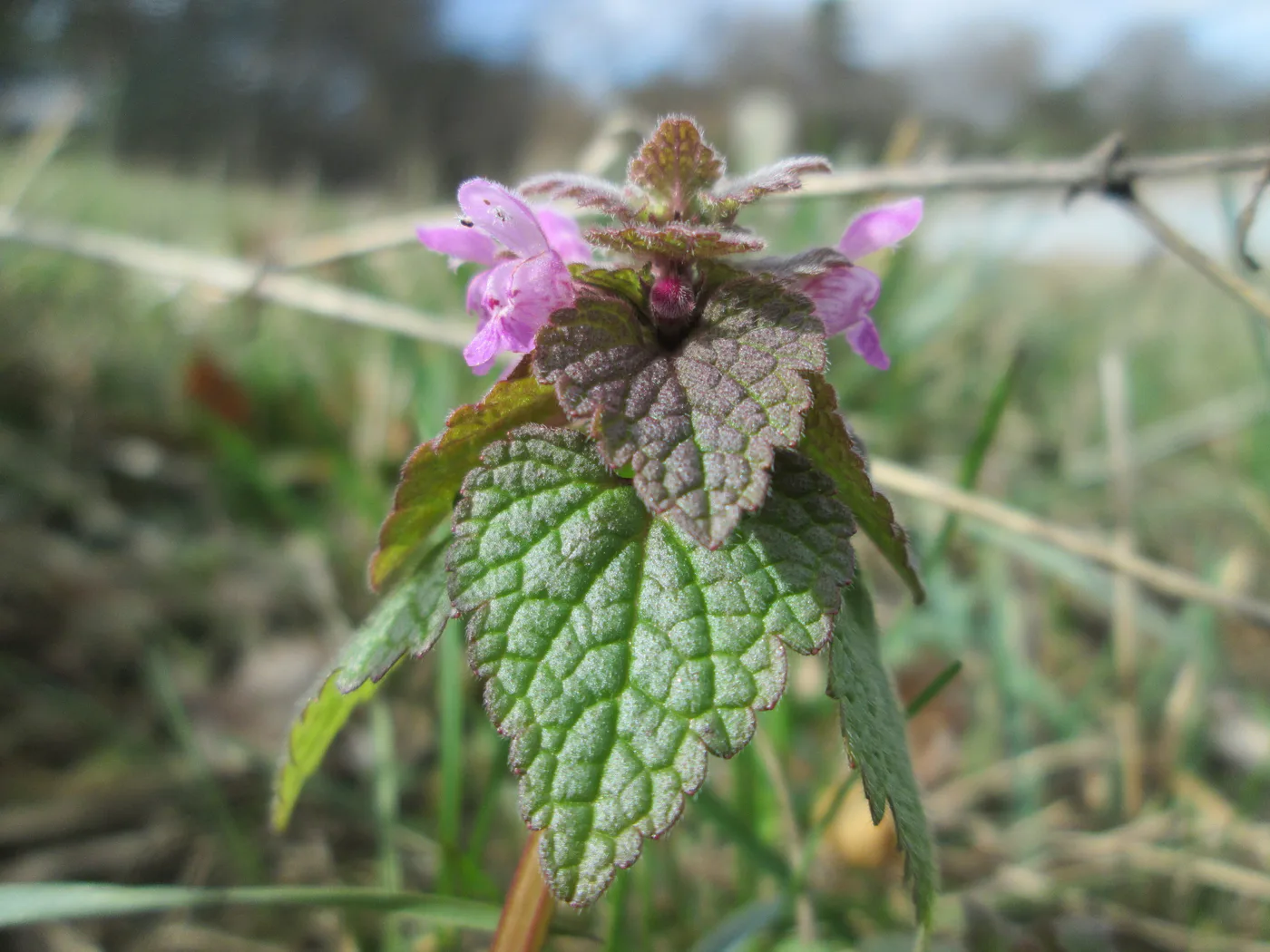
Red Dead-nettle is one of the familiar little wildflowers of cultivated and disturbed ground. In early spring it can form patches of purplish foliage in gardens, along field edges and on roadside verges. Look closer and you will find small, pink-purple flowers peeping out between the upper leaves, often when few other wildflowers are blooming.
Despite its name, Red Dead-nettle is not a true stinging nettle. It belongs to the mint family, Lamiaceae, and the word dead refers to the absence of a sting. Like other members of the mint family, it has opposite leaves, a four-angled stem and flowers with a characteristic upper and lower lip.
Identification
- Usually 10–30 cm tall, forming an upright or slightly spreading, softly hairy annual plant.
- The upper leaves are often crowded together and coloured reddish-purple, particularly in cool weather.
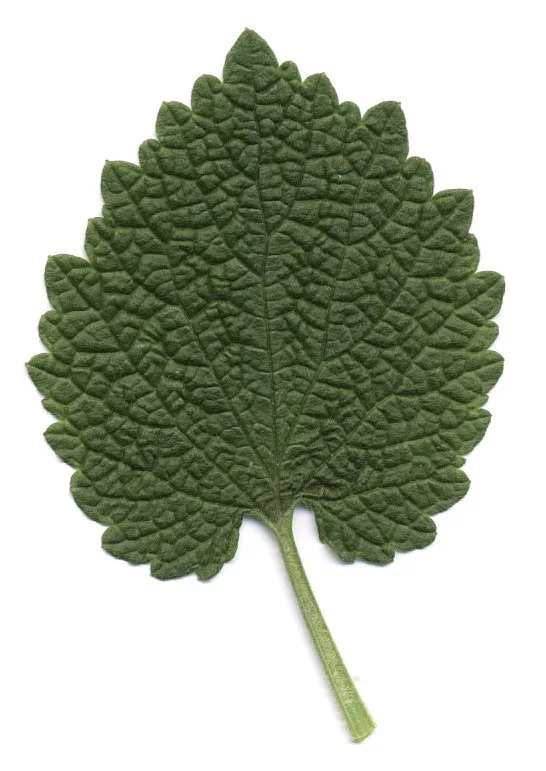
- Leaves are arranged in opposite pairs and are broadly triangular to heart-shaped, with rounded, toothed or scalloped edges.
- The stems are square in cross-section and may be reddish or purple-tinged.
- Small pink to purple flowers appear in clusters around the upper part of the stem, emerging from the leaf axils.
- Each flower has a hooded upper lip and a broader lower lip, often marked with darker spots.
- Unlike a stinging nettle, the hairs are soft and do not sting.
The combination of purple-flushed upper leaves, opposite toothed leaves and small two-lipped flowers is usually enough to recognise Red Dead-nettle in flower.
Flower structure
Although the flowers can seem to form a single crowded head, they arise in whorls in the axils of the upper leaves. In botanical terms these are verticillasters: paired, condensed flower clusters that give the appearance of a whorl around the stem.
Each flower has a tubular, fused corolla divided into two lips. The upper lip curves over the reproductive parts like a small hood. The lower lip spreads outward and provides a landing place for visiting insects; it often carries darker purple markings.
There are four stamens, usually in two pairs of different lengths, tucked beneath the upper lip. Outside the corolla is a persistent, five-toothed calyx. After pollination, the four-lobed ovary develops into four small nutlets, a familiar fruit type in the mint family.
Leaves and stems
Red Dead-nettle’s leaves change subtly as you move up the stem. The lower leaves are usually green, broadly heart-shaped or rounded, with clear stalks. The upper leaves are often smaller, more tightly packed and purplish, with short but visible stalks.
All the leaves occur in opposite pairs. Their surfaces are softly hairy, and the margins have broad, rounded teeth. The square stem is another useful clue to its family.
The purplish upper foliage is not itself the flower. It surrounds the much smaller tubular flowers, which can be overlooked at first glance.
Habitat
Red Dead-nettle thrives where the soil has been disturbed or cultivated. It is especially common in:
- arable fields and field margins
- vegetable plots and gardens
- roadside verges and path edges
- waste ground and bare soil
- hedgerow margins and other open disturbed places
It is widespread in Britain. Plants may germinate in autumn and overwinter, allowing them to grow and flower very early the following year. In suitable conditions they can complete their life cycle and set seed quickly.
Flowering period
Red Dead-nettle is commonly seen in flower from March to November, but it may begin in February or flower in mild winter weather. It is particularly noticeable in early spring, when its flowers provide food for insects emerging after winter.
Similar species
- Henbit Dead-nettle (Lamium amplexicaule) is perhaps the closest lookalike. Its upper leaves are rounded and clasp the stem directly, without noticeable leaf stalks. In Red Dead-nettle, the upper leaves generally retain short stalks.
- White Dead-nettle (Lamium album) is generally a larger perennial with conspicuous white flowers and greener foliage. Its flowers are arranged in separated whorls along the stem.
- Stinging Nettle (Urtica dioica) has toothed, opposite leaves, but is unrelated to Red Dead-nettle. It has stinging hairs and clusters of small greenish flowers rather than pink-purple, two-lipped flowers.
Where the names come from
Red Dead-nettle is ‘dead’ because, unlike a stinging nettle, it does not sting; its nettle-like leaves explain the comparison. ‘Red’ refers to the purplish-pink flowers and often reddish upper foliage.
Lamium is an ancient name for dead-nettles, sometimes linked to Greek lamia, a devouring creature, because of the flowers’ open, mouth-like shape. Purpureum is Latin for ‘purple’, describing the flower colour.
Folklore & history
Older regional names include bumblebee flower, sweet archangel and bad man’s posies. The bumblebee name is especially apt: its little hooded flowers can be busy with bees long before summer arrives.
Red Dead-nettle has been associated with cultivated land for a very long time. It was probably brought to Britain with early agriculture, and remains have been found in deposits dating back to the Bronze Age.
In traditional herbal practice, bruised leaves were applied to minor cuts, while dried leaves were used in preparations intended to help stop bleeding. These uses reflect the long history of people noticing even the small plants growing around their fields and homes.
Wildlife
Red Dead-nettle is especially valuable as an early nectar source. Bumblebees and other long-tongued bees visit its tubular flowers; red mason bees are among the insects recorded using it.
Its foliage also supports the caterpillars of some moths, including the garden tiger, white ermine and angle shades. A patch left to flower in a garden or along a field margin can therefore offer more wildlife value than its modest size might suggest.