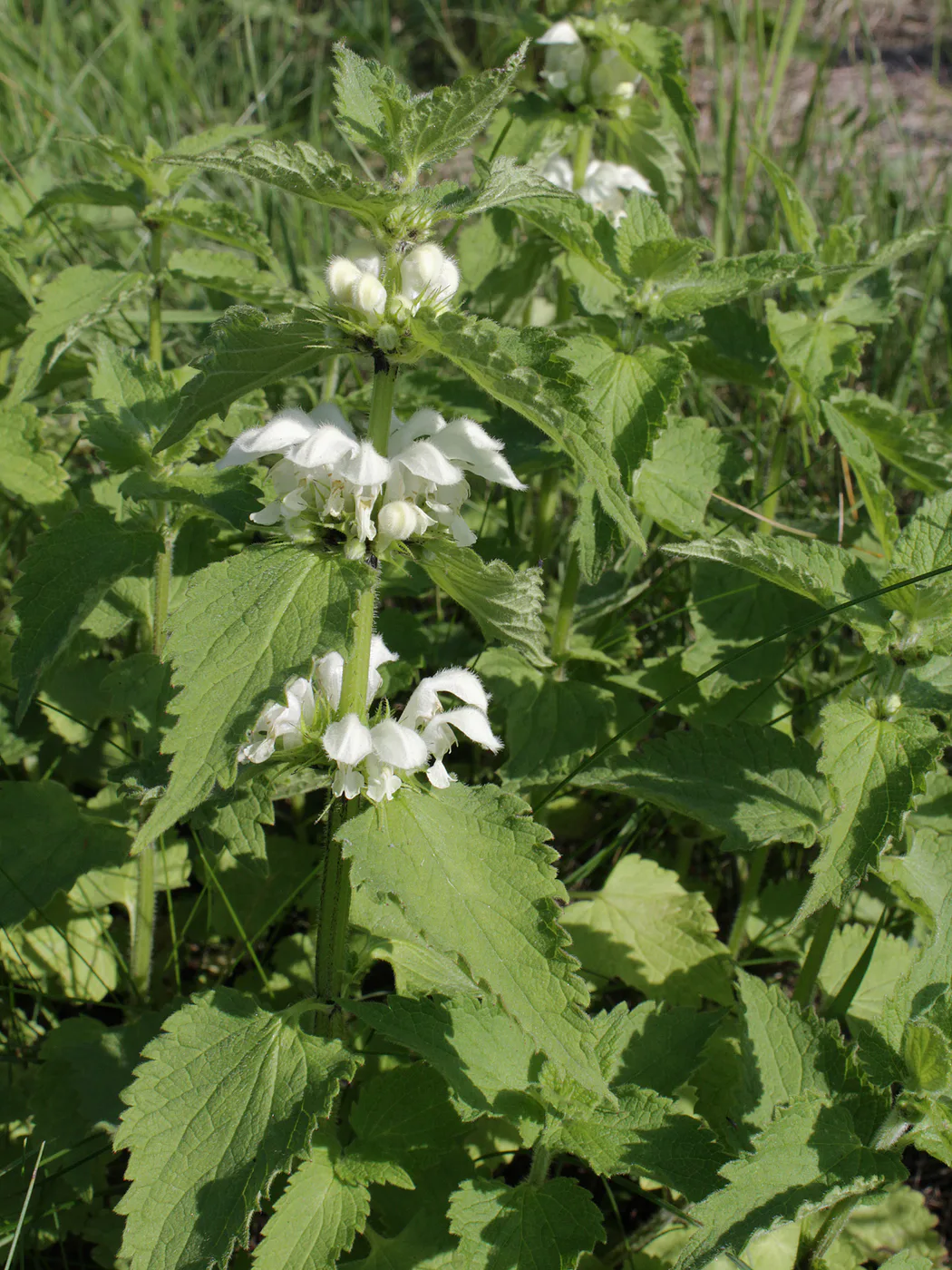
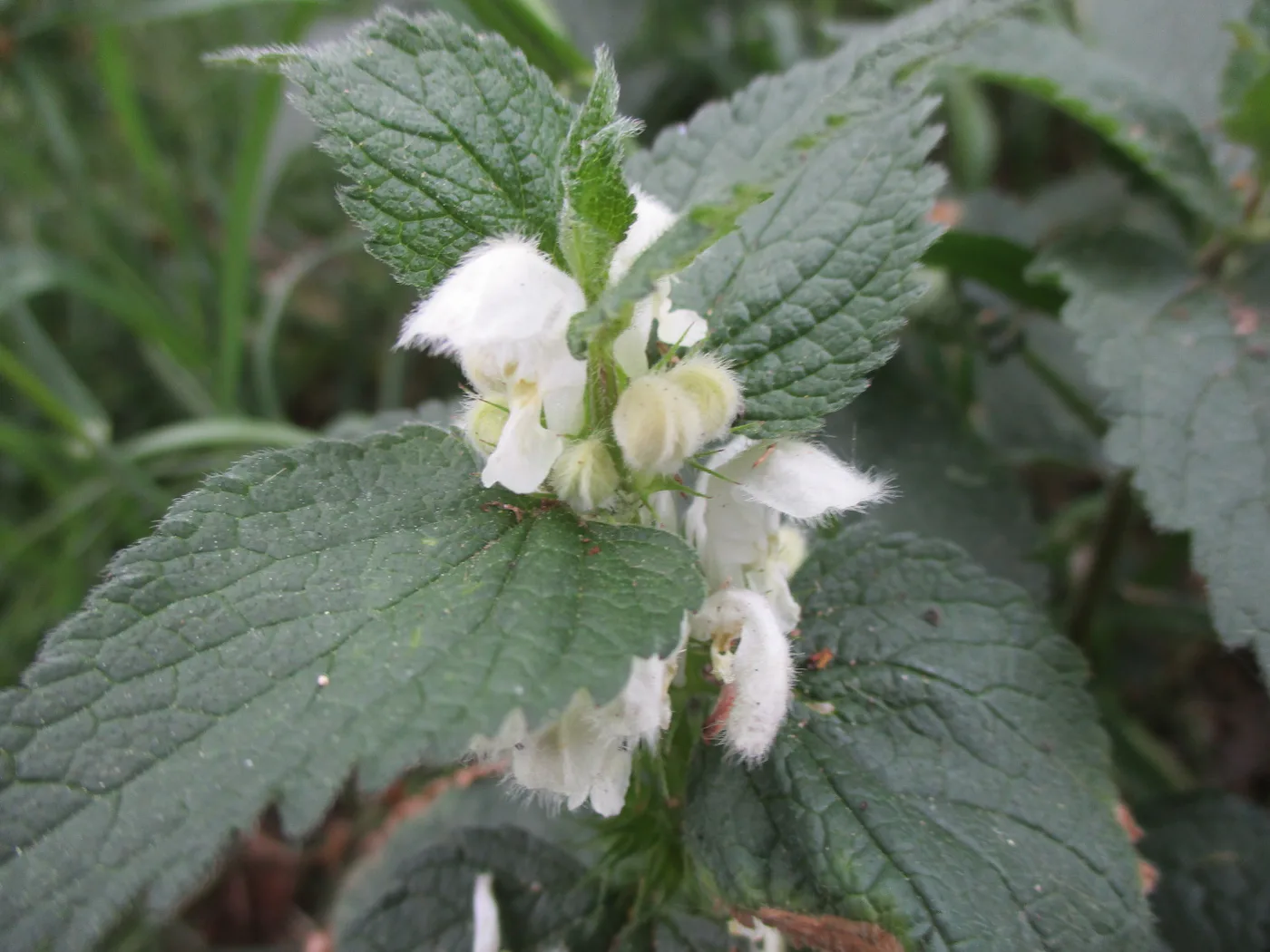
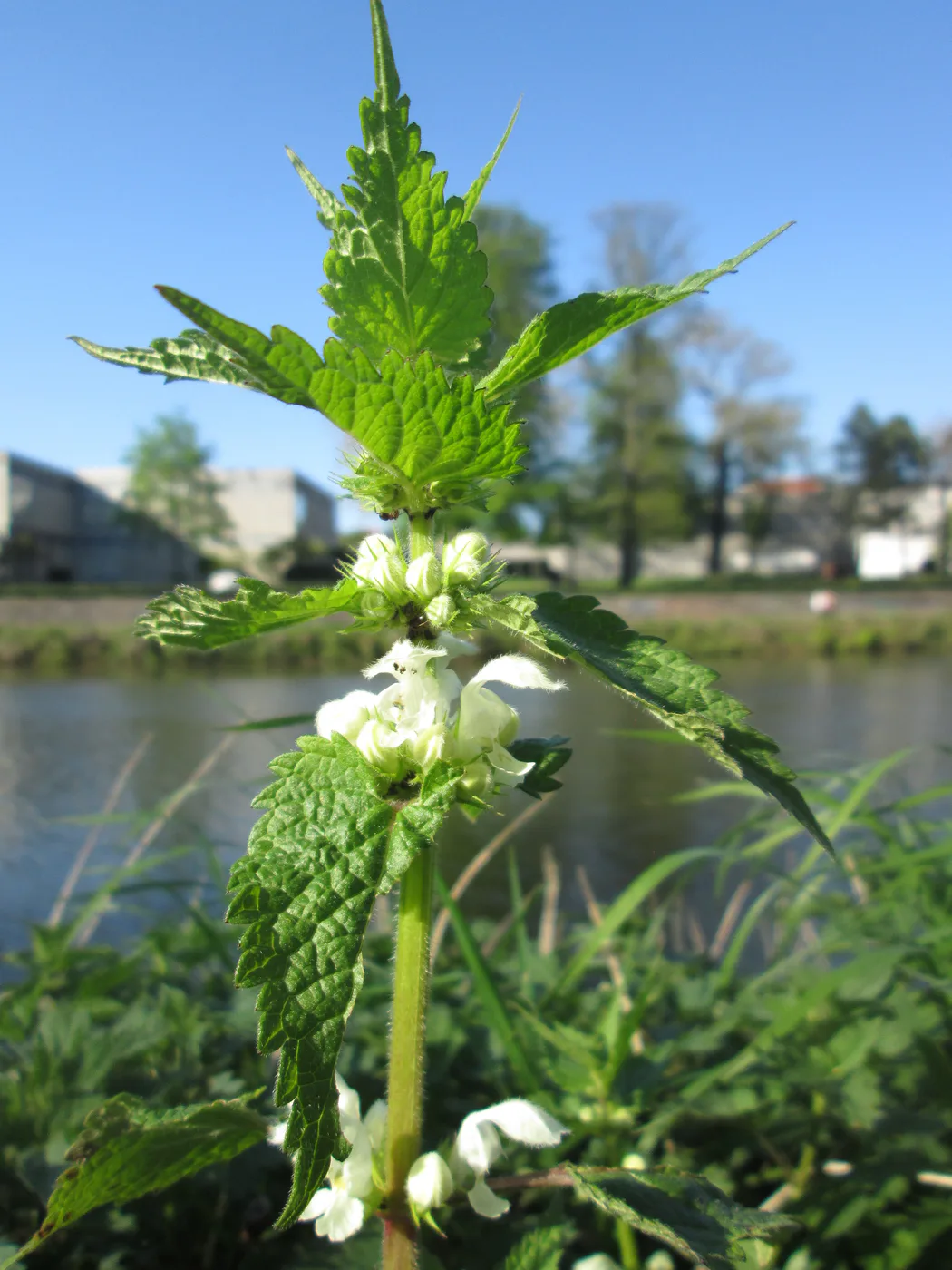
White Dead-nettle is a familiar sight beside hedges, along footpaths and on rough grassy banks. Its leaves can look remarkably like those of a Stinging Nettle, but it has none of that plant’s painful sting. When the flowers open, the resemblance disappears: tiers of creamy-white, hooded blossoms appear around its upright stems, often drawing the attention of bumblebees.
Despite the name, White Dead-nettle is not a true nettle. It belongs to the mint family (Lamiaceae), alongside Red Dead-nettle, Yellow Archangel and Self-heal. It is a long-lived perennial, able to spread by underground rhizomes and creeping shoots.
Identification
- An upright, softly hairy perennial, commonly 20–60 cm tall but sometimes reaching about 80 cm.
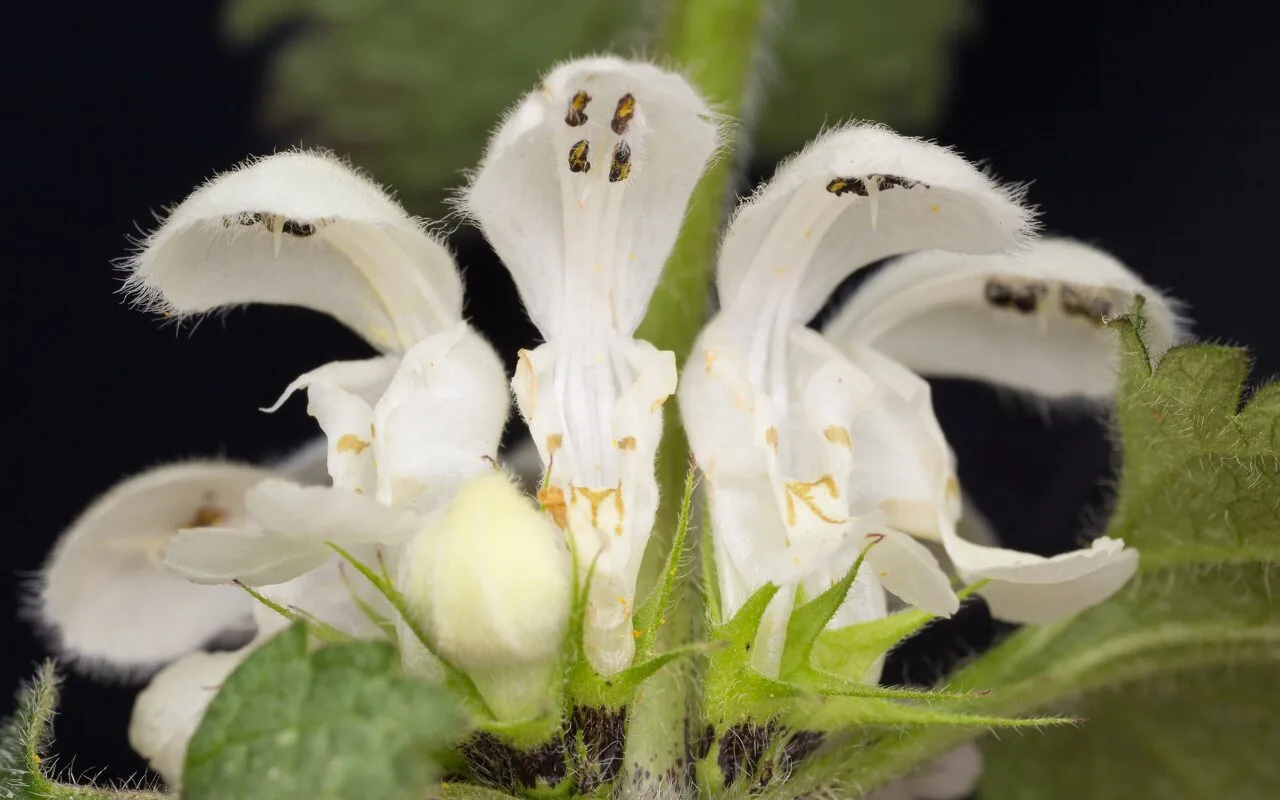
- Large white flowers arranged in several separated whorls around the upper part of the stem, rather than in a single crowded flower head.
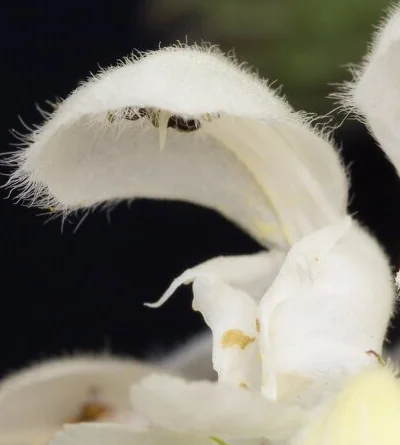
- Each flower has a conspicuous, finely hairy upper hood and a broad lower lip, sometimes showing pale yellowish or greenish markings.
- Opposite pairs of heart-shaped to triangular leaves, with pointed tips, deeply toothed margins and conspicuous veins.
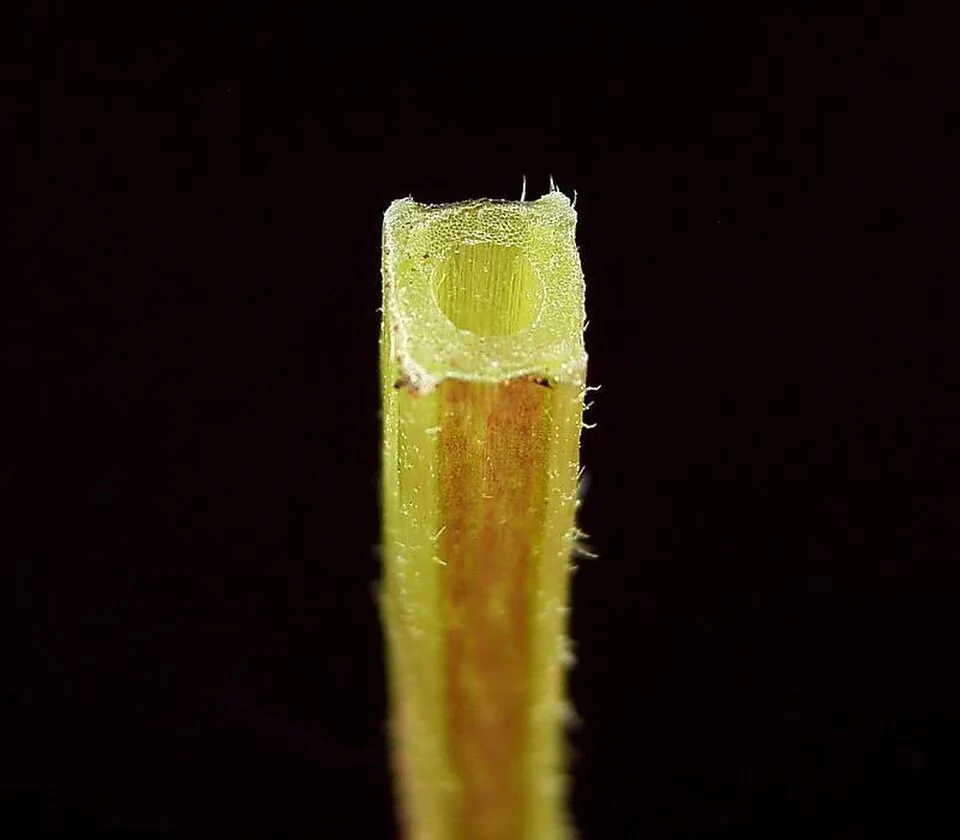
- Square or four-angled stems, often softly hairy, especially towards the upper part of the plant.
- No stinging hairs. Unlike Stinging Nettle, touching its leaves does not produce a nettle sting.
- Whorls of green, pointed calyces remain at the stem nodes after the white flowers fall.
The combination of nettle-like leaves, a square stem and large white, two-lipped flowers is usually enough to identify White Dead-nettle with confidence.
Flower structure
The flowers grow in clusters around the stem where opposite pairs of leaves emerge. Each apparent ring is a false whorl, known botanically as a verticillaster, formed from condensed clusters in the leaf axils. On a developed flowering shoot, several tiers may be spaced one above another.
Each flower has a fused, tubular corolla roughly 2–3 cm long. Its upper lip arches forward to make a hairy hood over the reproductive parts. The lower lip spreads out beneath it, with a broader central lobe and smaller side lobes. The five sepals are joined into a green, five-toothed calyx, whose narrow points project around the flower’s base.
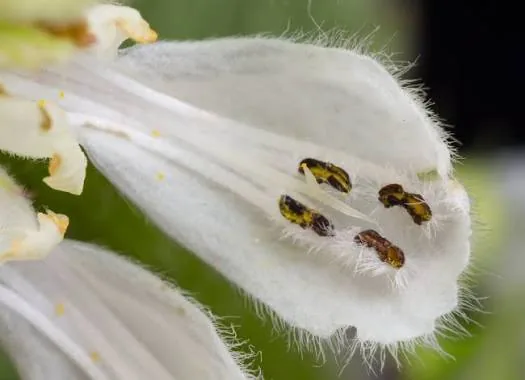
There are four stamens, in two pairs, sheltered beneath the hood. A visiting bumblebee lands on the lower lip and pushes into the flower to reach nectar deep in its tube; as it does so, its back can brush against the anthers and stigma. Following pollination, the fruit develops into four small nutlets, a typical mint-family feature.
Leaves and stems
The leaves are arranged in opposite pairs, with successive pairs usually turned at right angles to one another. Each leaf has a distinct stalk, a pointed tip, a heart-shaped or rounded base, and coarse, often double teeth along its edge. Strong veins give the surface a slightly crinkled appearance, while fine hairs make it feel soft rather than prickly.
Young plants can be mistaken for Stinging Nettle before they flower, but the stem offers a useful clue: White Dead-nettle has a distinctly four-sided stem and no stinging hairs. Older stems may be hollow, and a cut section shows the four-angled outline characteristic of the mint family. The plant can form spreading patches from persistent underground growth, unlike the smaller, usually annual Red Dead-nettle.
Habitat
White Dead-nettle is widespread across much of lowland Britain, particularly where the ground is fertile or has been disturbed. It grows along hedgerows, woodland margins, roadside verges, railway banks, field edges, gardens and waste ground. It is often found in partial shade and can thrive among taller vegetation, although it also grows in open, sunny places.
Its creeping underground stems allow an established patch to persist for years. It may grow in the same places as Stinging Nettle, which makes checking the flowers and stem especially helpful.
Flowering period
White Dead-nettle can flower from March into December, with flowers most abundant in spring and early summer. On mild days it may even flower outside this period. Its long season makes it a useful nectar plant well into autumn.
Similar species
- Red Dead-nettle (Lamium purpureum) is generally smaller, often with purple-flushed upper leaves and small pink-purple flowers crowded near the shoot tips. It is an annual, unlike White Dead-nettle.
- Yellow Archangel (Lamiastrum galeobdolon, also called Lamium galeobdolon) has similarly hooded flowers, but they are yellow with orange-brown markings. It is associated more strongly with woodland and shady hedgebanks.
- Stinging Nettle (Urtica dioica) has comparable toothed, opposite leaves but produces clusters of inconspicuous greenish flowers and possesses stinging hairs. It belongs to an entirely different family, Urticaceae.
- Spotted Dead-nettle (Lamium maculatum) can resemble White Dead-nettle in size and shape, but typically has pinkish-purple flowers and may show a pale stripe or silver markings on the leaves. Some plants encountered in Britain are garden escapes.
Where the names come from
The word nettle refers to its pointed, toothed leaves, which look much like those of the true Stinging Nettle. Dead means that the expected sting is missing: White Dead-nettle has no specialised stinging hairs. Other country names, including Blind Nettle, Deaf Nettle and Dumb Nettle, similarly suggest a nettle whose usual power has been taken away.
Lamium is an old botanical name commonly connected with the Greek laimos, meaning throat or gullet, an allusion to the open-mouthed appearance of the flowers. The species name album is Latin for white. The scientific name Lamium album was published by Carl Linnaeus in 1753.
The plant is also called White Archangel. In her 1931 book A Modern Herbal, Maud Grieve connected this name with the plant flowering around an old feast day associated with the Archangel Michael in May. Another traditional name is Bee Nettle, reflecting the way bees visit the rich nectar deep inside its flowers.
Folklore & history
White Dead-nettle has a long place in British herbal history. The Royal College of Physicians included it under the Latin name Lamii alba in the Pharmacopoeia Londinensis of 1618. Its presence in this early London medical reference shows that the plant was already recognised as a useful herb by professional physicians as well as country herbalists.
John Gerard described the White Archangel in his Herbal, first published in 1597. He drew attention to its rings of white flowers and recorded the old custom of preparing the blossoms with sugar or distilling them into a floral water. The resulting preparations were said to lift the spirits and brighten the complexion, an appealing reflection of the plant’s reputation in traditional household medicine.
White Dead-nettle also attracted a charming piece of country folklore. If the flower is turned upside down, the dark anthers tucked inside the hood can look like tiny pairs of boots or shoes. One version of the tale says the fairies hid their shoes there to keep them safe from centipedes that kept stealing them. Another tells it the other way round: the centipede hid its many little boots inside the flowers so that the fairies or pixies could not carry them off. Either way, the blossom became a miniature hiding place, and the dark anthers were imagined as the missing footwear.
Older herbalists also recorded White Dead-nettle in preparations for bleeding, bruises and wounds. In some parts of the countryside its hollow stems were cut to make simple whistles. These uses, together with names such as Bee Nettle and White Archangel, reveal how closely people once observed a plant that is now easily passed by on a roadside verge.
Wildlife
White Dead-nettle is particularly valuable to long-tongued bees. Bumblebees and some solitary bees can reach the nectar at the base of the deep flower tube, while the hooded structure brings visiting insects into contact with the pollen-bearing parts.
Red mason bees and white-tailed bumblebees are among its recorded visitors. The leaves also provide food for the caterpillars of some moths, including Garden Tiger and Angle Shades, and for small herbivores such as Green Tortoise Beetles. A flowering patch in a hedge bottom or garden can therefore support wildlife through much of the growing season.