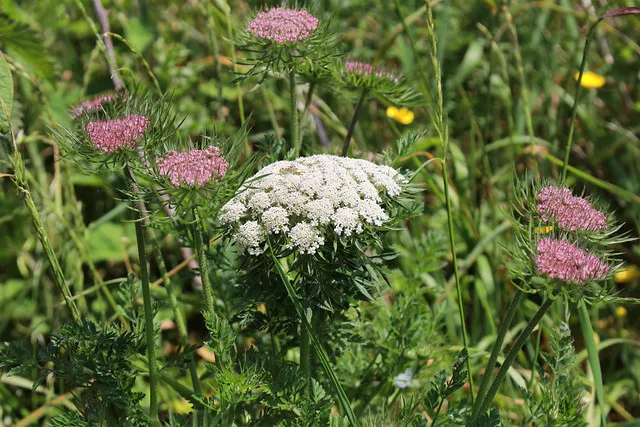
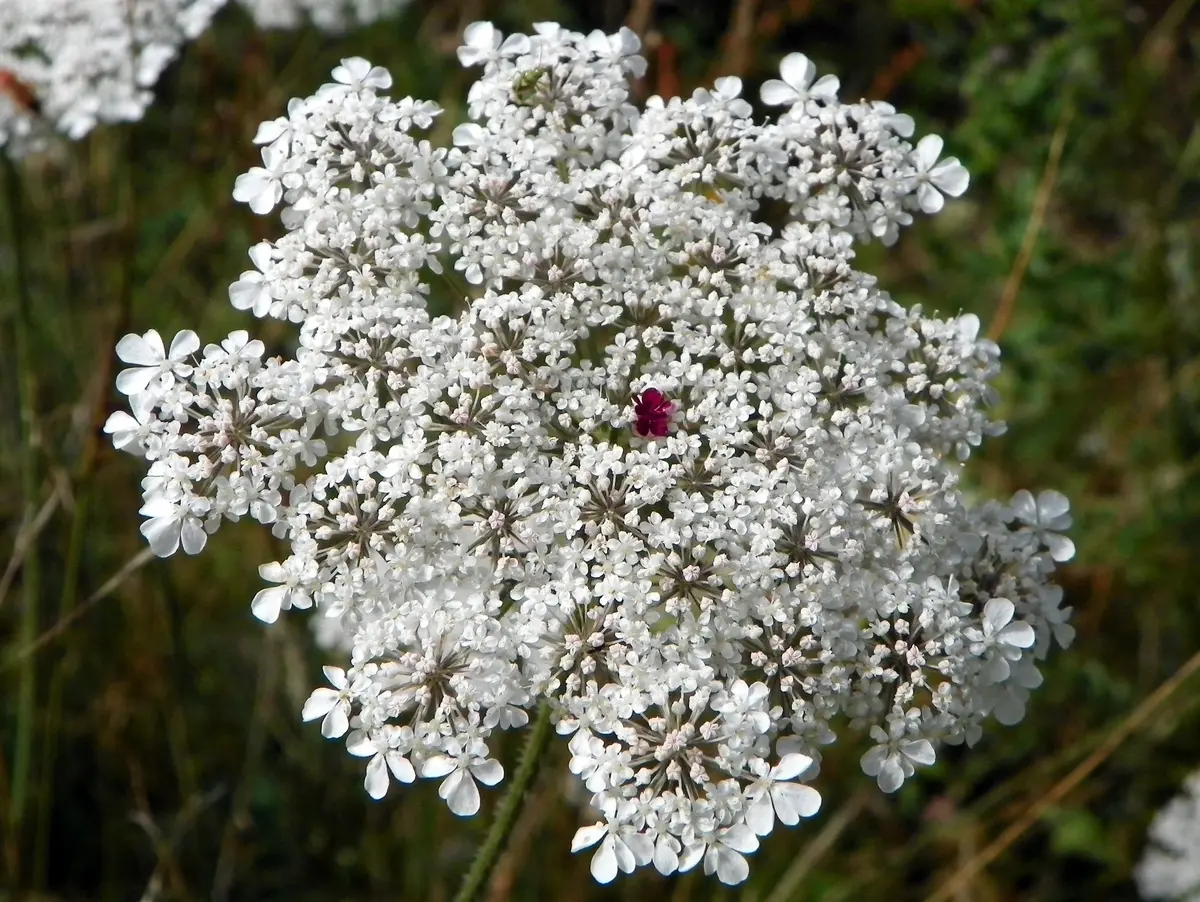
Wild Carrot is the wild ancestor of the familiar garden carrot. Its finely divided leaves, bristly stems and delicate white flowerheads are common sights in summer grassland, especially on dry, chalky soils and near the coast. Look closely at some flowerheads and you may spot an unexpected detail: a tiny dark red or purple flower right in the centre, set among hundreds of white ones.
This biennial belongs to the carrot family, Apiaceae, along with Cow Parsley, Hogweed, Fennel and Hemlock. The plants can look similar at a distance, so the flowerheads, leaves, stems and fruits are all worth examining.
Identification
- Usually 30–100 cm tall, with upright, branching stems that are solid, ridged and noticeably hairy or bristly.
- White or slightly pinkish flowers arranged in a dense, often flattened or gently domed compound umbel, typically several centimetres across.
- Sometimes one very small flower in the centre is deep red, burgundy or purple, standing out against the white flowers; some plants have no dark central flower at all.
- Beneath the main flowerhead is a conspicuous ring of long, finely divided bracts, often with three narrow, forked tips.
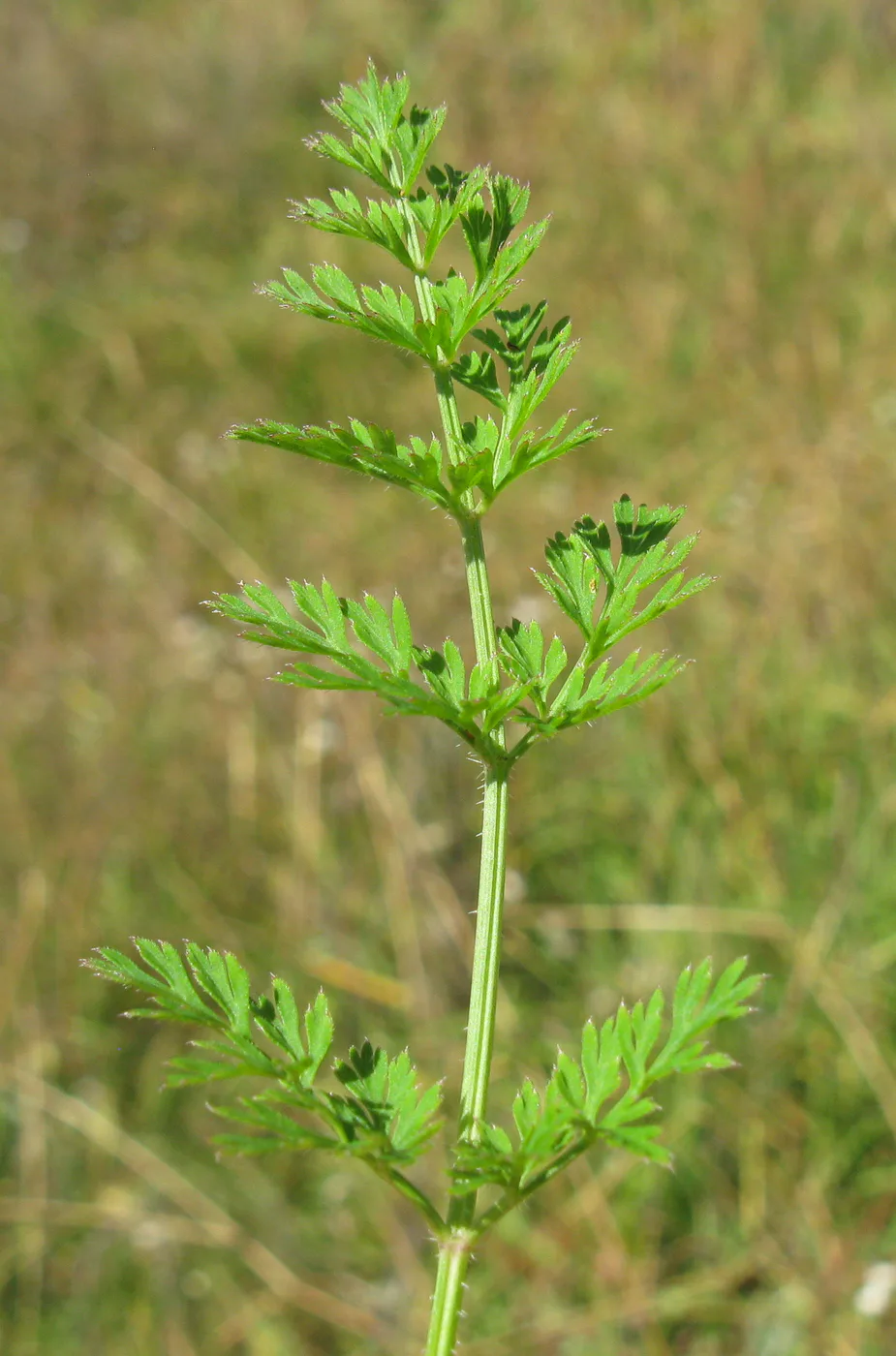
- Leaves are deeply divided into slender, feathery segments, resembling the foliage of cultivated carrots.
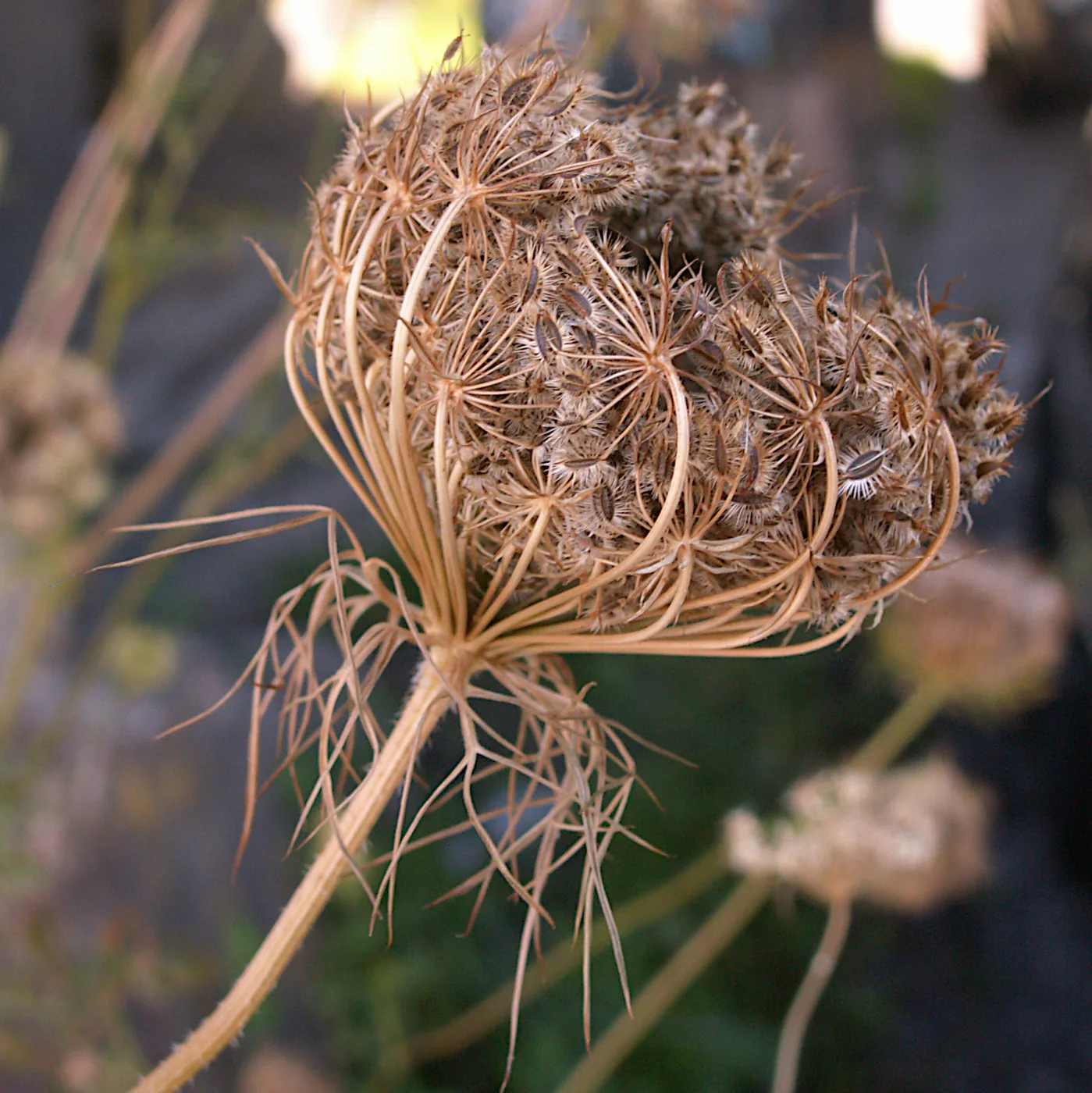
- As the fruits develop, the flowerhead’s stalks usually curve inwards to create a bird’s-nest-like seedhead.
The combination of divided bracts, a bristly stem and a flowerhead that closes into a nest is especially useful for distinguishing Wild Carrot from other white-flowered members of Apiaceae.
Flower structure
What looks like one white flower is actually a compound umbel: a cluster of smaller umbellets, each containing many individual flowers. Each small flower typically has five petals and five stamens. The outer flowers may have unevenly sized petals, lending the whole head a soft, lacy outline.
The dark red flower in the centre
One of Wild Carrot’s most intriguing features is the dark spot sometimes visible at the centre of the white umbel. It is not simply a red mark on a white petal. It is usually a tiny central floret—an individual flower—whose petals are dark red, wine-coloured or purple. Occasionally there may be more than one dark flower, and on many flowerheads the dark spot is absent altogether.
Why does Wild Carrot produce this odd dark flower? The answer is still debated. One suggestion is that it resembles a small insect already visiting the flowers, which might influence how pollinators approach the flowerhead. It is an interesting hypothesis, rather than a settled explanation.
The flowerhead has another useful identifying feature beneath it: a cluster of long, deeply divided bracts that can look like narrow green fingers spreading around the base of the umbel.
Leaves and stems
The leaves are alternate, with each leaf divided repeatedly into small, narrow segments. They are often described as two or three times pinnate, giving the foliage its fine, fern-like outline. If crushed, the foliage may have a carrot-like scent.
The stems are usually rough to the touch, with stiff hairs and raised longitudinal ridges. Unlike the hollow stems of some other umbellifers, Wild Carrot’s flowering stems are generally solid.
Below ground, the plant develops a slender, usually pale taproot rather than the thick orange storage root familiar from cultivated carrots.
Fruits and the bird’s nest
As flowering finishes, the long stalks of the umbel bend inwards. The once-flat flowerhead closes into a cup or nest, giving Wild Carrot another common name, Bird’s Nest.
The dry fruits split into two one-seeded halves, or mericarps. Their hooked spines can catch on animal fur, helping the seeds travel away from the parent plant. The curled seedheads are especially distinctive in late summer and autumn.
Habitat
Wild Carrot prefers sunny, relatively dry places, particularly where the soil is chalky or lime-rich. It can be found in:
- chalk and limestone grassland
- coastal cliffs, dunes and grassy slopes
- roadside verges and dry banks
- field margins and rough grassland
- disturbed ground and open, sunny places
It is widespread across much of Britain, especially in England and Wales, but is generally less frequent farther north.
Flowering period
Wild Carrot flowers mainly from June to September, often at its best in July and August. The flowerheads may be slightly pinkish in bud before opening white. The curled, nest-like fruiting heads can remain conspicuous well into autumn.
Similar species
- Cow Parsley (Anthriscus sylvestris) usually flowers earlier, often in April and May, and favours hedges and woodland edges. Its white flowerheads are generally airier, while Wild Carrot has conspicuous divided bracts beneath the umbel and later develops the familiar bird’s-nest seedhead.
- Hemlock (Conium maculatum) is highly poisonous. It is usually a taller, more robust plant with smooth, hairless stems commonly marked by purple-red blotches. Wild Carrot’s stems are bristly, and its long, divided bracts provide another clue. Never rely on a single feature to separate members of this family.
- Upright Hedge-parsley (Torilis japonica) also flowers in summer and has hairy stems, but the inflorescences and fruits differ. Its small hooked fruits form clusters without the characteristic inward-curling nest of Wild Carrot.
- Hogweed (Heracleum sphondylium) has much broader, coarser leaves and generally larger, sturdier umbels. Its foliage is quite unlike the delicate, finely divided leaves of Wild Carrot.
Where the names come from
Wild Carrot is the wild relative of the cultivated carrot. Its other name, Bird’s Nest, refers to the way the flowering head curls inward as the seeds ripen, looking rather like a little nest.
Daucus is an ancient Greek and Latin plant name used for carrots and similar umbellifers; its ultimate origin is uncertain. Carota is another ancient word for carrot, preserved in the English name.
Folklore & history
Wild Carrot is one of the plants called Queen Anne’s Lace, a name inspired by the intricate white flowerheads. A traditional story says that Queen Anne pricked her finger while making lace, and a drop of blood fell onto it. The tiny red flower at the centre of some umbels became the imagined drop of blood.
It is a lovely way of remembering the dark central flower, although the story is folklore rather than botanical history. The name Queen Anne’s Lace is also used for Cow Parsley, so it is not a reliable name for identifying a species.
The cultivated carrot belongs to the same species, Daucus carota, but has been selected over generations for a much larger, fleshier root. Older herbals also record the use of Wild Carrot seeds and roots in traditional remedies.
Wildlife
Wild Carrot’s exposed clusters of small flowers are accessible to a wide variety of insects, particularly hoverflies, small bees, solitary wasps and beetles. They provide nectar and pollen through summer, when dry grassland and coastal banks can be busy with pollinators.
The hooked fruits also help the plant spread as animals brush past, while its low-growing foliage adds texture and shelter to open grassland habitats.