Wood Anemone is a native perennial that brings white flowers to woodland floors in early spring. Also called windflower, it belongs to Ranunculaceae, the buttercup family. A patch in bloom can spread beneath the trees, with individual flowers held above finely divided foliage.
You may also encounter the scientific name Anemonoides nemorosa. Both names refer to the same species; this guide follows Kew’s treatment of Anemone nemorosa.
Identification
- A low-growing plant, commonly around 10–25 cm tall.
- One white flower at the end of each slender flowering stem.
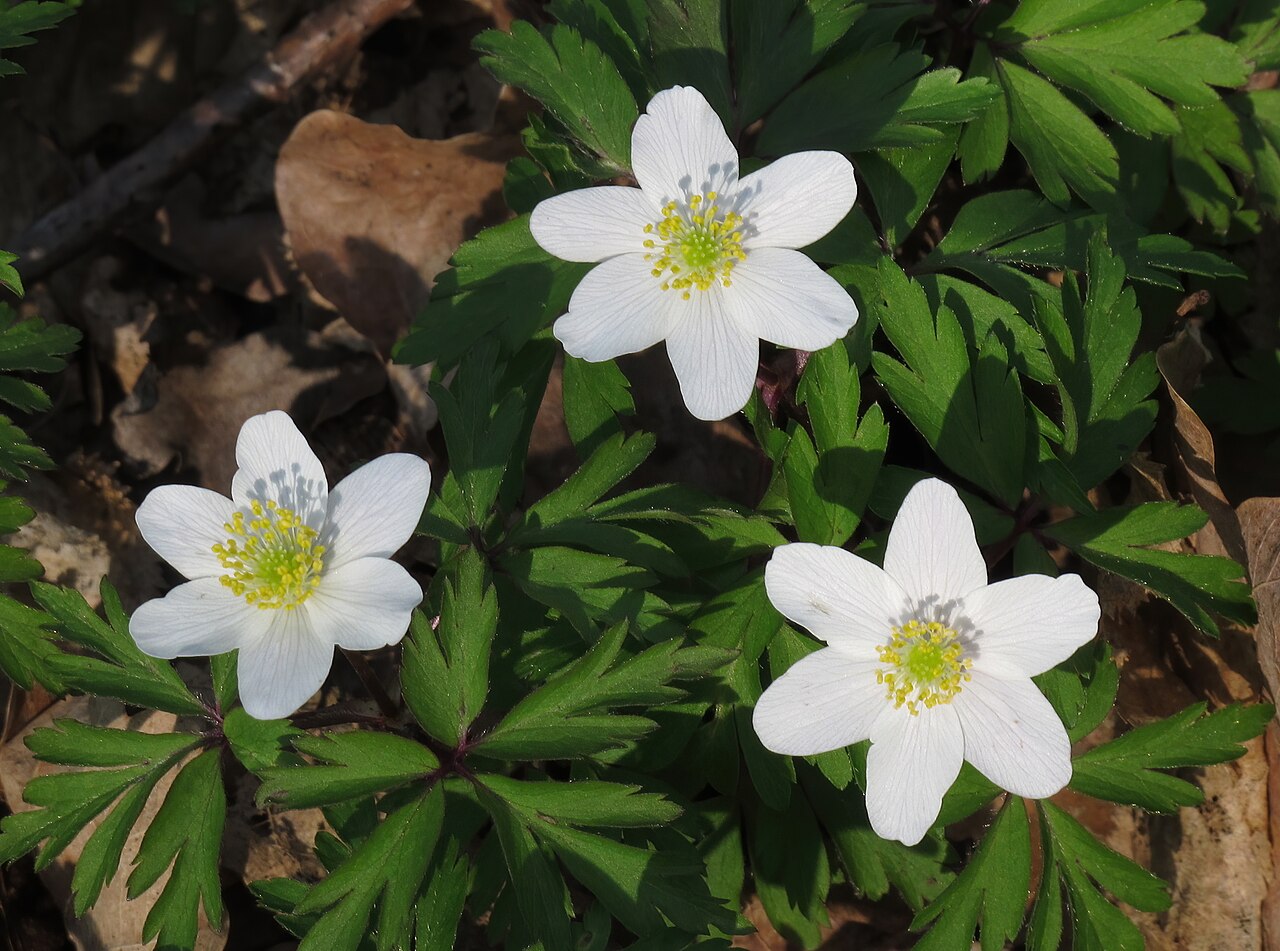
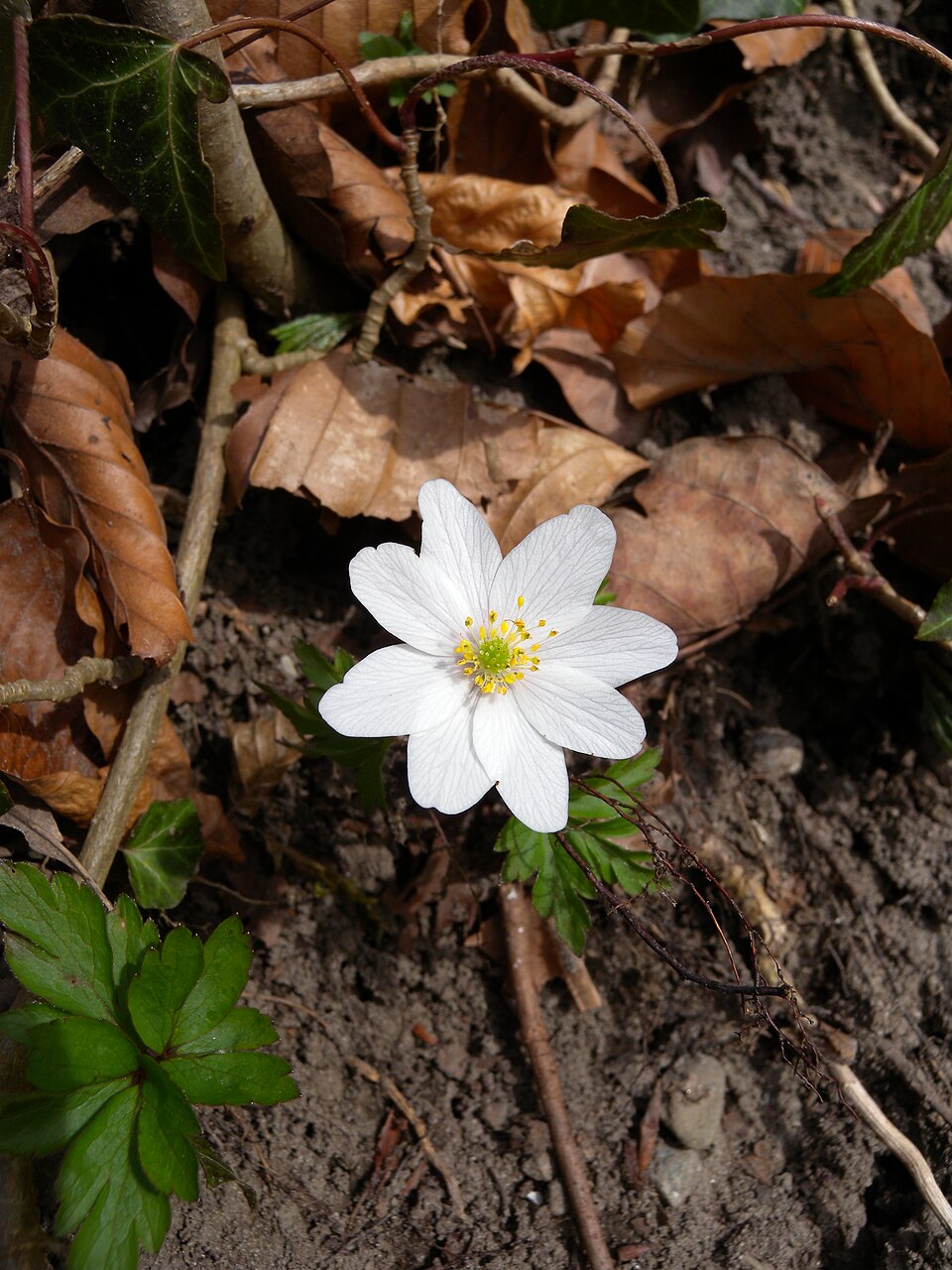
- Usually six or seven petal-like segments, sometimes more or fewer, with yellow anthers in the centre.
- Pink or purple colouring may be visible on the backs of the flowers.
- Deeply divided green foliage, including a ring of three leaf-like structures below each flower.
Check the foliage as well as the flower: the divided outline is a useful clue when several white woodland flowers are growing together.
Flower structure
The white parts that look like petals are actually petal-like sepals, also described as tepals. Wood Anemone has no separate ring of true petals.
Numerous stamens surround the centre. Each carries an anther that produces pollen. Unlike an Oxeye Daisy, each Wood Anemone bloom is one flower, rather than a head of many florets.
Flowers spread open in sunshine and tend to close or droop at night and in dull, wet weather.
Leaves and bracts
The three green structures around the flowering stem form a whorl of bracts. Each is divided into lobed and toothed segments, giving a leafy collar below the flower.
True leaves have a similar divided appearance but arise separately from the underground stem, or rhizome. This is a useful example of why a green, leaf-like structure beside a flower may be a bract.
Habitat
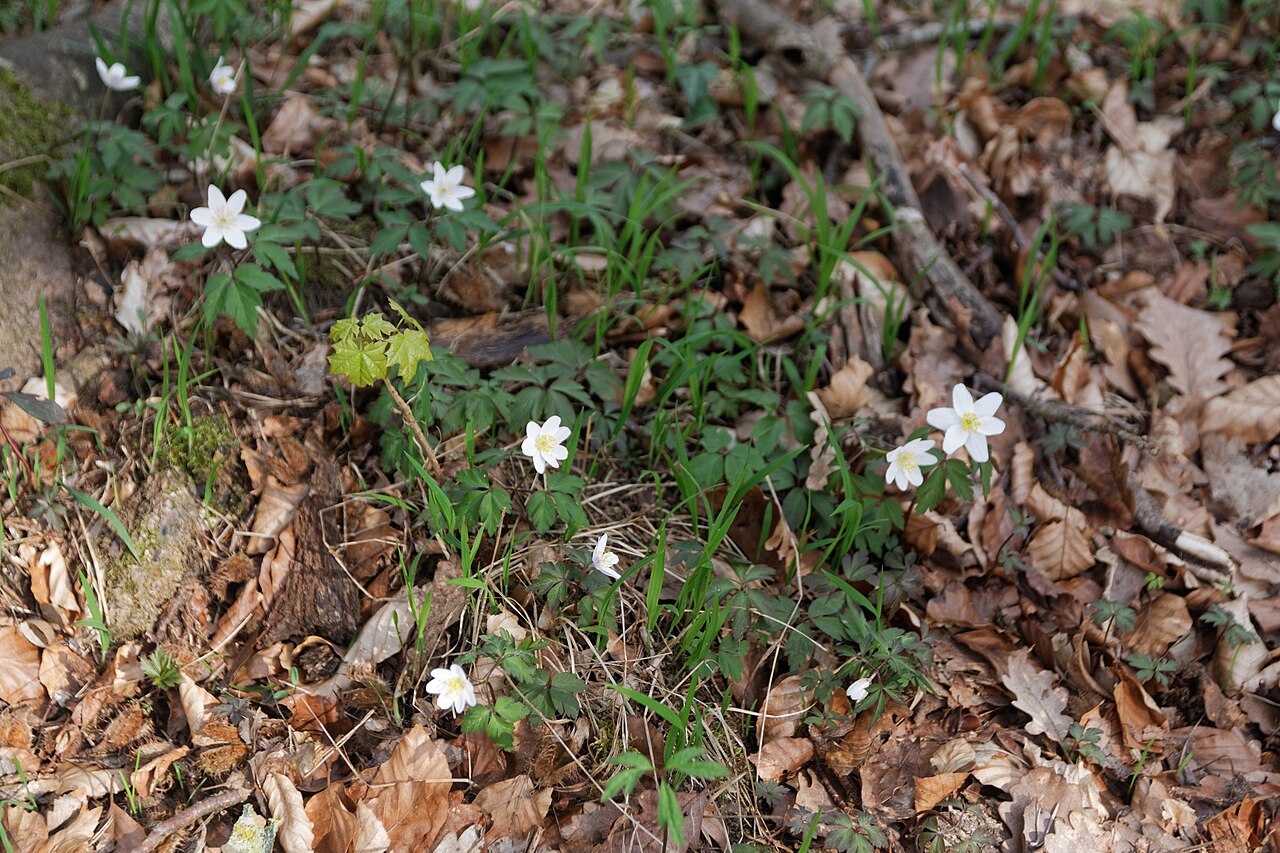
Look in deciduous woodland, old hedgerows and shaded banks. Wood Anemone is widespread in Britain and Ireland and can also occur in open habitats, including some meadows.
It is associated with ancient woodland and spreads slowly by creeping rhizomes. Established patches can be a clue to a site’s woodland history, although the presence of one species alone does not prove that a wood is ancient.
Flowering period
Usually March to May, with timing varying by location and weather. Flowers appear while light still reaches the woodland floor before the trees are fully in leaf. The foliage dies back during summer, leaving the plant dormant underground.
Similar species
Wood Sorrel (Oxalis acetosella) also has white spring flowers and grows in woodland. Its flowers usually show pinkish veins, and its leaves have three rounded, heart-shaped leaflets. Wood Anemone has much more deeply cut foliage and lacks that clover-like leaf outline.
Wildlife
The flowers offer pollen to visiting insects, including bees, flies and beetles; they do not produce nectar. Hoverflies are among their pollinators.
Sources and photo credits
- Scientific name, synonyms, family and native range: Kew, Plants of the World Online.
- Identification, height and flowering season: The Wildlife Trusts.
- Habitat, colour variation and flowering behaviour: Plantlife.
- Woodland association and comparison with Wood Sorrel: Woodland Trust.
- Bracts, flower structure, seasonal growth and pollination: BSBI, Fermanagh species account.
- Flowers and foliage: Robert Flogaus-Faust, Wikimedia Commons, CC BY 4.0.
- Flower close-up: MurielBendel, Wikimedia Commons, CC BY-SA 4.0.
- Woodland plants: Daniel VILLAFRUELA, Wikimedia Commons, CC BY-SA 4.0.


Photographs are reduced-resolution copies supplied by Wikimedia Commons. Listing thumbnails may be cropped for display; each photograph retains its stated licence.