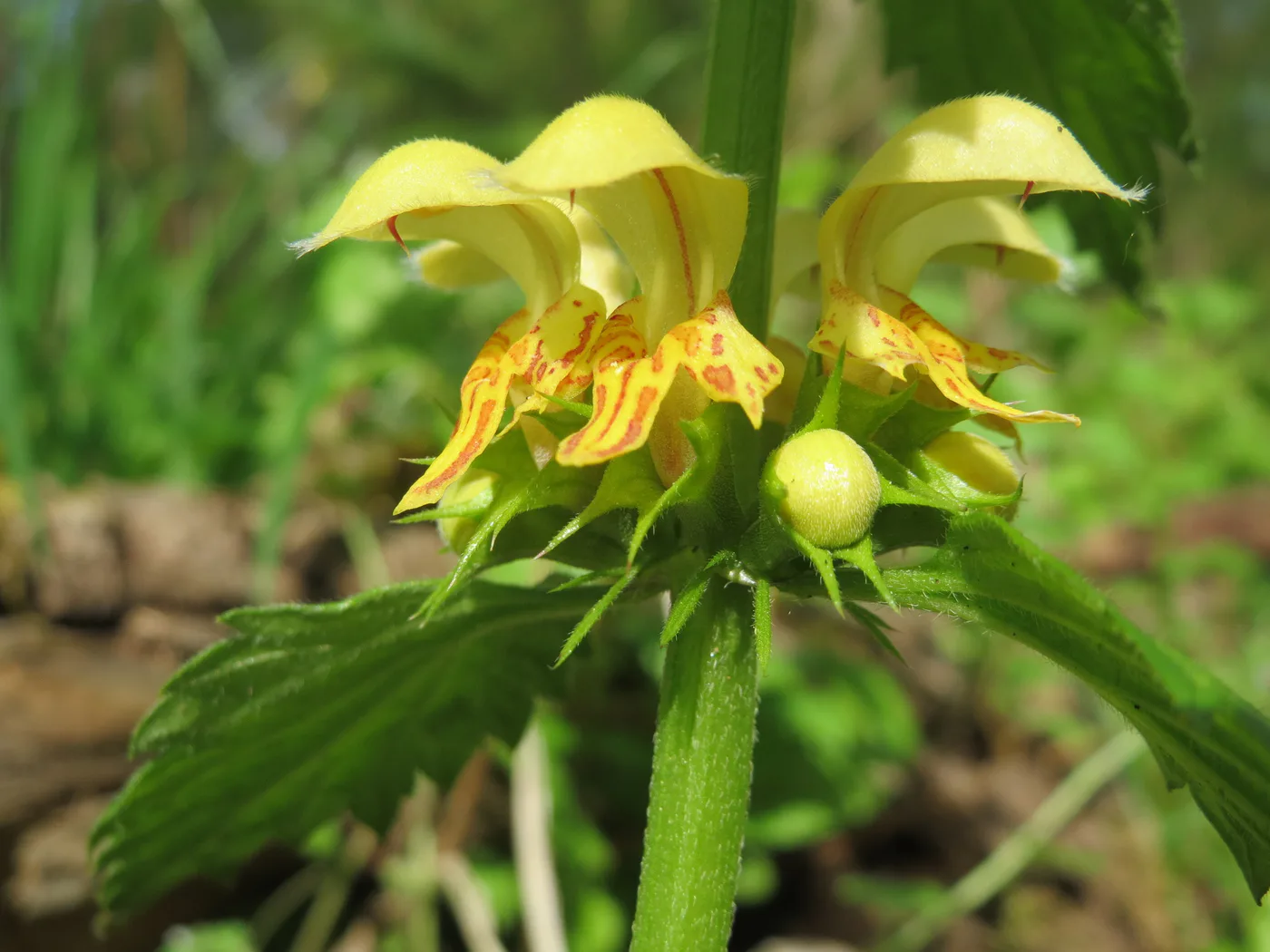
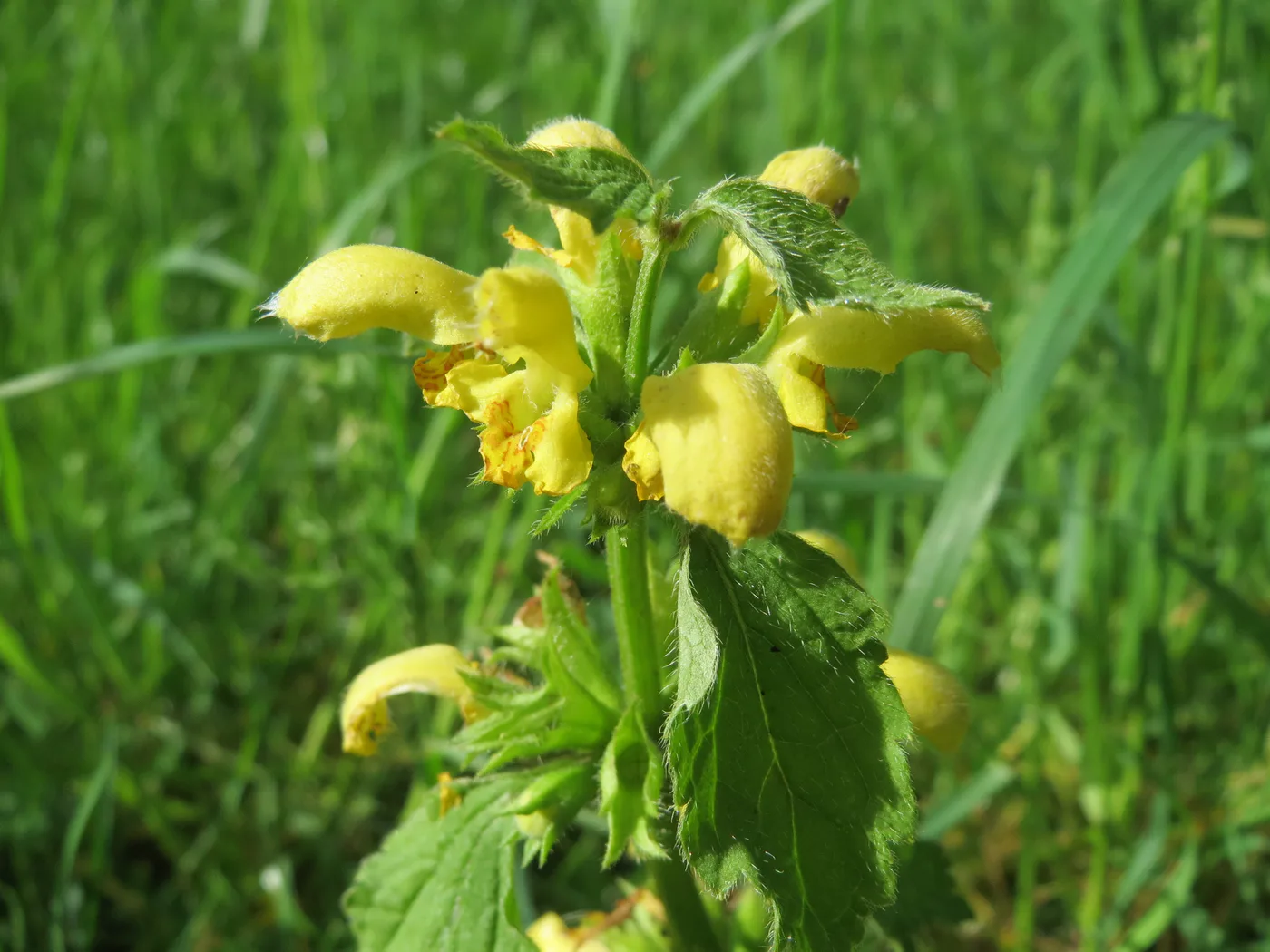
In a spring woodland, Yellow Archangel can brighten the shady ground with little clusters of golden flowers. It often appears as the bluebells are fading, and is a characteristic plant of older woods and hedgebanks. Look closely at the flowers and you will see their unusual hooded shape and fine orange-brown markings.
Yellow Archangel is a perennial in the mint family, Lamiaceae, alongside Self-heal and the dead-nettles. Its nettle-like leaves are harmless to touch, and its square stem and two-lipped flowers are typical features of the family. It is also known by the scientific name Lamium galeobdolon.
Identification
- Usually about 20–45 cm tall, sometimes taller, with upright flowering stems rising from a spreading patch of foliage.
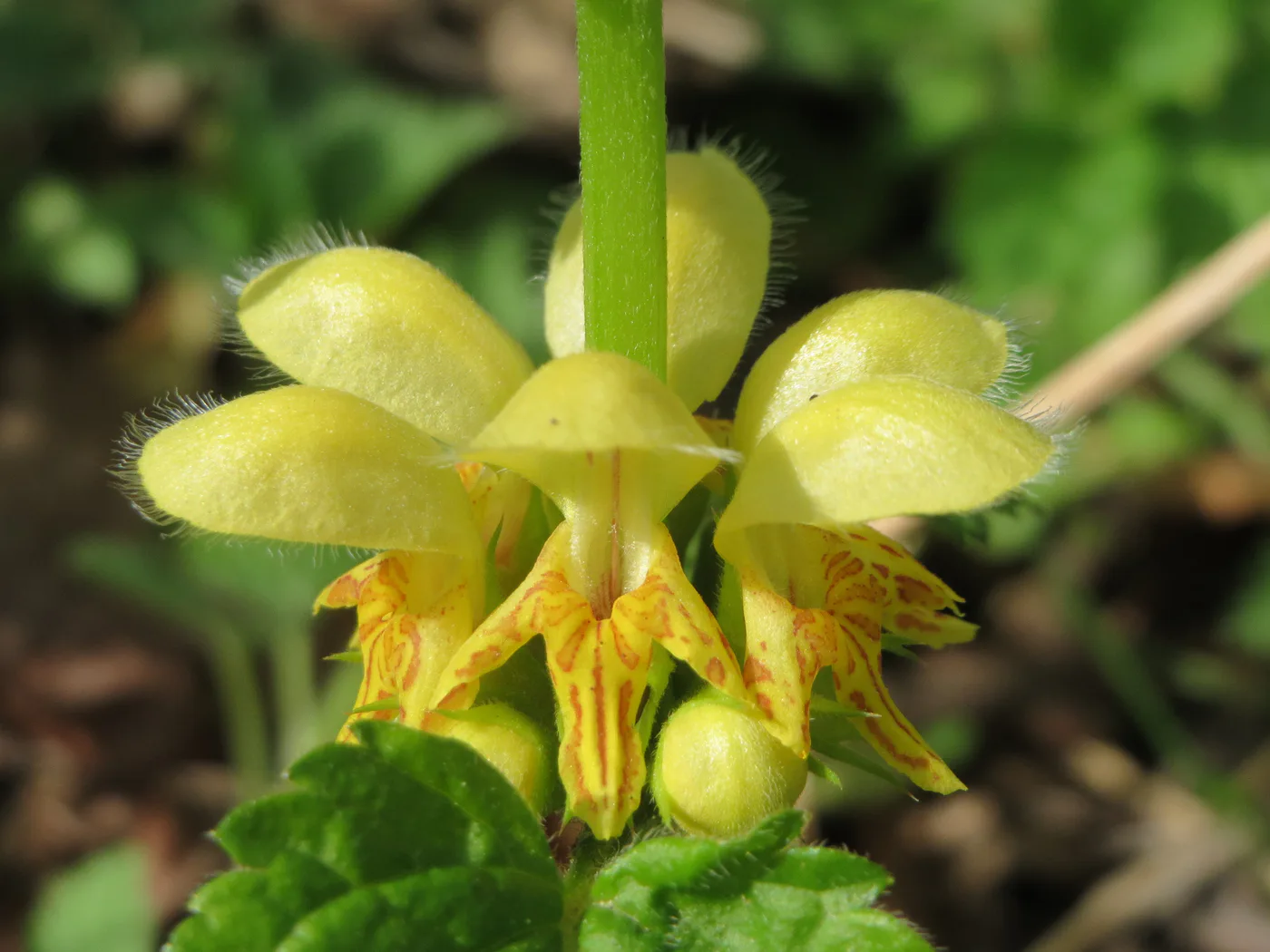
- Golden-yellow, two-lipped flowers, often with rusty orange or reddish-brown markings on the lower lip.
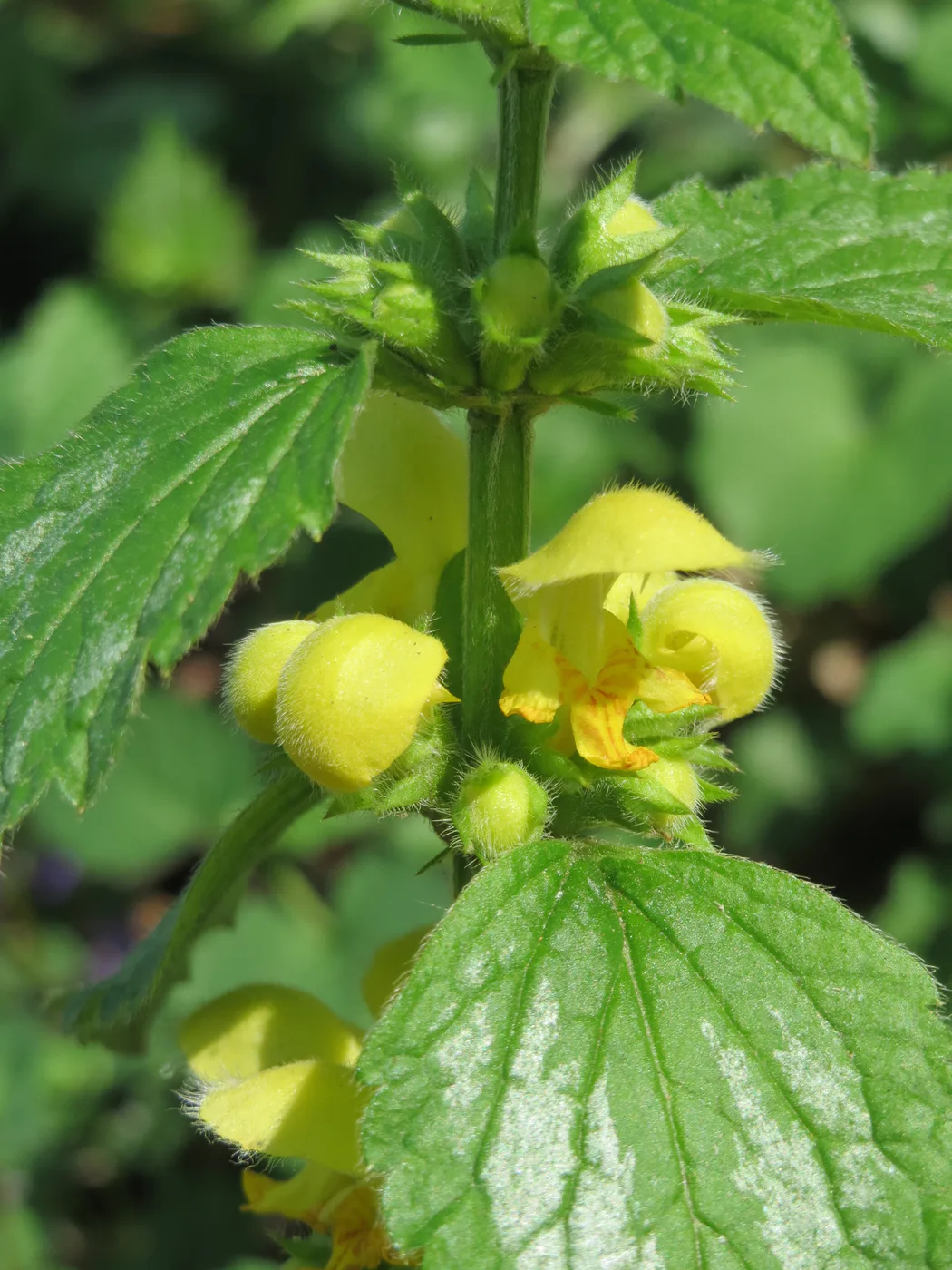
- Flowers arranged in short, rather crowded whorls at several levels among the upper leaves.
- Opposite, broadly oval to heart-shaped leaves with pointed tips, prominent veins and toothed margins.
- Stems are four-angled and often softly hairy; the leaves also have fine hairs.
- Creeping shoots allow the plant to spread across shady ground, sometimes creating extensive patches.
- The native woodland plant generally has green leaves, while a widely planted garden form has conspicuous silvery patches.
The yellow, hooded flowers are the most striking feature, but the opposite leaves and the square stem are helpful clues even when it is not in flower.
Flower structure
The corolla is formed from five fused petals and divided into two lips. The large upper lip arches over the stamens and style like a little helmet, while the three-lobed lower lip provides a landing place for visiting insects. Its orange-brown markings lead towards the nectar at the back of the flower.
Four stamens are tucked beneath the upper lip, in two pairs of unequal length. A five-toothed calyx surrounds the base of each flower. The flowers are grouped into apparent whorls arising from the upper leaf axils, a familiar arrangement in the mint family.
After flowering, the ovary develops into four small, one-seeded nutlets, although not all four necessarily mature.
Leaves and stems
The leaves are arranged in opposite pairs along the stem. They are usually heart-shaped to oval, with pointed tips, conspicuous veins and coarsely toothed edges. Their surface is often softly hairy. Their resemblance to stinging nettle foliage is striking, but Yellow Archangel has no stinging hairs.
The flowering stems are upright and four-angled. Lower, creeping shoots may root at their nodes, helping the plant spread through the woodland floor. Green foliage is characteristic of the native woodland form; conspicuous silver markings often indicate an introduced garden variety.
Habitat
Yellow Archangel favours shady, reasonably moist woodland, particularly old deciduous woods, as well as hedgerows, wooded banks and woodland edges. It is most widespread in England and Wales and often grows in colonies among other spring woodland flowers.
The native form is associated with ancient woodland and may become more noticeable where coppicing or a gap in the canopy allows additional spring light to reach the ground.
Flowering period
Flowers are usually seen from April to June, with May often being the best month. In a mild spring they may open earlier, and some flowers can linger into early summer.
Similar species
- Red Dead-nettle (Lamium purpureum) has similarly shaped flowers and opposite leaves, but its flowers are pink-purple and it usually grows in more open, disturbed ground. Its upper leaves are often flushed purple.
- White Dead-nettle (Lamium album) has white rather than yellow flowers, and often grows beside paths, hedges and waste ground. Its large, toothed leaves and whorled flowers reflect the same mint-family pattern.
- The silver-marked garden form of Yellow Archangel, often called subsp. argentatum or sold as ‘Variegatum’, has distinctive pale patches on its leaves. It can escape from gardens and spread vigorously in woodland. The native green-leaved woodland form is the one traditionally associated with ancient woods.
Where the names come from
The name archangel is traditionally linked with the flower’s supposed resemblance to an angel, with the arching upper lip and spreading lower lip suggesting a tiny figure with wings. Another explanation associates the name with the plant’s lack of a sting, unlike the nettles it resembles.
The genus name Lamiastrum points to its likeness to the dead-nettles (Lamium). The older name Lamium galeobdolon is still widely used in field guides and by botanical organisations.
Folklore & history
Yellow Archangel has long been associated with spring woodland and with the same traditional names and beliefs as the dead-nettles. The name archangel helped distinguish these harmless, nettle-like plants from stinging nettles.
In older folklore, archangel plants were associated with protection from misfortune and harmful spirits. Their appearance in spring, beneath newly opening woodland trees, gave them a natural place among plants connected with renewal and the return of warmth.
Wildlife
The nectar-rich, tubular flowers are particularly attractive to bumblebees and other long-tongued bees. The lower lip acts as a landing platform, while the markings guide insects towards the nectar. A bee pushing beneath the hood can brush against the stamens and stigma, helping to transfer pollen between flowers.
The dense leaves and creeping shoots also provide ground cover and shelter for small woodland invertebrates.