Black Bryony is a native climbing perennial of hedgerows, scrub and woodland edges. During summer its slender, twining stems carry glossy, heart-shaped leaves and small greenish-yellow flowers. In autumn, female plants are especially noticeable for their dangling strings of bright red berries.
Despite its name, it is not closely related to White Bryony. Black Bryony is a member of Dioscoreaceae, the yam family, and is also known by the older scientific name Tamus communis.
Identification
- A vigorous climber whose thin stems can wind several metres through hedges or shrubs, sometimes reaching around 4 m.
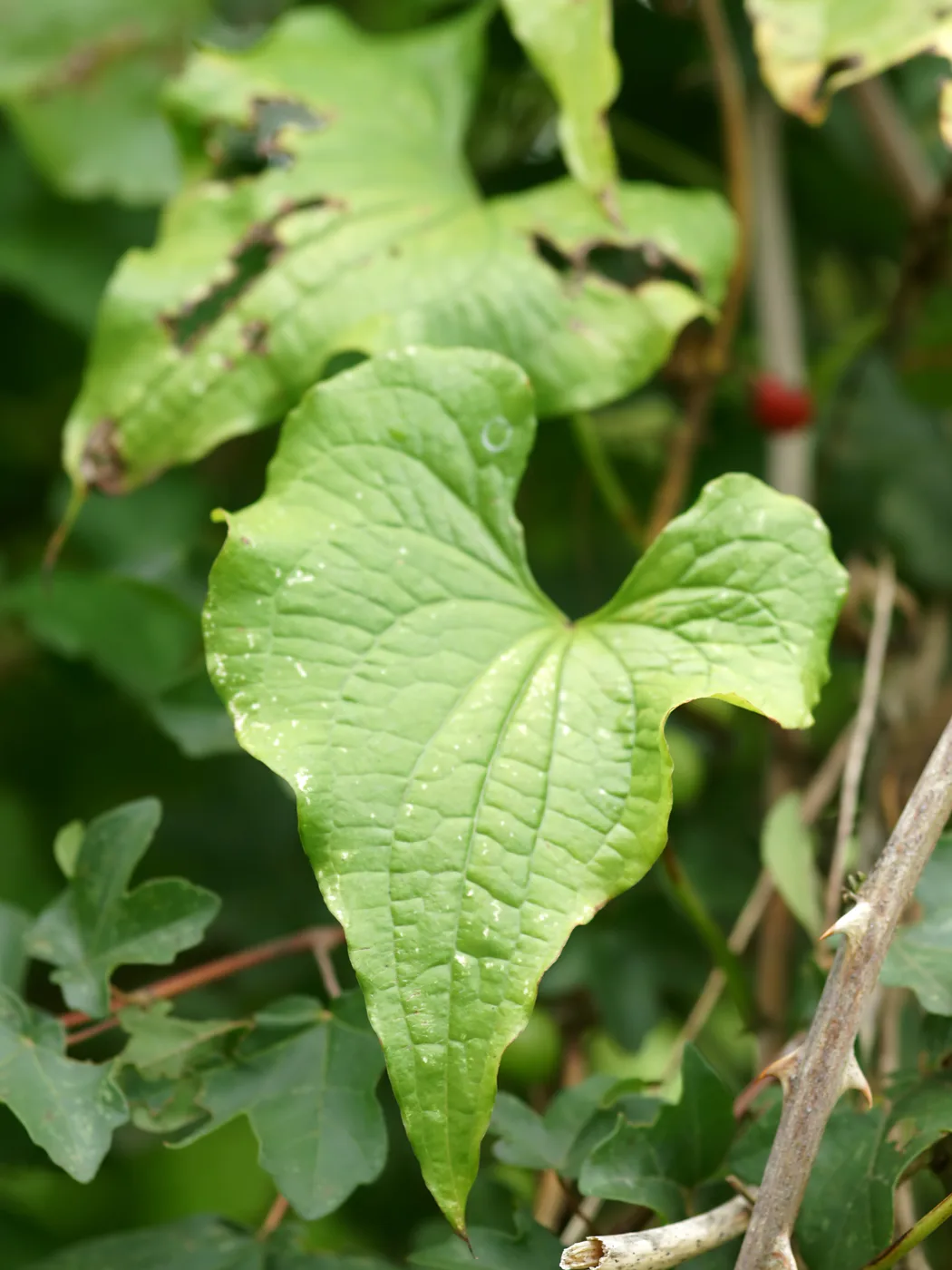
- Large, smooth, glossy, heart-shaped leaves with pointed tips and conspicuous veins.
- Leaves are alternate rather than opposite, each carried on a long stalk.
- No climbing tendrils: the stem itself twists around nearby supports.
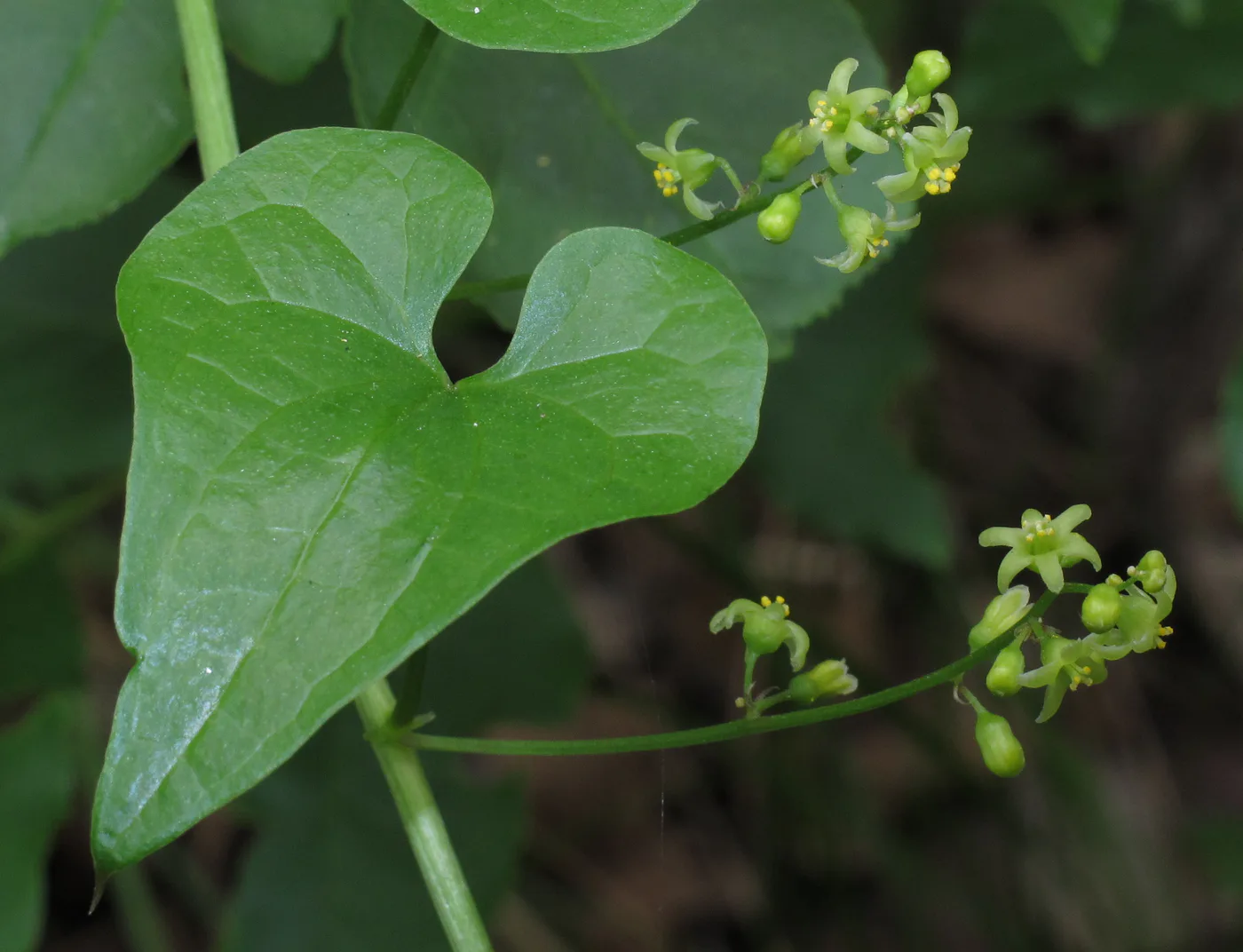
- Very small yellowish-green flowers, often in drooping sprays from the leaf axils.
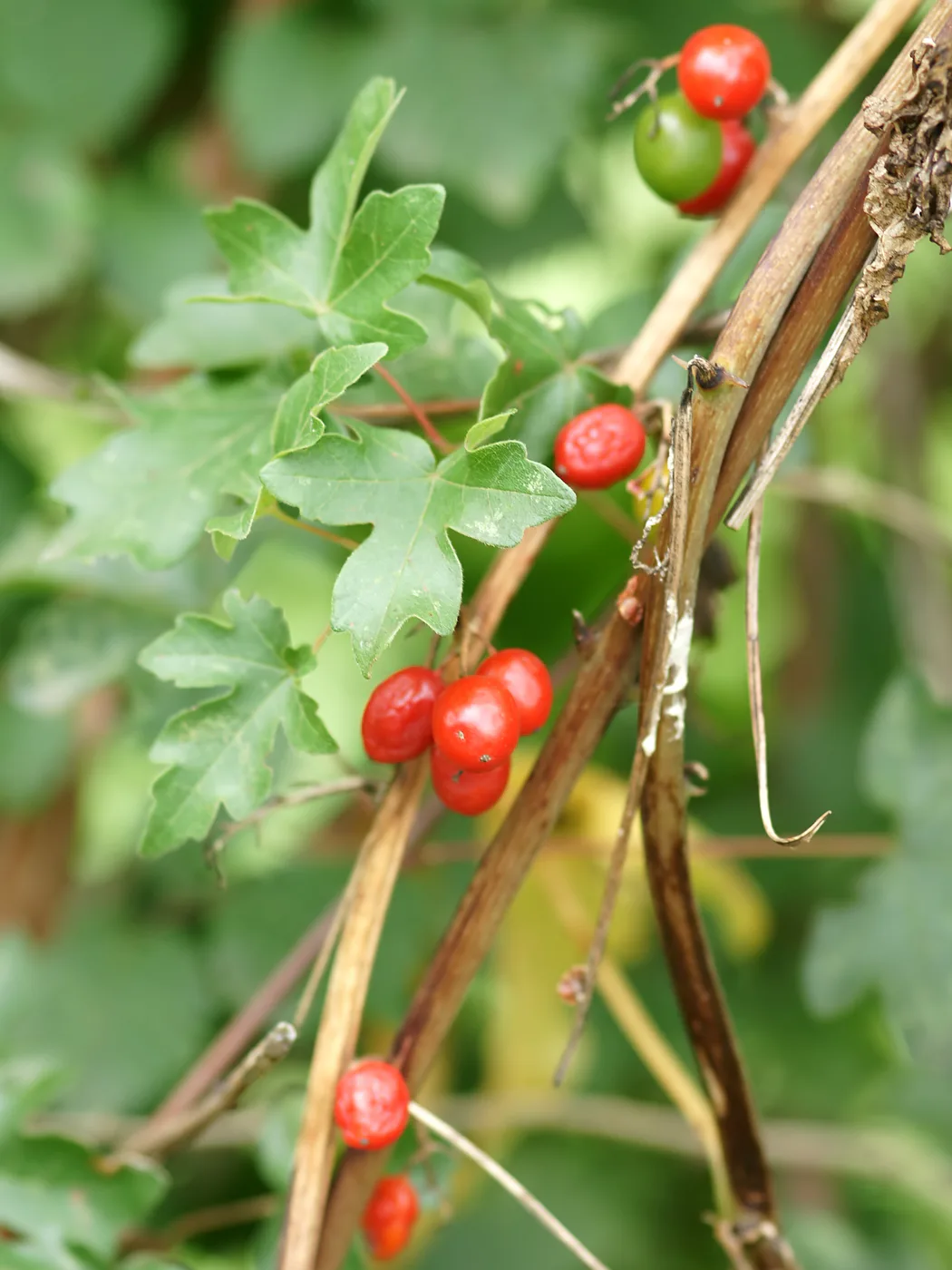
- On female plants, clusters of glossy red berries develop in late summer and autumn.
- A large underground tuber stores food and allows the plant to grow again in spring.
The combination of a twining stem without tendrils, glossy heart-shaped leaves and autumn strings of red berries is particularly useful for identification.
Flower structure
The flowers are much less conspicuous than the leaves or berries. Each small flower has six greenish-yellow tepals, forming two sets of three; these are the flower’s perianth parts rather than distinct petals and sepals.
The flowers are much less conspicuous than the leaves or berries. Each small flower has six greenish-yellow tepals, arranged in two whorls of three. Together, these form the perianth. The tepals are not clearly differentiated into petals and sepals.
Black Bryony has male and female flowers on separate plants, a condition called dioecy. Male flowers, with pollen-bearing stamens, occur in longer, slender racemes. Female flowers tend to be in shorter clusters; each has an inferior ovary that can develop into a fleshy red fruit after pollination.
Despite its heart-shaped leaves and net-like veins, Black Bryony is a monocot, a reminder that familiar leaf features do not always follow simple textbook patterns.
Leaves and stems
The leaves are usually broad, shiny and roughly triangular-heart-shaped, narrowing to a long pointed tip. Their leaf bases have two rounded lobes, and several strong veins curve outwards from the point where the stalk joins the blade. Unlike the narrow, parallel-veined leaves of many familiar monocots, these leaves have a branching network of veins.
The plant climbs by wrapping its slender stems around hedges, brambles and other vegetation. It has no tendrils or adhesive roots. Its growth comes from a substantial underground tuber, while the leafy shoots die back towards winter.
Habitat
Look for Black Bryony in old hedgerows, woodland margins, thickets and scrub, particularly where there is enough light for the climbing shoots to reach through surrounding vegetation. It also grows on banks, at field edges and in some gardens.
It is most frequently encountered in England and Wales, especially in milder areas, and is much less widespread in Scotland. It is a native British species despite its rather exotic appearance.
Flowering period
The small greenish-yellow flowers appear chiefly from May to August, with the main display in late spring and early summer. The berries mature later, turning from green to vivid red, and often remain visible into autumn or early winter.
Similar species
- White Bryony (Bryonia dioica) is another climbing hedgerow plant, but belongs to the cucumber family (Cucurbitaceae). It has rougher, usually lobed leaves, obvious tendrils for climbing, pale five-lobed flowers and red berries.
- Lords-and-ladies (Arum maculatum) also has glossy leaves and red berries, but its spring flowers are arranged on a spadix within a spathe, and its berries form a compact upright spike rather than hanging strings.
- Black Bindweed (Fallopia convolvulus) is a much smaller twining plant with arrow-shaped leaves and inconspicuous pale flowers, but it produces small dry fruits rather than fleshy red berries.
Where the names come from
The name Black Bryony probably refers to the plant’s large, dark underground tuber and its superficial resemblance to White Bryony. The two plants share a common name because they climb through similar habitats, not because they are close relatives.
Dioscorea commemorates Dioscorides, a Greek physician and writer on medicinal plants. The Latin communis means common or widespread. The older name Tamus communis is still found in many British wildflower books.
Other traditional names include Lady’s-seal, Oxberry and Devil’s Cherry.
Folklore & history
Black Bryony has a long history in British herbal traditions. Its substantial tuber was once compared with the roots of mandrake, a plant surrounded by stories of magic and unusual powers.
Under names such as Oxberry and Blackeye Root, Black Bryony was used in folk remedies for bruises, aching joints and rheumatism. In some local traditions, preparations made from the root were applied as plasters, while the berries were associated with remedies for chilblains.
The plant also appeared in older herbals under the name Tamus communis, and the striking red berries made it a familiar autumn feature of country hedges.
Wildlife
The small flowers attract bees and other visiting insects. In autumn, birds feed on the ripe berries and can carry the seeds away from the parent plant.
Its scrambling growth provides cover among hedge shrubs and woodland-edge vegetation. The berries are poisonous to people, but are eaten by some birds, making Black Bryony an interesting example of a plant whose fruits are used differently by wildlife and humans.