White Bryony is a vigorous, native perennial climber of hedgerows, scrub and woodland edges. Its rough, lobed leaves and tightly coiling tendrils make it look rather like a wild cucumber vine, which is fitting: it belongs to the cucumber family, Cucurbitaceae. Pale greenish-white flowers appear during summer, followed by strings of shiny red berries on female plants. All parts of the plant are poisonous, particularly the large underground root.
Identification
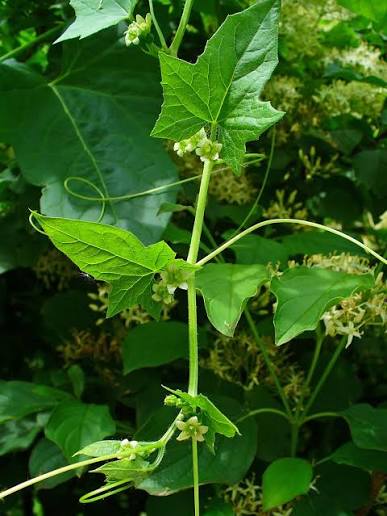
- Slender, scrambling stems that may climb several metres into hedges or shrubs, usually reaching around 2–4 m.
- Broad, rough-textured leaves divided into three to five, usually five, pointed lobes, with veins radiating from the leaf stalk.
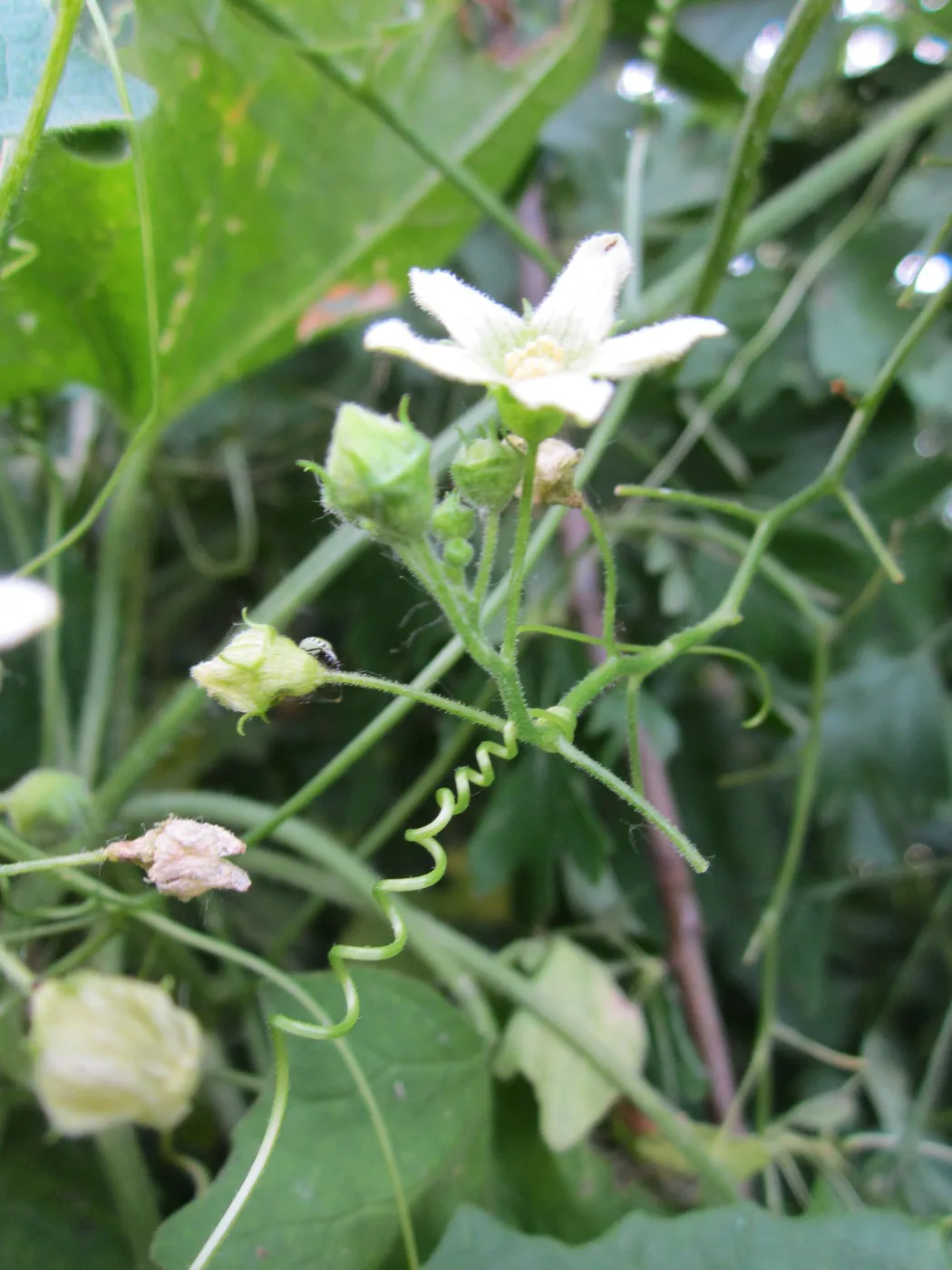
- Long, slender tendrils that twist into tight spirals and grip neighbouring stems for support.
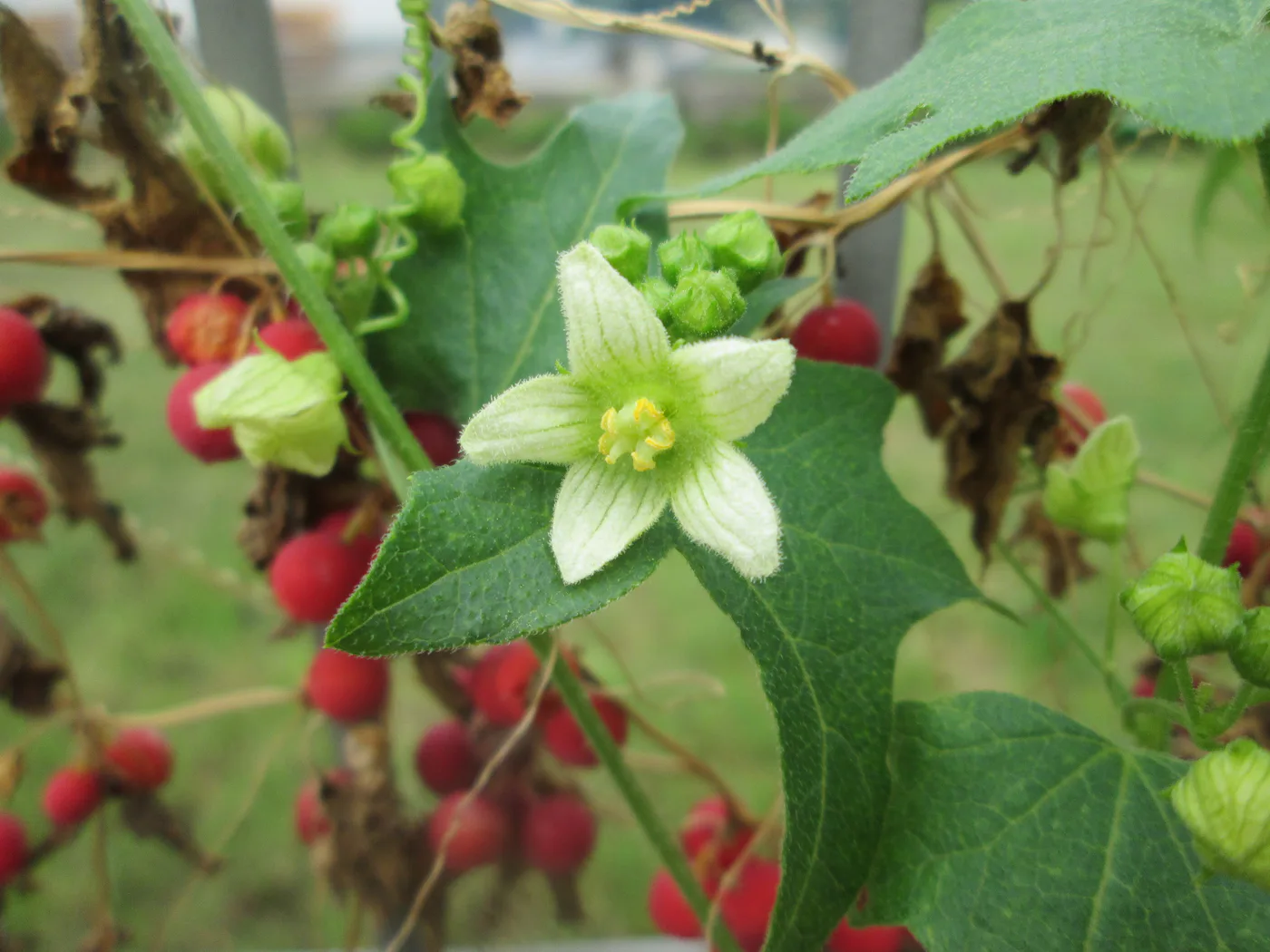
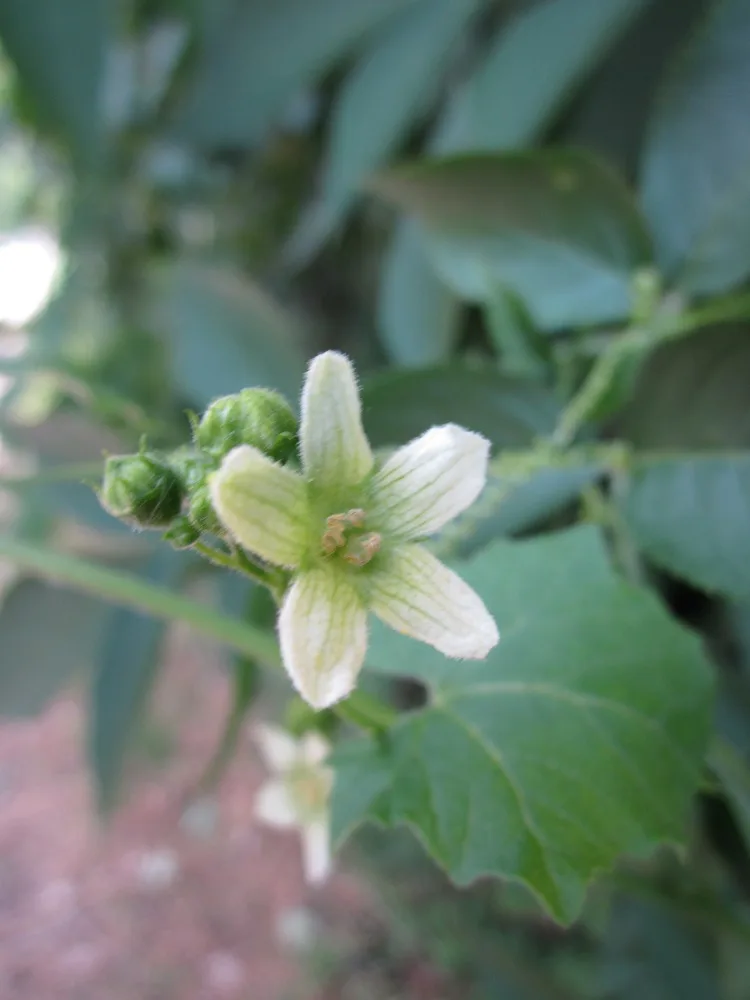
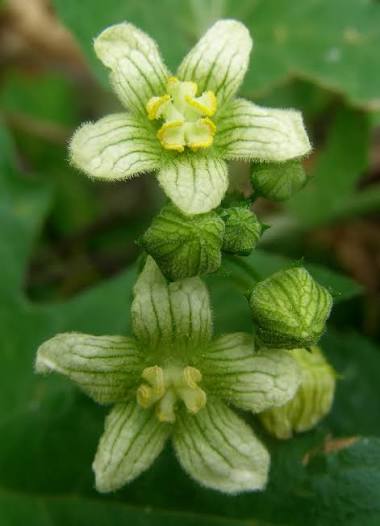
- Small, greenish-white, five-lobed flowers with fine green veins, arising from the leaf axils.
- Separate male and female plants; only the female plants develop berries.
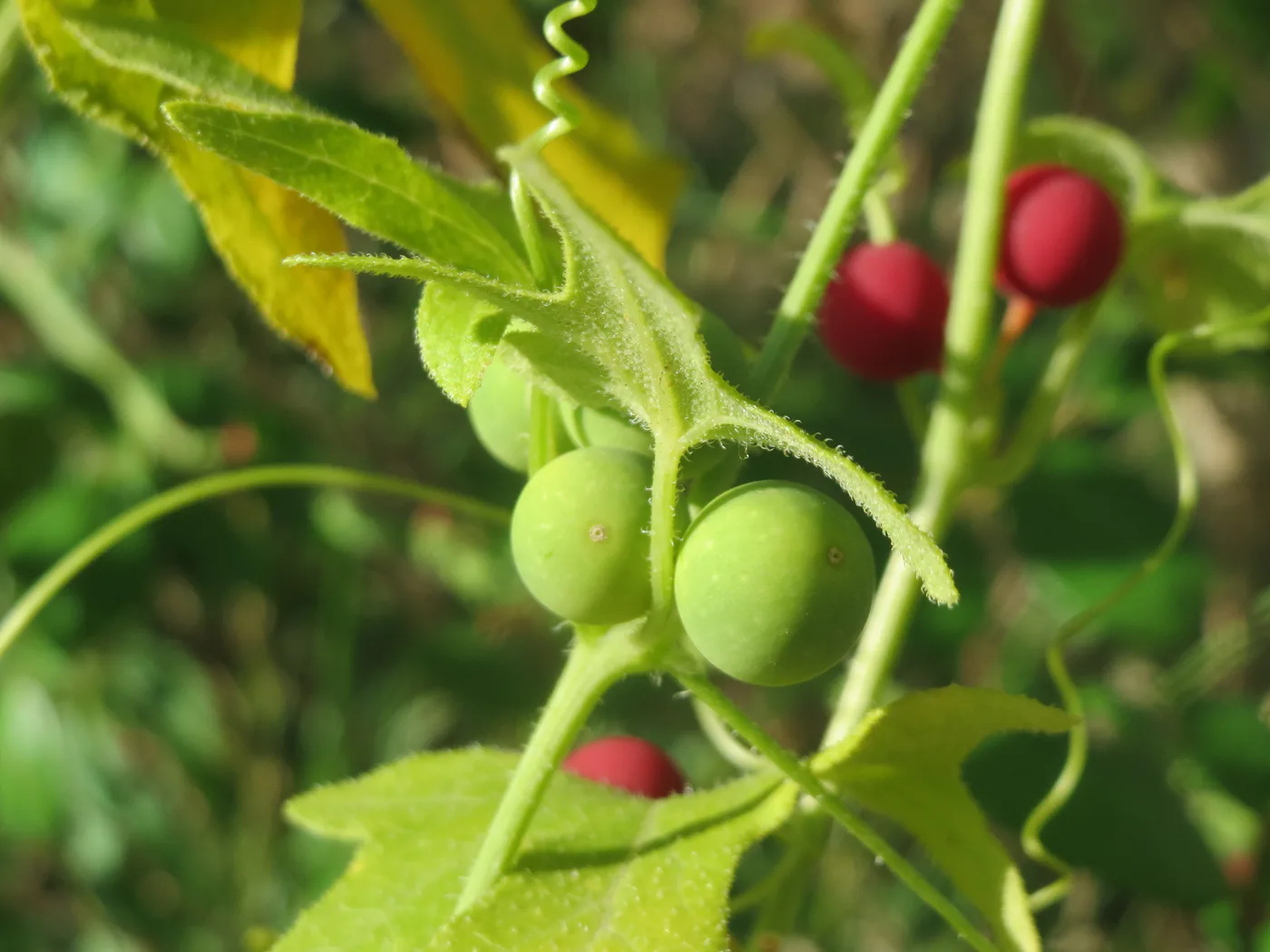
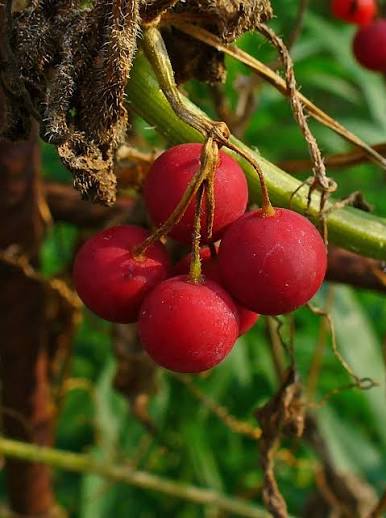
- Smooth, spherical fruits that turn from green to orange-red and then glossy red during late summer and autumn.
- A substantial, fleshy underground rootstock from which new shoots grow each spring.
The combination of hairy, lobed leaves and coiling tendrils is particularly useful for distinguishing White Bryony from Black Bryony, whose glossy leaves are heart-shaped and whose stems climb without tendrils.
Flower structure
Each flower is small, usually greenish-white or cream-coloured, with a five-lobed corolla. Distinct green veins run along the pale lobes, which may have fine hairs around their margins. The flowers belong to the cucumber family, even though they look quite unlike the much larger yellow flowers of garden cucumbers or courgettes.
White Bryony is dioecious: male and female flowers normally grow on separate plants. Male flowers have pollen-producing stamens and tend to occur in more numerous clusters. Female flowers carry an inferior ovary below the petals; after pollination, that ovary can develop into a red berry. The species name dioica refers to these ‘two houses’ of male and female plants.
Leaves and stems
The leaves are alternate, with long stalks and broad blades divided into several lobes. Their surfaces often feel distinctly rough or slightly bristly, and the leaf veins spread out from the stalk in a palmate pattern. The lobes can vary in depth, so some leaves look only gently indented while others are more sharply cut.
Unlike Black Bryony, White Bryony does not have to wind its whole stem around a support. Instead, it sends out slender tendrils that coil tightly around nearby vegetation. It can climb through brambles, bushes and hedges, where the leaves may spread over other plants in summer. Above-ground growth dies back in winter, while the large rootstock survives.
Fruits and seeds
On female plants, the flowers develop into small rounded berries that start green before ripening through orange to bright, glossy red. They are carried on delicate stalks and may remain conspicuous after much of the surrounding foliage has faded. The red berries are poisonous to people, though some birds eat them and disperse the seeds.
Habitat
White Bryony is characteristic of sunny hedgerows, scrub, thickets and woodland margins, especially on relatively fertile, often calcareous soils. It also grows around field edges, roadside banks and neglected corners of gardens. It is found mainly in England, especially in southern and eastern districts, and is much less frequent farther north.
Flowering period
The pale flowers appear mainly from May to August. Flowering can overlap with the development of the first fruits; red berries are most conspicuous in late summer and autumn, and occasionally persist into winter.
Similar species
- Black Bryony (Dioscorea communis) has shiny, unlobed, heart-shaped leaves, tiny greenish-yellow flowers with six tepals, and twining stems without tendrils. Despite the name, it belongs to the yam family rather than the cucumber family.
- Hedge Bindweed (Calystegia sepium) also climbs through hedges, but has arrow-shaped leaves and much larger white trumpet flowers. Its stems twine rather than using coiling tendrils.
- Common Honeysuckle (Lonicera periclymenum) has paired, undivided leaves and clusters of long, tubular, often fragrant flowers. It climbs by twining stems, not by tendrils.
Where the names come from
White Bryony takes its common name from its pale flowers and its long association with the ancient plant name bryonia. Its contrasting name, Black Bryony, is given to a different native climber that resembles it in habit and autumn fruits, even though the two plants are only distantly related.
The scientific name Bryonia comes from the classical name used for bryony-like climbing plants, while dioica means ‘of two households’, referring to the separate male and female plants. Other traditional English names include English Mandrake, Devil’s Turnip, Devil’s Cherry, Wild Hop and Isle of Wight Vine. The name English Mandrake reflects an especially curious episode in the plant’s history.
Folklore & history
White Bryony became entangled with the legends surrounding mandrake, a Mediterranean plant whose forked roots sometimes resemble a human figure. For centuries mandrake was credited with extraordinary powers and surrounded by stories of roots that screamed when pulled from the ground. Genuine mandrake was difficult to obtain in Britain, and White Bryony’s large, fleshy root provided a convenient substitute.
By the sixteenth century, some sellers were shaping bryony roots into little human figures and passing them off as mandrakes. The English herbalist William Turner described the deception in his New Herball of 1568, criticising the practice of carving the roots and even inserting millet seeds to make them appear to grow hair. The resulting figures were sold as charms, trading on popular beliefs about luck, love and the strange powers of mandrake.
The plant also appeared in older herbal traditions under names such as White Vine and Wild Hop. Its strong root and striking berries helped make it memorable, while its poisonous character contributed to its reputation as an unsettling plant of hedgerows and thickets.
Wildlife
White Bryony is particularly important to the Bryony Mining Bee (Andrena florea). Female bees collect pollen specifically from White Bryony flowers to provision their nests, making the plant essential to the bee’s life cycle. The Bryony Ladybird (Henosepilachna argus) is another specialist associated with its foliage.
Other bees and insects visit the summer flowers, while birds may eat the ripe berries and carry seeds into nearby hedges. The spreading stems can also provide shelter in dense hedge vegetation.