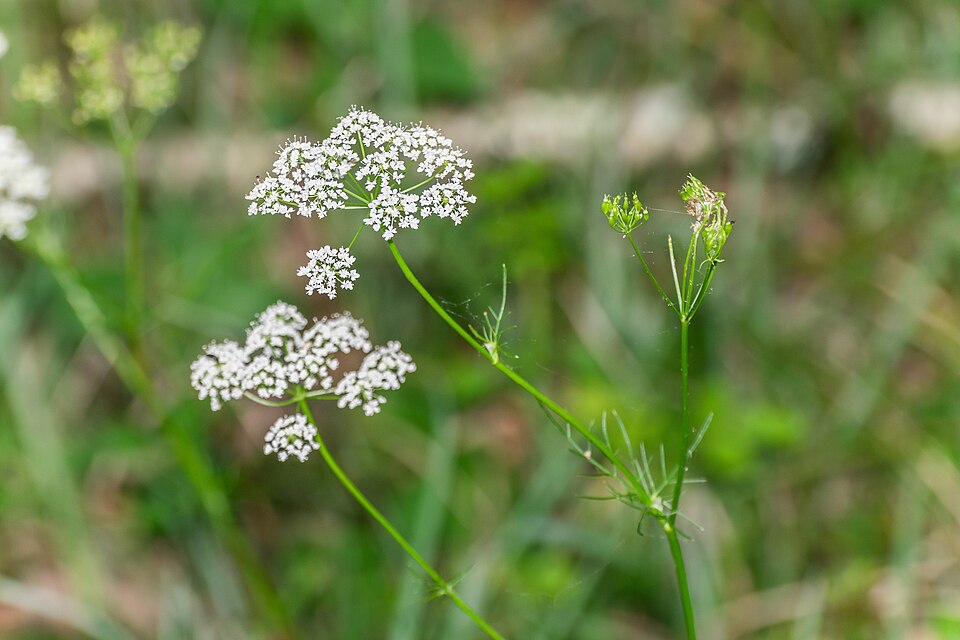
Pignut is a slender native perennial of meadows, open woodland, grassy banks and hedgerows. It is easy to overlook among taller grasses: its airy white flowerheads are much smaller and less showy than those of Cow Parsley. Its most remarkable feature is hidden underground — a small, brown, nut-like tuber at the end of a delicate connection to the stem.
It belongs to the carrot family, Apiaceae, along with Cow Parsley, Wild Carrot and Hemlock.
Identification
- A slender, usually hairless plant, often about 20–50 cm tall, with a smooth, lightly ridged stem.
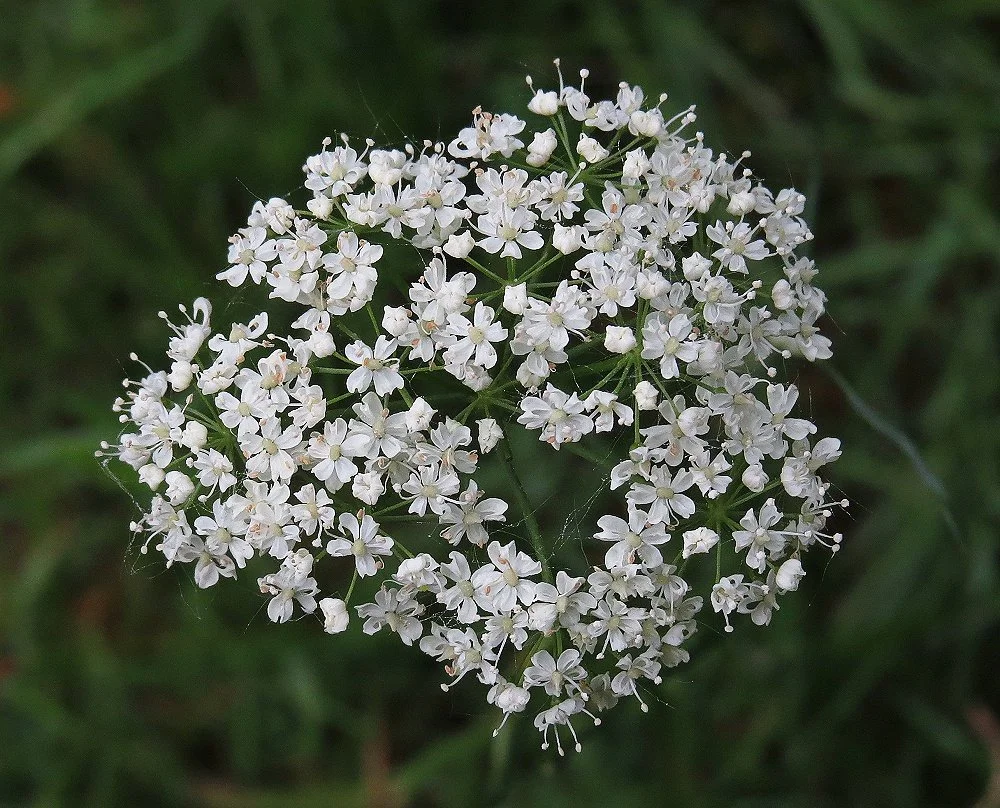
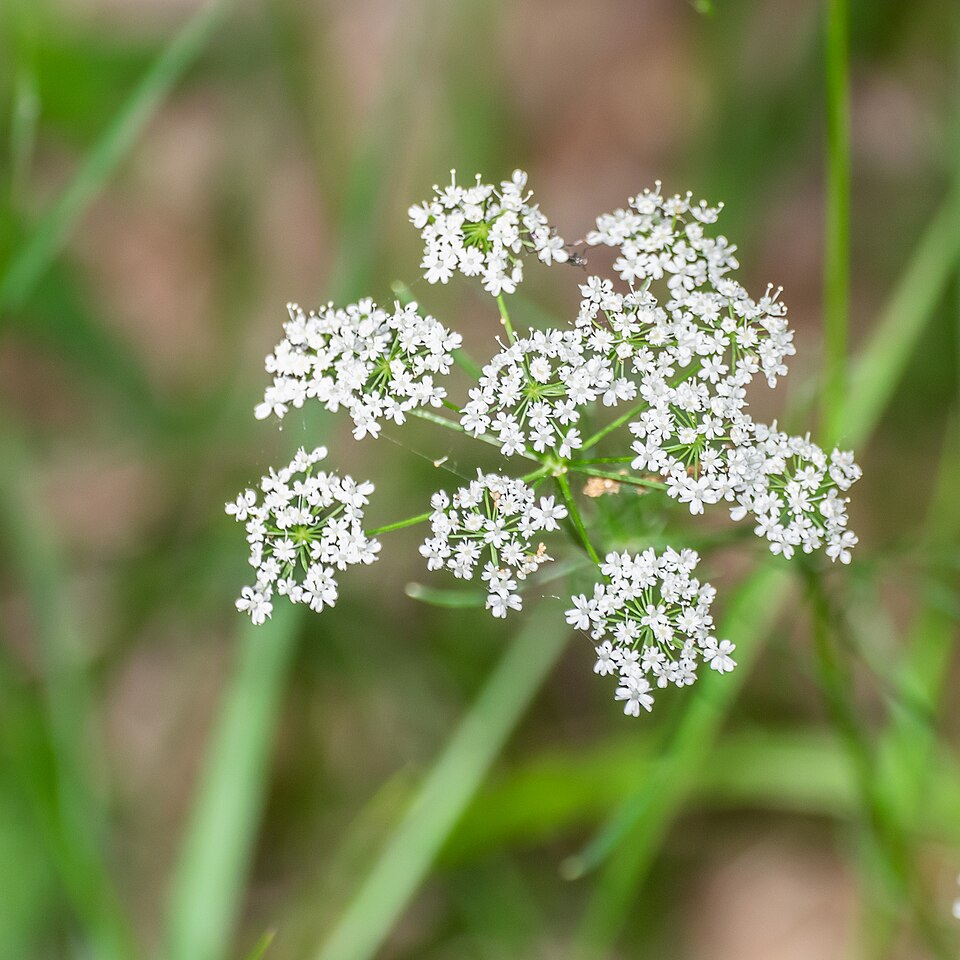
- Small, white flowers in loose compound umbels, typically only a few centimetres across.
- Each umbel normally has roughly 6–12 slender rays carrying smaller clusters of flowers, or umbellets.
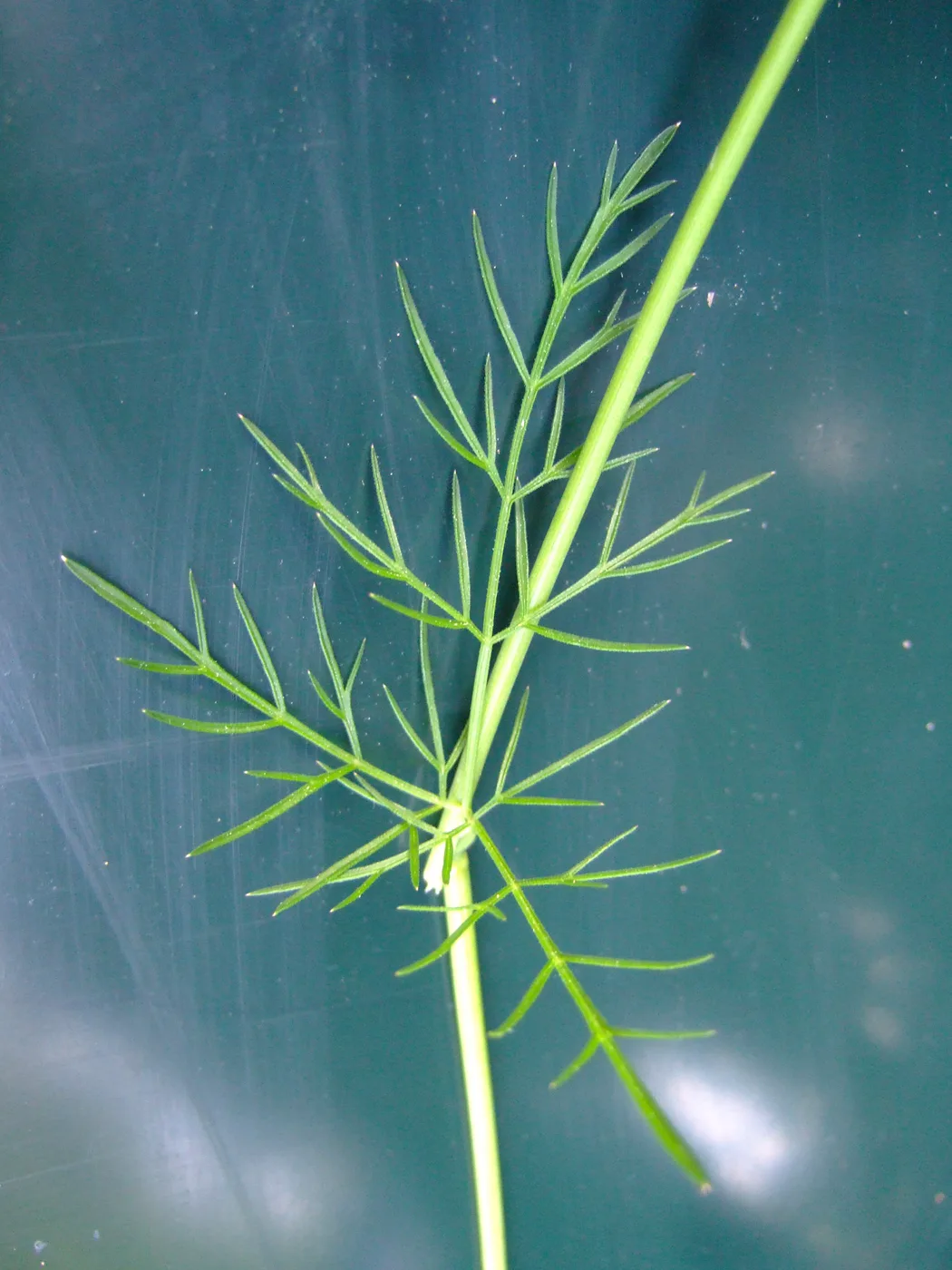
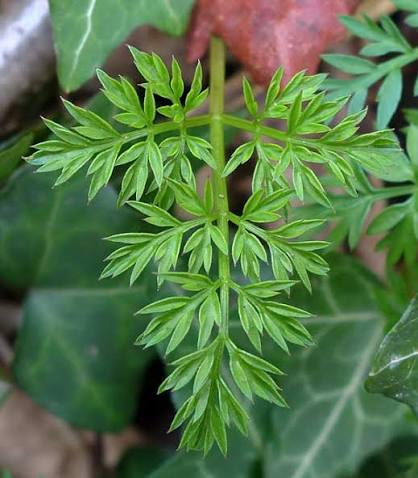
- Leaves are very finely divided, with narrow, pointed segments that give a delicate, feathery appearance.
- Basal leaves often yellow and wither by the time the plant flowers, so a flowering stem can look surprisingly bare.
- Usually no conspicuous bracts beneath the main umbel; narrow bracteoles can occur beneath its smaller umbellets.
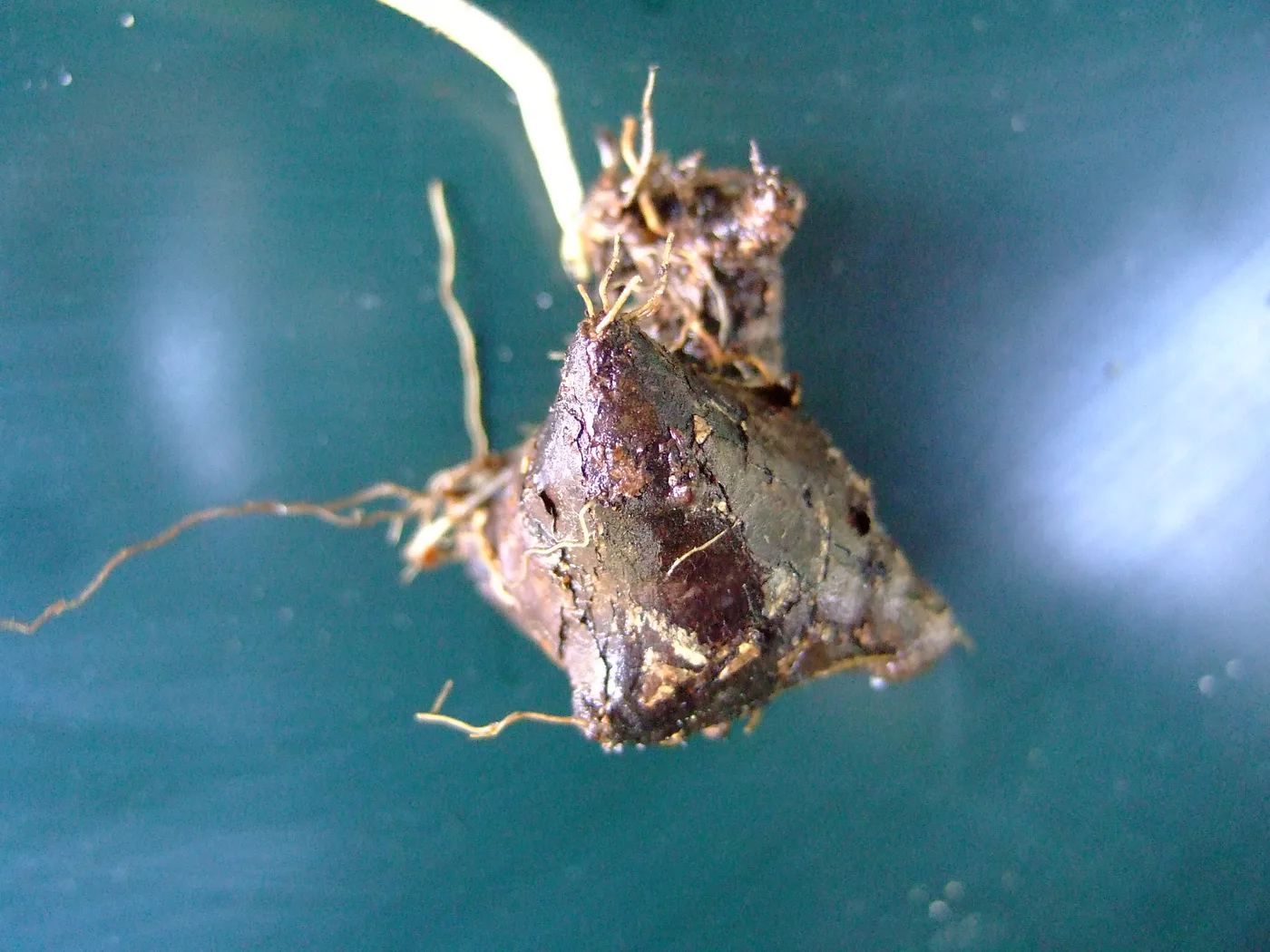
- An underground brown tuber, often around the size of a hazelnut, joined to the above-ground plant by a thin, easily broken connection.
The small, loose white umbels, narrow leaf segments and delicate habit are useful field clues, but white-flowered members of Apiaceae should be identified using several features together.
Flower structure
The tiny white flowers grow in a compound umbel: several slender rays radiate from one point, and each finishes in a smaller umbellet. An individual flower generally has five small petals and five stamens. From a distance, the whole flowerhead looks like a miniature, rather open version of Cow Parsley’s frothy umbels.
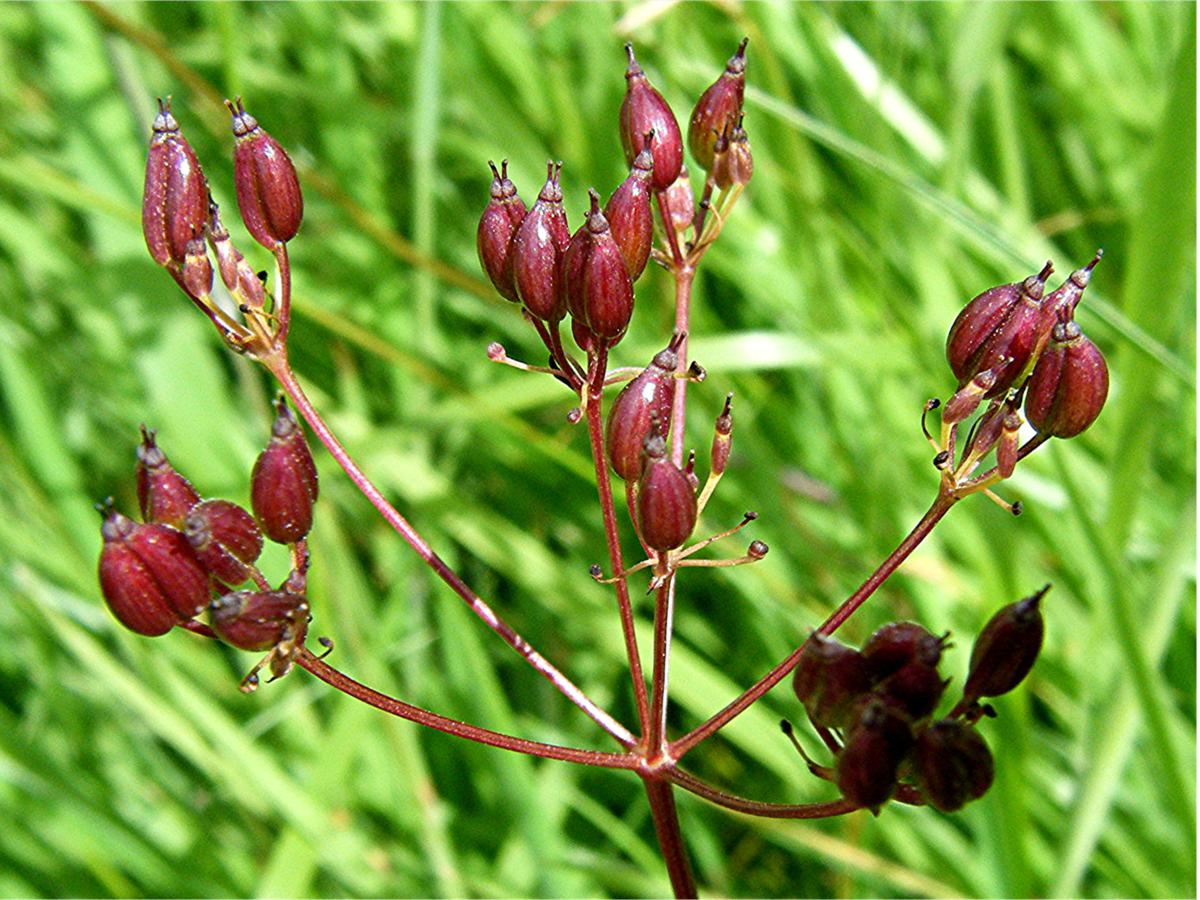
The rays are relatively few and widely spaced, giving the inflorescence a delicate appearance. At the base of the main umbel, large bracts are usually absent. After flowering, small oblong fruits develop, with faint ribs along their surfaces.
Leaves and stems
Pignut leaves are two or three times pinnate, repeatedly divided into increasingly narrow segments. The lower leaves can look almost fern-like, while upper leaves are smaller, with fine linear lobes and sheathing bases where they join the stem.
A particularly useful detail is that the larger lower leaves often fade and disappear as the flowering stems develop. The smooth, hairless stems are slender and may branch near their tops, with the flowerheads carried lightly above the surrounding grass.
The underground tuber
Below the soil is the feature that gave Pignut its name: a dark-brown, rounded or slightly irregular storage tuber with pale flesh. It is not a true botanical nut. The tuber lies beneath the plant, connected by a fine stem-like structure that can break very easily, which helps explain why it is so seldom seen.
The tuber stores food that allows this perennial to return in following seasons. Its resemblance to a small chestnut inspired several of the plant’s traditional names.
Habitat
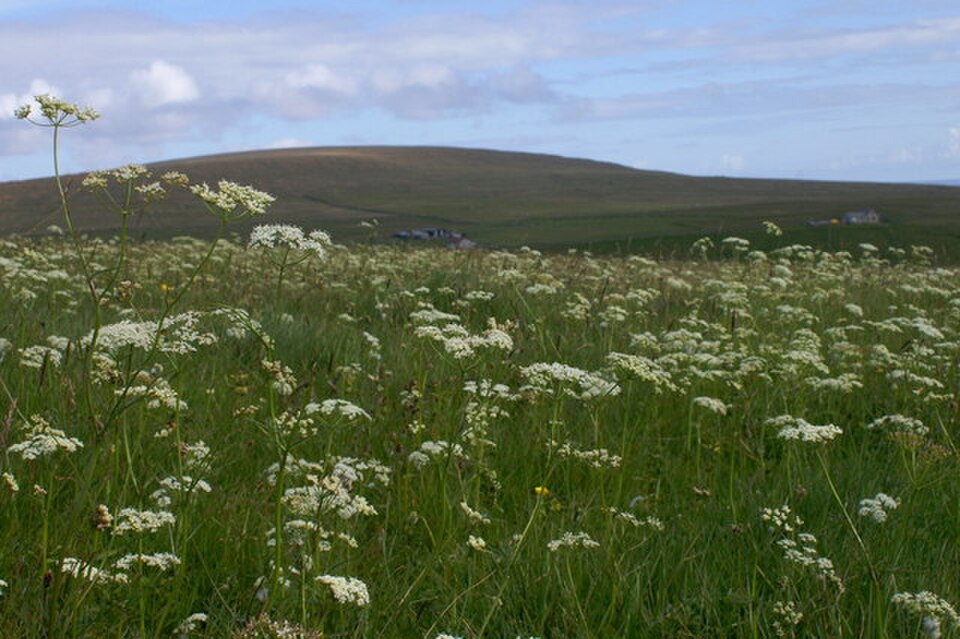
Pignut is widespread in much of the UK. It grows in open deciduous woodland, along old hedgebanks and woodland rides, in unimproved meadows, heathland edges and other lightly shaded grassy places. It is especially associated with ground that has not been regularly ploughed or heavily improved. It can grow in scattered groups among grasses and spring wildflowers.
Flowering period
Pignut normally flowers between May and July, often at its best in May and June. Its fine basal foliage appears earlier in spring and may have withered by the time the white flowers are fully open.
Similar species
- Cow Parsley (Anthriscus sylvestris) is usually much taller, with broad, frothy flowerheads and more substantial fern-like leaves. Pignut has smaller, looser umbels and finer leaf divisions.
- Wild Carrot (Daucus carota) often has conspicuous divided bracts beneath the main umbel, hairy stems and later develops the familiar curled, bird’s-nest seedhead.
- Hemlock (Conium maculatum) is a much larger, highly poisonous member of the same family, with smooth stems often marked by conspicuous purple blotches.
- Hemlock Water-dropwort (Oenanthe crocata) is a robust, highly poisonous waterside plant with thicker grooved stems, broader glossy leaf divisions and larger clusters of white flowers.
Where the names come from
The name Pignut refers to the dark, rounded underground tuber and to pigs rooting through soil for edible underground food. The resemblance of this tuber to a small nut also gave rise to names such as Earthnut, Groundnut and Earth Chestnut. Kippernut is another recorded traditional name.
The scientific name has its own meaning. Conopodium combines Greek words referring to a cone and a little foot, generally interpreted as a reference to the conical base of the styles in the flower. Majus is Latin for ‘greater’ or ‘larger’. These names relate to botanical form, while the English names remember the plant’s place in rural life.
Folklore & history
For generations, children in Britain and Ireland searched for Pignut tubers in spring. Finding one involved following the thin stem carefully into the soil; it was easy for the connection to break before the prized little tuber was reached. Accounts of country childhood describe the fresh tubers as crisp and nutty, comparable in flavour to a hazelnut or sweet chestnut.
Pignuts were familiar enough to appear in literature. In Shakespeare’s The Tempest (first performed around 1611), Caliban promises to show Stephano where wild food can be found, offering to dig him ‘pig-nuts’ with his long nails. It is a brief but memorable glimpse of the plant’s role as a food gathered from the ground, rather than grown as a crop.
The herbalist John Gerard recorded the plant in his Herball of 1597, including a location near Highgate, north of London. Such early botanical records show that Pignut was both recognised and familiar long before modern field guides.
Another old explanation of the nursery rhyme ‘Here we go gathering nuts in May’ suggests the nuts could have been Pignuts, since May is not the season for gathering tree nuts. It is an attractive interpretation rather than a proven origin of the song. Regional memories and names such as Kippernut and Earthnut reflect how closely this modest plant was once tied to local knowledge of the countryside.
Wildlife
The open flowerheads offer accessible nectar and pollen to small flies, hoverflies, beetles and other insects in late spring and early summer. The underground tubers are also eaten by some mammals, including badgers. Pignut contributes to the variety of native plants in old grassland and woodland-edge communities.