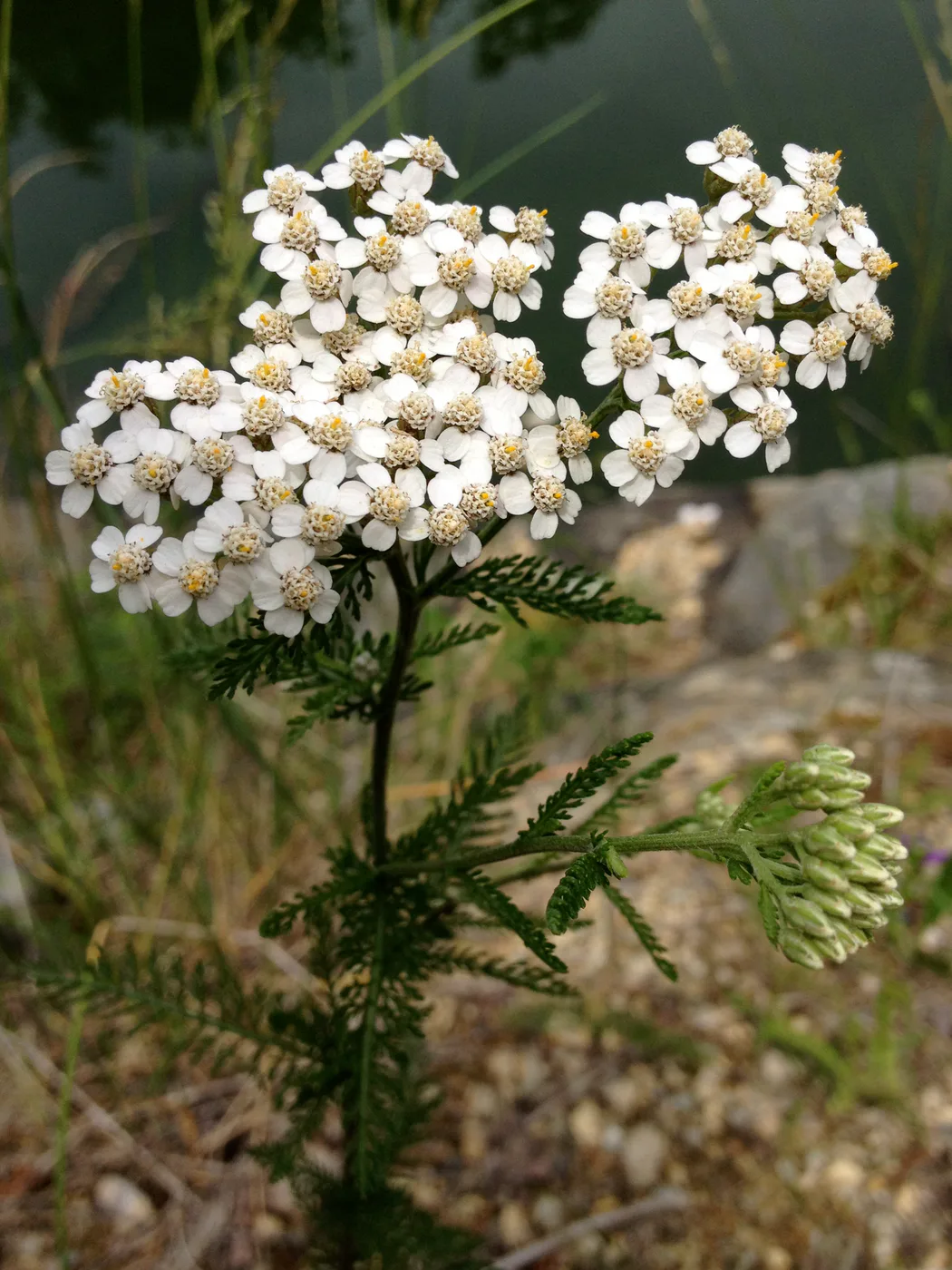
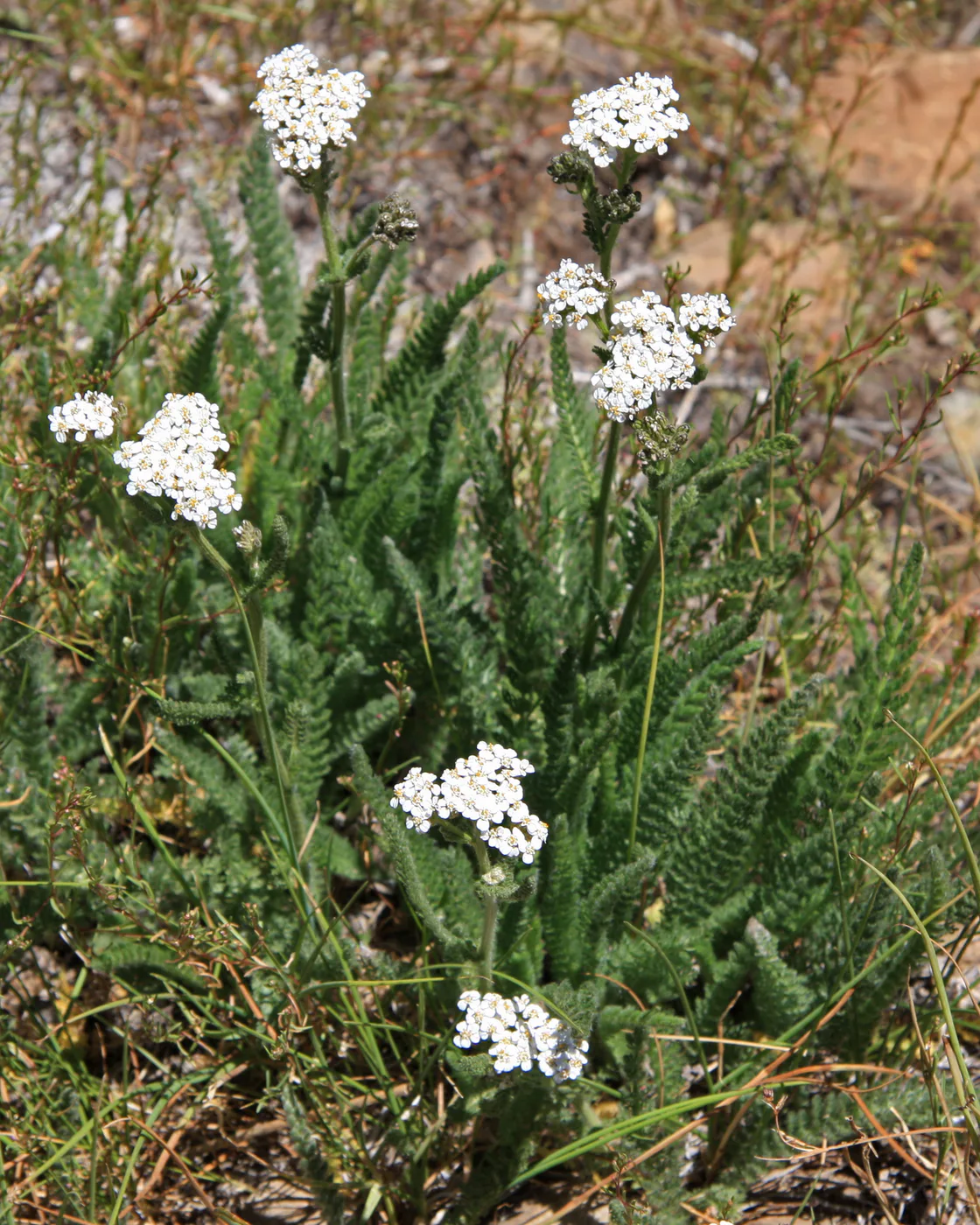
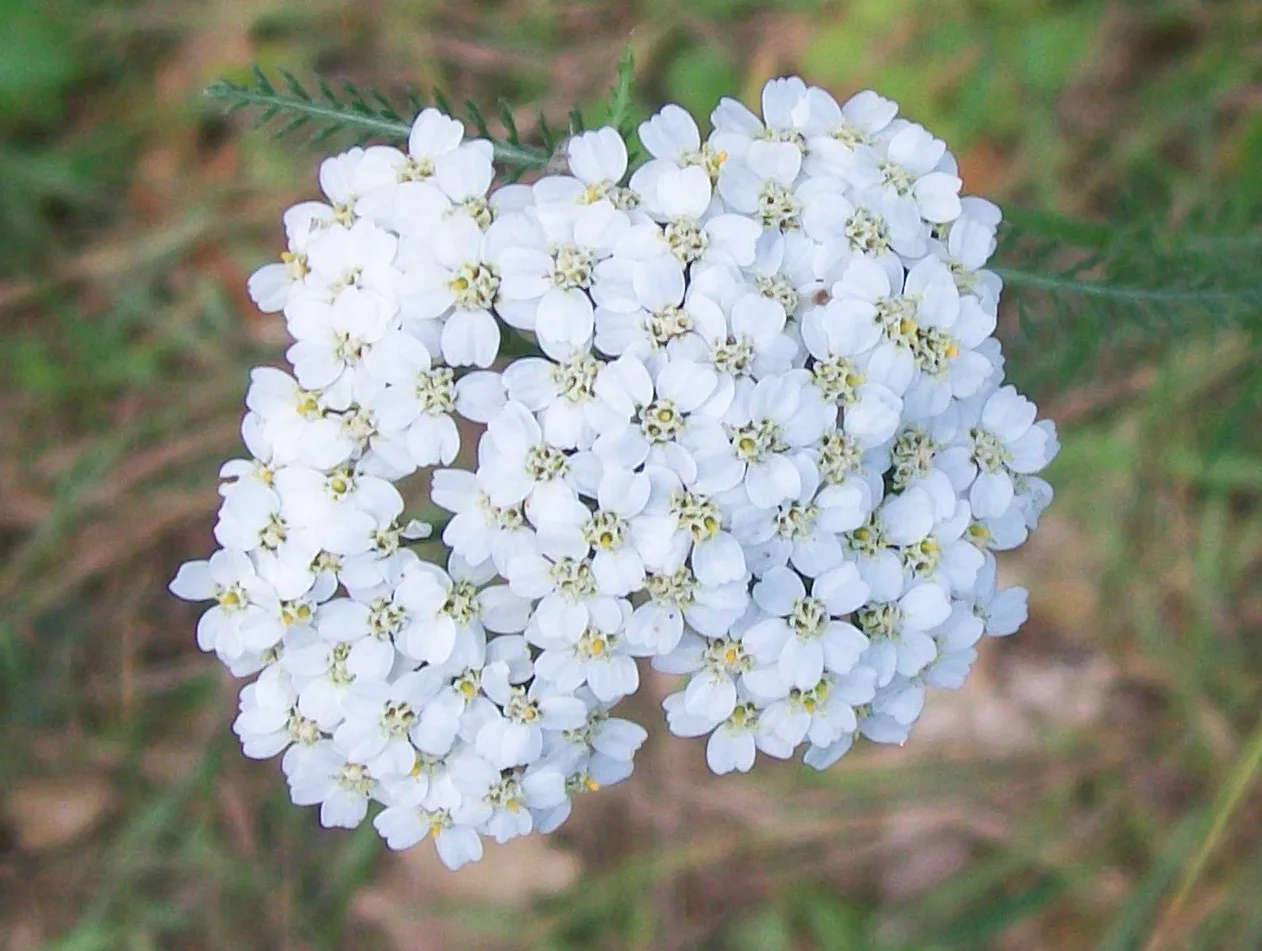
Yarrow is a familiar perennial of grassland, roadside verges, banks and other open places. Its broad, flat-looking flower clusters and very finely divided leaves make it distinctive once you know what to look for.
It belongs to the daisy family, Asteraceae. Like an Oxeye Daisy, each apparent flower is actually a small flower head made up of several individual florets.
Identification
- Usually 20–80 cm tall, with upright flowering stems.
- Broad, flat-topped clusters of many small white flower heads; pinkish forms also occur.
- Leaves are extremely finely divided, giving them a soft, feathery or fern-like appearance.
- The leaves are aromatic when crushed.
- Several branching flower stalks bring the individual heads to roughly the same level.
- The plant often grows in patches because it can spread below ground.
The combination of flat white flower clusters and the deeply divided leaves is especially useful in the field.
Flower structure
Each small “flower” is a capitulum, the characteristic flower head of Asteraceae.
Around the edge are a few short white ray florets. Small tubular disc florets occupy the centre.
A group of green bracts surrounds the base of each head.
Because many of these small heads are carried together, the whole flowering top can look at first glance like one large, flat cluster rather than dozens of separate daisy-like heads.
Leaves and stems
Yarrow’s leaves are one of its best identification features.
They are narrow in overall outline but cut repeatedly into many small segments, giving them a delicate, feathery appearance. This highly divided form is reflected in the scientific name millefolium, meaning roughly “a thousand leaves”.
The leaves occur along the stem as well as toward the base of the plant. When crushed, they have a noticeable aromatic smell.
Flowering stems are tough and upright, usually branching toward the top.
Habitat
Yarrow is common in open grassy habitats including:
- meadows
- pastures and other grassland
- roadside verges
- banks
- field margins
- waste ground
- lawns and other short grass
It is particularly noticeable during summer when its white flower clusters stand above the surrounding vegetation.
Flowering period
Yarrow flowers mainly from June through August and often continues into September.
Individual plants can produce several broad flowering clusters, and established patches can be conspicuous in grassland and on verges.
Similar species
- Sneezewort (Achillea ptarmica) is a close relative, but its individual flower heads are noticeably larger and its leaves are simple, narrow and sharply toothed rather than finely divided.
- Wild Carrot (Daucus carota) can also produce broad white flower clusters, but it belongs to Apiaceae. Its individual flowers are arranged in an umbel, rather than in tiny daisy-like capitula, and its flowering head often curves inward as the seeds develop.
- Hogweed (Heracleum sphondylium) has large white umbels and much broader leaves, making it a much more robust plant.
Looking closely at the individual flower heads quickly separates Yarrow from superficially similar white-flowered members of Apiaceae.
Where the names come from
Yarrow is an old English plant name whose earliest roots are not completely certain. The alternative name Milfoil describes its finely divided, almost feathery leaves.
Achillea recalls Achilles, the Greek hero traditionally associated with using the herb on wounds. Millefolium combines Latin mille (‘a thousand’) and folium (‘leaf’): a poetic description of its many tiny leaf divisions.
Folklore & history
Yarrow has accumulated many traditional names, including Milfoil, Soldier’s Woundwort, Nosebleed and Old Man’s Pepper.
An old Greek tradition connected the plant with the warrior Achilles and the treatment of wounds, helping to explain names such as Soldier’s Woundwort.
Yarrow has also appeared in folk divination and protective traditions in Britain and elsewhere in Europe.
Wildlife
The numerous small flower heads provide accessible nectar and pollen for a wide range of insects.
Bees, hoverflies, beetles and other small pollinators visit the flowers, and Yarrow is a useful component of species-rich grassland and wildlife-friendly lawns.