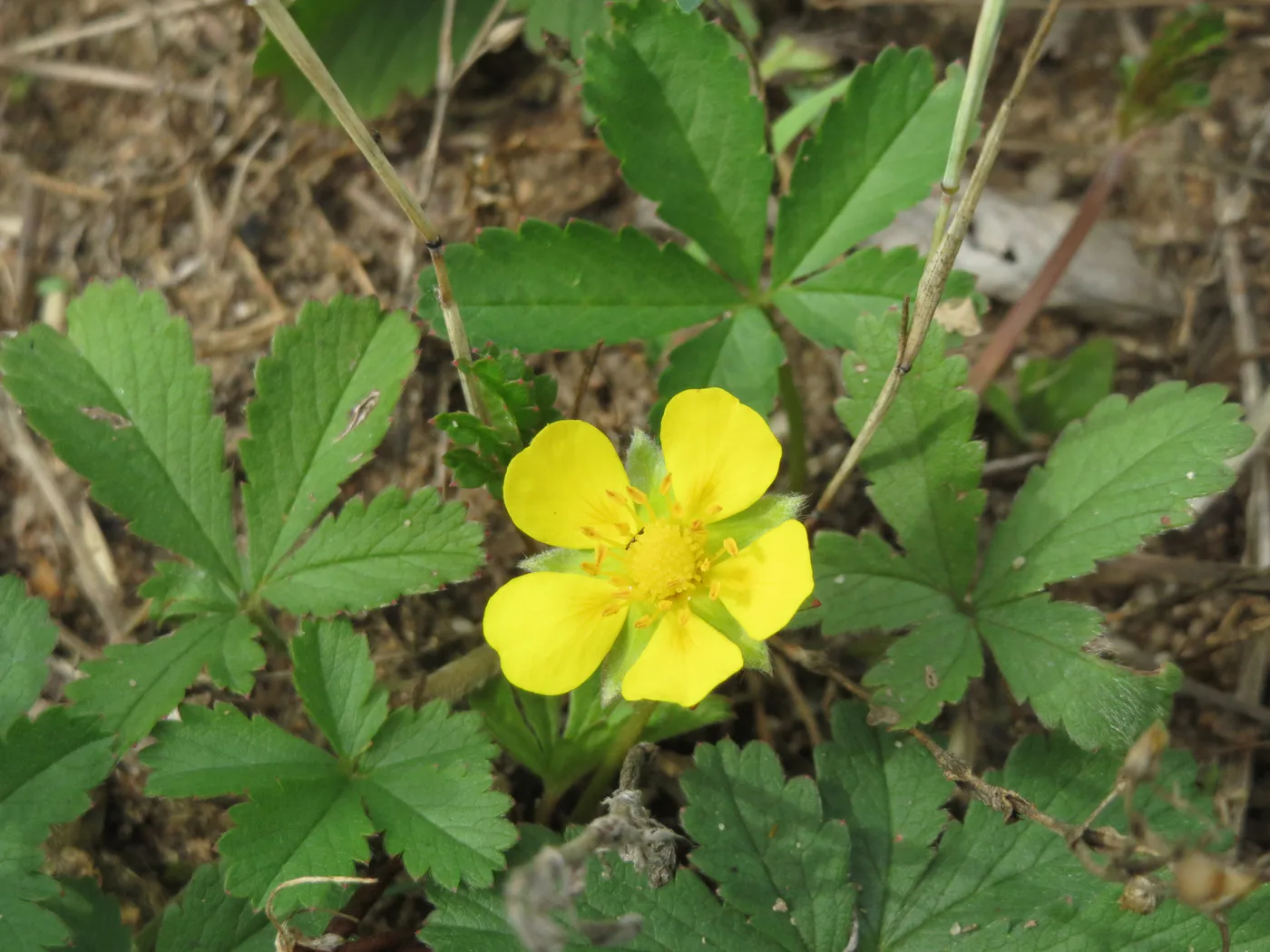
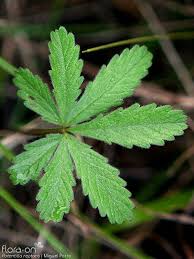
Creeping Cinquefoil is a low, spreading native perennial that often appears along footpaths, on grassy banks, in lawns and at the edges of hedges. Its bright yellow flowers can resemble those of a small buttercup, but the leaves are divided into five finger-like leaflets and the long, slender runners spread out across the ground, rooting as they go. It belongs to the rose family (Rosaceae), alongside Tormentil and Silverweed.
The plant’s shoots may travel much farther than its flowers rise above the ground. A single rooted crown can send out several reddish runners that produce new plants at intervals, eventually weaving a network of leaves and flowers through short grass.
Identification
- A mat-forming perennial, usually less than 20 cm tall, but with long, thin, creeping stems that may extend well beyond the original plant.
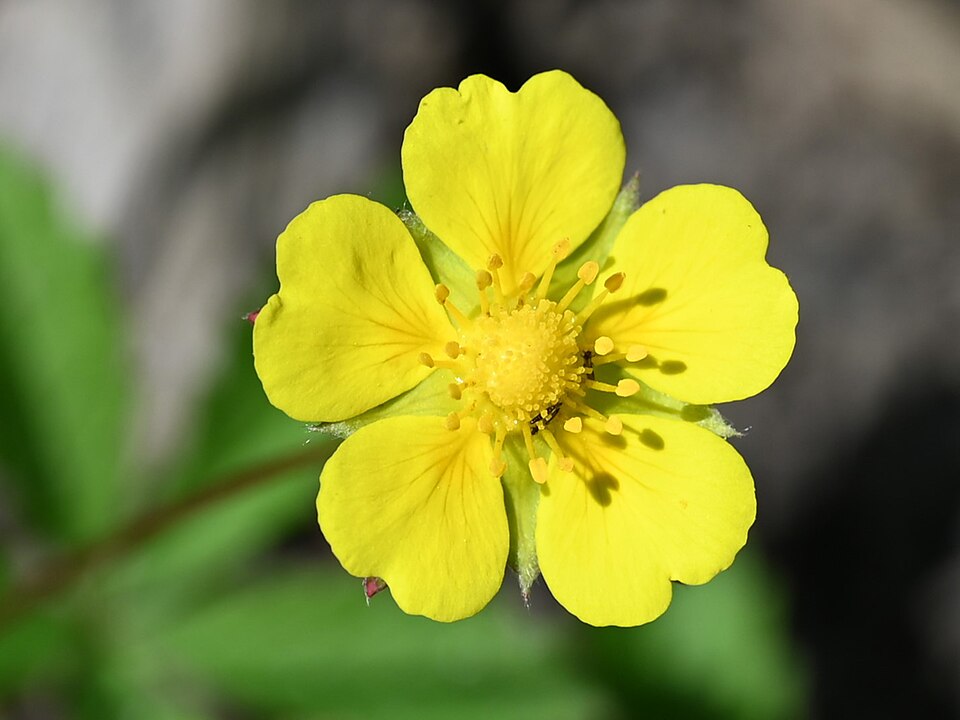
- Single, bright yellow flowers, usually around 1.5–2.5 cm across, with five separate petals that are often gently notched at their tips.
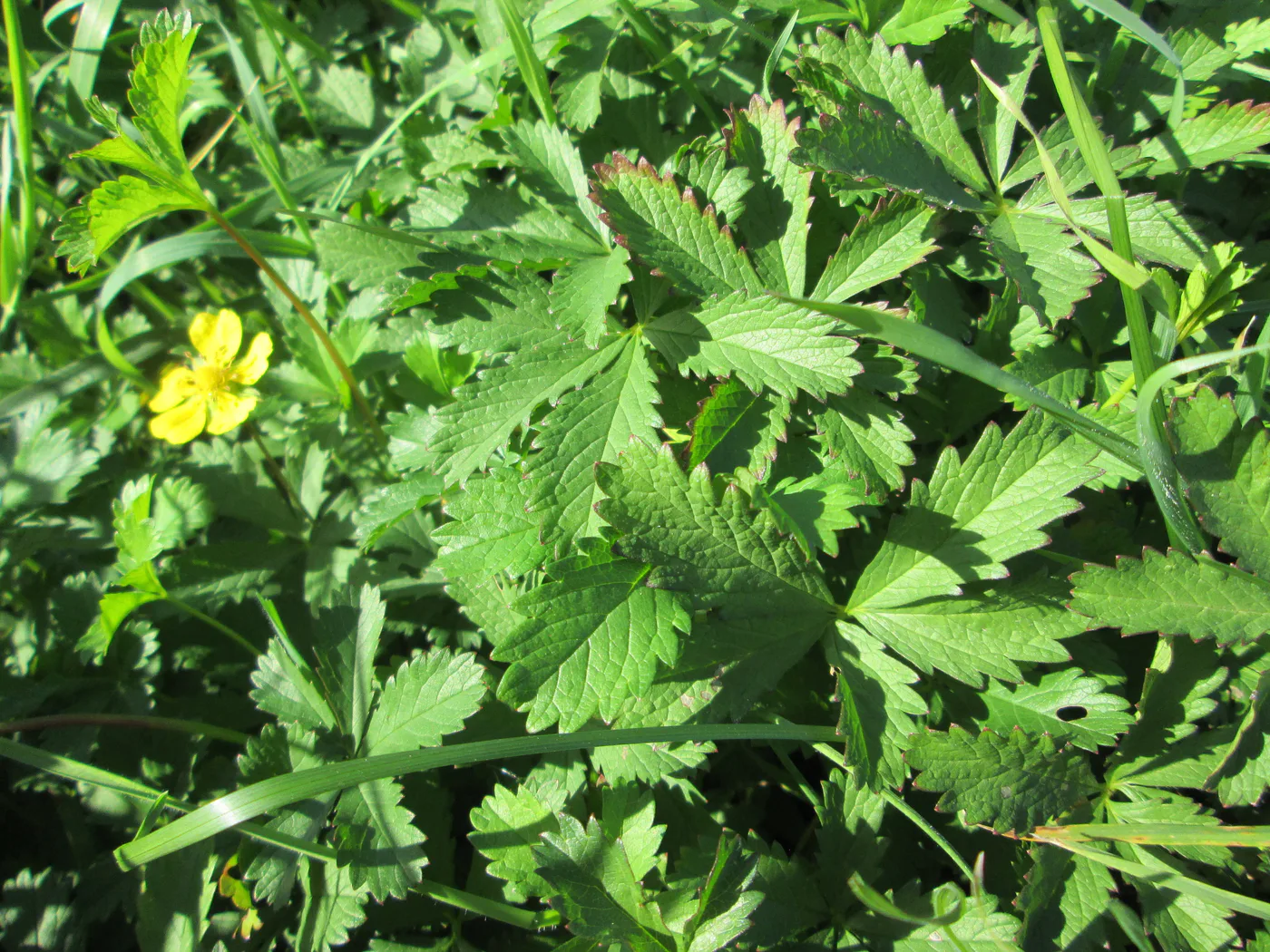
- Five, occasionally seven, noticeably toothed leaflets radiating from one point at the end of a long leaf stalk, rather like fingers on an outstretched hand.
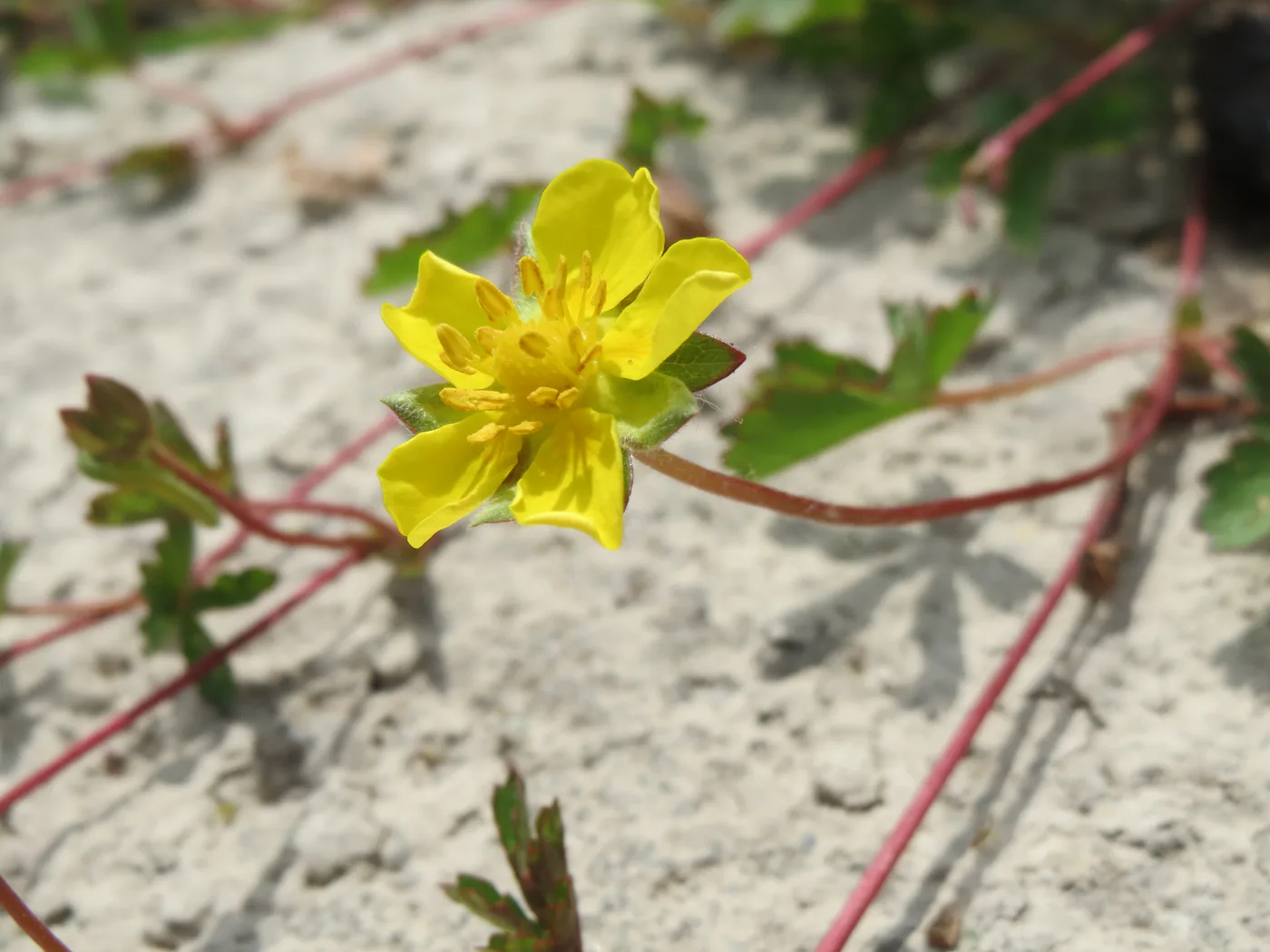
- Long, slender, often reddish runners lying along the ground and forming roots at their nodes.
- Leaves borne on stalks along the runners; small leaf-like stipules occur where each leaf joins its stem.
- Flowers carried individually on slender stalks arising from the leaf axils, rather than packed together in dense heads.
- Common in short grassland, disturbed ground, banks, roadsides, hedgerows and gardens.
The combination of five yellow petals, five toothed leaflets and long rooting runners is especially useful. The similar Tormentil usually has four petals, three main leaflets and shorter, branched flowering stems.
Flower structure
Each flower is a single bloom, not a head of many small flowers. It typically has five broad, separate yellow petals, with five green sepals behind them. Between the sepals is an additional outer whorl of five smaller, sepal-like structures called the epicalyx.
Numerous stamens, each tipped with a pollen-bearing anther, form a ring around a crowd of separate carpels in the centre. Following pollination, the carpels develop into small, dry, one-seeded fruits known as achenes.
The petals often close during dull weather or at night and open again in brighter conditions. The flowers are carried singly, usually on relatively long stalks that lift them above the surrounding leaves.
Leaves and stems
The foliage provides one of the clearest ways to recognise Creeping Cinquefoil. Each palmately divided leaf has five leaflets — occasionally seven — meeting at a central point at the top of a relatively long stalk. Their edges are deeply and regularly toothed. This arrangement contrasts with the feather-like leaves of Silverweed, whose many leaflets are paired along a central axis.
The stems are thin, often reddish and trail over the soil rather than growing upright. These creeping shoots are known as stolons, or runners. Where a runner touches suitable ground at a node, it can develop roots and a fresh tuft of leaves. This allows the plant to spread quite rapidly and form extensive patches, especially where the grass is short and some bare soil is available.
Habitat
Creeping Cinquefoil is widespread across much of England and Wales and occurs in Ireland and parts of Scotland, becoming scarcer farther north. Look for it in rough lawns, grassy verges, field margins, hedgebanks, tracksides, waste ground and coastal dunes.
It grows in a wide range of soils and is particularly noticeable where regular cutting, grazing or other disturbance keeps taller plants from overshadowing it. Its long runners readily take advantage of gaps in the vegetation.
Flowering period
The main flowering season is June to September, although individual flowers may appear earlier in warm springs and persist into autumn. Plants in open, sunny positions tend to flower more freely than those growing in deeper shade.
Similar species
- Tormentil (Potentilla erecta) usually has four rather than five yellow petals. Its leaves have three main toothed leaflets, sometimes seeming to have five because of the two large stipules, and it lacks Creeping Cinquefoil’s long, freely rooting runners.
- Trailing Tormentil (Potentilla anglica) can have a mixture of four- and five-petalled flowers and more variable leaves. Its trailing stems make it an especially important species to compare carefully.
- Silverweed (Potentilla anserina) also produces five-petalled yellow flowers and long runners, but its leaves are feather-like with many paired leaflets and conspicuously silvery undersides.
- Creeping Buttercup (Ranunculus repens) has five shiny yellow petals and creeping stems, but its leaves are divided into three broad, lobed leaflets. It belongs to the buttercup family rather than Rosaceae.
- Common Rock-rose (Helianthemum nummularium) has five yellow petals but small, simple, opposite leaves and somewhat woody stems, rather than long-stalked leaves made up of five toothed leaflets.
Where the names come from
The word cinquefoil is an old name that describes the plant’s leaves. It comes through Old French from cinq, meaning five, and foil, meaning leaf. The five leaflets spreading from a single point explain traditional names such as Five-finger Grass, Five-leaf Grass and Five-finger Blossom. Variants recorded in older writing include synkefoyle and sinkfield — reminders of how botanical names changed as they passed from one language and generation to another.
The scientific name is equally descriptive. Potentilla comes from Latin potens, meaning powerful, with the diminutive ending suggesting a ‘little powerful one’. The name alludes to the medicinal reputation once attached to plants in this genus. The species name reptans derives from Latin repere, to creep or crawl, describing the runners that travel across the ground. Potentilla reptans was formally named by Carl Linnaeus in 1753.
The plant is sometimes called Common Cinquefoil or Creeping Potentilla. The name is particularly apt when the long red-tinged stems are visible between the leaf clusters: even a small flower can belong to a plant spreading surprisingly far across a patch of ground.
Folklore & history
Cinquefoil was familiar to medieval herbalists and later country healers, who valued its astringent roots and leaves. Historical herbal preparations made from cinquefoils were used for stomach complaints, diarrhoea, sore mouths and wounds. Roots containing tannins also had practical uses in traditional dyeing, including the production of reddish-brown shades for colouring leather.
Its five-parted leaf gave cinquefoil a place beyond herbal medicine. Five-lobed and five-pointed forms recur in medieval decorative carving, church windows and heraldic designs. The plant’s five ‘fingers’ helped make it a symbol associated with protection, good fortune and the human hand. Folk traditions recorded around cinquefoil include hanging it near doorways for protection and carrying it for luck or love. Such customs concern the symbolic cinquefoil rather than always identifying a single botanical species.
The name itself preserves a small piece of this history: long before modern field guides used the scientific name Potentilla reptans, country names such as Five-finger Grass encouraged people to recognise the plant by the shape of its leaves. Today the same feature remains one of the best identification clues.
Wildlife
The open, yellow flowers offer pollen and nectar to bees, hoverflies and other visiting insects. The low, spreading leaves can create a little cover for invertebrates among sparse grass, while the runners help the plant hold patches of disturbed or loose soil.
Creeping Cinquefoil can also serve as a food plant for the caterpillars of some moths and butterflies associated with cinquefoils. In species-rich grassland it contributes to the mixture of small flowering plants used by pollinating insects through the summer.