Silverweed is a low, creeping perennial with bright yellow flowers and intricately divided leaves that can flash silver when the wind turns them over. Its long, reddish runners spread across grassland, path edges, field margins and coastal ground, rooting wherever they touch suitable soil. Despite its buttercup-like colour, Silverweed belongs to the rose family (Rosaceae), alongside Wood Avens and Meadowsweet.
The scientific name is commonly given as Potentilla anserina, while some modern botanical treatments place it in the genus Argentina as Argentina anserina.
Identification
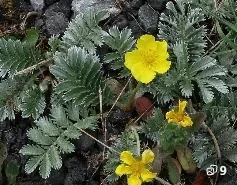
- A mat-forming perennial, generally only 5–15 cm high, though its slender runners may extend far beyond the main plant.
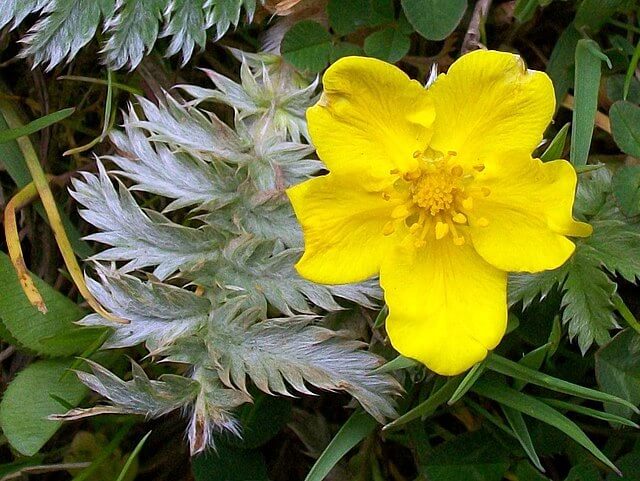
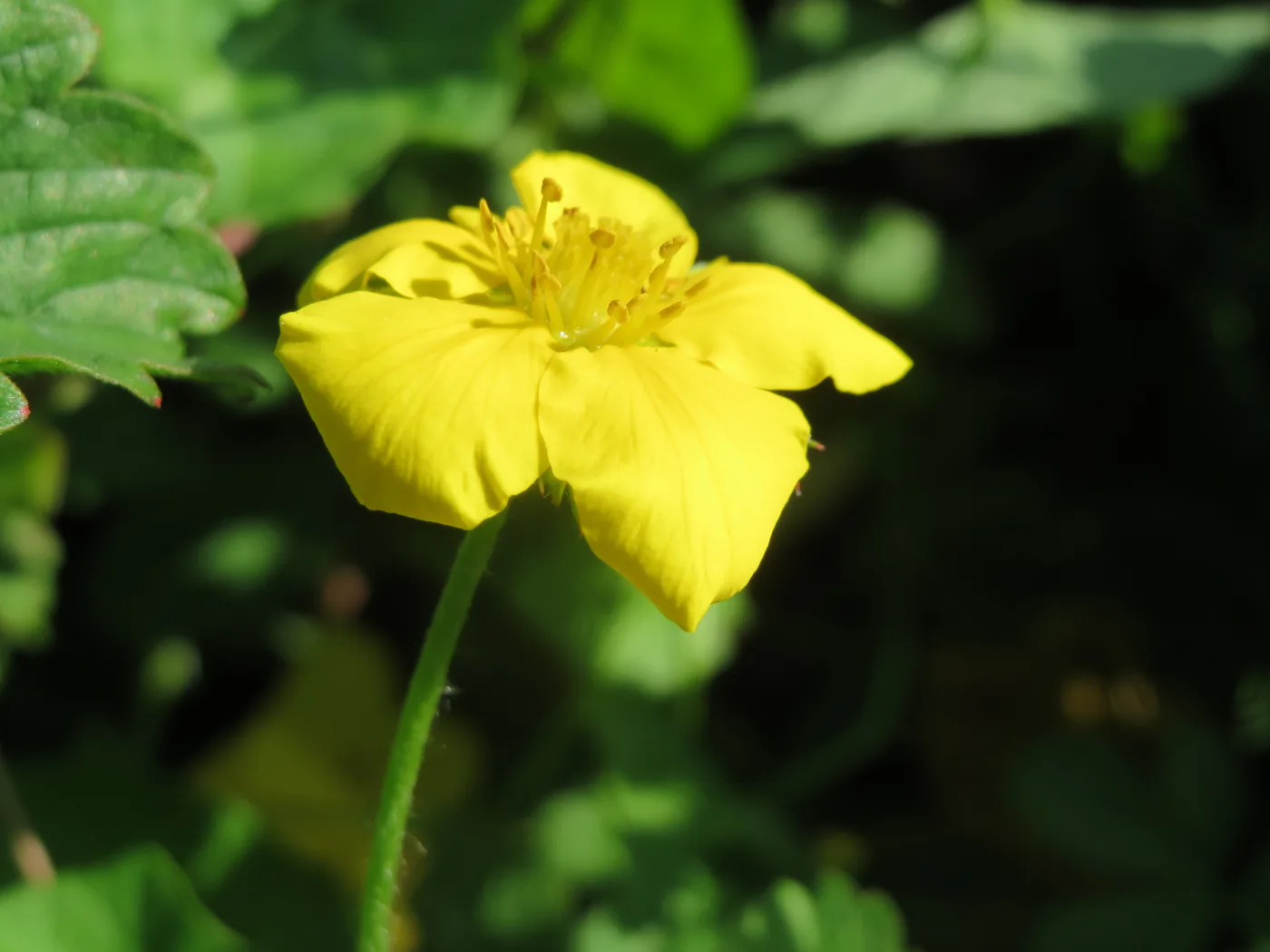
- Bright yellow, usually five-petalled flowers, about 1.5–2.5 cm across, carried singly on stalks above the leaves.
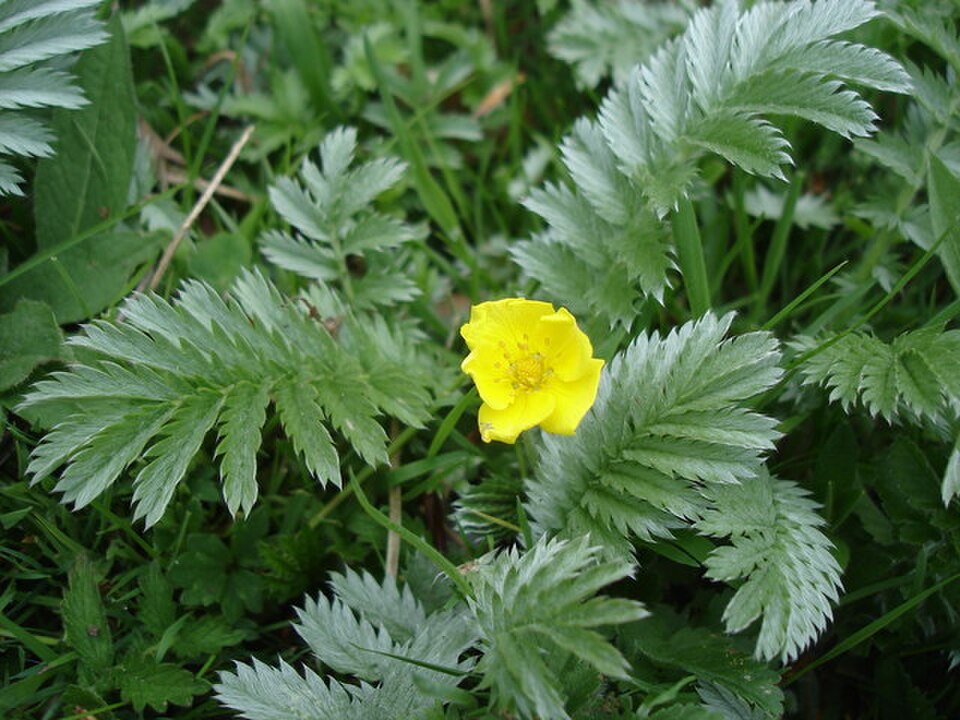
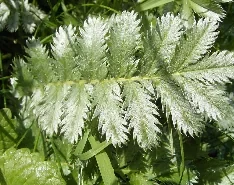
- Leaves divided feather-like into many paired leaflets, with smaller leaflets often occurring between the larger pairs.
- Leaflets with deep, forward-pointing teeth and a covering of fine, silky hairs, particularly dense on the undersides.
- Upper leaf surfaces may be fresh green or silvery; the undersides are generally much paler, often almost white.
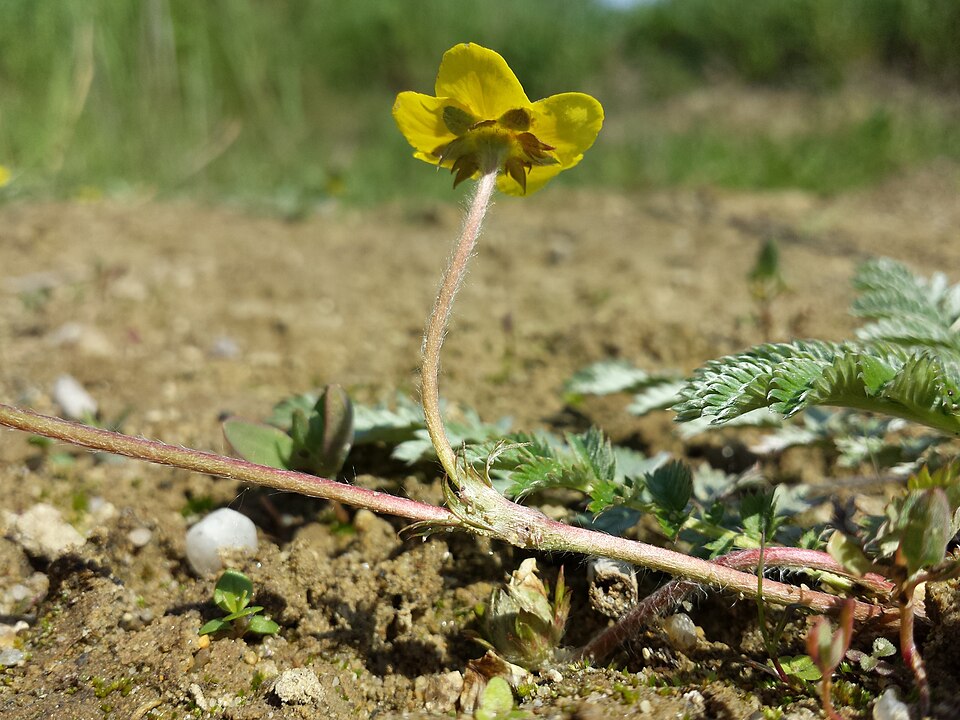
- Long, thin, frequently reddish creeping runners that produce new rooted plantlets at intervals.
- Often grows in patches along grassy paths, banks, dunes, damp meadows and other open ground.
The combination of yellow five-petalled flowers, feather-like leaves and silvery undersides is especially distinctive. When the plant is not flowering, the leaf shape and pale undersides are still useful identification features.
Flower structure
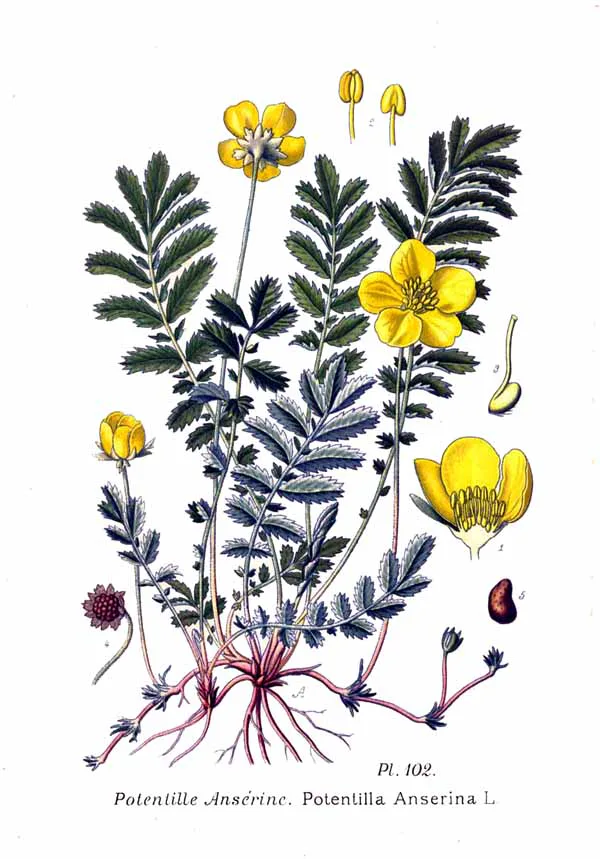
Silverweed produces single, shallowly cup-shaped flowers rather than clusters of many flowers on one stalk. Each usually has five rounded, separate yellow petals, with five green sepals behind them and a second set of five smaller sepal-like lobes forming an outer calyx.
Numerous stamens surround the centre; each bears a pollen-producing anther. The small central carpels are separate and, following pollination, each can form a tiny dry, one-seeded fruit called an achene. Their clustered arrangement is typical of many members of the rose family.
In sunny weather the open, yellow flowers attract bees, hoverflies and other insects seeking pollen or nectar.
Leaves and stems
The leaves are one of Silverweed’s most recognisable features. Rather than being a single undivided blade, each leaf is pinnately divided into pairs of sharply toothed leaflets along a central stalk, usually with a leaflet at the tip. Much smaller leaflets are often tucked between the larger ones, giving the leaf a finely feathered appearance.
The silky hairs are especially dense on the undersides of the leaflets. When leaves turn in a breeze, their pale surfaces catch the light and give a patch of Silverweed its characteristic silver sheen. The upper surfaces are often greener than the name suggests, so a plant can look surprisingly green when seen from above.
Long, creeping stolons, commonly called runners, spread over the soil surface. These often have a reddish tinge and can produce roots and new leaf rosettes at the nodes. In this way a single established plant can spread to make a broad, low mat. The flowering stalks generally remain short, rising only a little above the leaves.
Habitat
Silverweed is common and widespread across the UK. It is often found on damp, fertile soils, particularly in rough grassland, damp pastures, floodplain meadows, ditches and beside lakes or streams. It also tolerates disturbance and can grow in compacted ground beside footpaths, gateways and roadsides.
Near the coast it occurs on dune edges, sandy tracks and other open places where its creeping runners can colonise gaps in the vegetation. It generally favours good light and does less well where tall vegetation casts deep shade.
Flowering period
Silverweed generally flowers from May to September, with most flowers appearing in late spring and summer. Its leaves can often be seen outside the flowering season, especially during mild weather.
Similar species
- Creeping Cinquefoil (Potentilla reptans) also has creeping stems and yellow five-petalled flowers. Its leaves, however, are divided into five leaflets radiating from one point, more like fingers on a hand, rather than arranged in many pairs along a central stalk. It lacks Silverweed’s strongly silvery leaf undersides.
- Tormentil (Potentilla erecta) has small yellow flowers usually with four petals and leaves with three main leaflets, sometimes appearing to have five because of large stipules. It is generally more upright and does not have Silverweed’s feather-like leaves.
- Creeping Buttercup (Ranunculus repens) has shiny yellow flowers and spreading runners, but its leaves are made of three broad, toothed lobes rather than many small paired leaflets. It belongs to the buttercup family.
- Wood Avens (Geum urbanum) is another yellow-flowered member of Rosaceae, but its small flowers are carried on upright branching stems above differently divided leaves, and its fruits develop hooked tips.
Where the names come from
The name Silverweed refers to the fine, light-coloured hairs on the leaflets, particularly their undersides. When the wind moves the foliage, the pale surfaces shimmer against the deeper green upper sides. Other traditional English names include Silver Feather, Goose Tansy, Goose Grass and Wild Tansy. The last names reflect the plant’s rather tansy-like divided leaves, although Silverweed is not a true tansy.
Potentilla comes from the Latin potens, meaning powerful, a reference to the medicinal reputation of plants in the genus. The species name anserina derives from Latin anser, meaning goose. It is commonly connected with the plant growing on land grazed by geese or being eaten by them. The alternative genus name Argentina refers to its silvery appearance, from Latin argentum, silver.
The scientific name Potentilla anserina was published by Carl Linnaeus in 1753. The alternative combination Argentina anserina reflects a later botanical classification; both names refer to the same species.
Folklore & history
Silverweed was once far more than a familiar plant along a pathway. Its slender, starchy underground roots were collected and eaten, especially in northern Britain. Historical accounts describe them being roasted, boiled or dried and ground into meal. Children in seventeenth-century Yorkshire were recorded digging up and eating the roots, and nineteenth-century writer Anne Pratt remembered country children roasting them over a fire.
In the Scottish Highlands and Islands the roots provided an additional source of food in difficult seasons. The Gaelic name brisgein was used for the roots, and on Colonsay they were remembered as seachdamh aran — the ‘seventh bread’ — suggesting an important reserve food when other supplies were scarce. Alexander Carmichael, collecting Highland traditions in the nineteenth century, recorded that the roots had been prepared as porridge, bread meal and other dishes before potatoes became widespread.
Silverweed also appeared in traditional herbal preparations, particularly for digestive complaints, cramps and sore throats. Its astringent qualities helped give the plant a reputation as a useful household herb.
There was practical folklore associated with its leaves, too. Travellers were said to put the soft foliage inside their shoes to ease rubbing or sore feet during long journeys. Names such as Chafe Grass recall this old custom. The combination of silvery leaves, creeping habit and useful roots made Silverweed a familiar companion to people living and working in the countryside.
Wildlife
Silverweed’s open flowers provide pollen and nectar for bees and other visiting insects, including hoverflies. Its spreading foliage can offer low cover among sparse grasses and other small plants.
The plant is also grazed by some animals, and its runners help bind loose soils and gradually fill patches of open ground. In damp grassland and coastal habitats it forms part of the low-growing plant community supporting a variety of invertebrates.