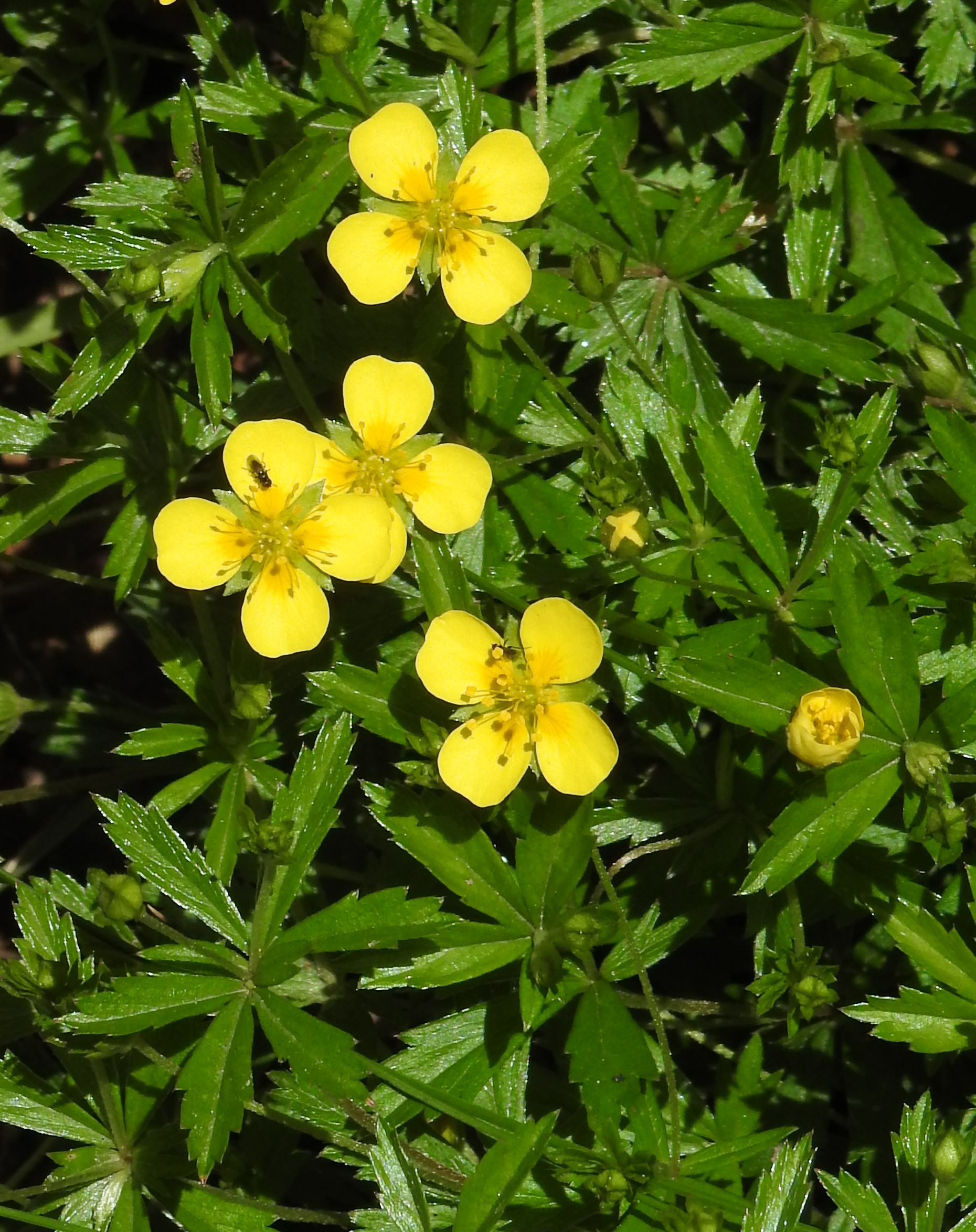
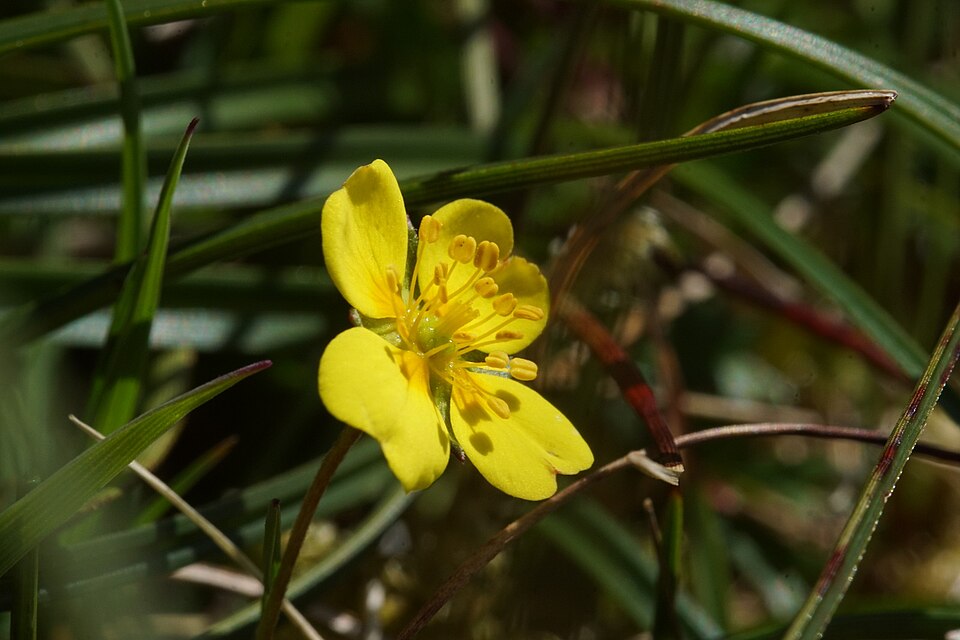
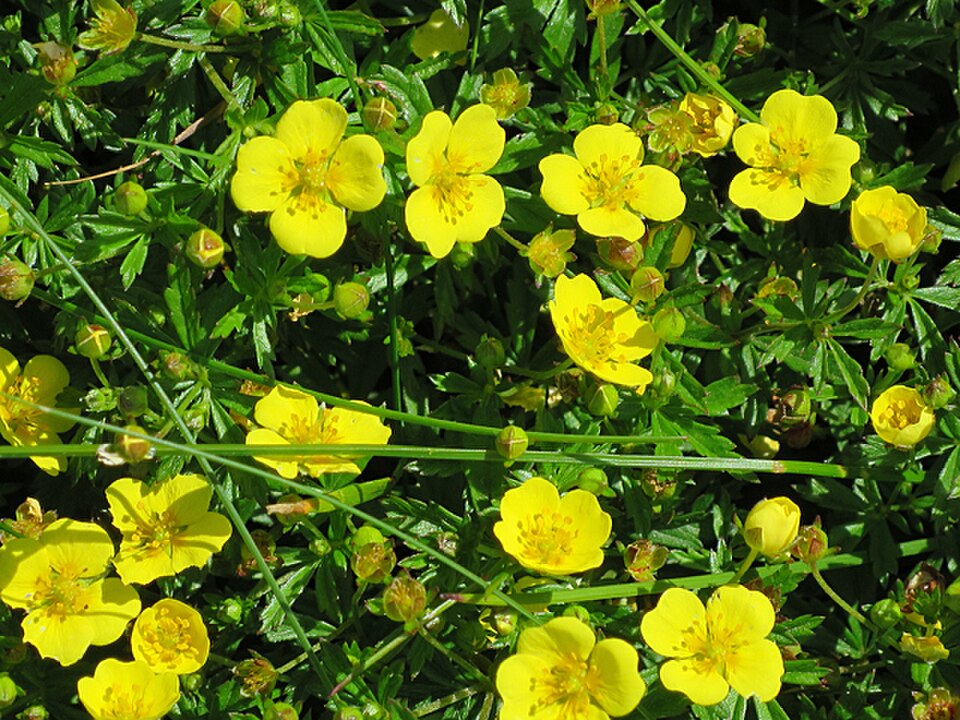
Tormentil is a small native perennial whose bright yellow flowers are easy to overlook among the grasses of heaths, moors and rough pastures. Each flower is usually made up of just four petals — unusual for a member of the rose family (Rosaceae), whose flowers more commonly have five. It is a characteristic wildflower of acidic ground throughout much of the UK.
The plant may look rather delicate above ground, but beneath its wiry stems it has a sturdy, woody underground rhizome. This reddish interior gave rise to the old name Bloodroot and made Tormentil useful in traditional herbal preparations, dyeing and tanning.
Identification
- A low-growing, often rather sprawling perennial, generally 5–30 cm high, with slender, slightly hairy stems that branch and rise above surrounding grass.
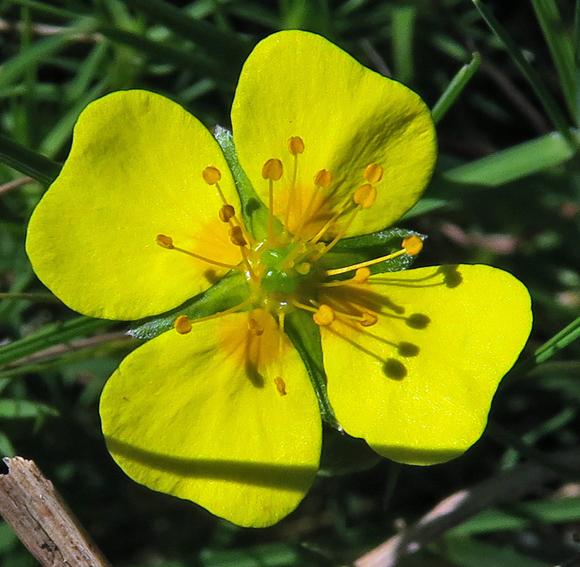
- Small, clear-yellow flowers, usually around 0.7–1.2 cm across, with four separate petals. Five-petalled flowers are unusual but can occur.
- Petals slightly notched or rounded at their tips, arranged around a conspicuous cluster of golden stamens.
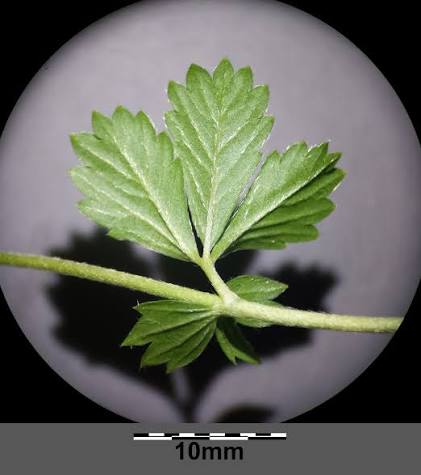
- Leaves mostly divided into three pointed, coarsely toothed leaflets, with two leafy stipules at the base that can give the impression of five leaflets.
- Stem leaves are usually short-stalked or nearly sessile; the stems are often wiry and much-branched rather than forming long rooting runners.
- A short, thickened underground rhizome that can show a striking reddish colour when cut.
- Particularly frequent in short acid grassland, heathland, moorland and lightly shaded woodland rides.
The most useful field clue is the combination of four yellow petals and three main toothed leaflets. Compare the leaves as well as the flowers: Tormentil may be confused with other yellow cinquefoils, especially when the plant is not in bloom.
Flower structure
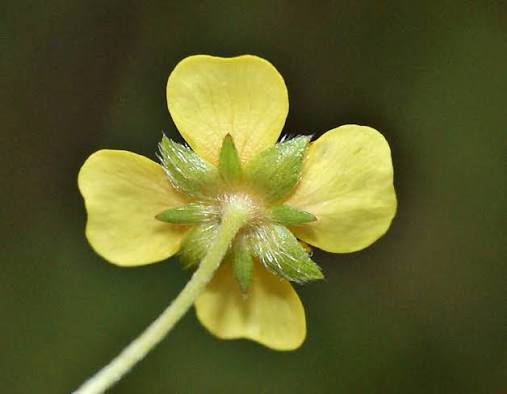
The individual flowers are carried singly on slender stalks arising from the branching stems. Each typically has four yellow petals, four green sepals and a smaller outer whorl of four sepal-like segments, sometimes described as an epicalyx. The petals spread widely enough to expose the flower’s crowded centre.
Numerous yellow-tipped stamens surround a group of separate carpels. After pollination, these develop into small, dry, one-seeded fruits called achenes. The flowers are much smaller than those of Silverweed or Creeping Cinquefoil, and generally have a more open, star-like appearance.
Four petals are a particularly helpful feature because most familiar members of the rose family, including many other cinquefoils, have five. Unlike the cross-shaped flowers of the cabbage family, Tormentil has many stamens rather than six arranged as four long and two short.
Leaves and stems
Tormentil’s leaves are divided into three main leaflets, each with conspicuous teeth, often deeper towards the tip. At the base of each leaf are two small, leafy stipules. These can resemble extra leaflets, making it worth looking carefully before counting. The upper surface is usually deeper green, while fine hairs may give the underside a paler appearance.
The plant produces wiry, branching stems that can creep through vegetation or rise a little above it, but it generally lacks the long, rooting stolons typical of Creeping Cinquefoil. This distinction is especially useful before the flowers open.
A thickened rhizome remains underground from year to year. It contains a high concentration of tannins and has an orange-red or blood-red interior when freshly broken or cut.
Habitat
Tormentil is widespread across the UK, particularly on acidic, nutrient-poor soils. Look for its small yellow flowers in rough grassland, heath, moorland, pasture, woodland clearings and along open forest tracks. It can grow on dry banks or in damper grassy places, provided the vegetation does not become too tall and dense.
It is especially characteristic of heathy ground, where it may grow among fine grasses, heather and other small wildflowers. It also occurs on roadside banks and coastal dune heath, but is less typical of the strongly lime-rich grasslands favoured by Common Rock-rose.
Flowering period
Tormentil generally flowers from May to September, sometimes continuing into October in mild conditions. Individual blooms are small, but the plant can produce flowers in succession through much of summer.
Similar species
- Creeping Cinquefoil (Potentilla reptans) has yellow flowers with five petals and leaves made up of five finger-like leaflets. Its long runners root at the nodes, unlike the generally non-rooting stems of Tormentil.
- Trailing Tormentil (Potentilla anglica) can have four- or five-petalled flowers and sometimes appears intermediate between Tormentil and Creeping Cinquefoil. Its longer, often rooting stems and more variable leaves make it worth checking carefully.
- Silverweed (Potentilla anserina) has larger yellow flowers with five petals and distinctive feather-like leaves with many paired leaflets and silvery undersides.
- Creeping Buttercup (Ranunculus repens) also has yellow flowers and spreading growth, but its flowers have five glossy petals and its leaves are divided into three broader lobes; it belongs to the buttercup family.
- Common Rock-rose (Helianthemum nummularium) has five crinkled yellow petals, simple opposite leaves and low, woody stems. It tends to favour chalky or limestone ground rather than acid heath.
Where the names come from
The name Tormentil has a surprisingly uncomfortable origin. It came into English through Old French tormentille, from medieval Latin tormentilla, a name traditionally associated with Latin tormentum, meaning torment or pain. The reference is generally explained by the plant’s reputation for easing painful stomach cramps and other complaints. Some historical dictionaries note that the precise reason for the name is not entirely certain.
Bloodroot and Bloodwort refer to the red colour inside the underground rhizome, not to the yellow flowers. Another old name, Septfoil, means ‘seven leaves’, and belongs to an older tradition of naming cinquefoil-like plants by the number of visible divisions in their foliage. Shepherd’s-knot is another recorded folk name, probably inspired by the plant’s knotted underground base.
The genus Potentilla is related to Latin potens, meaning powerful, reflecting the medicinal reputation of plants in this group. The species name erecta means upright, referring to its ascending stems. Carl Linnaeus first published the plant as Tormentilla erecta in 1753; in 1797 it was placed in Potentilla by Ernst Adolf Raeuschel, giving the accepted name Potentilla erecta.
Folklore & history
Tormentil was a familiar household herb long before it became a small yellow flower in a field guide. Its tough rhizome is exceptionally rich in tannins, which give it an astringent taste and explain its longstanding use in preparations for stomach upsets, diarrhoea, sore mouths and gums, and minor wounds. The roots were gathered, cleaned and dried, and appeared regularly in European herbal traditions.
Its history is also one of practical craft. Tannin-rich roots could be used to prepare animal skins, especially where oak bark was scarce. Martin Martin’s account of St Kilda, published in 1698, records islanders tanning leather with the roots of Tormentil. This is a striking example of a tiny moorland flower supplying an essential material for everyday life.
The reddish rhizome also yielded colours used in dyeing. Across northern Europe, particularly in Scandinavian traditions, Tormentil roots were valued both for dye and for tanning, sometimes producing warm reddish shades. The same vivid colour helps explain why Bloodroot remained such a memorable name.
Early English herbals compared Tormentil with cinquefoil. Rembert Dodoens’ work, translated into English by Henry Lyte in 1578, described its resemblance to the familiar five-leaved cinquefoil. Despite its modest flowers, Tormentil acquired a reputation as a potent plant — reflected in its names, its place in herbals and the number of practical uses found for its underground stem.
Wildlife
Tormentil’s small open flowers offer nectar and pollen to solitary bees, hoverflies and other visiting insects. Its long flowering season makes it a useful component of summer heathland and acidic grassland, even though each flower is individually tiny.
The plant thrives where open, lightly managed vegetation allows small wildflowers to receive sunlight. Maintaining varied, relatively short grassland and heathland helps keep Tormentil and its associated invertebrates from being shaded out by dense scrub or rank grasses.